Rare French pocket watch with revolutionary date indication Circa 1800
- Kenmerk
- AS2106
- Diameter
- 56 mm
- Estimate
- € 9.000 - 18.000
- Price sold
- € 11.150
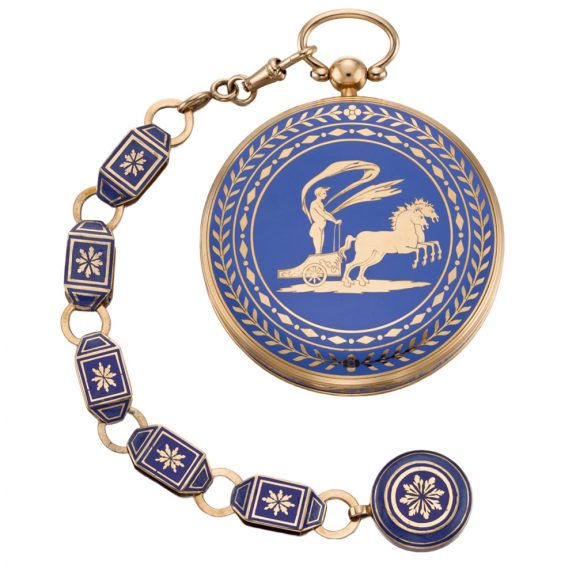
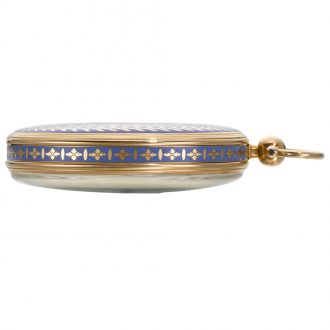
Gold and enamel watch with blue enamel chatelaine by François-Louis Godon
–
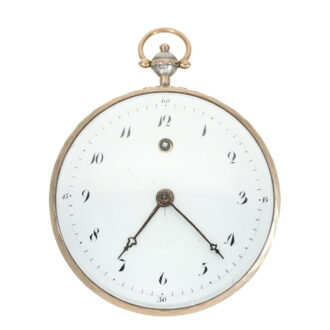
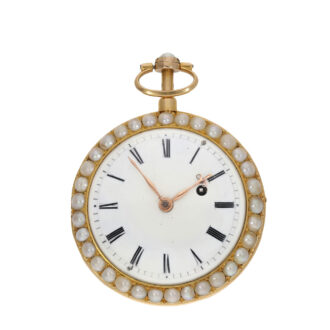
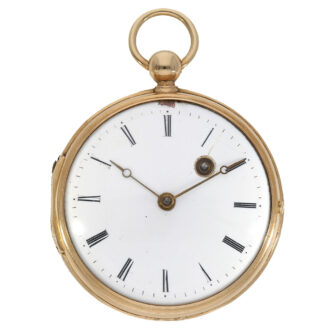
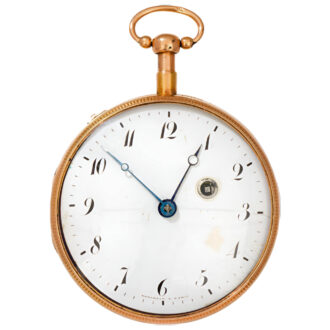
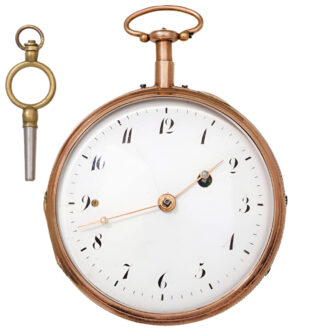
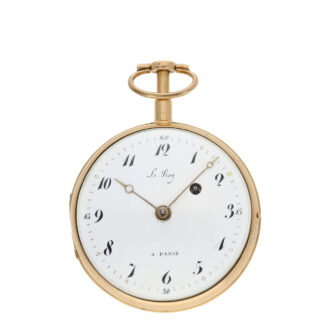
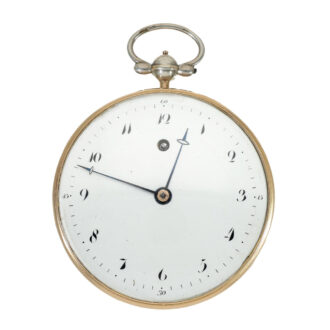
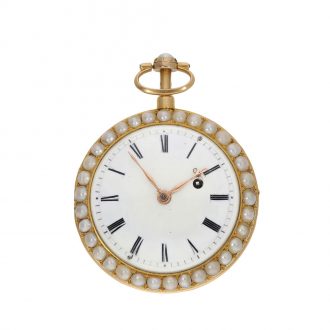
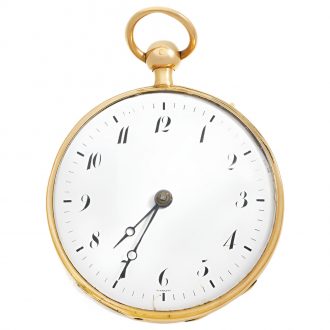
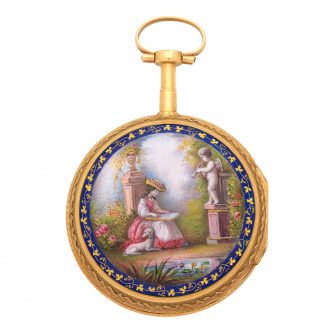
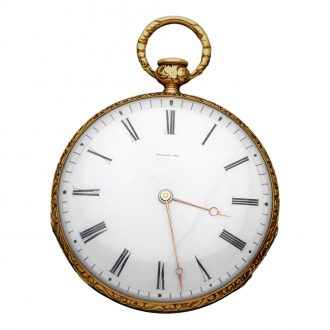
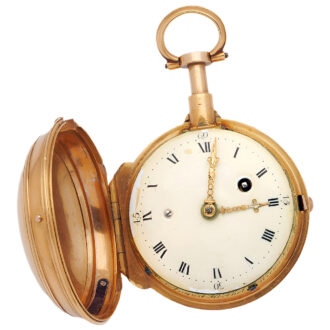
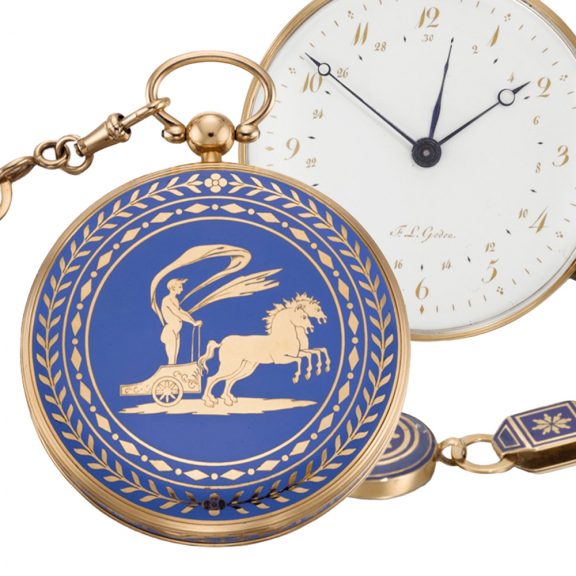
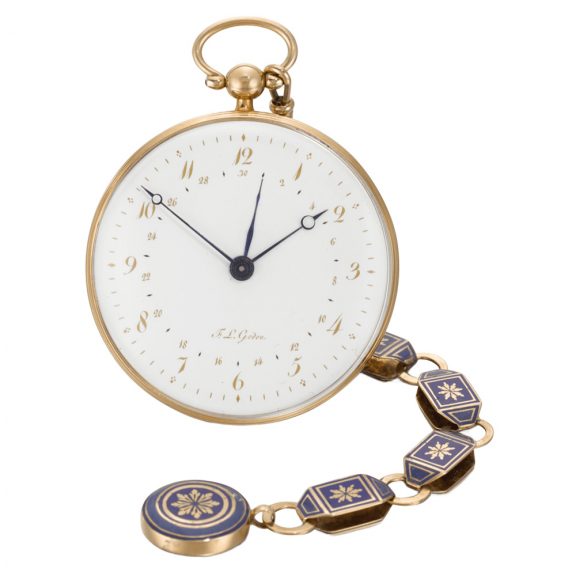
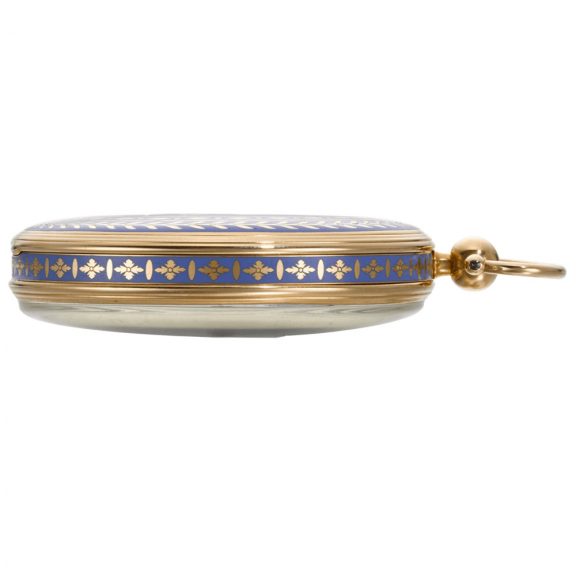
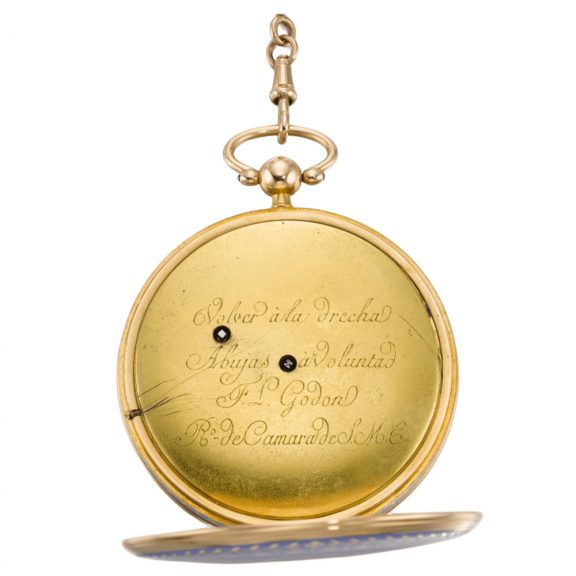
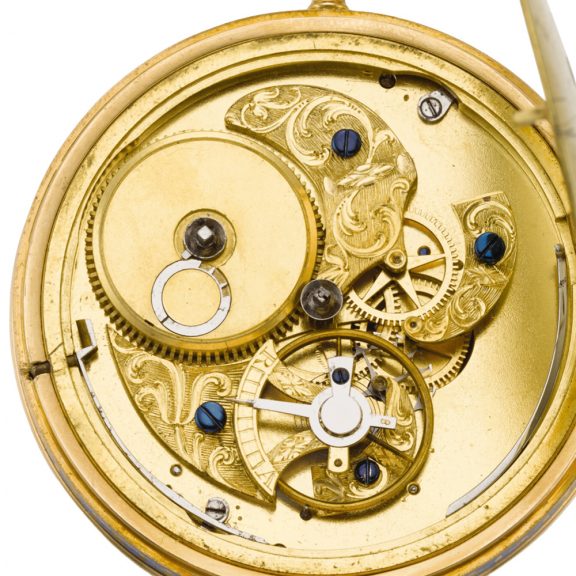
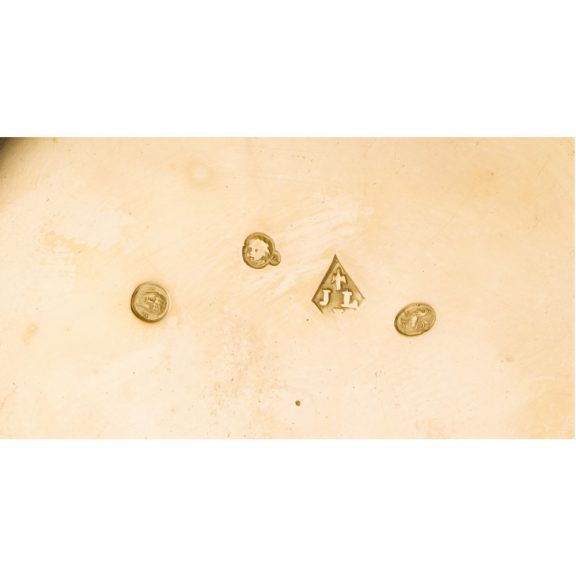
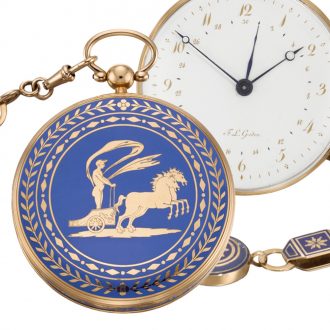
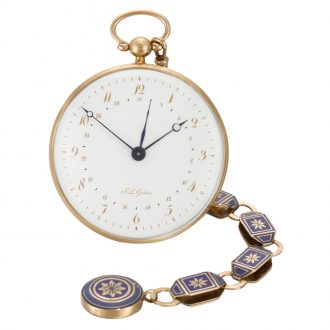
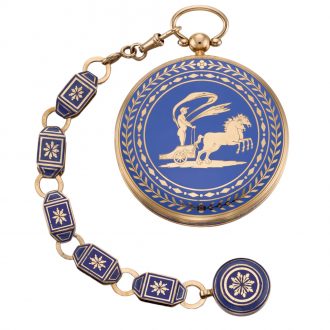
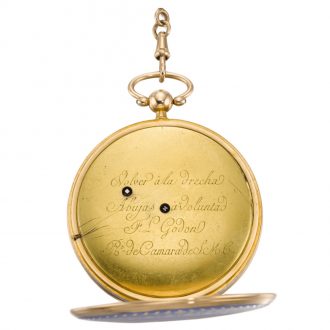
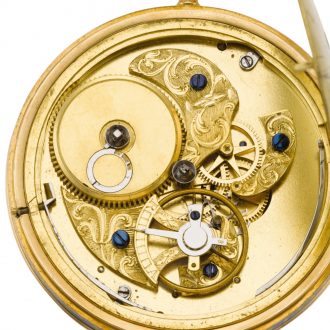
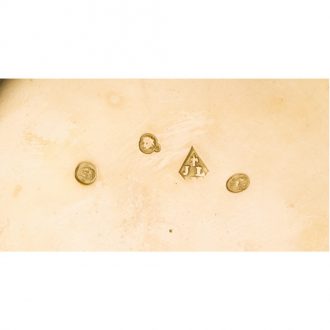
A rare gold and enamel French watch with revolutionary date indication and blue enamel chatelaine, circa 1800. This watch has a gilded full plate movement with a cylinder escapement, a plain gilt flat balance, a hanging barrel, and a decoratively engraved balance bridge; a gilt metal cuvette signed F. L. Godon, Ro. de Camara de S.M.C. (watchmaker to the Catholic King of Spain). The white enamel dial is signed F. L. Godon, featuring gilt Arabic numerals, an inner Revolutionary date indication with Arabic numerals, and blued steel hour and minute hands, along with a blued steel date indication hand. The gold case has a case back and bezel adorned with pale blue enamel depicting Helios driving a horse drawn chariot; the case is numbered 684, with Paris control marks for 1798-1908 and the maker’s mark for Joly, accompanied by a similar gold and blue enamel chatelaine.
–
Diameter: 56 mm
–
Signed: F. L. Godon
–
The movement is running smoothly. The dial is in good condition with no visible marks or cracks. The case back and band have been repolished, and the enamel has been restored. The cuvette shows scuffs from previous attempts to open it. The chatelaine has minor chips and some losses.
–
The French Revolutionary or Republican Calendar was introduced towards the end of 1793 and lasted until 1805. The twelve months of the year were each divided into thirty days. To compensate for what would otherwise result in a shortage of days to complete a full yearly cycle, the system introduced five extra (six in a leap year), called complementary days. These extra days were added to the end of the revolutionary year. The dial of the present watch is calibrated for the Revolutionary Calendar, with the date ring running to just 30 rather than 31 days.
–
François-Louis Godon, Parisian clockmaker and watch dealer, France.
François-Louis Godon was born around 1754 in Donzy, Nièvre. However, French Wikipedia gives his birthplace as Bagneaux, Yonne. From 1785, he worked with Jean Baptiste André Furet, who was declared bankrupt on 4 March 1786. François-Louis was appointed master in February 1787 and was based in the Rue de Valois-St-Honoré between 1789 and 1790. Godon was appointed clockmaker to King Charles III of Spain in March 1786. He became the official Parisian supplier of porcelain, clocks, and furnishing bronzes to the Spanish court. He remained a royal supplier under Charles IV. He signed his clocks with FL Godon, Ro. de Camara de SMC, Clockmaker to the Catholic King of Spain. Today, many of his clocks can be admired in the Museo Nacional de Artes Decorativas in Madrid and the Spanish royal collections. An almost identical copy of a French pendulum clock made by Robert Robin in Paris for Queen Marie Antoinette is in the National Museum of Decorative Arts in Madrid. The bronze part of the clock is by Pierre-Philippe Thomire. The enamel work probably comes from Sévres by Joseph Coteau (1740-1812). The clock was designed by the artist and designer Jean-Démosthène Dugourc. As a clockmaker, Godon also supplied clocks to the King of France. Godon married Justine-Louise Prévost on Thursday, 4 July 1793 (16 Messidor an I) in Paris. A son, Jules-Auguste Louis Godon de Frileuse (1795-1852), was born from this marriage. She later became a magistrate and deputy royal prosecutor.
–
François-Louis Godon died on a business trip on 17 January 1800 (27 nivôse an VIII) in Bayonne at the innkeeper Jean Auvergne’s establishment at 555 Rue des Tanneries (now rue Thiers), at about 46 years old.
Signed: F. L. Godon
Share this page: