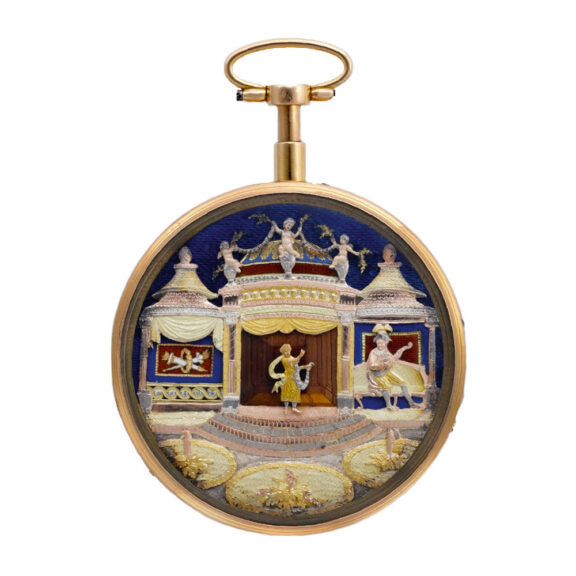
Highly important and exeptional Swiss gold automaton Circa 1815
- Kenmerk
- TA2890
- Diameter
- 59 mm
- Estimate
- € 125.000 - 250.000
- Price sold
- € 185.400
Gold repeating, erotic and musical watch
–
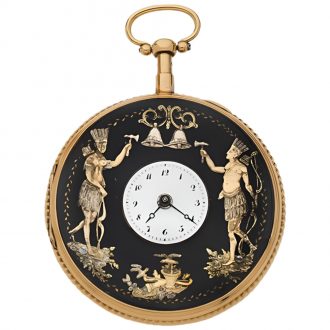
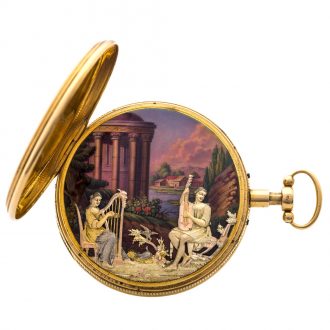
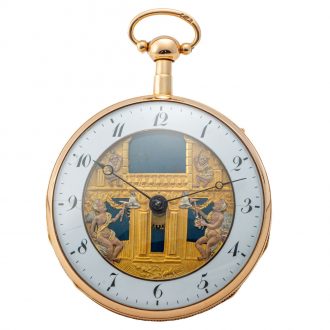
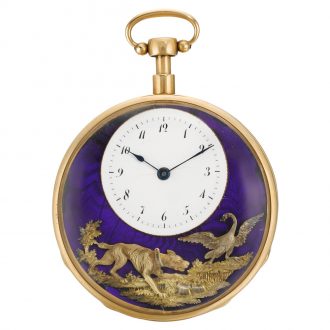
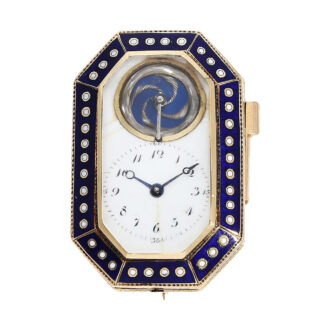
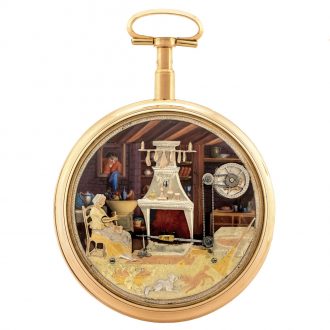
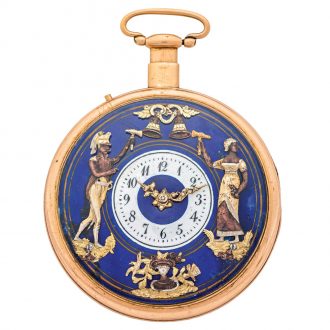
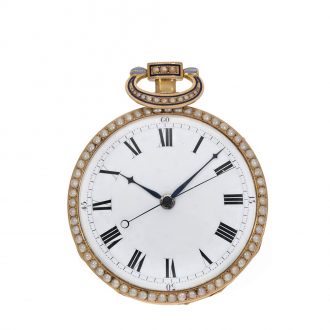
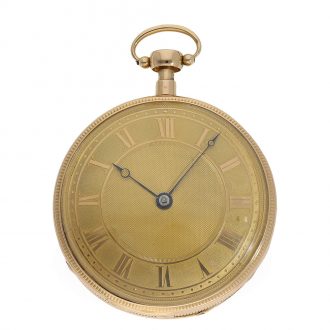
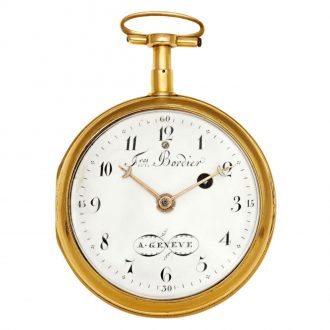
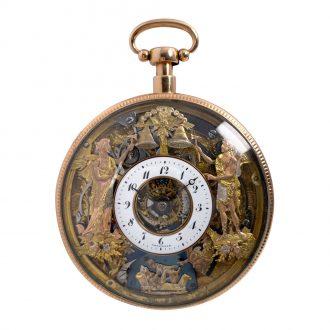
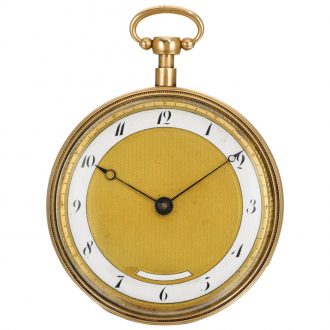
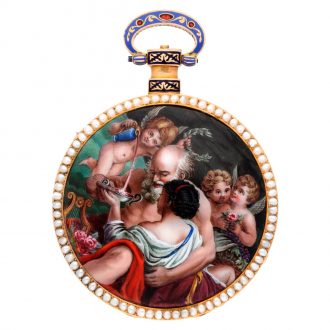
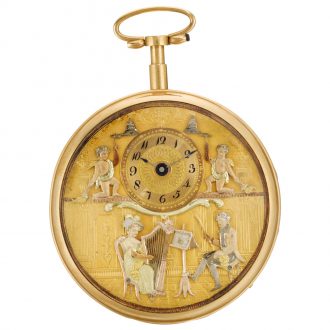
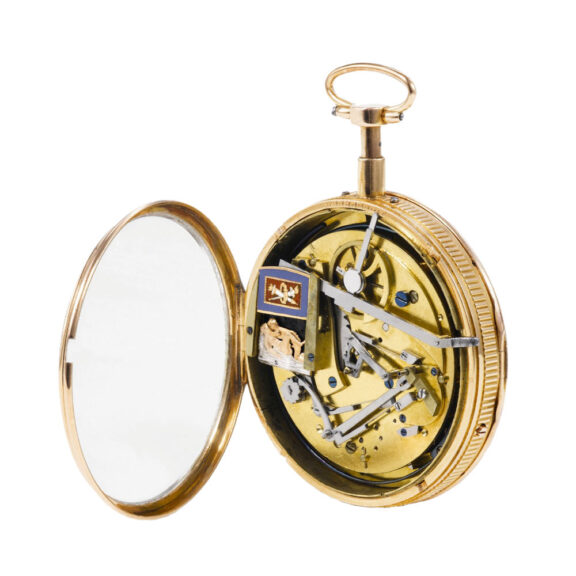
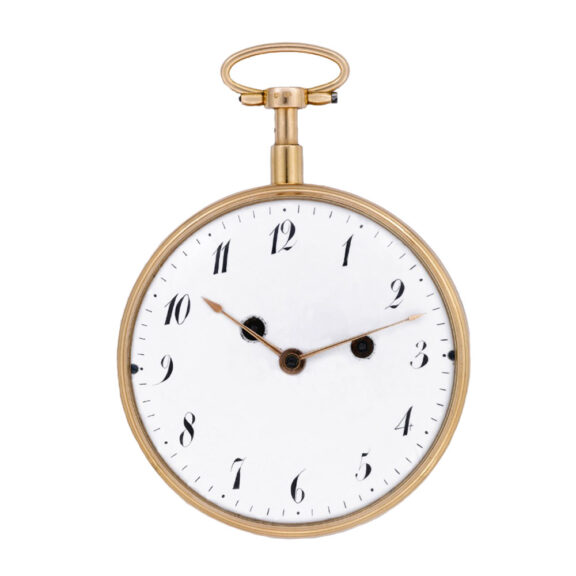
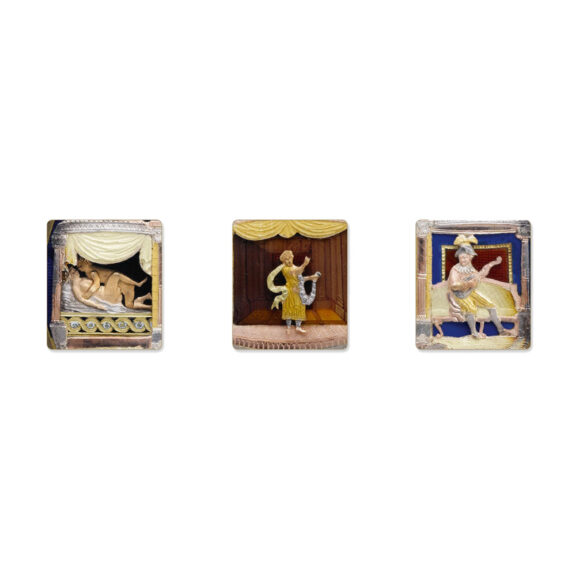
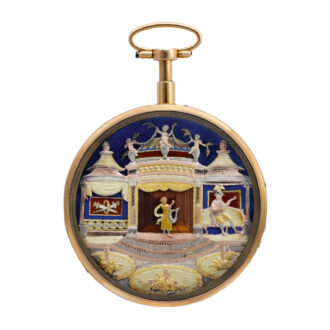
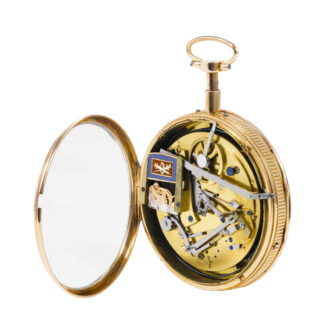
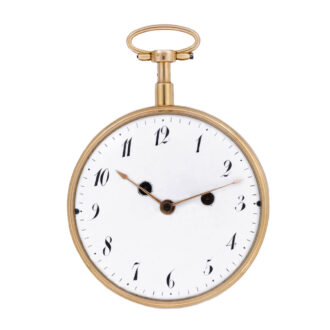
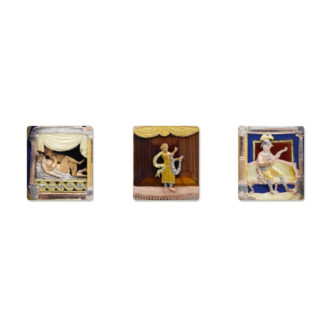
A highly important and exceptionally Swiss, 18K gold and enamel automaton watch, circa 1815. The Theater by Henry Capt, Genève with triple-train, musical double automaton quarter repeating with provision for à tact repeating and concealed erotic automaton scene. Glazed on both sides, a reeded centre of the band, pushbutton at 8 o’clock for à tact repeating, symmetrically at 4 o’clock gold pushbutton for activating the automaton, lever at 2 o’clock on the automaton side for revealing the erotic automaton.
–
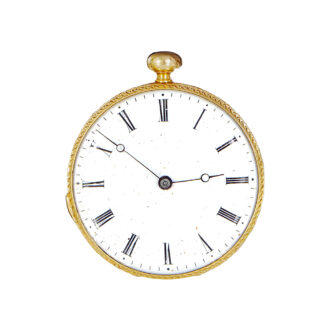
White enamel dial, Breguet numerals, outer minute divisions, winding apertures for going and musical/automaton trains. Gold arrowhead hands. A gilt brass, full plate movement, cylindrical pillars, fixed barrel, cylinder escapement, brass escape wheel, three-arm gilded brass balance, fl at balance spring, pinned drum type musical movement, six blued steel tuned vibrating blades mounted inside of both plates (three on pillar, two on back) driven by 7-wheel train terminated with pinion governor set in the eccentric bushing for tempo adjustment, repeating on tapered blued steel gongs by depressing the pendant. The automaton is controlled by a cam set on the going barrel which is also the pinned drum. Signed on the movement ring in Henry Capt’s typical manner.
–
Diameter: 59 mm
–
Signed: Henry Capt Genève
–
This piece represents one of the earliest applications of the invention of Antoine Favre, presented in 1796 to the Geneva Société des Arts, for a “carillon without bells playing two tunes and imitating the sound of the Mandolin, enclosed within a snuffbox of ordinary size”, in which vibrating tuned blades replaced the much more bulky and fragile carillon bells.This invention was to revolutionize musical horology and the art of making objets de vertu in Geneva. It appears, however, that Favre only re-invented vibrating blades, which were presented in 1769 by Michel Joseph Ransonnet of Nancy to the French Academy of Sciences.
–
Their “re-invention” by Favre possibly saved the Genevan horological industry from a period of stagnation due to the French occupation, high taxes, and the English embargo.The invention did not make Favre wealthy. By 1799 he was losing his eyesight and asked the Société des Arts to loan him 36 Louis. Sad as it was from a human point of view, Favre’s colleagues prospered greatly from his invention. The first to grasp the tremendous potential of the new idea were Isaac Daniel Piguet, Henry-Daniel Capt and Philippe-Samuel Meylan. Their early pieces, like the present one, are extremely rare, and most of the surviving pieces are in museums. The Société des Arts’ “Committee on Mechanics”, which examined Favre’s invention, suspended its meetings until 1800. In 1798, after a prolonged “war of nerves”, French troops marched into Geneva and annexed the Republic. Over 90% of the work-force was affected, the situation was tragic. It was not until the beginning of the 1800’s that the Fabrique began functioning again. Therefore, the oldest mechanical musical pieces with tuned blades were produced no earlier than approximately 1801 or 1802. Pieces signed by Capt alone date from either before 1802, when he became associated with Piguet or after 1811- which is probably the case for this piece – after Capt’s association with Piguet ended.
–
The present watch is one of the first musical automata of the second generation that is, using tuned teeth instead of hammers and bells slim in comparison to its predecessors, elegant but robust. The Private Collection of Theodor Beyer auction was held in Zurich, Switzerland in November 2003. The Beyer family engaged in the horological business early in 1760. As the sixth generation of retailers of horology, Theodor Beyer expanded the family’s business and shared the family’s wonderful collection of timepieces with the public with The Beyer Watch Museum. Mr. Theodor Beyer was known as one of the most prominent horologists in Europe. His passion and knowledge of horology created a halo of the highest professionalism around him. In his early years, Mr. Beyer studied watchmaking when he was first apprenticed to Patek Philippe, which enabled him to have comprehensive understanding of the interior mechanisms as well as the external aesthetic qualities of watches. He was active in the world of horology since 1970s and 1980s where he collected a wide range of valuable timepieces. He was deemed as the most prestigious collector by various auctioneers as his profound horological knowledge, great vision and enthusiasm were widely appreciated. Mr Beyer left the legacy of a world-renowned shop and a jewel of a museum to his son Rene Beyer in 1996. He then passed away in July 2002.
Signed: Henry Capt Genève
Share this page: