Swiss gold historically important World Time watch Circa 1945
- Kenmerk
- SA2610
- Diameter
- 44 mm
- Estimate
- € 250.000 - 750.000
- Price sold
- € 675.500
Gold World Time “Victory” watch
–
A unique and historically important Swiss 18 carat yellow gold World Time watch, made by Agassiz Watch Co. SA with Louis Cottier, circa 1945.
–
The movement is a nickel lever movement with 18 jewels. It has a cut bimetallic compensation balance and a micrometre regulator, and it is adjusted to temperature.
–
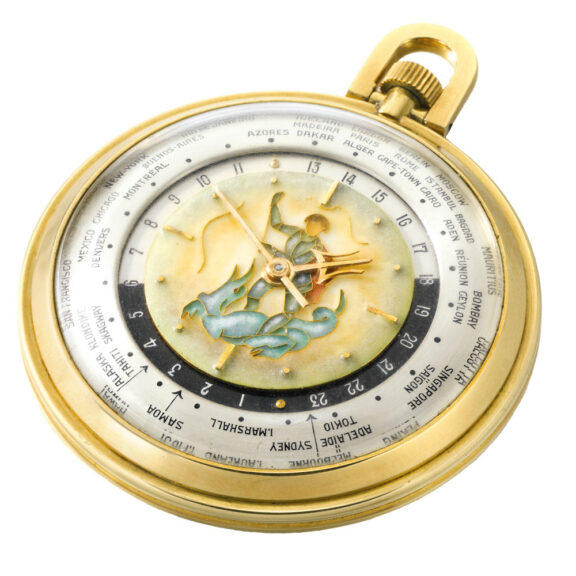
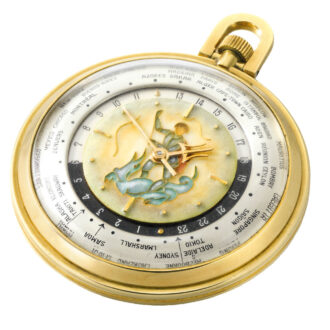
The dial is decorated in multicoloured cloisonné enamel and shows Saint George slaying the dragon. The time is read with a trident hour hand. Around the enamel centre is a 24-hour ring that shows day and night. The outer silvered ring is engraved with 44 cities of the world. London is picked out in gilt at 12 o’clock as the home city.
–
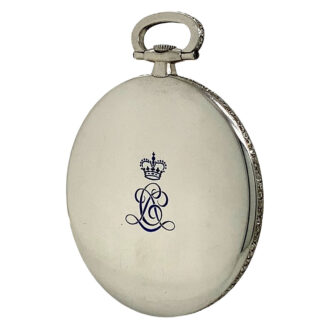
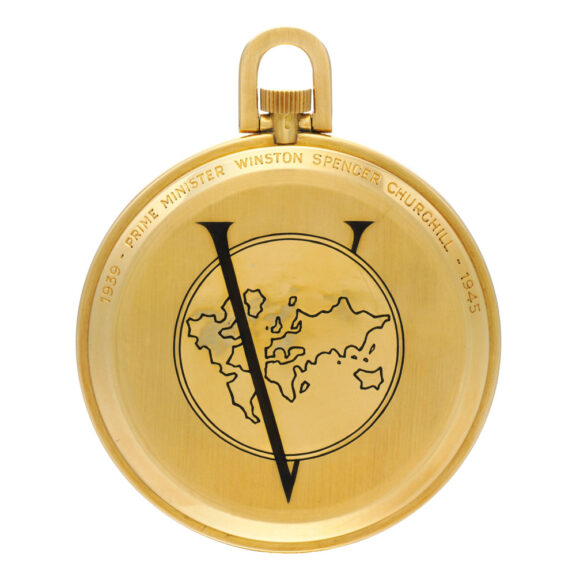
The case has a brushed finish. The back is engraved “1939 – Prime Minister Winston Spencer Churchill – 1945”. In its centre is a map of the world with a black enamel “V” for Victory.
–
Case and movement signed.
–
Diameter: 46 mm
–
Signed: Agassiz & Co – Louis Cottier
–
World War II was one of the worst events in history. Millions of people died or suffered, on the battlefield, in the camps and at home. The war changed the world for ever. When it ended in May 1945, the whole world celebrated. Switzerland celebrated too. In Geneva, a group of people wanted to thank the countries that had fought for a safer and fairer world.
–
They chose to say thank you in the way Switzerland knows best: with watches. They had four watches made, one for each of the four Allied leaders: Charles de Gaulle, Harry S. Truman, Joseph Stalin and Winston Churchill. The war had touched the whole world, so each watch shows the time around the world. Each watch also has its own enamel dial and its own hour hand, made for that country and its leader.
–
The watches were made by Agassiz & Co., but the most important person was Louis Cottier. He prepared the movements and designed the dials and the engravings. When the watches were finished, the newspapers named Cottier, not Agassiz.
The project was kept secret. Maison Wenger made the four cases, but did not know what they were for. This was even though Edouard Wenger and Louis Cottier had been friends since school.
–
Cottier started work on the watches in August 1945. That same month, the group gave a special watch, set in a 100-franc coin, to General Henri Guisan, the head of the Swiss Army during the war. In September, they gave Eleanor Roosevelt a world time clock, in honour of her late husband, President Franklin D. Roosevelt. The four watches had to be ready by 30 November 1945, so that the leaders could receive them at Christmas. People called them “symbols of perfection”, and praised Cottier for having “combined art and science”.
–
Churchill kept his watch for the rest of his life. After his death in 1965, it stayed with his family. It was offered at Sotheby’s about twenty years ago and then disappeared again. In 2015, 70 years after the end of the war and 50 years after Churchill’s death, it came back. This watch is more than a beautiful piece of watchmaking. It is a piece of history and a symbol of courage, just like Churchill’s famous words: “We shall never surrender.”
–
The dials and hands of the watches are as follows:
President Truman: No 44 495, the dial with the Statue of Liberty as a symbol of freedom, the hour hand an olive branch representing peace.
–
Prime Minister Churchill: No 44 496 (present piece), Saint George slaying the dragon with the hour hand as a trident symbolising the heroic fight of England.
–
General de Gaulle: No 44 497, Joan of Arc planting the Lorraine Cross in the French shore. The hour hand is the Lorraine Cross as a symbol of Liberation.
–
Marshall Stalin: No 44 498, a worker standing in front of burning industrial plants, above him, the stormy skies of Stalingrad. The hour hand, a five branched star, mirrors the communist insignia of the USSR.
–
Mrs Eleanor Roosevelt: The pendulette bears an inscription in memoriam to her husband and a depiction of the Armada with the emblem of Justice on the sails coming from New York symbolised by the Statue of Liberty to Europe, represented as a city in flames. The hour hand is the symbol of Earth and the feet of the clock are in a V form for Victory.
–
Thanks to the Cottiers’ archives, it is known that the dials he designed were produced by Maison Stern (known as Stern Creations since 1981) and Louis Calame, and enamelled by Michel Deville. The dedications on the case backs were engraved by Edgar Maerky. The case of the clock was realised by Jules Reusse.
–
Several sketches show the different possibilities Louis Cottier elaborated. They simply serve as a testament, not only to the importance of the watches but also to the amount of time and energy this genius watchmaker invested in them. Whereas each dial is unique, all four watches feature the same case back depicting an enamelled map of the world bisected by “V” for victory. At the top of the case back, there is a personalized dedication. The one on Churchill’s watch reads “1939 – Prime Minister Winston Spencer Churchill – 1945”. The watches were delivered with a letter signed by the members of the group and bearing the seal of Geneva. Interestingly, only the letter addressed to Churchill was written in English.
–
Text taken from the letters:
President Truman:
1941 – 1945
Au president des Etats-Unis d’Amérique
Harry S. TRUMAN,
l’hommage respectueux d’un groupe de citoyens de Genève, en témoignage de leur espoir confidant dans ses efforts pour l’avènement dans le monde des “quatres libertés” proclamées par son illuster prédécesseur Franklin D. Roosevelt.
Genève, Noël 1945.
–
Prime Minister Churchill:
1939 – 1945
To the right Honourable
Winston Spencer CHURCHILL,
The happy warrior. He inspired England with courage and endurance when she was alone, defenceless and in great peril, and led her through five years to victory.
The gift of some citizens of Geneva.
Geneva, Christmas 1945.
–
General de Gaulle:
1939 – 1945
Au general de GAULLE
president du Gouvernement de la République française,
pour la ferveur de sa foi et de ses
espoirs en la Résistance française
victorieuse, l’hommage de citoyens de Genève, auxquels des Français
se sont réunis, dans une admiration
commune pour l’héroïque combat
commence le 18 juin 1940.
Genève, Noël 1945.
–
Marshall Stalin:
1941 – 1945
Au maréchal Joseph STALINE,
le chef glorieux des armées russes,
l’hommage d’un groupe de citoyens
de Genève, en témoignage d’admiration
pour l’ardent patriotism des
people de l’U.R.S.S. et leurs
combats victorieux.
Genève, Noël 1945.
–
Mrs Eleanor Roosevelt:
1941- 1945
“IN MEMORIAM”
Au president Franklin D. ROOSEVELT,
l’immortel apôtre de l’idée démocratique,
l’hommage reconnaissant de citoyens de
Genève, pour la lute victorieuse qu’il a
menée dans la défense des libertés
humaines.
Genève, Noël 1945.
–
The thank you letter of Winston Churchill was published in the press in September 1946:
Switzerland, 14th September 1946 (translated from French)
Dear Mr Baumann,
It is a delight to own the beautiful watch that you were kind enough to give me.
I admire so much the care and the quality with which this delicate example of craftsmanship and Swiss precision was realised. My family and I will always cherish your superb gift which will remain in our estate as a souvenir of your beautiful country and your friendly feelings which inspired your delicate attention to me.
Please accept and pass your friends my warmest thanks for your testimony of kindness that I was so pleased to receive.
Yours sincerely,
Winston S. Churchill
–
Louis Cottier:
Louis Cottier (28-09-1894 – 16-09-1966) was born in Carouge, Switzerland, his father, Emmanuel Cottier, was himself a watch and automata maker. The young Louis studied watchmaking in Geneva and acquired, very quickly, the reputation of an extremely talented student with true artistic flair. As an independent watchmaker, he opened his own workshop in Carouge, making watches, wristwatches and desk clocks. Such was his reputation that Hans Wilsdorf, founder of Rolex and Tudor, entrusted his precious collection to him to restore and service.
–
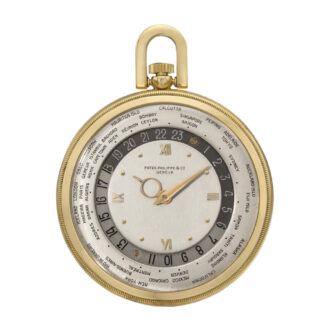
Cottier also specialized in developing watches without hands, for example, the Patek Philippe No 977 121 prototype, jumping digital hours and other unusual displays, as well as angle aviator watches and automata. In 1931, he invented the “Heure Universelle” (World Time) mechanism and made this complication for famous manufacturers such as Agassiz, Patek Philippe (reference 605, 1415, 2523 etc.), Rolex (reference 4262) and Vacheron Constantin (reference 3372). The first world time watch was produced in 1931 by Cottier for the jeweller Baszanger. In the 1940s, the day and night indication (as on the present piece) became the norm for World Time. In the 1950s, Louis Cottier upgraded the mechanism by adding a second crown to make the use of the complication easier.
–
Extensive research shows that only 455 movements were supplied for wristwatches, pocket watches and clocks by Cottier, now rightly regarded as one of the most important Swiss watchmakers of the 20th century. A man of extreme and demonstrable humility, Louis Cottier never registered a hallmark and any of the watches he produced bare his signature.
–
Saint George:
The earliest known depictions of Saint George and the dragon date back to the tenth and eleventh centuries brought back from the crusades. It later became part of Christian tradition whose stories told of Saint George gallantly saving the King’s daughter from being sacrificed to the dragon. The adopted, and still now, celebrated patron saint of England, whose banner, the St George’s Cross, forms the National flag as well as being a central motif in the flag of the United Kingdom was an obvious and powerful choice for Cottier’s design. St George is the symbol of the victory of good over evil, of light over darkness. Indeed, this was imagery the British public was familiar with, Churchill was portrayed as the Dragon slayer by E.H. Shepard in January 1941 in Punch. It is also interesting to note that Churchill’s World War II plane was named Ashkelon after the lance of Saint George.
–
The enamel technique:
Craftsmen use different techniques to decorate dials and cases with enamel such as champlevé, cloisonné and basse taille. The cloisonné technique, as on the present watch, is used to produce some of the most beautiful and sought-after timepieces. It consists of outlining the scored motifs with a fine metal wire and then filling the troughs created with an enamel paste. In fact, different layers of enamel are often required to get different colours or effects and each of them necessitates a different temperature of firing. As a result, several firings are necessary, each of them reducing the artist’s margin for error virtually to zero. The piece is often protected with a translucent layer of enamel named flux.
–
Among horological production, only a fraction of the finest pieces is decorated with enamelled dials. This is considered by connoisseurs as the ultimate expression of beauty and craftsmanship.
–
Examples of World Time watches with enamelled dials are exceedingly rare and most of them are signed by Patek Philippe. When enamelled, the undeniably travel conscious World Time watch usually depicts a map of the world or a part of it. Examples, such as the present piece, with a different representation, are part of a very limited circle of extraordinary pieces.
Signed: Agassiz & Co – Louis Cottier
Share this page: