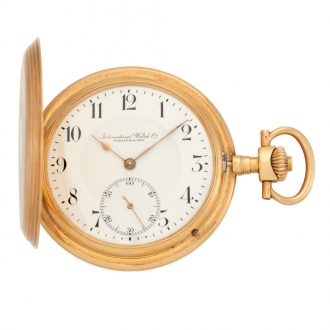
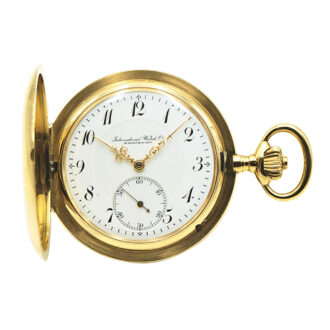
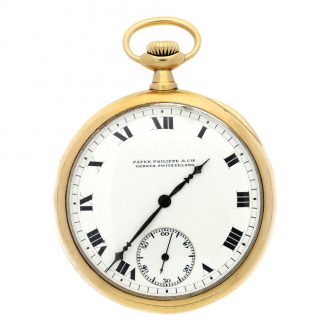
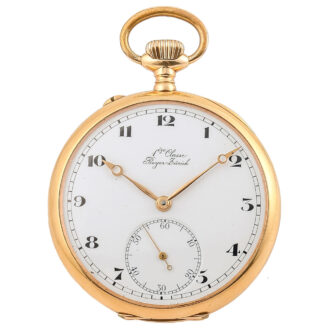
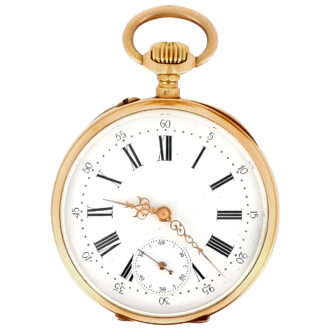
Swiss 18K gold half open faced keyless lever watch Circa 1914
- Kenmerk
- AL3454
- Diameter
- 46 mm
- Estimate
- € 12.500 - 30.000
- Price sold
- € 18.000
Gold watch with on the back a historical figure
–
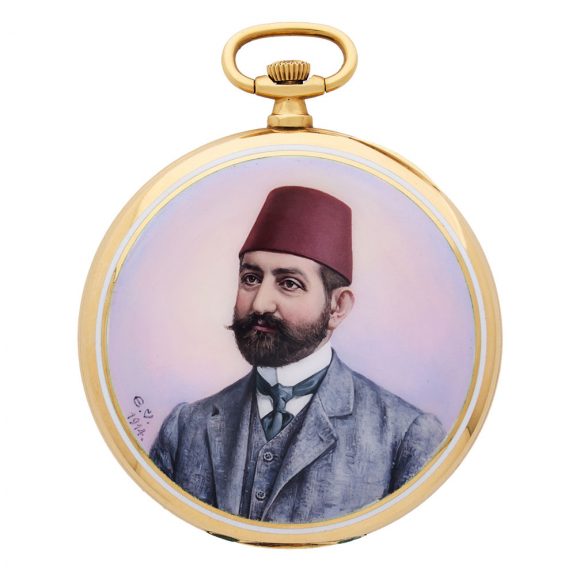
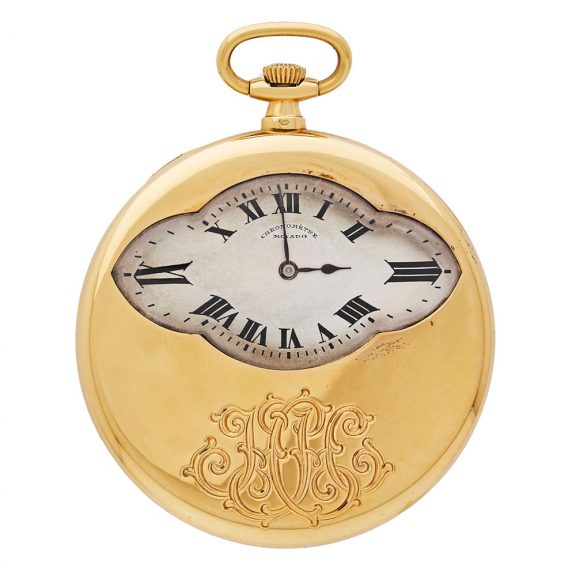
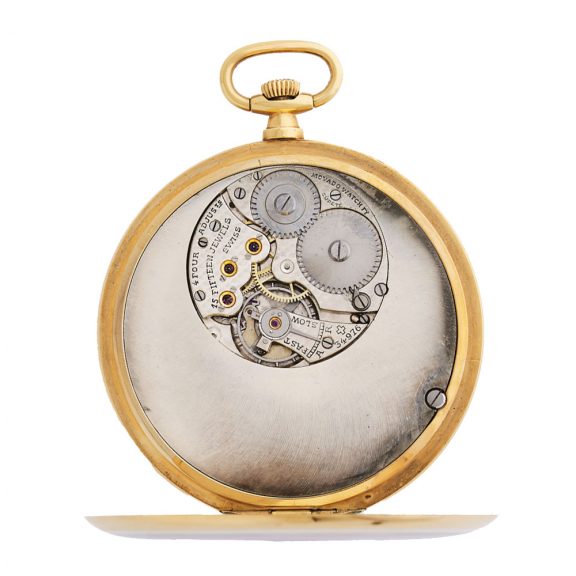
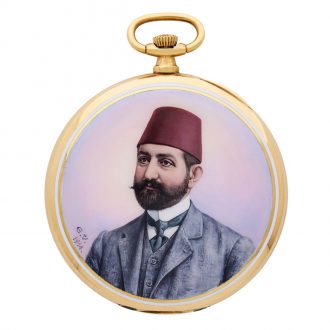
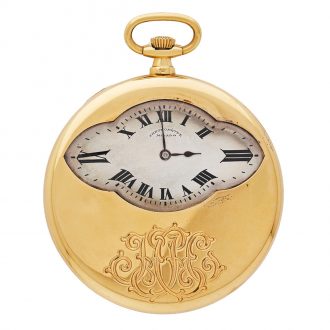
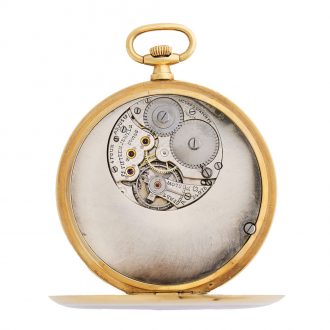
A Swiss half open faced pocket watch in 18 carat gold with enamel on the back depicting Seyhülislam ve evkaf naziri Ürgüplü Hayri Efendi, made by Movado, circa 1914. It has a nickel platinum movement with crown winding, chronometer type, 15 jewels, lever escapement, balance spring, 4 adjustments, and an index for advance/delay adjustment, signed Movado. The patinated dial features Roman numerals for the hours, steel spade hands, and a railroad minute track, with Chronomètre Movado signed in the centre. The round case has an off centre dial on the front, with a monogram engraved with several stylized initials on the lower half. The back shows painted enamel of Seyhülislam ve Evkaf Naziri Ürgüplü Hayri Efendi with the mention on the rim E.V. 1914.
–
Diameter: 46 mm
–
Weight 62.7 g
–
Signed: Movado
–
This watch signed by Movado shows on the back Mustafa Hayri Efendi, originally from Urgup, who was Sheikh of Islam from 1914 to 1916. Known as Heyri Bey, he studied at the Faculty of Law in Istanbul before becoming Minister of Justice and Head of the Council of State. The titles of Şeyhülislam and Evkaf Nazırı were two important positions in the administration of the Ottoman Empire, each playing a vital role in religious and social governance.
–
Şeyhülislam (Sheikh-ul-Islam)
Role and Importance: The Şeyhülislam was the highest religious authority in the Ottoman Empire, equivalent to a grand mufti or supreme religious leader. This position made the Şeyhülislam the Sultan’s chief advisor on religious, legal, and legislative matters. His role was to interpret and apply Islamic law throughout the empire.
–
Functions: He issued religious decrees on matters ranging from state affairs to everyday life issues, ensuring that political decisions remained in line with Islamic principles. The Şeyhülislam could directly influence imperial policies, including legitimizing war or promoting reforms, as was the case during the empire’s modernization in the late 19th century.
–
Position in the Hierarchy: Although the Şeyhülislam was appointed by the Sultan, he had a great deal of autonomy in religious matters. His opinion was often decisive in matters of justice and legitimacy, and he enjoyed great respect within Ottoman society.
–
Evkaf Nazırı (Minister of Endowments)
Role and Importance: The Evkaf Nazırı was the minister responsible for managing waqf (pious and charitable endowments) properties. In the Ottoman Empire, waqf properties were lands, assets, or funds placed in trust to support religious, charitable, or public institutions such as mosques, schools, hospitals, and other social works.
–
Functions: He oversaw the administration and management of these properties, ensuring they were used properly in accordance with the donors’ objectives. Waqf revenues financed a large part of the Empire’s institutions and contributed to the well-being of society.
–
The Waqf Ministry also played an economic role, as these assets represented a significant part of the Empire’s land and movable wealth.
–
Social and Political Influence: Waqf management was crucial in the Ottoman Empire, ensuring the sustainability of religious institutions and social stability. The Evkaf Nazırı therefore had a major influence on urban development and support for the needy.
–
Ürgüplü Hayri Efendi: Example of a Şeyhülislam and Evkaf Nazırı
Ürgüplü Hayri Efendi combined these two roles during a critical period of the Ottoman Empire at the start of the First World War. As Şeyhülislam, he contributed to religious decisions about the empire’s entry into war on the side of the central powers, legitimizing these choices from an Islamic perspective. As Evkaf Nazırı, he oversaw waqf assets, managing social and economic resources during a period of upheaval.
–
The dual role of Şeyhülislam and Evkaf Nazırı was symbolic of the interconnectedness of religion and politics in the Ottoman Empire. The management of religious affairs and waqf assets strengthened the authority of the Ottoman state while supporting social welfare and ensuring compliance with Islamic law.
Signed: Movado
Share this page: