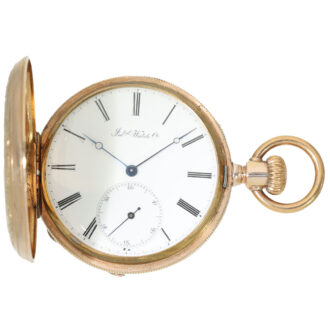
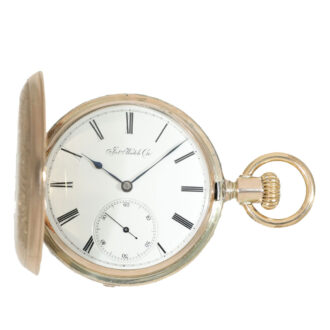
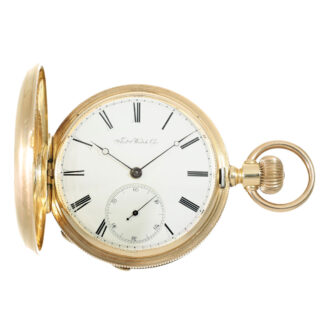
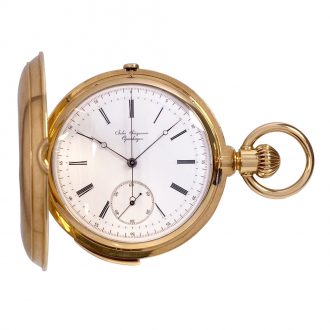
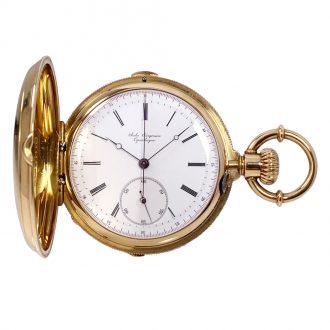
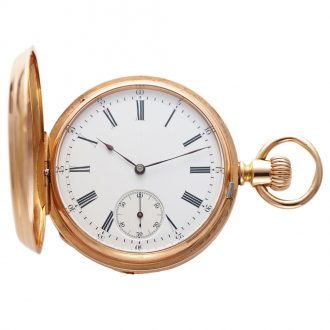
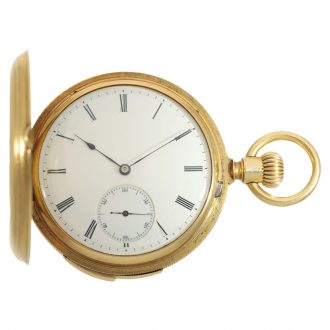
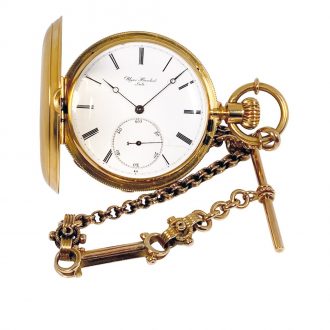
Highly important Swiss gold complicated pocket watch Circa 1873
- Kenmerk
- TA2621
- Diameter
- 60 mm
- Estimate
- € 125.000 - 200.000
- Price sold
- € 160.400
Gold repeating lever pocket watch
–
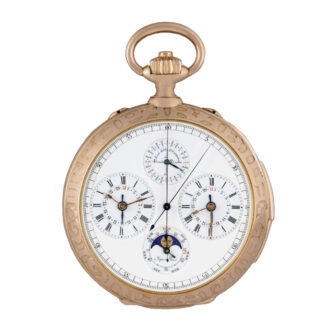
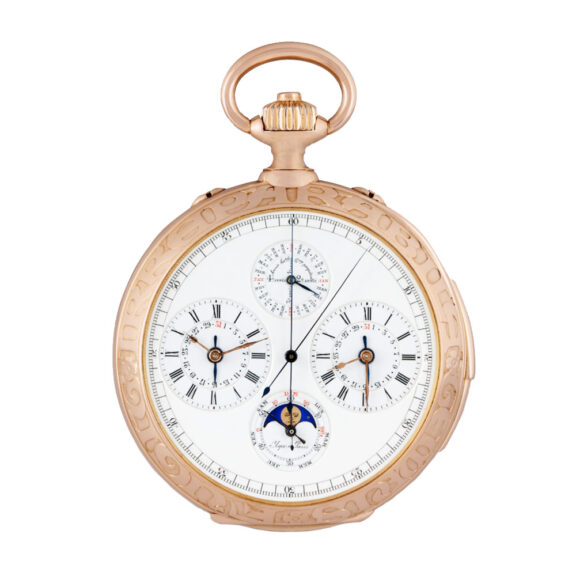
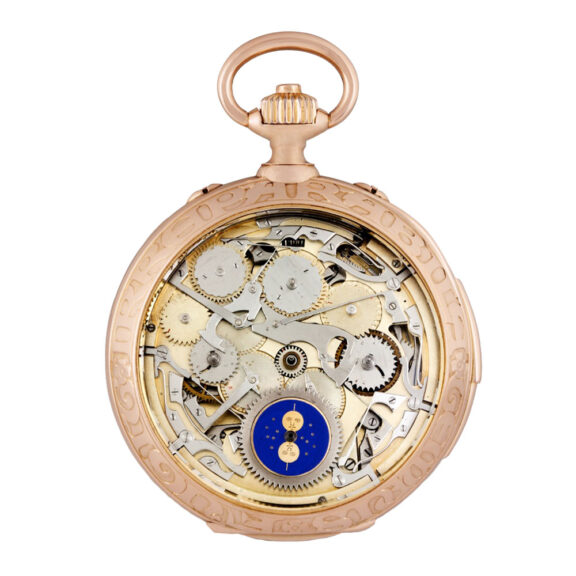
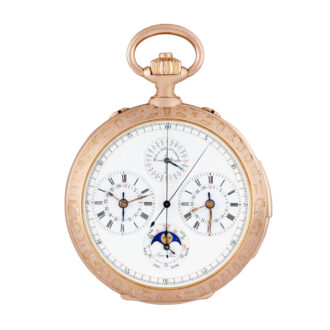
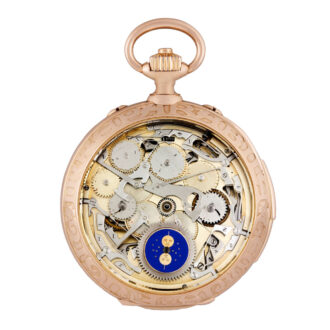
Highly important Swiss, unique and exceptional, large, 18K pink gold, keyless pocket watch, circa 1873. With a chronograph, central progressive 60-minute register, moon phase, the lunar calendar and reference d’heure world-time calculation chart. Double perpetual calendar for Julian and Gregorian calendars, minute repeating, two-time zone, antimagnetic. Accompanied by the original G. Aspe receipt of sale, fitted box with initials PH and Louis Audemars Extract from the Archives.
–
One of the most important complicated watches of the 19th Century – The Unique Julian & Gregorian double perpetual calendar, two-time zone, minute repeating and chronograph Watch of 1873 Louis Audemars, Grande Complication, retailed by G. Aspe, Paris. Started in April 1873, finished circa 1880, sold by Aspe, Paris, to Monsieur P. Hebert on June 23, 1896, for 3240 Francs.
–
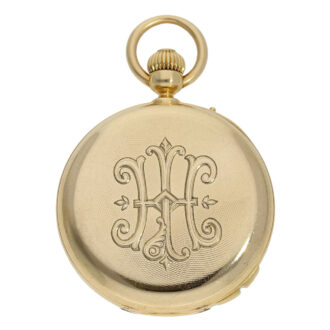
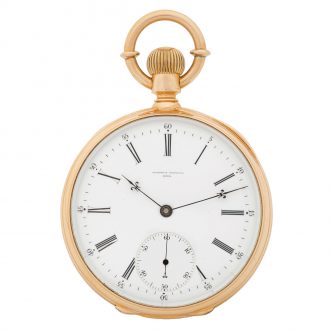
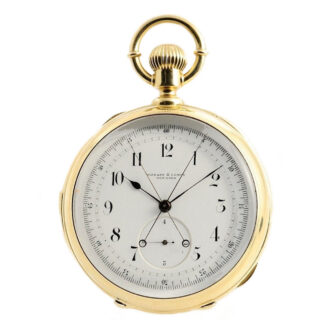
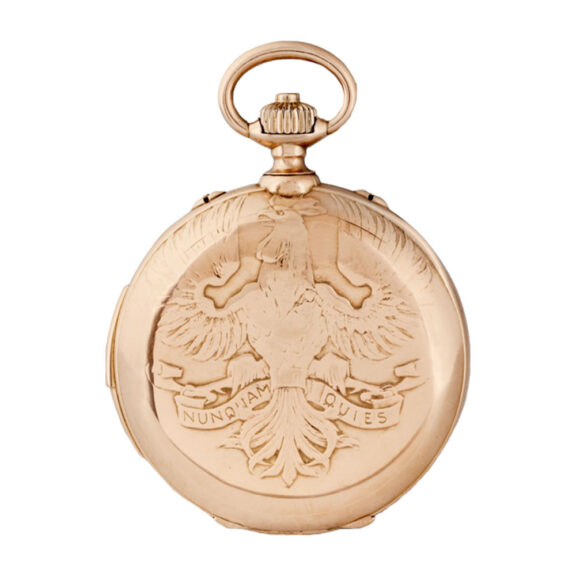
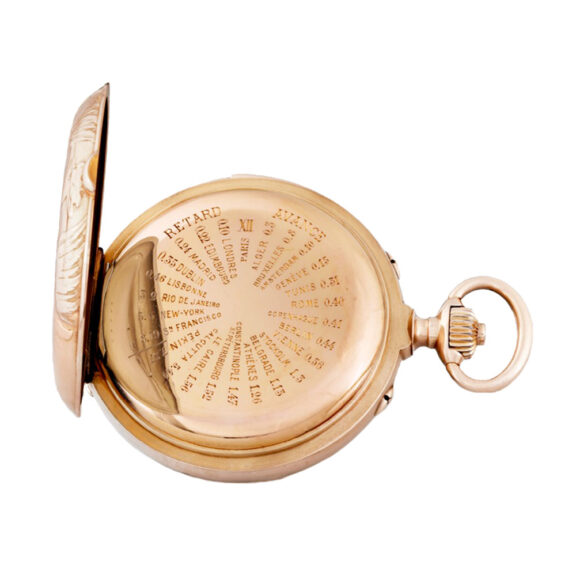
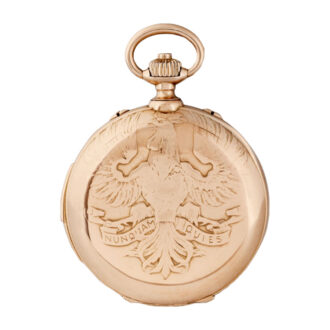
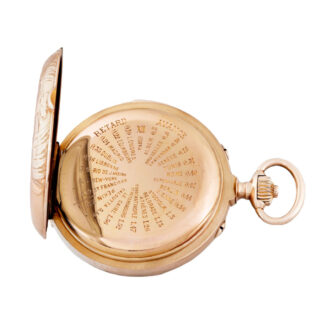
A polished case, the bezel engraved around Fugit Irreparabile Tempus (Time Past is Irretrievable), pushers in the band for hand-setting of each dial, the back cover decorated in relief with the Gallic cockerel, and its wings outstretched and holding a banner engraved with the motto Nunquam Quies (Never Rest). Hinged gold cuvette engraved with a reference d’heure – the names of 26 world cities with Paris as the meridian, each city engraved with its respective time difference from Paris. White enamel dial, two symmetrical mean time dials with radial Roman numerals, outer minute track, concentric inner date dials with hands on the same axis, one for Julian calendar, the other for Gregorian, subsidiary dials for the months of the 4-year cycle, days of the week concentric with seconds with hands on the same axis, aperture for the moon phases with a lunar calendar at the edge, outer seconds and fifths of a seconds track with Arabic five-second numerals for the chronograph and central 60-minute register. Pink gold spade hands.
–
A bridge calibre, matte gilt movement, 40 jewels, counterpoised and calibrated straight-line lever escapement, cut bimetallic compensation balance with gold meantime and temperature compensation screws, special alloy antimagnetic Breguet balance spring, index regulator, repeating with two polished steel hammers on two gongs activated by a slide on the band. Dial signed Aspe à Paris.
–
Diameter: 60,5 mm
–
Signed: Louis Audemars Le Brassus
–
This extraordinary and unique watch with a double perpetual calendar can be considered the successor to the famous Louis Audemars watch La Russe built between 1860 and 1870 and is one of the great complications of the Louis Audemars Company. La Russe has the complications of two time zones and Julian and Gregorian calendars but is not a perpetual calendar. It is likely therefore that the present watch, started in 1873, was intended to surpass La Russe in terms of sophistication and dial design. The present watch was constructed by some of the greatest watchmakers of the 19th century in the Louis Audemars workshops over a period of about 7 to 10 years. La Russe, as the name suggests, was made for the Russian Imperial Court and the present watch was, at the time of conception, intended for the same market. Until 1918, the Julian calendar was still used in Russia and by the end of the 19th century, it was 12/13 days behind the Gregorian calendar which had been adopted by the rest of Europe after 1582.
–
Watch with perpetual calendar working simultaneously for both Julian and Gregorian calendars an extraordinary horological rarity. This is combined with minute repeating, two time zones and a chronograph with a central 60-minute register, the days of the week and the second’s hands are from the same axis as the moon phase. The cuvette is engraved with a reference d’heure world time calculation chart to allow the wearer to set the second time zone dial accurately for another city. This system allowed travellers to know exactly the time in the city they were in, and to calculate the time of the city where they were going. Despite all these complexities, the dial is designed to be elegant and clear. The present watch was probably the last of the true Grande Complication watches to be made in the Louis Audemars workshops. This handful of watches, each unique and with innovative complications was started around 1860 with each watch requiring around 10 years to be completed. These watches are all named and legendary; L’Universelle (finished 1870); La Russe (finished 1870); The Le Roy (finished 1872); La Millesime (finished 1873); La Royale (finished 1873); The Longitude (1873).
–
The History of Louis Audemars Watch
This watch is recorded in a full-page register of Superior Watches in the original documents of the Louis Audemars Company. The work was started in April 1873 and is recorded as a work in progress on 31st December 1876, when the double calendar mechanism is mentioned, and it is stated that the quadrature had been rebuilt. At this date, the watch had a stock value of 741 Francs. A work in progress record of 30th June 1880 records that the watch had been regulated en blanc and given an updated value of 933 Francs. The final record of this watch appears prior to the liquidation of the Audemars Company in 1885. Many of the pieces in this final document are marked vendue as having been sold. No. 12199 is not thus marked and was therefore part of the bankrupt stock. It is unknown how the watch came to be in the possession of the retailer G. Aspe in Paris, although it can be assumed that Aspe bought the watch subsequent to the liquidation of the Audemars stock. The Watchmakers Who Built No. 12199 As attested to in the original Louis Audemars register for No. 12199, this watch was made by some of the most illustrious Swiss watchmakers of the 19th century working in collaboration with the Louis Audemars Company. Those listed are as follows: Ami Benoit (July 18, 1873); Auguste Golay (November 20, 1873); Constant Piguet (May 17, 1873); Auguste Meylan (August 21, 1873); Emile Meylan (November 24, 1873); Louis Piguet (November 5, 1877).
Signed: Louis Audemars Le Brassus
Share this page: