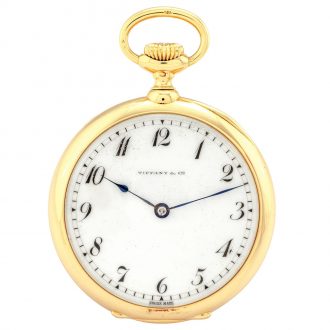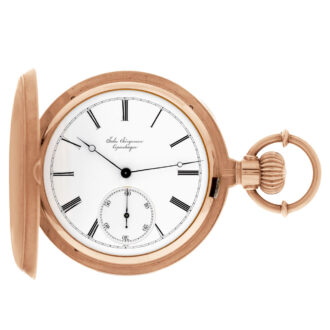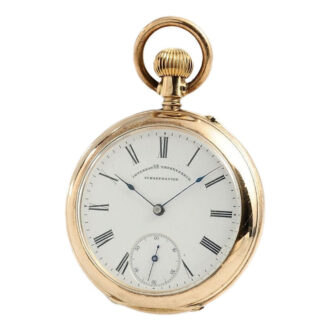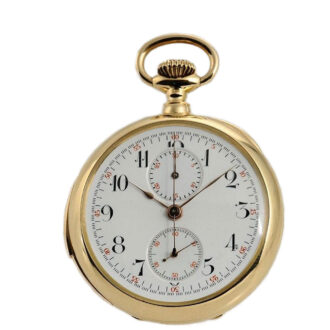
Certainly unique Swiss pink gold pocket watch Circa 1894
- Kenmerk
- TA3144
- Diameter
- 60 mm
- Estimate
- € 250.000 - 1.000.000
- Price sold
- € 1.720.800
Patek Philippe 24-hour perpetual calendar chronograph with five-minute repeater
–
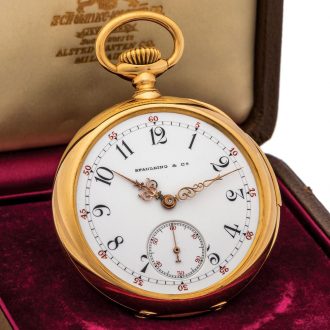
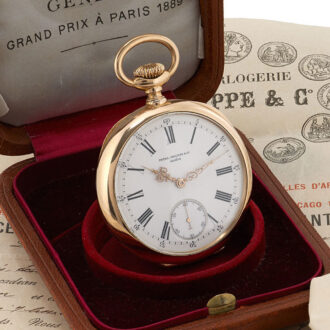
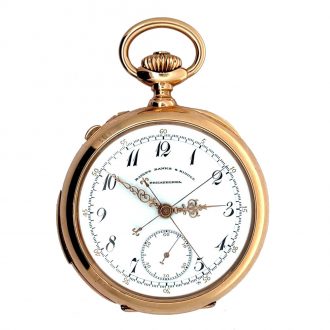
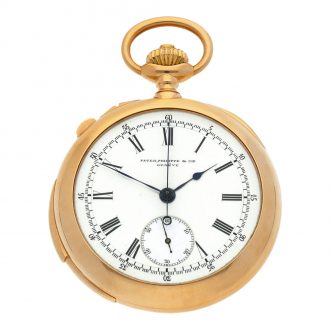
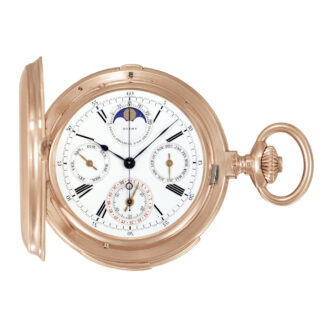
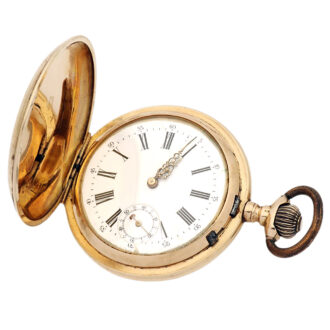
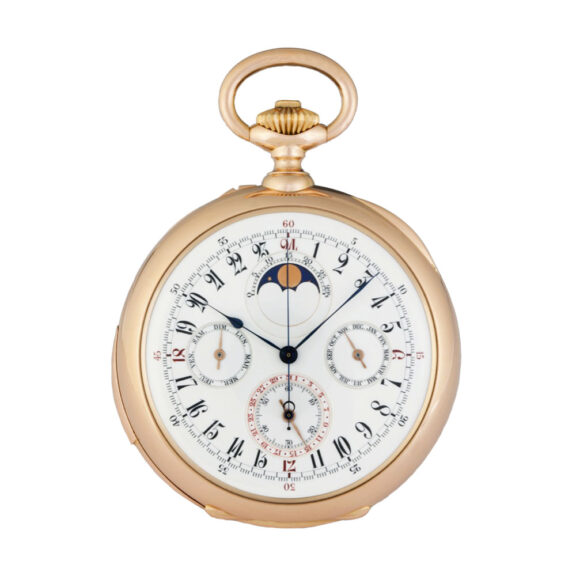
This exceptional and highly important Swiss pocket watch in 18K pink gold is almost certainly unique. It has a perpetual calendar, a chronograph, moon phases with a lunar calendar, a 24-hour dial (the hour hand goes round once a day), and a special repeater that strikes the hours, quarters and five-minute intervals. Patek Philippe sold it on 27 November 1894 for 3,750 Swiss francs to Monsieur E. E. Hoesch of Villa Barbaia, Mergellina, Naples. It comes with its original certificate of origin and sales receipt.
–
The case. The polished case has five-knuckle hinges. A button in the crown starts, stops and resets the chronograph, and a bolt at 23 (on the 24-hour dial) locks it. The hinged gold cuvette has small pushers on its edge to set the calendar and moon phases.
–
The dial. The white enamel dial has radial 24-hour numerals, with the 24 in red. Around the edge are a minute track and a chronograph scale, with numbers every five seconds and 15, 30, 45 and 60 in red. Small dials show the date (in red) with the seconds, the day of the week and the month. An aperture shows the moon phase, with the lunar calendar around it. The hour and minute hands are blued steel spade hands; the calendar hands are gold.
–
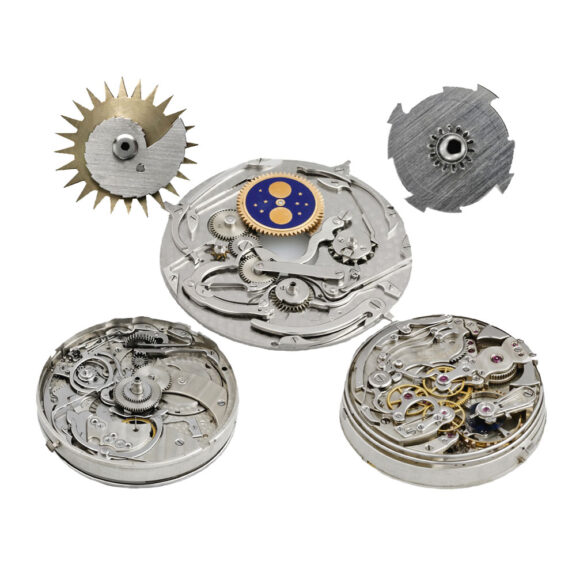
The movement. The movement has Geneva striping, 35 jewels and wolf’s-tooth winding. It has a counterpoised straight-line lever escapement, a cut bimetallic compensation balance with timing and temperature screws, a blued steel Breguet balance spring with a terminal curve, and a swan-neck micrometer regulator. A slide in the band sets off the repeater on gongs. The case, cuvette and movement are signed.
–
Diameter: 60 mm
–
Signed: Patek Philippe & Cie Genève
–
The discovery of a previously unknown, highly complicated Patek Philippe is always exciting, and even more so when the watch is almost certainly unique. That is the case here: no other example is known.
–
The watch has clearly been well looked after and has survived in almost untouched condition for well over a century. It has a large, heavy 60 mm pink gold case, a perfect 24-hour dial, and a movement with a unique repeater and an unusual combination of complications. Remarkably, it still has its original certificate of origin and sales receipt. All of this makes it one of the most important 19th-century Patek Philippe watches to have come to light.
–
The movement: Patek Philippe No. 97443 has the following complications:
–
24-hour train
The hour hand goes round once every 24 hours instead of every 12. This needs a specially built movement, with wheels that have more teeth, so that the hour wheel turns at half the speed of a normal watch. The dial is therefore numbered from 1 to 24.
–
Full 24-hour repeater
This is the unique feature of watch No. 97443. When the repeater slide is pressed, the watch strikes the full hour, from 1 up to 24. Between midnight and 1 am, for example, it strikes 24 times.
–
Quarter repeater
After the hours, the watch sounds a double strike for each quarter that has passed: one after a quarter past, two after half past, and three after a quarter to.
–
Special five-minute repeater
Besides the 24 hours and the quarters, No. 97443 has an unusual five-minute repeater. A normal five-minute repeater strikes the hours and then one note for every five minutes that have passed. This watch works differently. After the hours and quarters, it adds one single strike when five minutes have passed since the last quarter, and two when ten minutes have passed.
–
Chronograph
A single button in the crown starts, stops and resets the chronograph, and a bolt on the case locks it.
–
Perpetual calendar
The calendar automatically allows for the length of each month and for leap years, even though the dial has no leap-year indicator.
–
Moon phases
The moon-phase display shows the moon waxing and waning over its 29½-day cycle. A scale around the aperture shows the age of the moon.
Signed: Patek Philippe & Cie Genève
Share this page: