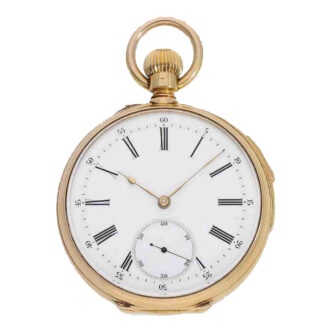
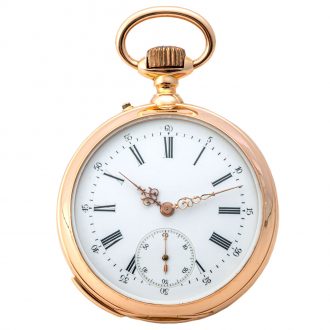
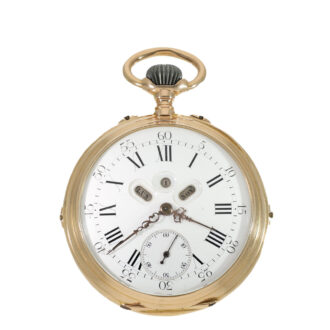
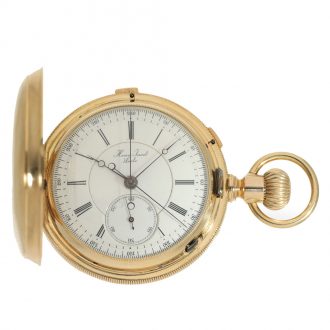
Swiss grande and petite sonnerie three train clock watch Circa 1870
- Kenmerk
- HA0263
- Diameter
- -
- Estimate
- € 17.500 - 30.000
- Price sold
- € 18.450
Rare large heavy gold three train half hunting cased clock watch
–
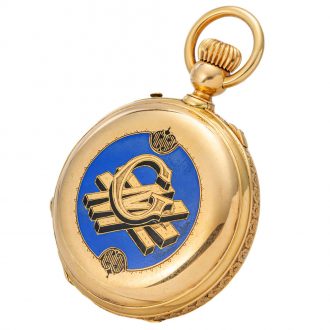
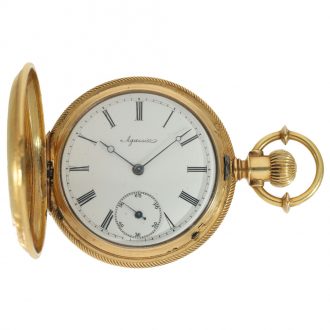
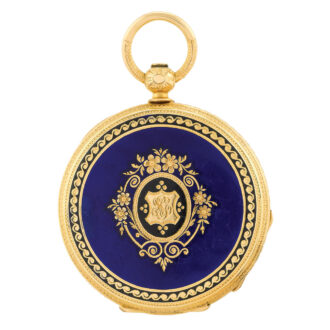
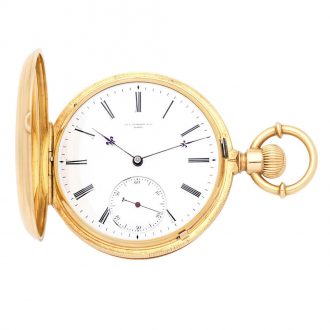
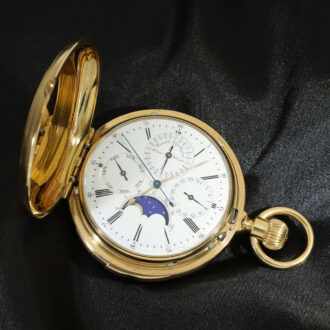
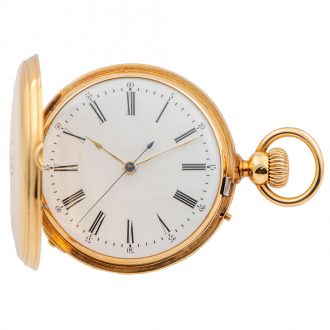
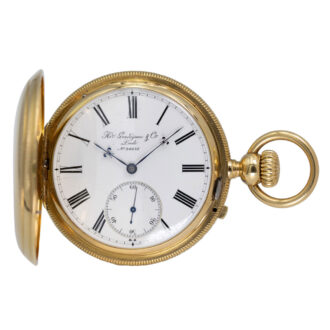
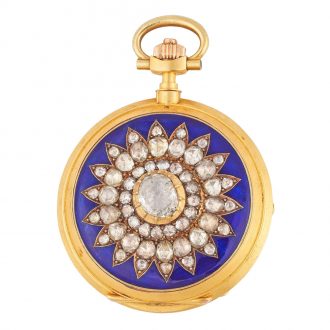
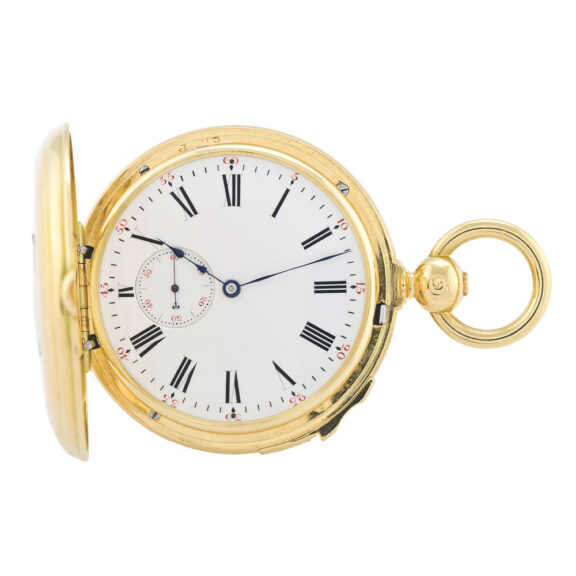
An extremely fine and rare large heavy 18 Carat gold three train Grande and Petite sonnerie striking half hunting cased clock watch with independent slide activated minute repeating, a total of four gongs and four hammers, two for the striking and two for repeating. Repassée (reviewed) by Bourdin, Rue de la Paix 28, Paris and made in Switzerland Circa 1870. Four body, bassine et filets and polished case with master mark ‘EM’, the hinged and sprung front cover with radial royal blue champlevé enamel Roman numerals and inner minute divisions around the glazed aperture, the back cover with champlevé royal blue enamel monogram of mirrored ‘LL’ within foliate scrolls and a hinged gold cuvette.
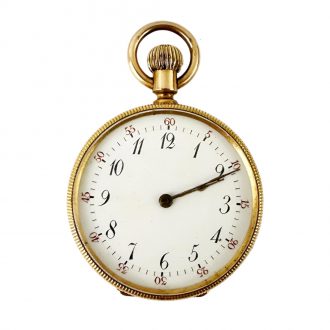
White enamel dial with radial Roman numerals, outer minute divisions and red Arabic five-minute numerals, subsidiary seconds at 9 0’clock with red Arabic 10-second numerals and blued steel double spade hands. Matte gilt movement with standing barrels for the going and striking trains, repeating barrel wound by the slide on the band, 37 jewels, lateral lever escapement with banking by two pins, cut bimetallic compensation balance with gold meantime and temperature adjustment screws, blued steel Breguet balance spring with over coil, index regulator, striking with two hammers on two gongs and repeating with two further hammers on two further gongs.
Cuvette signed Repassée par Bourdin.
–
Diameter: 54 mm
–
Signed: Repassée par Bourdin
–
KEW OBSERVATORY TRIALS FOR WATCHES Various testing laboratories around the world were responsible for grading and testing watches. The most stringent being the Kew (Teddington) Observatory, just west of London. A standard Swiss chronometer test would last 15 days, however, the Kew test lasted 44 days. The tests consisted of observing the timekeeping of the watch in various positions and at various temperatures and awarding points for accuracy in these differing states. 83.3 marks is regarded as especially good and does the makers great credit. The eight testing positions were as follows: Pendant up – 67° Dial up – 42° Pendant right – 67° Dial up – 67° Pendant left – 67° Dial up – 92° Pendant up – 67° Dial down – 67°. This tourbillion pocket watch was entered for Kew Observatory trial in 1914 where it achieved a mark of 90.6 points out of a possible hundred points. Literature: ’Le Tourbillon’, Reinhard Meis, Editions de l’Amateur, Paris, 1990.
Signed: REPASSÉE PAR BOURDIN
Share this page: