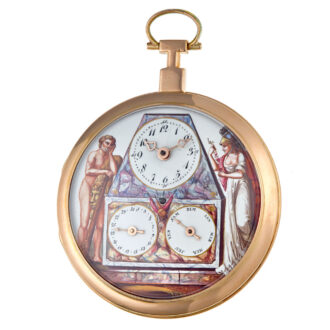
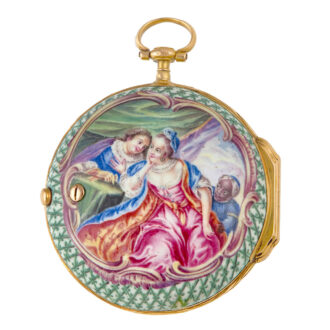
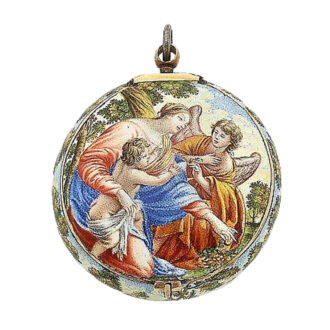
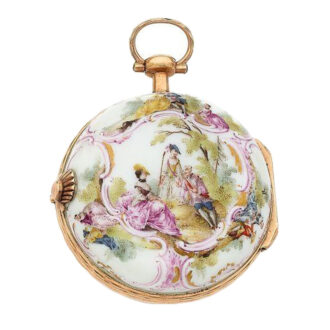
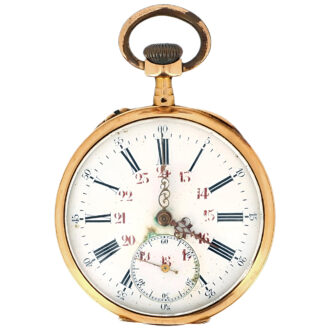
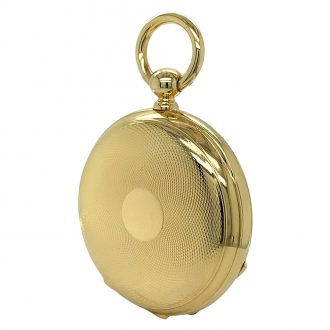
Swiss gilded silver watch for the English market Circa 1882
- Kenmerk
- DB0596
- Diameter
- 51 mm
- Estimate
- € 3.250 - 6.000
- Price sold
- € 4.000
Gilt-silver cylinder watch by Vacheron & Constantin
–
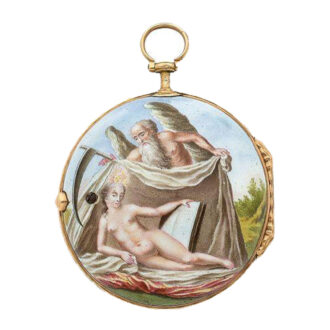
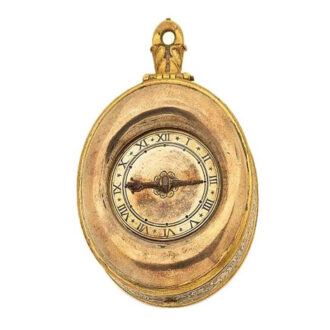
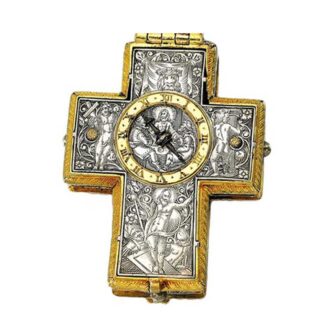
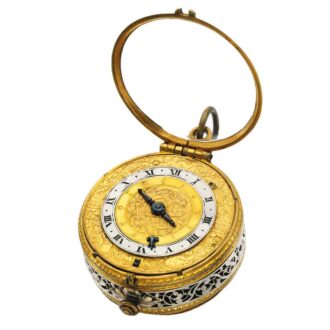
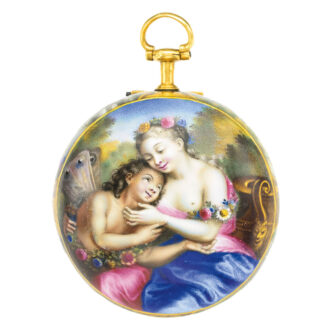
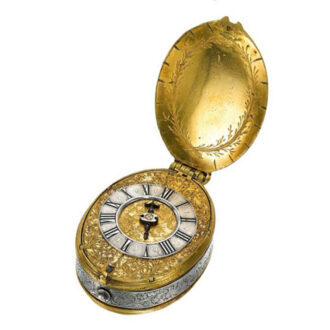
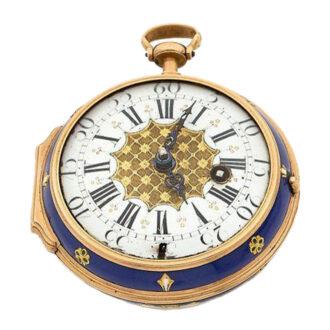
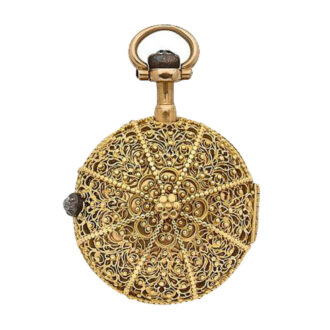
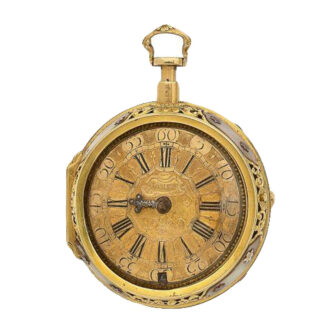
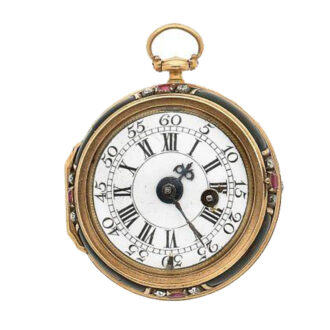
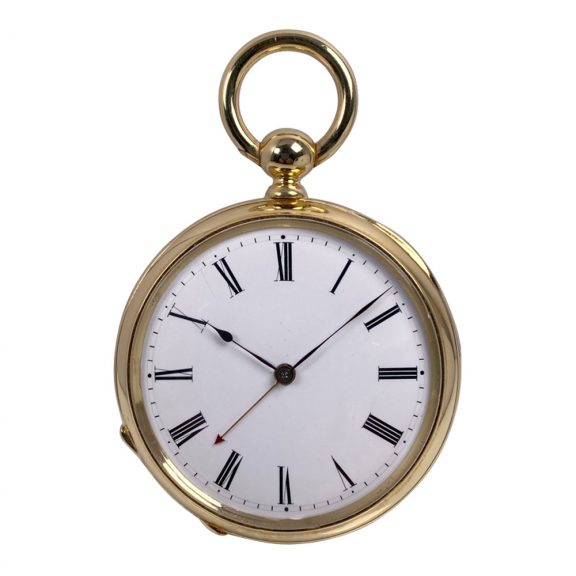
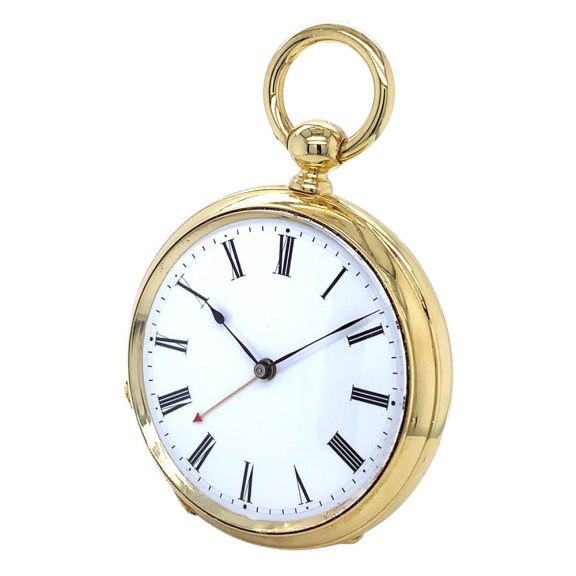
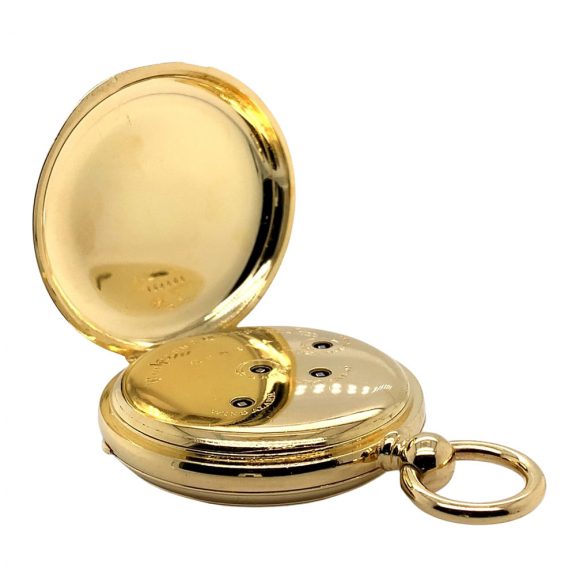
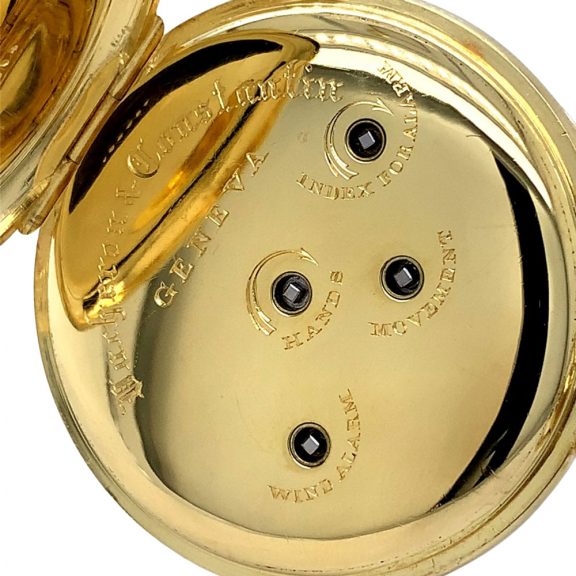
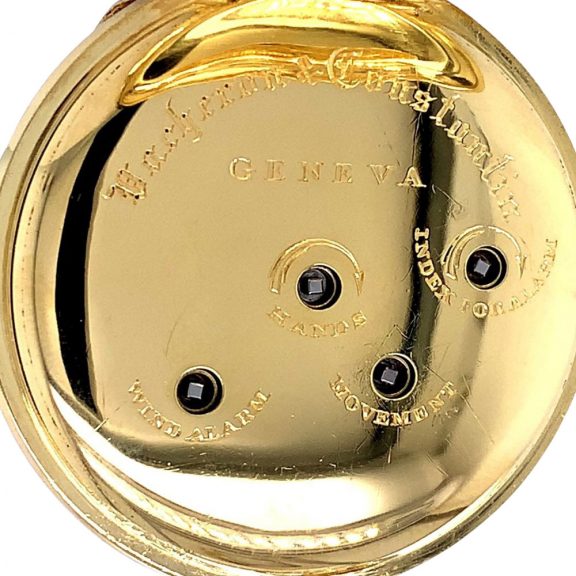
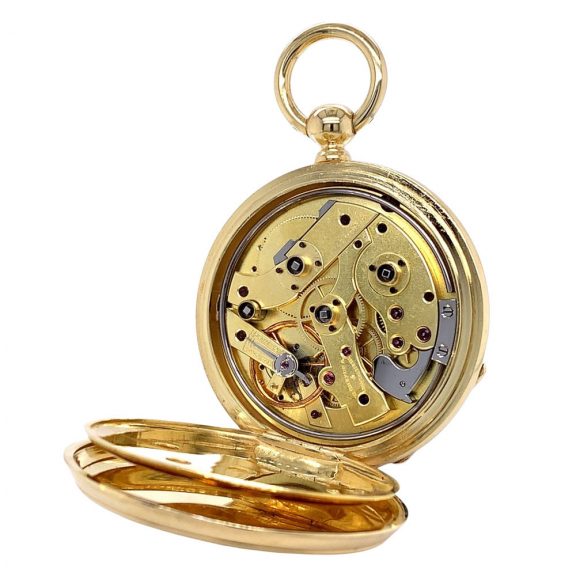
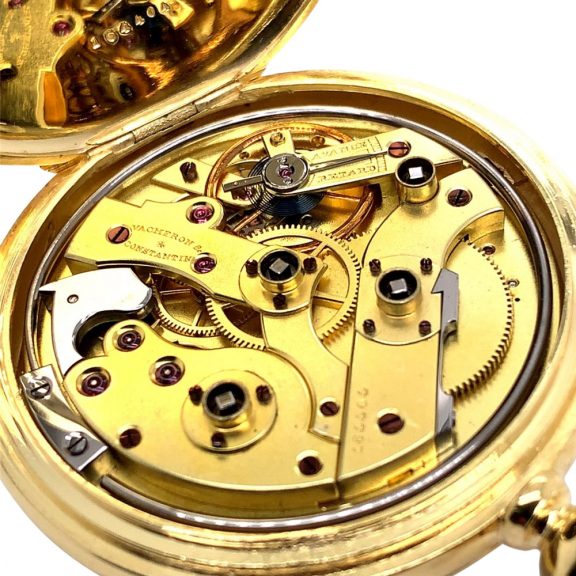
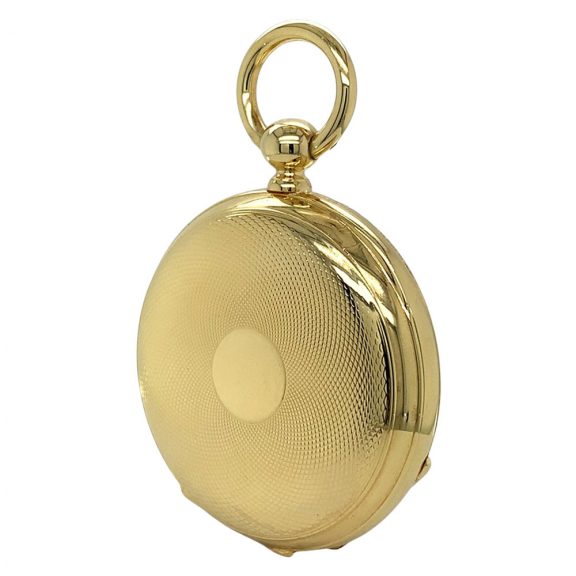
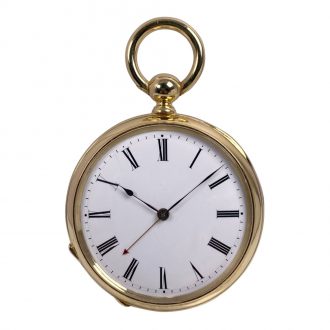
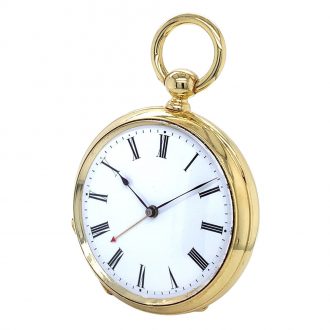
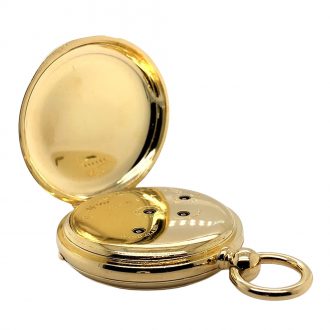
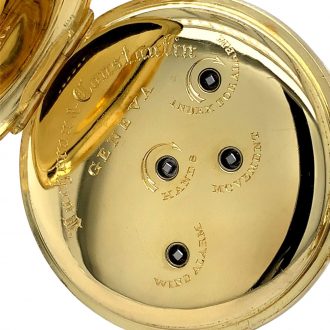
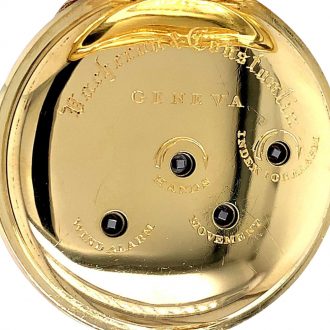
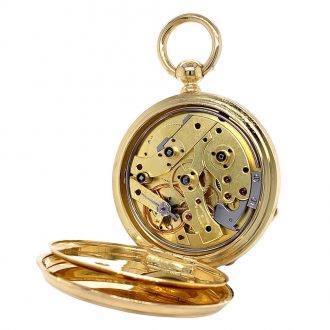
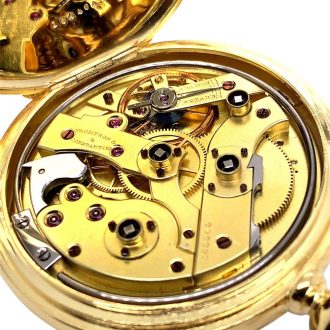
A very fine and rare Swiss gilded silver open faced cylinder pocket watch with alarm made for the English market, circa 1882. Bridge movement, a hammer, one gong, key wind, two barrels, a cylinder escapement and ring balance. White enamel dial with Roman hours, an outer minute track and black spade & whip hands. The case back is engine-turned, polished bezels, pendant and bow. Cuvette signed, movement signed and numbered, case and movement with matching numbers.
–
Diameter: 51 mm
–
Weight: 103 g
–
Signed: Vacheron & Constantin Geneva
–
The alarm mechanism with gong was patented on September 5th, 1889 as Swiss patent number 20033 and is only extremely rarely found in pocket watches.
–
Constantin SA is a highly regarded Swiss luxury watch and clock manufacturer founded in 1755 by Jean-Marc Vacheron. It is one of the oldest watch manufacturers in the world in continuous operation since its foundation. Jean-Marc Vacheron was an independent watchmaker in Geneva, Switzerland. At the age of 24, he signed on his first apprentice, thus founding a business by clarifying his intention to pass on his skills. In 1770 the company created the world’s first horological complication and nine years later it designed the first engine-turned dials.
The son of Jean-Marc Vacheron, Abraham Vacheron (1760-1843) took over the family business in 1785. In 1810, Jacques Barthélemi Vacheron (1787-1864), the grandson of the founder, became the head of the company. He was the first to initiate the company’s exports to France and Italy. Later, Jacques-Barthélemy realized that he needed a partner to travel overseas and sell the company’s products. Therefore, in 1819, François Constantin became his associate. The company continued its activities under the name Vacheron & Constantin. Both men shared the same interest in sophisticated and complicated watches. François Constantin had a keen eye for business, opening several new markets during three decades of travelling for the company. On July 5, 1819, he wrote to Jacques Barthélémi Vacheron from Turin. In his letter the phrase that became the company’s motto: “Do better if possible and that is always possible.”
In 1833, Vacheron and Constantin hired Georges-Auguste Leschot to supervise the manufacturing operations. Leschot was an inventor and his creations turned out to be a success for the company. His inventions had a significant impact on the watchmaking industry in general. He was the first person to standardize watch movements into calibres. In 1844, Leschot was awarded a gold medal from the Arts Society of Geneva, which highly appreciated his pantographic device, a device that was able to mechanically engrave small watch parts and dials.
After François Constantin died in 1854 and Jacques-Barthélemy Vacheron’s death in 1863, the company was taken over by a series of heirs. In 1862, the company became a member of the Association for Research into non-magnetic materials. Vacheron & Constantin, Fabricants, Genève became the official name of the company in 1877. In 1880, the company started using the Maltese cross as its symbol until today. This was inspired by a component of the barrel, which had a cross-shape and was used for limiting the tension within the mainspring. In 1887, Vacheron & Constantin was reorganized into a joint-stock company. The first Vacheron & Constantin boutique in Geneva was opened in 1906. During the Great Depression, the company found itself in a difficult situation.
In 1936, Charles Constantin became the head of the company, for the first time since the 1850s a representative from the Constantin family became the president of Vacheron & Constantin. However, in 1940, Georges Ketterer acquired the majority portion of the stock of Vacheron & Constantin from Charles Constantin. George Ketterer died in 1969, and his son, Jacques Ketterer, succeeded as the head of Vacheron & Constantin. In 1970, the company officially changed its name to Vacheron Constantin. The company was affected by the Vacheron quartz crisis during the 1970s and 1980s. When Jacques Ketterer died in 1987, Vacheron Constantin changed hands. Sheik Ahmed Zaki Yamani the former Oil Minister of Saudi Arabia and eager watch collector, became the company’s majority shareholder. Since 1996, it has been a subsidiary of the Swiss Richemont Group. In 2004, Vacheron Constantin opened its new headquarters and manufacture in Plan-les-Ouates, Geneva.
Signed: Vacheron & Constantin Geneva
Share this page: