Swiss gold complicated watch for the Spanish market Circa 1910
- Kenmerk
- TA5423
- Diameter
- 56 mm
- Estimate
- € 12.500 - 25.000
- Price sold
- -
Gold watch with nine horological complications
–
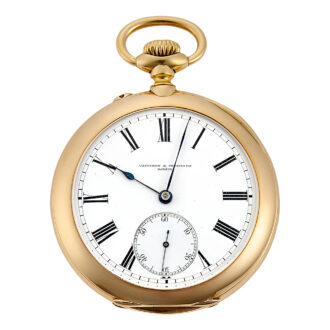
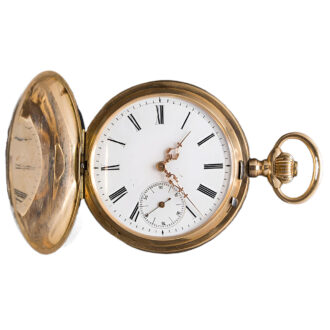
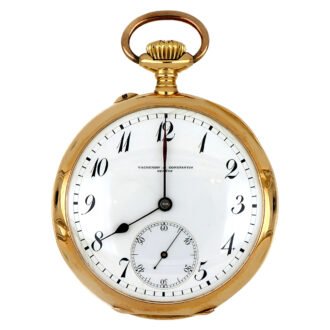
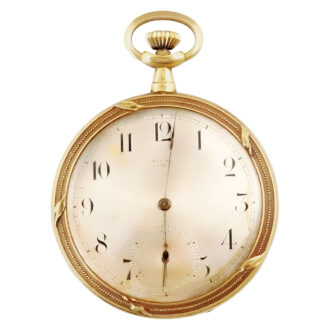
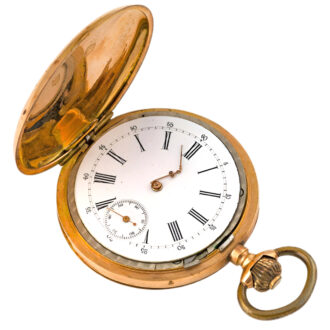
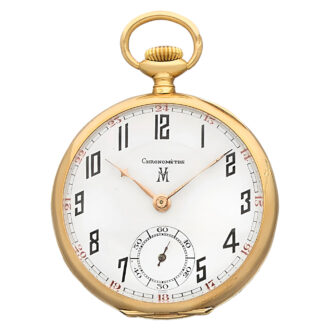
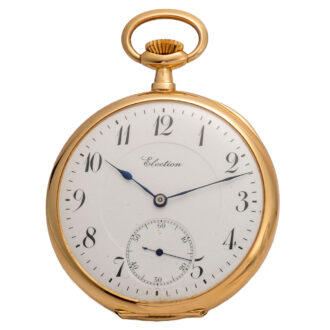
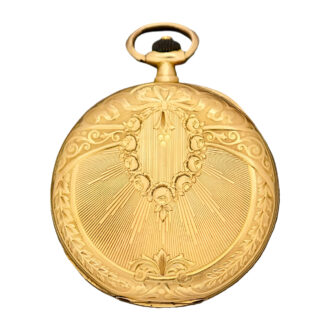
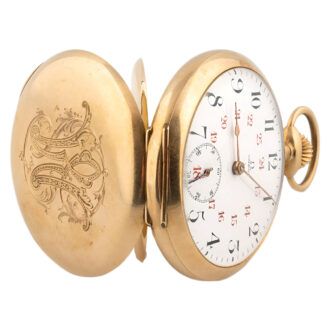
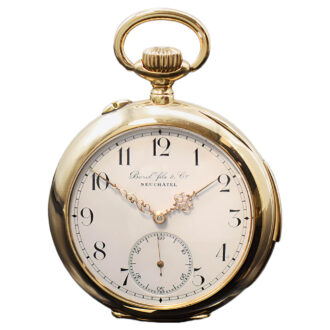
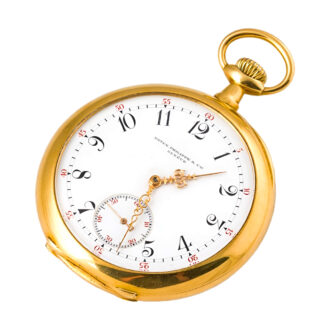
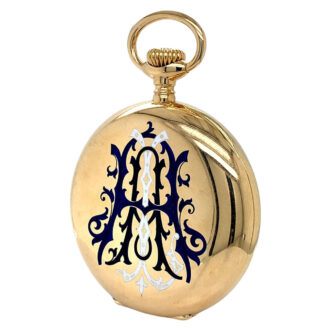
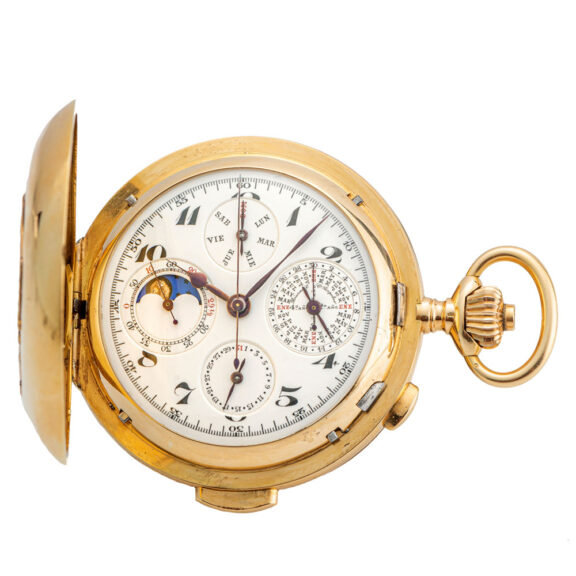
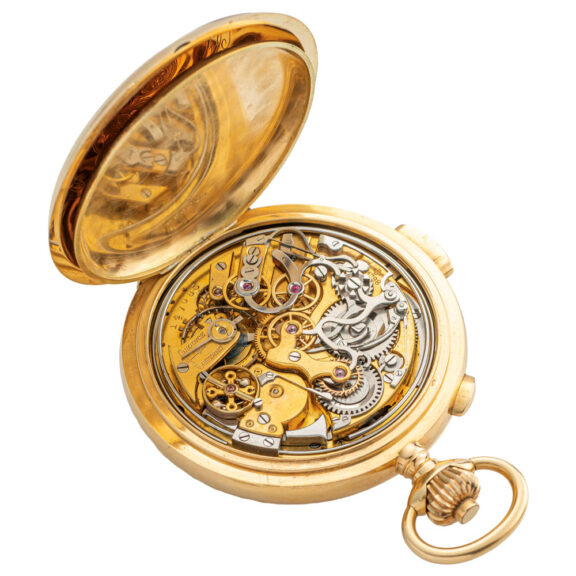
A Swiss, 18 carat yellow gold hunting cased keyless pocket watch with nine horological complications made by Charles Barbezat-Baillot in Le Locle, circa 1910. Made for the Spanish market, by Charles Barbezat-Baillot under the trademark Fix Watch Co and retailed by El Trust, Madrid. A minute repeater with chronograph, minute counter, perpetual calendar, age & moon phase. The cover and case back are polished, the cover is engraved in fine cut with a garland, and, applied in gold, the cypher AG.
–
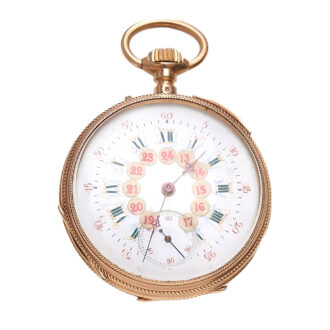
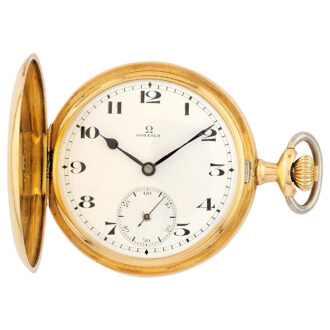
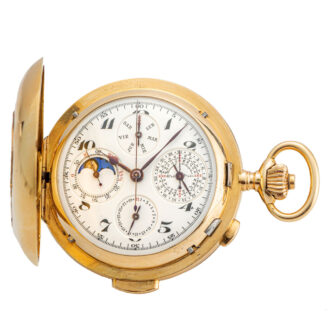
White enamel dial with suspended Breguet numerals, outer minute track, subsidiary seconds at 9 and blued steel Spade hands. A gilded brass movement, going barrel, straight line lever escapement, cut bimetallic compensated balance with gold poising screws and blued steel hairspring with terminal curve, polished steel index regulator; repeater work on the main plate, under the dial, with silent centrifugal force governor to regulate the speed of the repetition mechanism, chronograph work on the top plate. Signature on the case.
–
Diameter: 56 mm
–
Weight: 134 g
–
Signed: Charles Barbezat-Baillot, Le Locle
–
Accompanied by a copy of the invention patent and advertisements
–
Nine horological complications:
-Minute repeater by two hammers on two steel gongs, activated by the rectangular push piece located on the case band at 6 o’clock.
-1/5 second chronograph, activated by the rectangular push piece located on the case band at 4 o’clock.
-Instantaneous 30 minute counter, subsidiary dial at 3 o’clock.
-Half instantaneous perpetual calendar
-Date of the month, subsidiary dial at 6 o’clock.
-Day of the week, subsidiary dial at 12 o’clock; indications given in Spanish.
-Month of the year, subsidiary dial at 3 o’clock; indications given in Spanish.
-Four year cycle of leap years, subsidiary dial at 3 o’clock.
-Age and phases of the moon, subsidiary dial, graduated from 0 to 29 ½, and aperture at 9 o’clock.
–
Movement based on the Swiss invention patent No. 334, delivered on January 8, 1889, to Charles Barbezat-Baillot, Le Locle, for improvements to the construction of the mechanisms of repetition for pocket watches of all sizes. This patent includes, in particular, the centrifugal force regulator to regulate the speed of the repetition mechanism.
–
Charles Barbezat-Baillot, Le Locle
The company C. Barbezat-Baillot was founded by Charles Barbezat-Baillot (1847-1938). He was the elder brother of Henri Barbezat-Bôle (1851-1921), the founder of H. Barbezat-Bôle S.A., Le Locle. Charles Barbezat-Baillot is the holder of many invention patents related to watchmaking and registers numerous trademarks: Trusty, Le Phare, Dixi, Fix Watch Co., etc.
–
El Trust, Joyero y Relojero Internacional, Madrid
This Madrilenian watchmaking and jewellery (Puerta del Sol, No. 12) was managed in the early 20th century by D. Modesto Largo Alvarez. It then markets exclusively for Spain the watches Fix Watch Co., a registered trademark of the Charles Barbezat-Baillot (1847-1938) company of Le Locle (co-founded in the 1870’s, with Henry Guye (1838 -1877), under the name Guye & Barbezat). This house is then known worldwide for its pieces Le Phare (The Lighthouse), fitted with its centrifugal force regulator for repeater (Swiss invention patent No. 334, dated January 8, 1889, for Perfectionnements apportés à la construction des mécanismes de répétition pour montres de poche de toutes dimensions (Improvements to the construction of the mechanisms of repetition for pocket watches of all sizes), several times award-winning invention, at the Swiss National Exhibition in Geneva in 1896, the Paris Universal Exhibition in 1900, etc.).
–
It’s probably following a commercial contract that the Le Locle company then provides this retailer with the best of its production, including models with minute-repeater, chronograph with recorder and perpetual calendar or triple date. In the 1920’s, this Spanish retailer (who also opened a store in San Sebastian in the Basque Country) offered his customers watches by Longines (including pocket watches with minute-repeater on three gongs, known as Carillon or Chime) and by Patek Philippe, manufacturer of which it is still depositary in the 1950’s. Meanwhile, with the War of Spain, this retailer emigrated to Argentina in 1936, in Buenos Aires. The house is then in the hands of C. Pellegrini, Esq. Corrientes.
Signed: Charles Barbezat-Baillot, Le Locle
Share this page: