Swiss 18K gold cylinder watch with automaton scene Circa 1810
- Kenmerk
- AA0057
- Diameter
- 59 mm
- Estimate
- € 45.000 - 90.000
- Price sold
- -
Gold automaton watch by Robert & Courvoisier
–
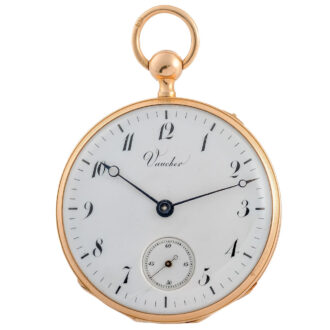
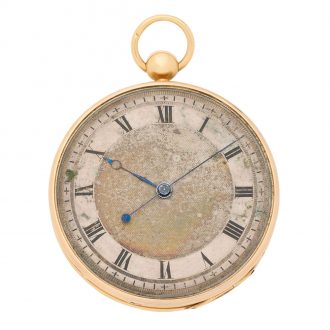
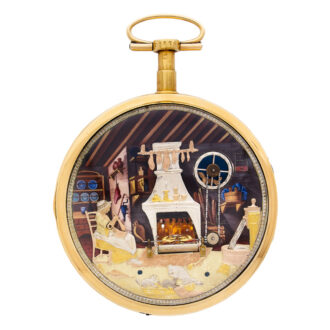
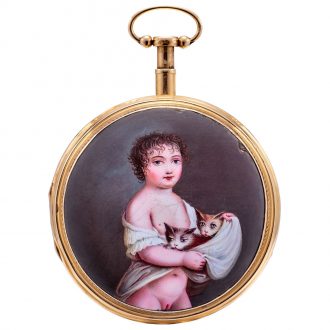
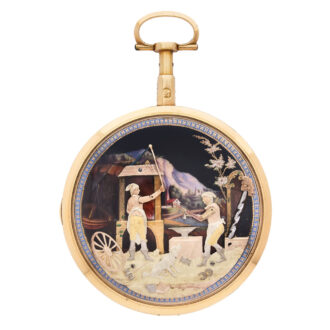
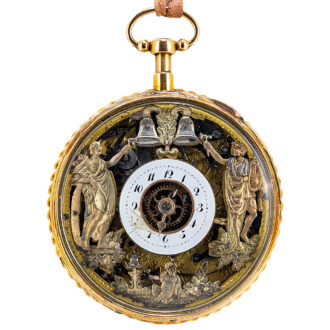
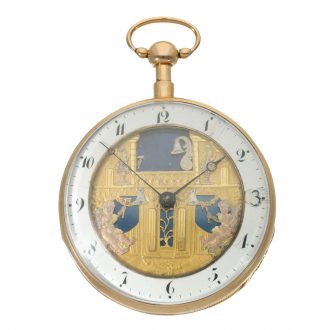
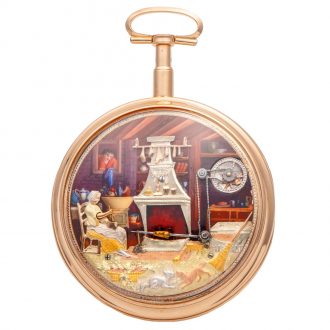
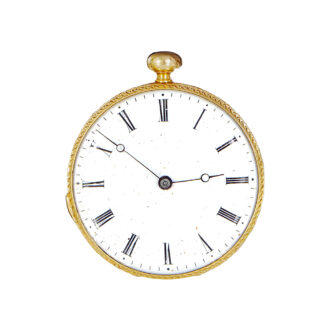
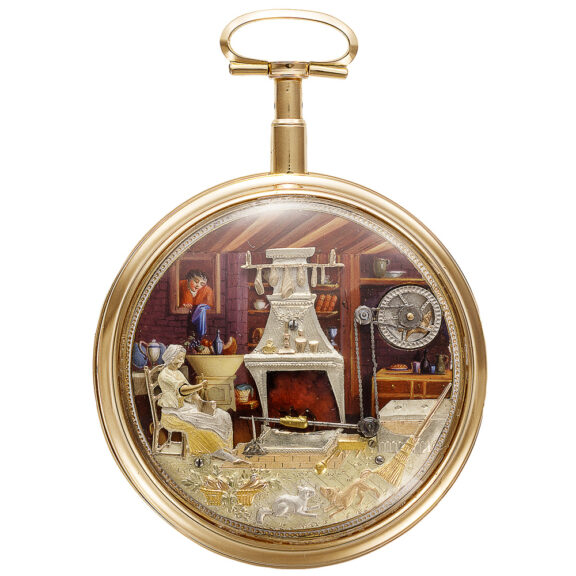
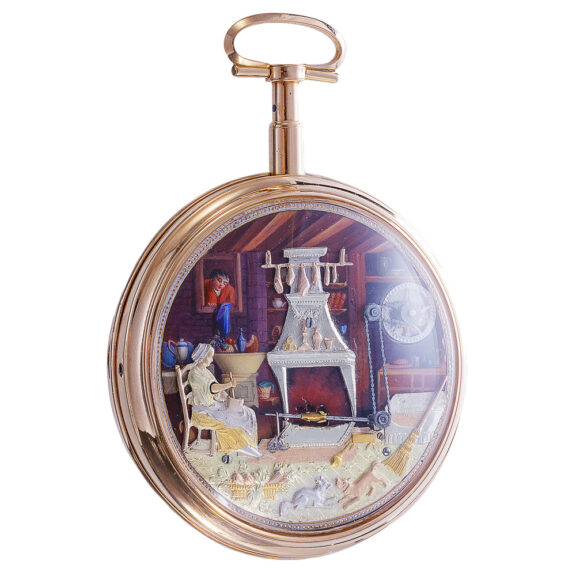
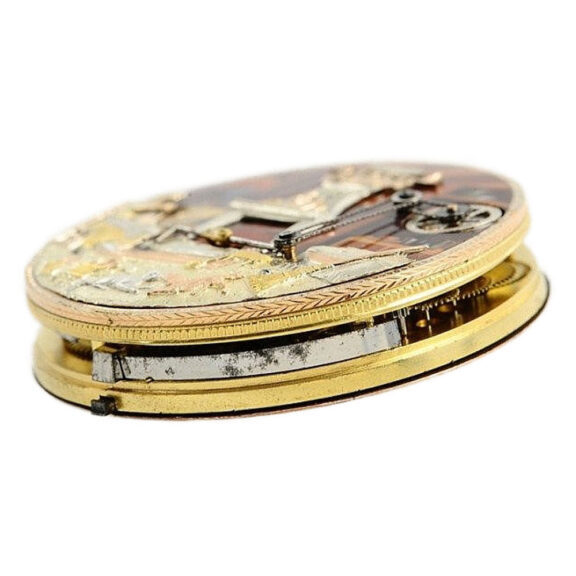
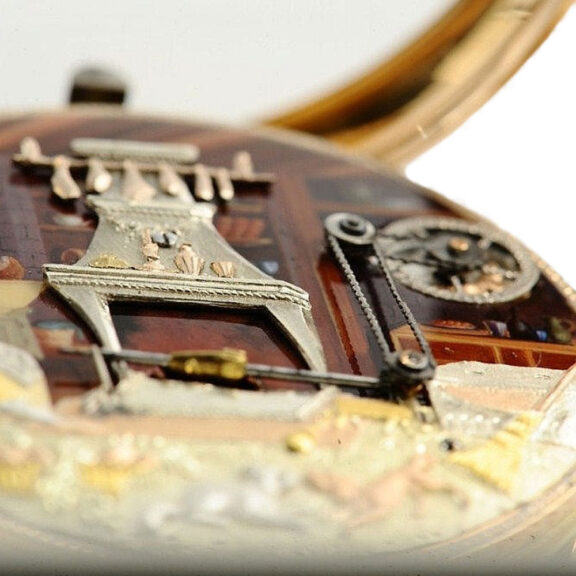
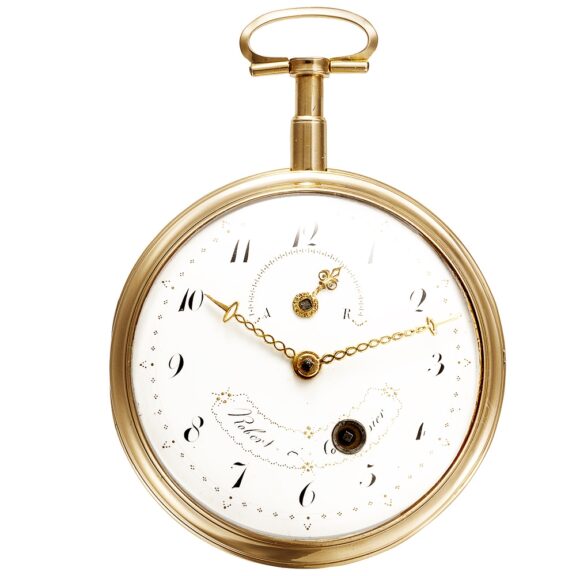
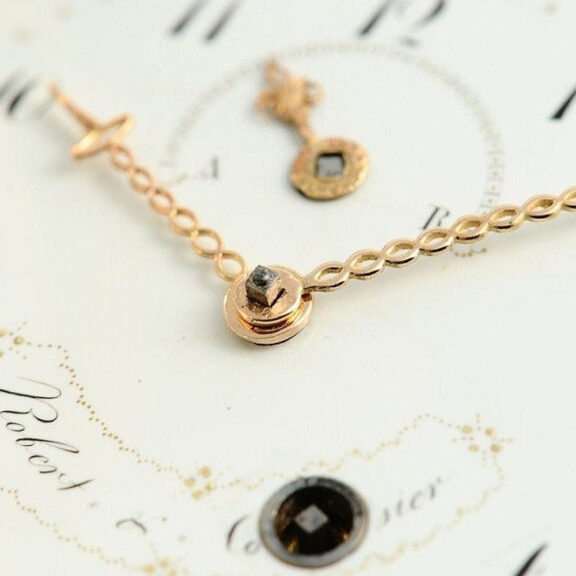
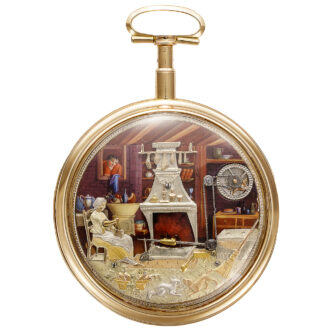
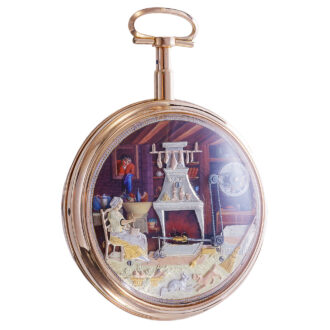
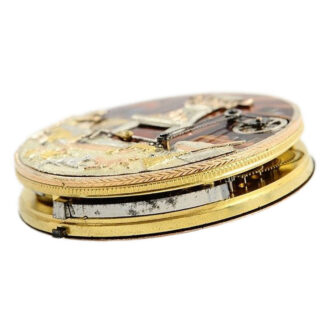
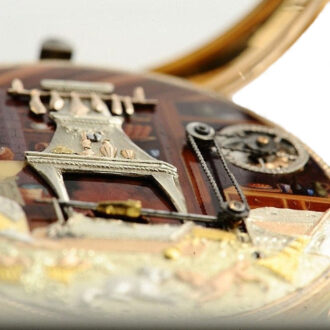
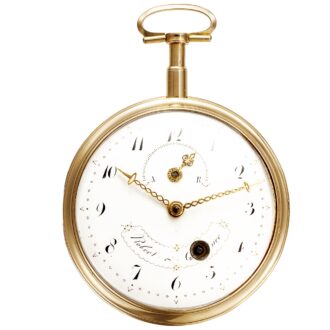
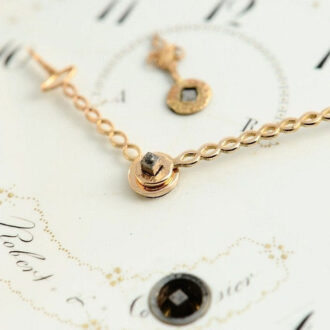
An important Swiss 18 Carat gold open faced gentleman’s pocket watch with automaton scene The Kitchen, circa 1810. Tiered case with glazed back and automaton depicting a genre scene á quatre couleurs of a Dutch kitchen with a cook sitting in a chair and stirring a pot next to an open fire, while a dog in a wheel turns a chicken on the spit, in the foreground a chased scene with a cat and a dog beneath a basket with vegetables, the background with a very finely painted enamel scene showing the interior of the kitchen and a man watching from a window, the automaton is activated by pressing the pendant. Signed white enamel dial with Arabic numerals, a retrograde regulator scale and double serpentine gold hands. Gilded brass bridge movement, key winding, chain and fusee, solid moulded pillars, cylinder escapement, three-arm brass balance and a blued steel flat hairspring.
–
Diameter: 59 mm
–
Weight: 121 g
–
Signed: Robert & Courvoisier à Genève
–
Robert & Courvoisier are clock and watchmakers from La Chaux-de-Fonds, Switzerland. The firm was founded in 1795 as a successor to J. Robert & Fils, Courvoisier. In 1770 the firm was originally established by Josué Robert (1691–1771). After Robert’s death, a year after the company was founded, the firm was renamed Josué Robert & Fils and was led by his son Louis Benjamin Robert (1732–1781). They mainly produced large clockworks, but as Benjamin’s son-in-law, Louis Courvoisier became a companion, pocket watches were put into production. When Louis Benjamin died, Louis Courvoisier became the manager of the firm. From 1787 to 1795 the firm was called J. Robert & Fils, Courvoisier. From 1795 to 1805 it was renamed Robert & Courvoisier. Since 1805 the firm’s name was Robert, Courvoisier & Cie with Philip Grandjean as a business partner. In 1852 it became Courvoisier Frères. The firm continued under the direction of various members of the Courvoisier family until the 1930s. Along with the Jaquet-Droz firm, they were the most important makers of musical clocks and around the turn of the 18th and 19th centuries, their portable officers’ watches were famous.
–
The Kitchen. This automaton watch model, dating from the very beginning of the 19th century, is home to one of the most pleasant scenes imagined at the time. It makes us discover the interior of a kitchen full of charming and funny details. These watches include an animated scene of five to seven automata on a background always painted differently. At the top, on the right, the wheel of a spit is in motion with inside a small mammal that hops and trains it, below on the right the water of the fountain flows and in the centre a chicken on its spit that turns and grills in front of a fire, behind at the bottom of the chimney the flames crackle, on the left, sitting on a chair, a woman grinds with her right arm a mixture in a pestle placed on her thighs which she holds with her left arm, her foot activates the spit.
––
From a mechanical point of view, there are three kinds of applications:
1. A movement built with fusee and chain and a verge escapement. The automata are activated upon request by an independent gear of train with going barrel, triggered by a push bolt on the side of the case. To operate the watch and the scene with automata, there are two barrels to wind, one at 6:30 and one at 11 o’clock or 4:45 and 7:45. The diameter of the case is between 57 and 60 mm. They are usually attributed to Pierre-Simon Gounouilhou (1779-1847) from Geneva.
2. A movement built with a going barrel and cylinder escapement. The automata are activated on request by the repetition mechanism, the trigger is therefore operated by depressing the pendant. To operate the watch and the automaton scene, there is only one barrel to wind at 2:30 o’clock. A fast/slow sector at 6 o’clock. The diameter of the case is 61 mm. Only one watch is listed to date. It is signed by DuBois & Fils, Le Locle, an association of watchmakers active in the late 18th century and early 19th century, founded by Philippe DuBois (1738-1808).
3. A movement built with fusee and chain and a cylinder escapement. The automata are activated on request by the repetition mechanism, the trigger is therefore operated by depressing the pendant. To operate the watch and the automaton scene, there is only one barrel to wind at 5:30 o’clock. A fast/slow sector at 12 o’clock. The diameter of the case is 59 mm. Only the present watch, signed by Robert & Courvoisier, La Chaux-de-Fonds, Horloger du Roy de Prusse et de la Cour, is listed to date.
Signed: Robert & Courvoisier à Genève
Share this page: