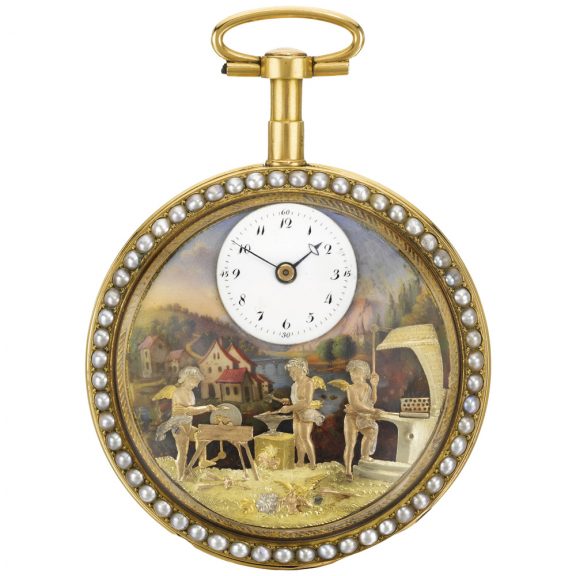
Swiss gold, enamel and pearl set automaton watch Circa 1810
- Kenmerk
- AS1667
- Diameter
- 57 mm
- Estimate
- € 25.000 - 50.000
- Price sold
- € 26.350
Gold, enamel and pearl automaton watch by William Ilbery
–
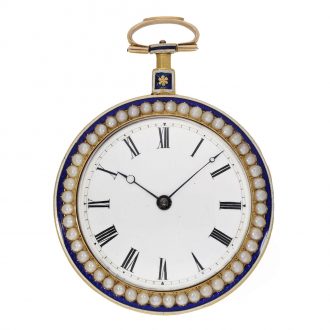
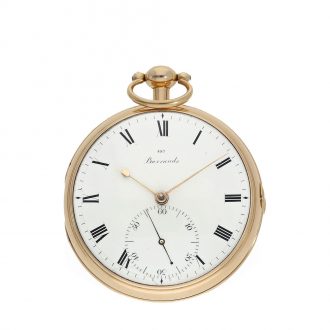
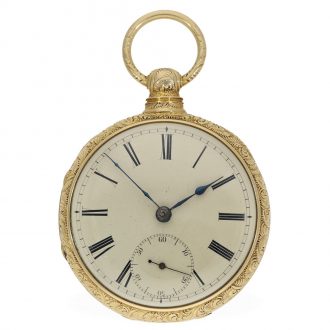
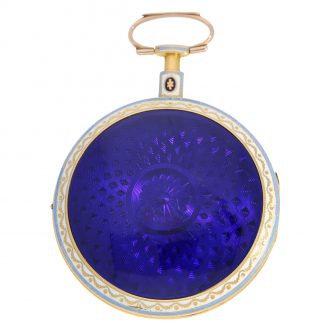
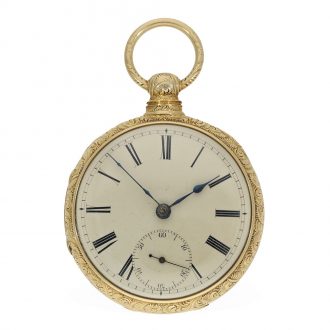
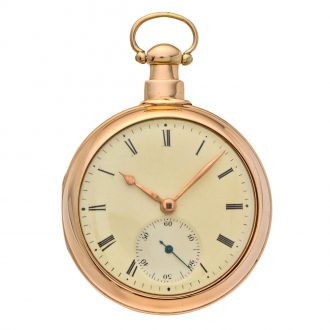
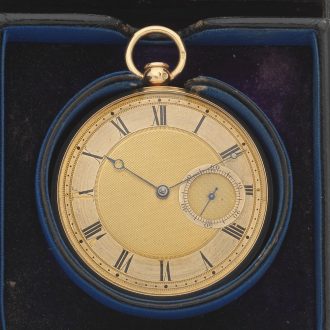
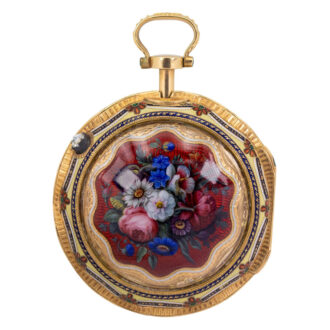
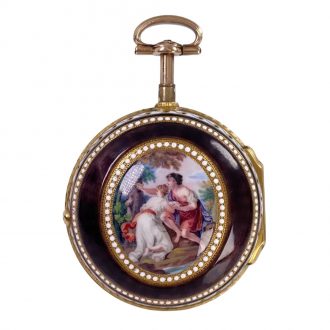
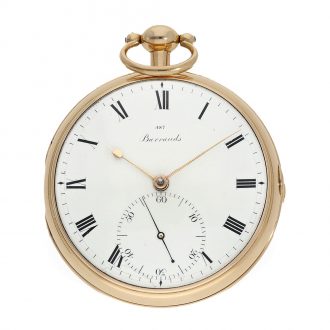
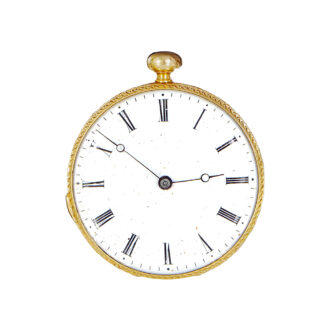
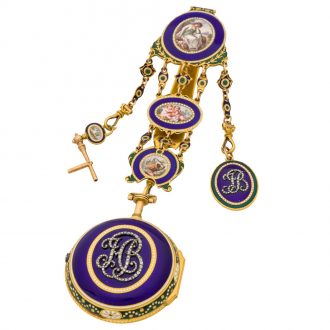
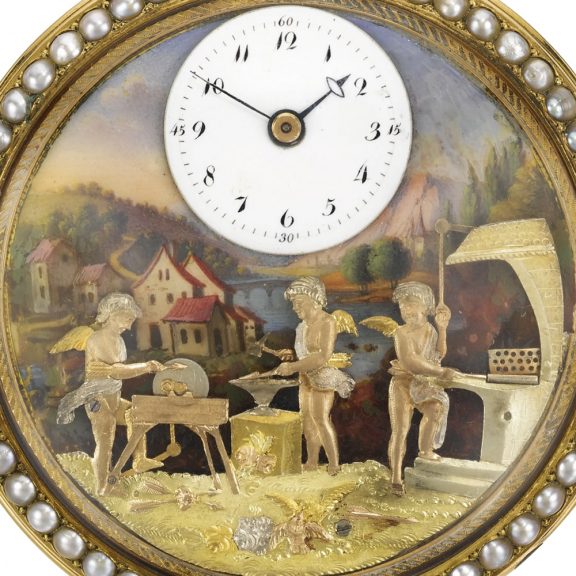
A fine and rare Swiss gold, enamel, and pearl-set automaton watch made for the Chinese market, circa 1810. The watch features a gilded movement with a cylinder escapement, two trains, and separate standing barrels for going and automata. It also includes a three-arm brass balance wheel and a slide for activating the automata close to the case hinge. The small white enamel dial features Roman numerals and an outer Arabic minute ring. The five-motion automaton includes three vari-coloured Cupids in the foreground: one on a grinder, one at an anvil, and another at an oven with a rotative depiction of fire. This is all set within a polychrome painted enamel scene of Cupid’s Forge of Love, with a pair of lovebirds in the foreground, against a polychrome painted enamel lakeside landscape.
–
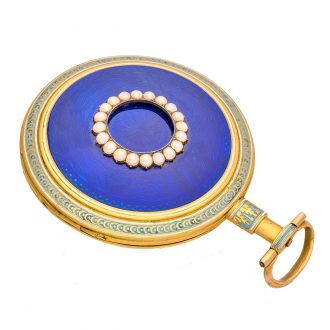
The watch features a gold case with translucent blue enamel over engine turning, complemented by split-pearl-set bezels. The case back can be easily released via a pusher attached to the pendant, and it also includes a stylish stirrup bow. The gilt metal cuvette features an opening catch beneath the pendant and a plain polished gilt metal cuvette signed Ilbery London to the interior.
–
Diameter: 57 mm
–
Signed: Ilbery London
–
The dial is in good condition, but the case has scuffs to the translucent blue enamel and a chip to the edge. There are also scuffs to the gold band. The movement and automata are working.
–
The watch currently bears Ilbery’s signature on the cuvette, but it was probably made by another workshop and then sold by Ilbery. Another similar example was sold at Sotheby’s New York on December 10, 2015, lot 199. An additional example of the automaton featuring the Cupid’s Forge theme is depicted in Watches & Automata, The Maurice Sandoz Collection, plate I.20, page 126.
–
William Ilbery, circa 1760-1839, was active in London from 1780 in Goswell Street, he moved to Duncan Terrace towards the end of the 18th century. After James Cox in London and Jaquet-Droz in Switzerland, he also specialized in producing luxury watches for the Chinese market. His early production was very much in the English style, featuring a full plate movement and an English-type single-wheel duplex escapement. However, for his highest-quality watches, he incorporated a spring detent escapement. Later, the watch movements he produced were much inspired by the Lépine calibre with a free-standing barrel, as were Jaquet-Droz’s Swiss production signed in London and that of William Anthony, who worked in London. The cases of his watches were sumptuously decorated by the best Genevan enamellers, such as Jean-Francois-Victor Dupont, who usually signed his work, and Jean-Louis Richter, who signed rarely. He organized the production in Switzerland, mainly in Fleurier, of profusely engraved movements for the Asian market. He was followed in this by makers such as Bovet and Juvet who also worked in Fleurier (Val de Travers). Ilbery can therefore be considered one of the most representative makers of ‘Chinese’ watches. He seems to have maintained close contacts with the continental trade since a watch signed ‘Ilbery Paris’ is known while Ilbery & Son are recorded in London and Fleurier, as well as in Canton.
Signed: Ilbery London
Share this page: