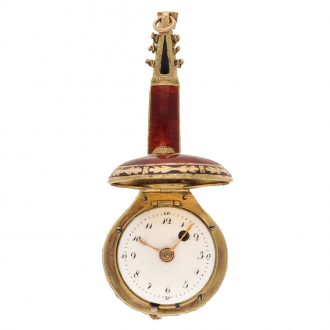
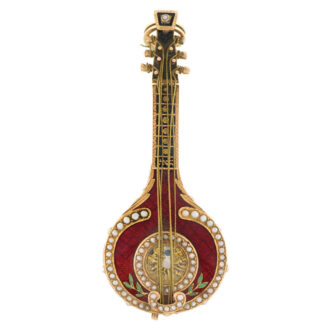
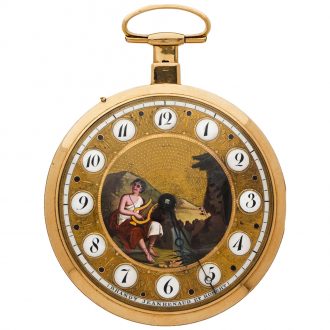
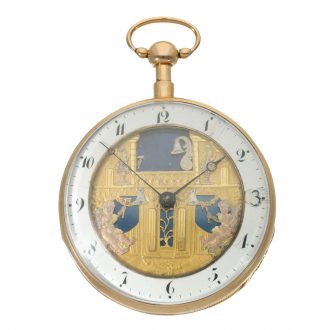
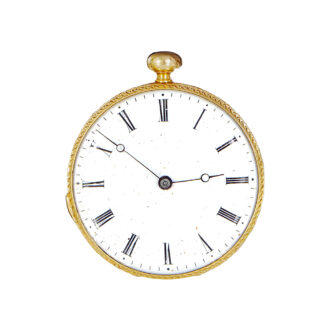
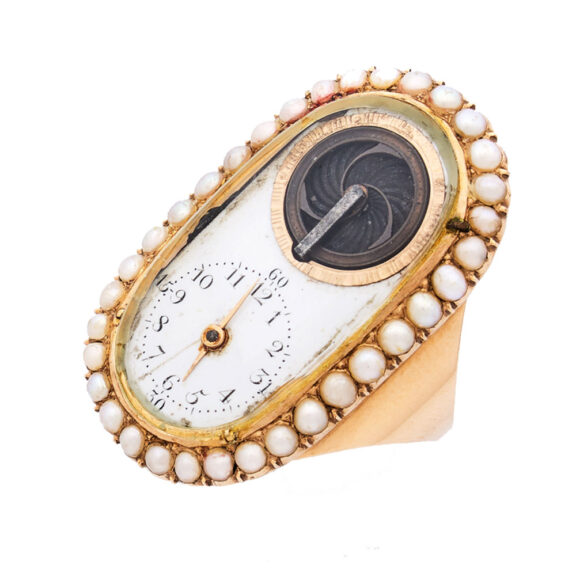
Swiss gold, enamel and pearl set oval ring watch Circa 1810
- Kenmerk
- AL3462
- Diameter
- -
- Estimate
- € 3.500 - 7.000
- Price sold
- € 3.500
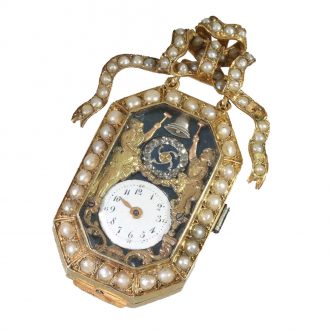
Gold open faced key wind cylinder ring watch
–
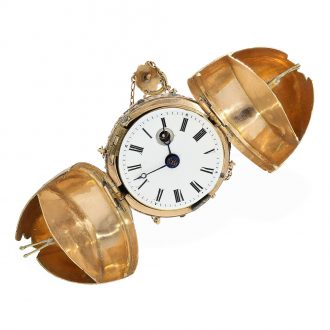
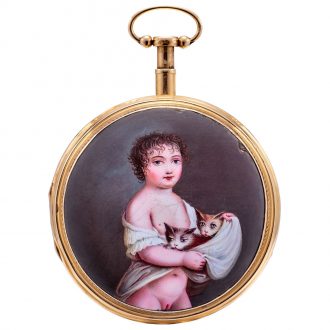
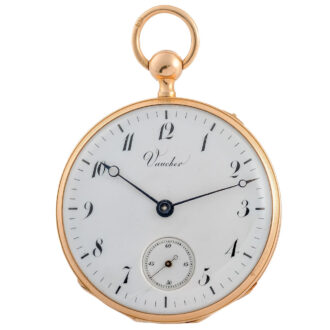
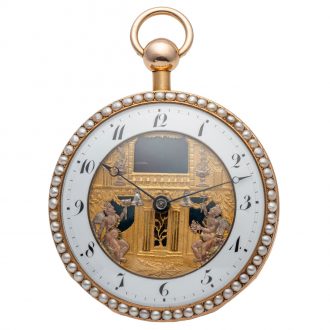
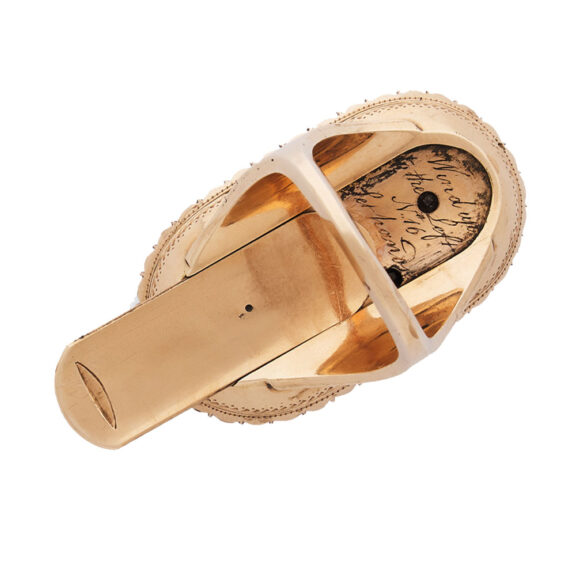
A fine Swiss pink gold open faced oval ring watch, set with half pearls, dating from the early 19th century. It has a mechanical key winding movement with a cylinder escapement and balance spring; unsigned. The white enamel dial features off centred black Arabic numerals for hours, a quarter hour indication with Arabic numerals, and a circular opening in the upper section revealing the active balance spring. The timepiece is housed in a hinged oval pink gold case with a smooth gold finger ring. It has an elegant bezel set with a continuous border of split half pearls and a sliding back cover that opens to reveal hidden winding squares with engraved instructions.
–
Length: 35 mm
–
Weight: 17.3 g
–
Signed: No name
–
The ring watch is a fascinating piece of jewellery combining the function of a watch with the elegance of a ring. Its origins date back centuries and illustrate the evolution of miniature watchmaking to make time accessible in a discreet and refined form.
–
The beginnings of the portable watch in the history of watchmaking
The first watches appeared at the beginning of the 16th century. They were often large, bulky, and used as ceremonial objects. As technology progressed, European watchmakers began reducing mechanism sizes to create miniature watches.
–
Towards the end of the 16th century, some watchmakers made watches in the form of rings to be worn as jewellery. These first ring watches were rudimentary and only gave approximate time. Queen Elizabeth I of England (1533-1603) wore a ring watch on her finger. At the time, this object embodied sophistication and refinement at the royal court.
–
ring watch in the 17th and 18th centuries
As miniaturization progressed, ring watches became popular, especially among noblewomen. They were often decorated with precious stones and enamel, reflecting a taste for ornamentation and sophistication. Ring watches symbolized luxury and social status. Watchmakers competed to insert increasingly precise mechanisms into elegant ring settings. However, their small size often made these watches less precise than others and mainly decorative.
–
The ring watch, symbol of the costume watch at the beginning of the 19th century
Particularly fashionable between the late 18th and mid-19th century, ring watches represented an alternative to traditional jewellery. Their shapes varied from round and oval to rectangular and shuttle-shaped. The bezels of the most luxurious examples were decorated with pearls or diamonds. Some had off-centre dials leaving room for a visible balance wheel, like this one.
–
The ring watch from the 20th century to the present day
With the advent of wristwatches at the beginning of the 20th century, ring watches experienced a revival as fashion accessories rather than time measuring instruments. In the 1930s and 1940s, fine jewellery houses like Cartier reinvented the ring watch by integrating modern watch movements into luxurious rings. These creations seduced jewellery lovers and demonstrated exceptional expertise in miniaturization.
–
The contemporary ring watch: luxury jewellery and modern technology
Today, the ring watch is a rare and exclusive object, mainly made by fine jewellery and watchmaking houses. Technical progress allows creation of ring watches with precise and reliable mechanical hand-wound duoplan movements despite the small size required. Modern ring watches combine refined design with functionality, even if their use remains primarily ornamental. Some luxury watch brands continue to manufacture ring watches, such as the Jaeger Le Coultre, with its famous ultra-thin calibre, often in limited editions, for customers looking for unique and elegant pieces.
Share this page: