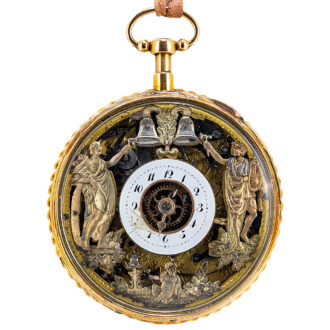
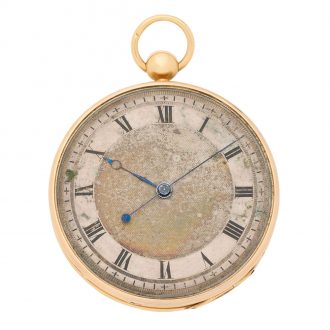
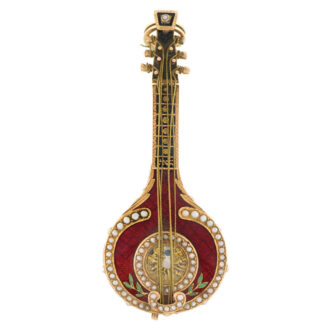
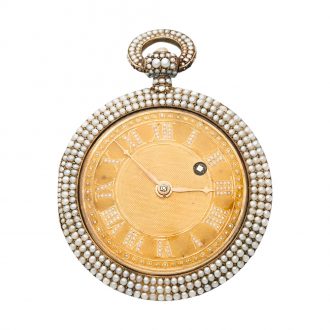
Exceptional Swiss gold and enamel automaton Circa 1805-1810
- Kenmerk
- SA2003
- Diameter
- 55 mm
- Estimate
- € 300.000 - 500.000
- Price sold
- € 523.400
Multi coloured gold shield shaped automaton
–
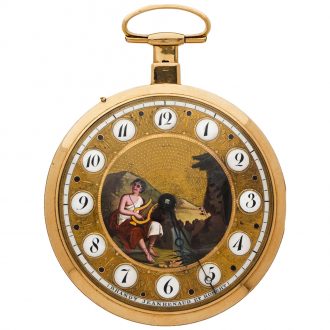
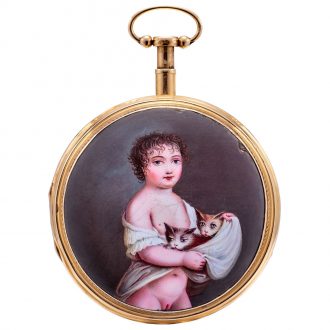
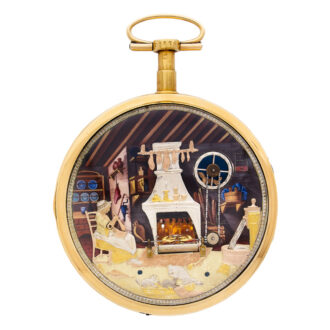
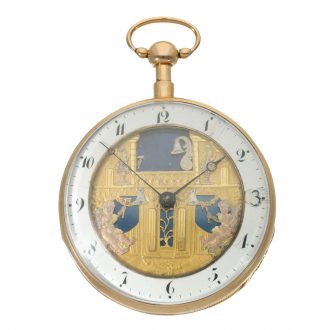
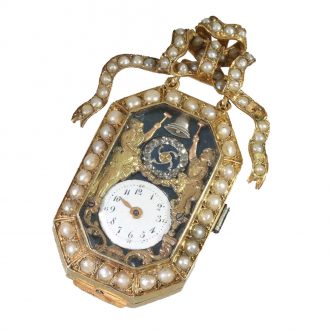
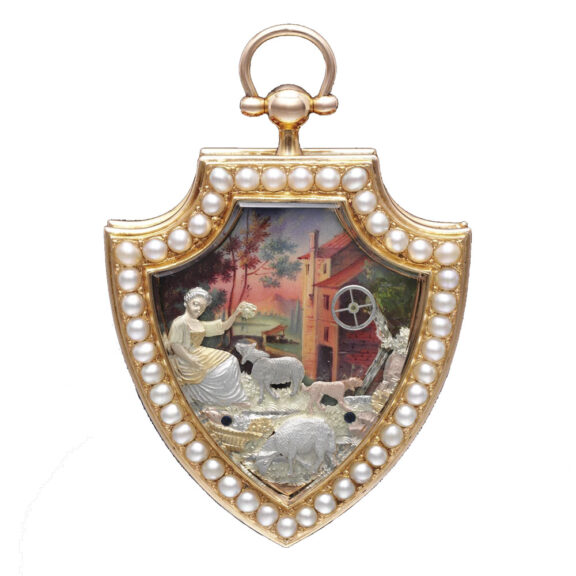
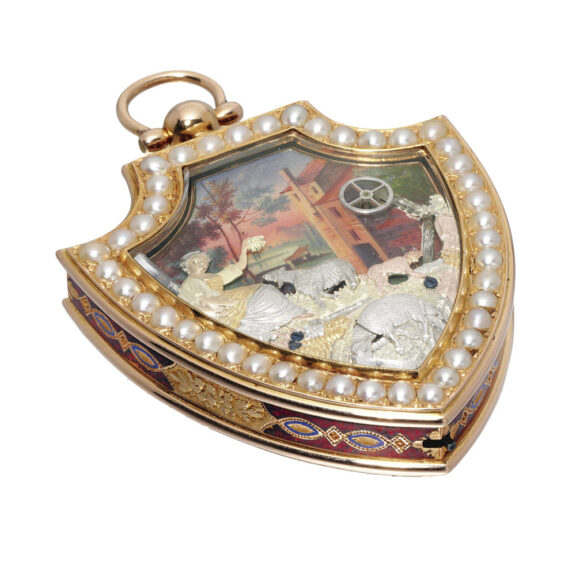
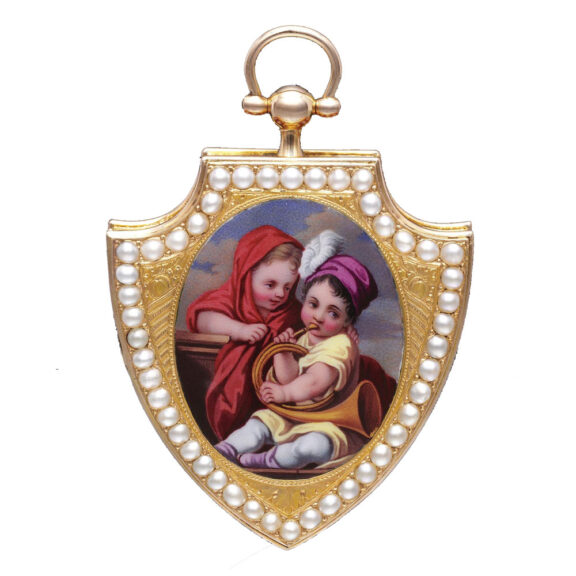
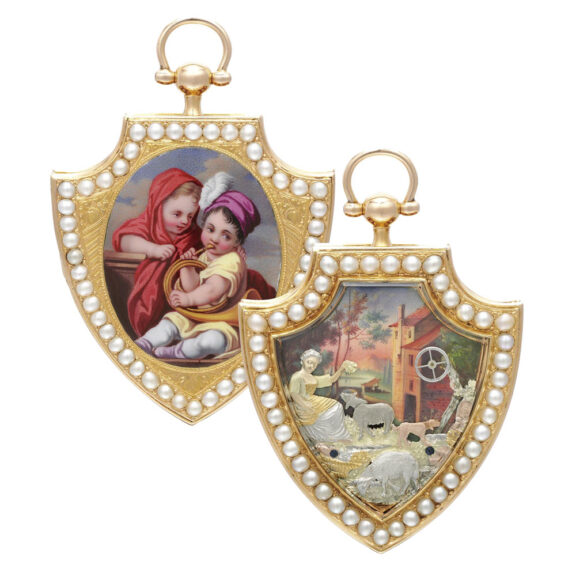
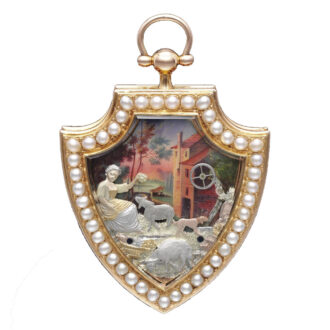
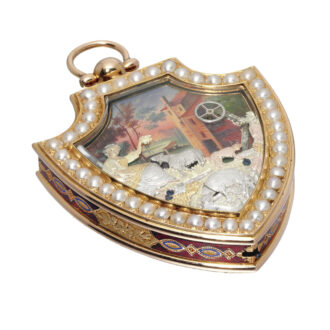
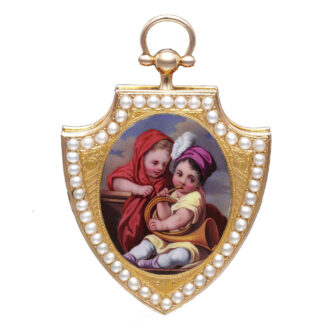
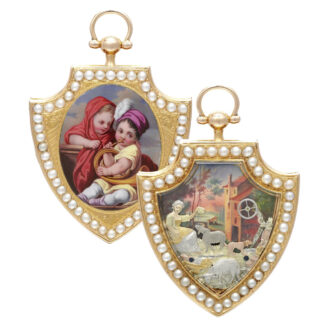
An exceptional Swiss three colour gold, enamel and split pearl set shield form automaton made for the Chinese market, attributed to Piguet & Capt, circa 1805-1810. A shield shaped gilt automaton work with seven motions comprising the shepherdess raising and lowering her arm, the two sheep and the dog raising and lowering their heads, a water wheel revolving fed by flowing water represented by rotating glass rods. A gold cuvette engraved with a putto playing by a fountain. The automaton scene is chased in three colour gold against a finely painted polychrome enamel background depicting a Swiss lake scene with a mill, both bezels are set with split pearls, the reverse fitted with an oval medallion finely painted with a polychrome enamel scene of two rosy cheeked children, one playing a horn while the second figure looks on, both vibrantly enamelled in tones of red, yellow and magenta, the lower part of the band is fitted with a start/stop lever for the automaton, the band decorated with enamel in tones of red and blue. Comes with a key and later presentation box.
–
Dimensions: 55 x 38 mm
–
Thickness: 11.3 mm
–
Signed: No name
–
Isaac Daniel Piguet (1775 – 1841) and Henri Capt (1773 – 1841) were partners from 1802 to 1811 in the firm bearing their name, Piguet & Capt. The duo is considered amongst the most important makers of small automata at the end of the 18th and beginning of the 19th centuries. Of the examples attributed to them, quite possibly the present one is amongst the most impressive, considering its relatively small size combined with the technical feat of including automata of such complexity. Examples of their craftsmanship are exhibited in the world’s foremost collections such as the Patek Philippe Museum in Geneva.
–
The enamel is possibly by Jean Abraham Lissignol, who was a Swiss painter, revolutionary and one of the finest enamellers of his time. He was born in Geneva on May 7th, 1749 and died in Plainpalais on June 28th, 1819. He was the pupil of Jean-Marc Roux and later became his partner. Specialized in snuff boxes and watch cases, he worked for Jaquet-Droz & Leschot, the Rochat Brothers and John Rich. He appears to have often used allegorical subjects, particularly those including plump cherubs. A box in the Patek Philippe Museum shows such a scene identified as ‘The Allegory of The Arts and Nature’. In 1806, Lissignol wrote eloquently to the Paris authorities (Geneva then being occupied by France) suggesting that the Imperial Court should buy enamelled trinkets to encourage the failing trade in Geneva, just as they had bought Lyons silk to help that market recover.
–
–
An exceptional Swiss three colour gold, enamel and split pearl set shield form automaton made for the Chinese market, attributed to Piguet & Capt, circa 1805-1810. A shield shaped gilt automaton work with seven motions comprising the shepherdess raising and lowering her arm, the two sheep and the dog raising and lowering their heads, a water wheel revolving fed by flowing water represented by rotating glass rods. A gold cuvette engraved with a putto playing by a fountain. The automaton scene is chased in three colour gold against a finely painted polychrome enamel background depicting a Swiss lake scene with a mill, both bezels are set with split pearls, the reverse fitted with an oval medallion finely painted with a polychrome enamel scene of two rosy cheeked children, one playing a horn while the second figure looks on, both vibrantly enamelled in tones of red, yellow and magenta, the lower part of the band is fitted with a start/stop lever for the automaton, the band decorated with enamel in tones of red and blue. Comes with a key and later presentation box.
–
Dimensions: 55 x 38 mm
–
Thickness: 11.3 mm
–
Signed: No name
–
Isaac Daniel Piguet (1775 – 1841) and Henri Capt (1773 – 1841) were partners from 1802 to 1811 in the firm bearing their name, Piguet & Capt. The duo is considered amongst the most important makers of small automata at the end of the 18th and beginning of the 19th centuries. Of the examples attributed to them, quite possibly the present one is amongst the most impressive, considering its relatively small size combined with the technical feat of including automata of such complexity. Examples of their craftsmanship are exhibited in the world’s foremost collections such as the Patek Philippe Museum in Geneva.
–
The enamel is possibly by Jean Abraham Lissignol, who was a Swiss painter, revolutionary and one of the finest enamellers of his time. He was born in Geneva on May 7th, 1749 and died in Plainpalais on June 28th, 1819. He was the pupil of Jean-Marc Roux and later became his partner. Specialized in snuff boxes and watch cases, he worked for Jaquet-Droz & Leschot, the Rochat Brothers and John Rich. He appears to have often used allegorical subjects, particularly those including plump cherubs. A box in the Patek Philippe Museum shows such a scene identified as ‘The Allegory of The Arts and Nature’. In 1806, Lissignol wrote eloquently to the Paris authorities (Geneva then being occupied by France) suggesting that the Imperial Court should buy enamelled trinkets to encourage the failing trade in Geneva, just as they had bought Lyons silk to help that market recover.
–
F.L. Hess is recorded as an enameller in Geneva circa 1828 with his establishment at Allemands-Dessous 42. Among his works recorded in private collections and the Patek Philippe Museum is a watch made for the Chinese market signed ‘Hess’ on the enamel (Inv. S-769). Its painted scene ‘Maternal Love’ is probably inspired by a painting of Elizabeth Vigee Le Brun (1755-1842), duplicated on other watches from the same period, such as the ‘Amphora’ attributed to Piguet & Capt from the Sandberg Watch Collection, now exhibited in the Patek Philippe Museum (Inv. S-454).
–
King Farouk, the last King of Egypt, known for his extravagance and lavish lifestyle, was overthrown on July 3rd, 1952. He was forced to abdicate and fled Egypt three days later into exile first to Monaco and then Italy until his death in 1962. Farouk left behind an extensive and Important collection of works of art which the new Egyptian Government seized. Subsequently the government engaged Sotheby’s to organise the sale of his collections.
–
The 1954 ‘Palace Collections of Egypt’ would be a landmark sale and at the time considered the auction of the century. Farouk’s collection spanned a wide range of collecting categories, primarily Objects of Vertu, Watches, Automata, Jewellery, Silver, Stamps, Coins, Paperweights and Galle Glass. The auction lasted over a month between February and March of 1954. In the brochure advertising the sale, it was written “the master craftsmen of all countries and periods are represented in the fabulous collection of small works of art in precious materials”. Of the automata was written, “Switzerland is the home of a whole series of exquisite musical automata”. This watch was one of two automaton shields offered in the sale. The first lot was smaller with a see-saw automaton and no figural enamel scene on the back.
Share this page: