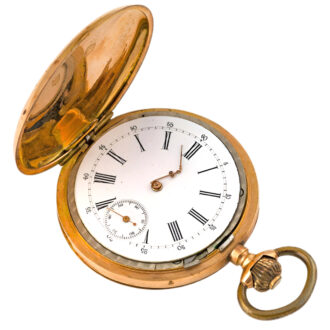
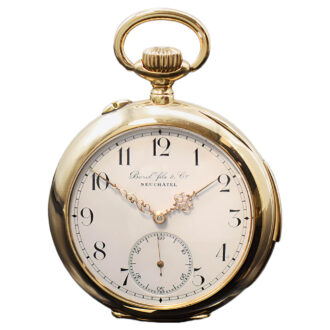
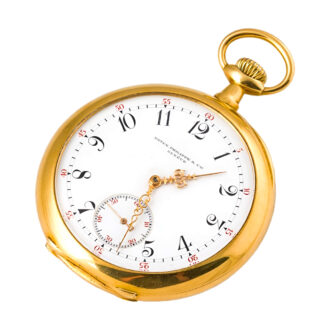
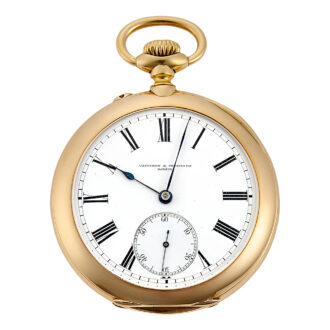
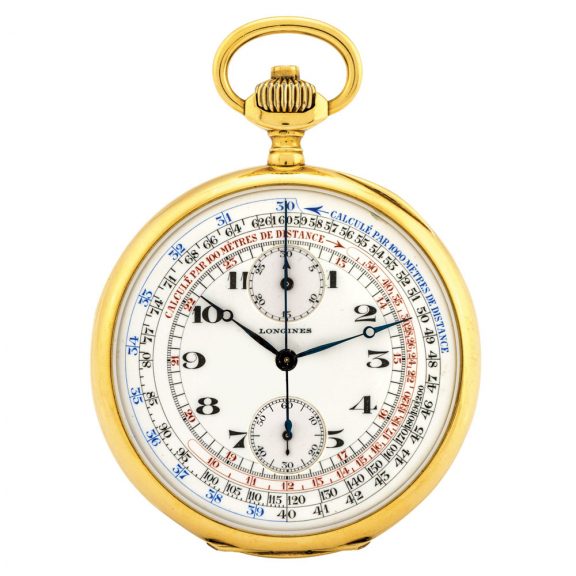
Swiss gold lever with register, tachometer and telemeter Circa 1910
- Kenmerk
- TA4447
- Diameter
- 52 mm
- Estimate
- € 2.000 - 4.000
- Price sold
- € 2.200
Gold multiscale chronograph by Longines
–
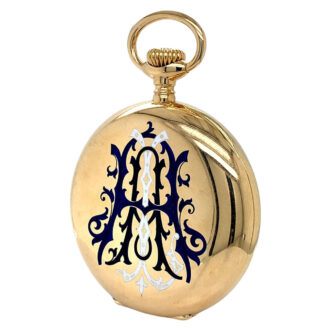
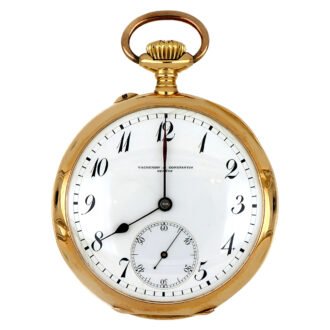
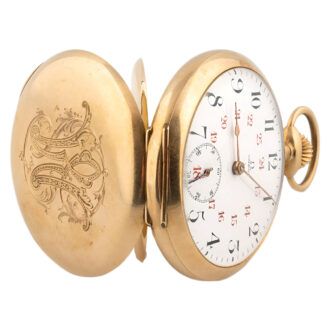
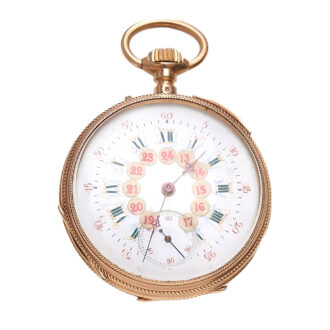
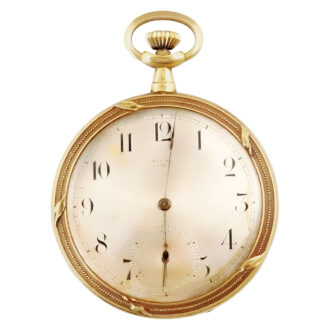
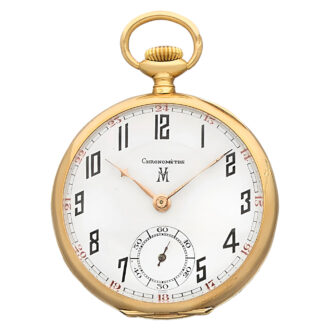
A rare Swiss 18 carat yellow gold keyless pocket watch, circa 1910. A Longines multiscale chronograph, instantaneous 30 minute register, tachometer and telemeter.
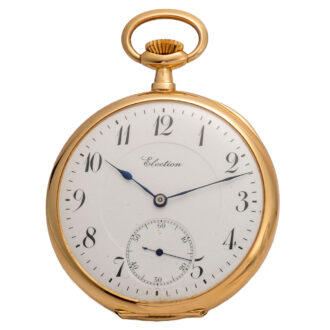
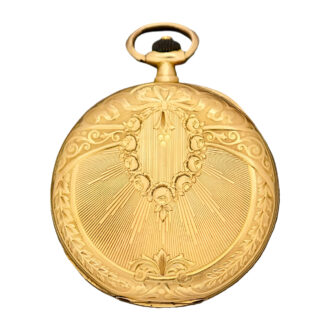
A solid, polished case, the back cover with an engraved coat of arms, co-axial button in the crown for the start/stop and return-to-zero functions of the chronograph. Hinged gold cuvette engraved with the Longine’s seven Grand Prix medals. White enamel dial with Breguet numerals, outer Arabic minute and chronograph seconds divisions, outermost tachometer and telemeter graduation to 1000 m., sunk subsidiary dials for the seconds and the 30 minute register and blued steel Breguet hands. Matte gilt movement, 18 jewels, straight line lever escapement, monometallic balance with screws, self-compensating Breguet balance spring, cam micrometre regulator, visible chronograph mechanism. Dial, case, cuvette and movement signed.
–
Diameter: 51.5 mm
–
Signed: Longines Swiss
–
Compagnie des Montres Longines, Francillon S.A. or simply Longines is a Swiss luxury watchmaker based in Saint-Imier, Switzerland. Founded by Auguste Agassiz in 1832. Auguste had two partners, lawyers Henri Raiguel and Florian Morel. The company’s original name was Raiguel Jeune & Cie. By 1846, Raigeul and Morel had retired from the watchmaking industry, leaving Agassiz as the sole head of the company. Several years later, Agassiz brought his nephew, trained economist Ernest Francillon, into the business. Francillon was the mastermind behind several impressive innovations that would distinguish the company from its competitors. Later, when Agassiz started suffering from ill health, he passed leadership to Francillon.
–
Under Francillon, the company began segueing out of the établissage system and moved towards more modern production methods. Francillon solidified his firm’s progression to mass production in 1867 by establishing his first factory in southern St. Imier known locally as Les Longines (long meadows), which gave rise to the Longines name. To help his efforts to improve the production at Longines further, Francillon brought on Jacques David, a talented engineer. He appointed him as Technical Director and put him in charge of the new factory. Francillon sent Jacques David to the 1876 World’s Fair in Philadelphia to gather new ideas and strategies from American watchmakers. Upon returning, David wrote a 108-page report detailing what he learned during his trip. The report is considered one of the most significant documents in watchmaking history, detailing the inner workings of American watch factories. In his analysis, David concluded the Swiss watchmaking industry needed to change significantly to keep pace with its American competitors.
–
In 1878, Longines developed its first chronograph movement, the 20H, a mono-pusher chronograph, in which all three chronograph functions (start, stop and reset) were controlled through the crown. With this movement, Longines could produce stopwatches suitable for precise timing in professional events. By 1880, Longines was known for the quality and precision of its timepieces, that year Francillon trademarked the Longines name and its winged hourglass logo in 1889. It is the oldest unchanged active trademark registered with the World Intellectual Property Organization (WIPO). By 1886, Longines had established itself as a primary supplier of timing equipment for most New York sporting officials. The company has been a subsidiary of the Swiss Swatch Group and its predecessors since 1983.
Signed: Longines Swiss
Share this page: