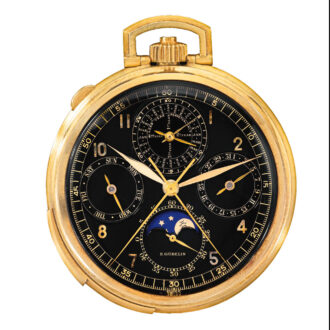
Swiss repeater with retrograde date and moon phases Circa 1885
- Kenmerk
- AS1687
- Diameter
- 58 mm
- Estimate
- € 27.500 - 50.000
- Price sold
- € 40.950
Gold full hunter lever watch by LeCoultre
–
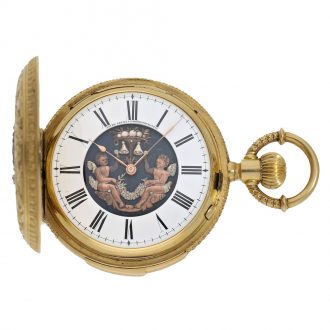
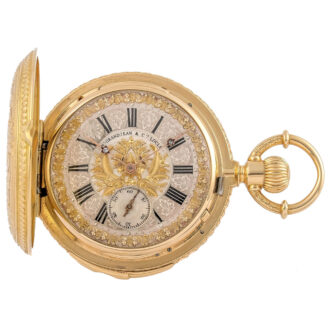
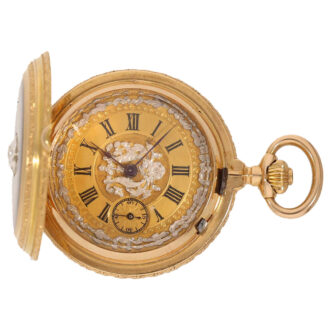
An impressive and rare Swiss gold hunting-cased keyless lever minute repeating watch with triple calendar, retrograde date, and moon phases, circa 1880–1892. The case was made by Bapst & Falize, Paris. This watch features a gilded, highly jewelled lever movement with wolf’s tooth winding, a bimetallic compensation balance, and snail-form precision regulation. The dial is white enamel with Roman numerals, an outer Arabic minute ring, a sector for the retrograde date, and three apertures for day, month, and moon phases.
–
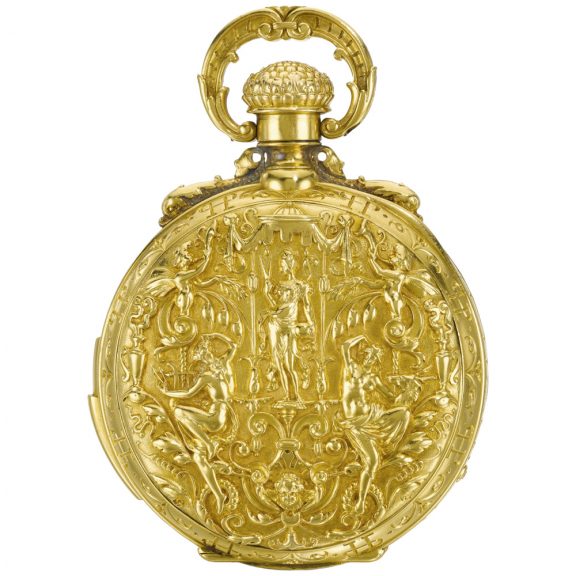
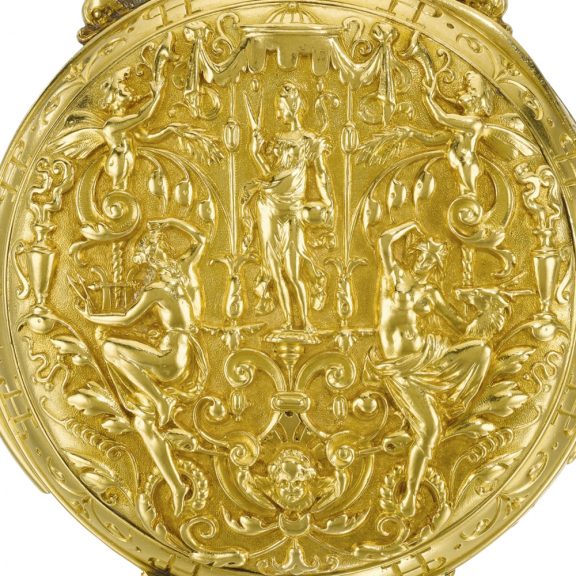
The gold case has repoussé covers chased and engraved in Renaissance style. The front cover depicts Chronos standing atop a globe, surrounded by three partially draped figures of the Fates: Lachesis, Atrophos, and Chlotos, holding skeins of wool with two pendant love trophies below. The back cover is similarly decorated with Apollo and Diana. The back bezel is engraved around its circumference with ‘qui temps a tout a PHP’, and the front bezel features a repeated monogram PHP separated by stylized flowers. The case back interior is engraved with the maker’s mark BF, a ring, and a pearl drop flanked by a stylized motto Adamas Margarita and further signed around the perimeter LeCoultre Horloger à Genève and Bapst & Falize Orfèvres à Paris.
–
Diameter: 57.5 mm
–
Signed: Lecoultre, Genève, and Bapst & Falize, Paris
–
The movement is fully wound but not running. The hand-setting adjusts correctly. There is a hairline within the subsidiary seconds dial on the dial, but otherwise, it appears to be in good overall condition. The case is impressive, with some light rubbing and a slight loss of definition.
–
The watch case likely matches the one depicted in Henri Vever’s, French Jewellery of the Nineteenth Century (2001, p. 988). The caption describes a chased gold watch featuring ‘the three Fates’ on one side and ‘Apollo and Diana’ on the other, designed by Lucien Falize and chased by Oms (1882). This case clearly shows Lucien Falize’s inspiration, drawn from classical Renaissance designs. Between 1880 and 1892, Germain Bapst and Lucien Falize merged their respective houses, with Bapst being jewellers to the French crown and having a significant client base, and Falize contributing his considerable design talent and business acumen. After a 12-year collaboration, the partnership dissolved in 1892. Bapst pursued academic interests, while Falize continued to manage the jewellery business.
Signed: Lecoultre, Genève, and Bapst & Falize, Paris
Share this page: