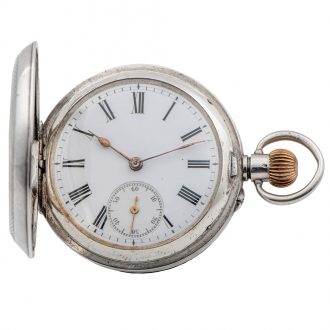
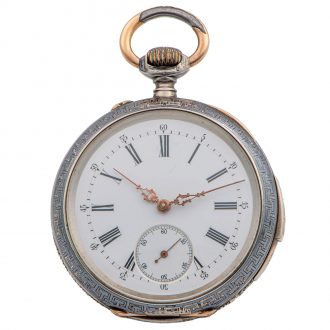
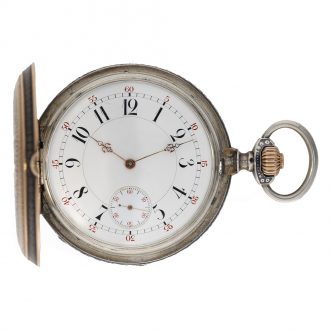
Swiss silver technically interesting split seconds chronograph Circa 1890
- Kenmerk
- HC1214
- Diameter
- 54 mm
- Estimate
- € 1.500 - 3.500
- Price sold
- € 2.600
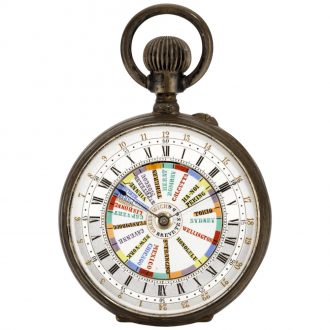
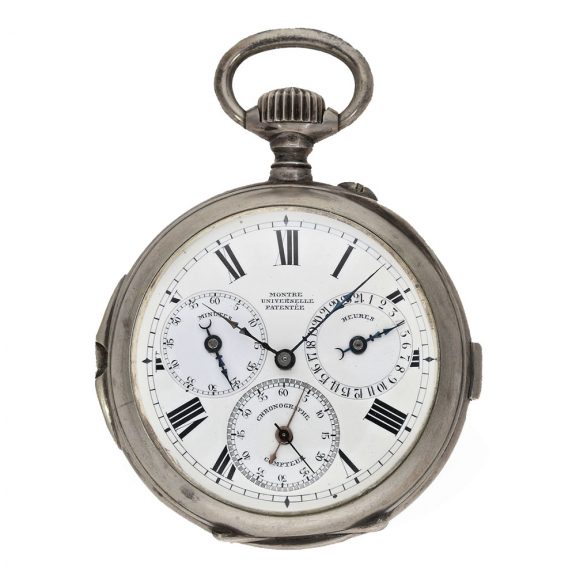
Pocket watch “Montre Universelle” with interesting dial
–
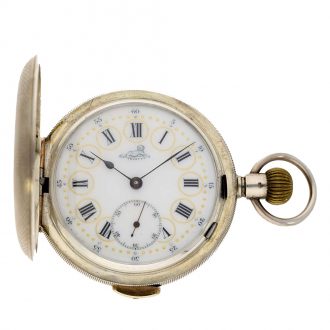
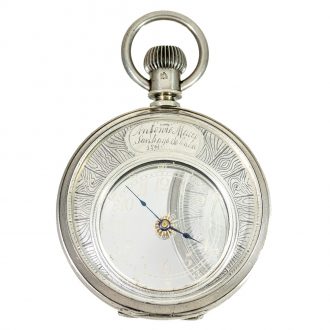
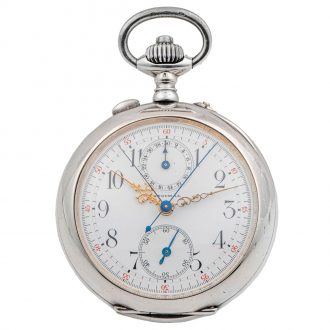
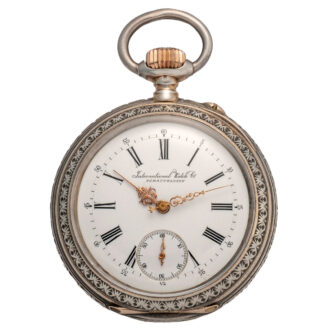
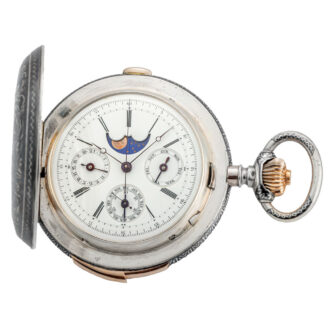
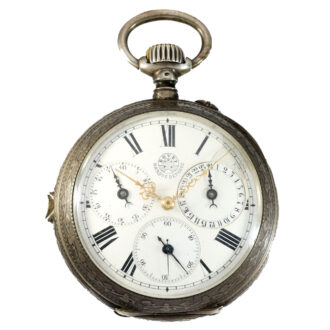
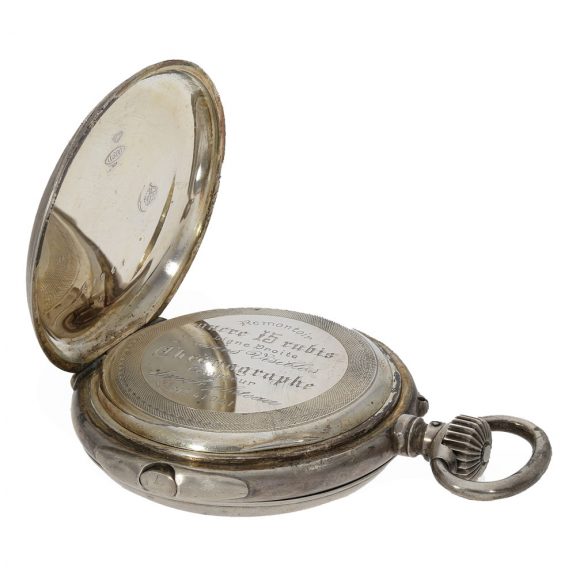
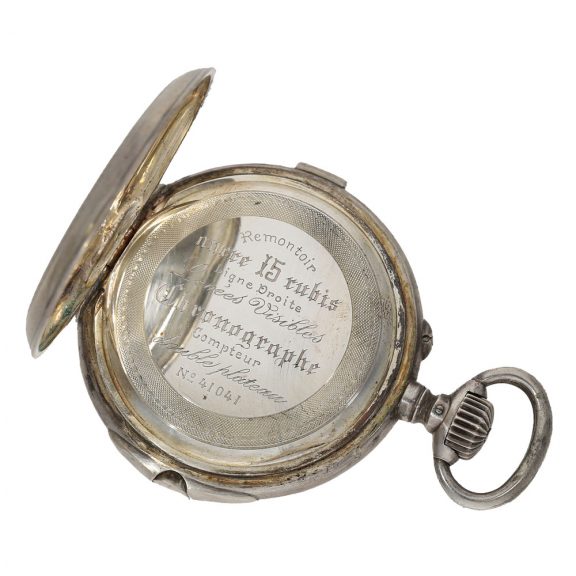
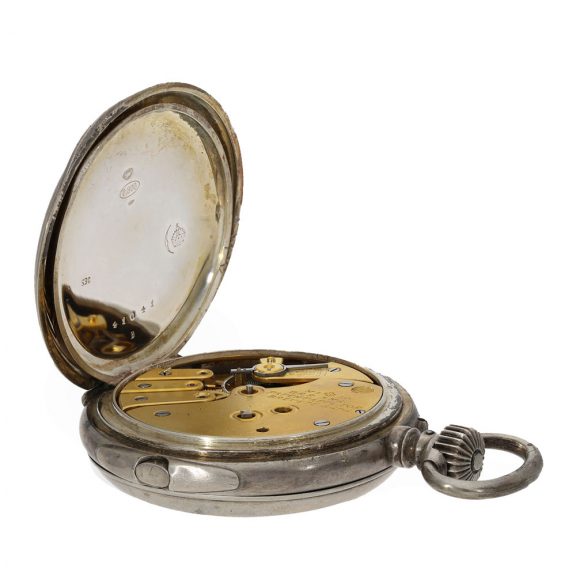
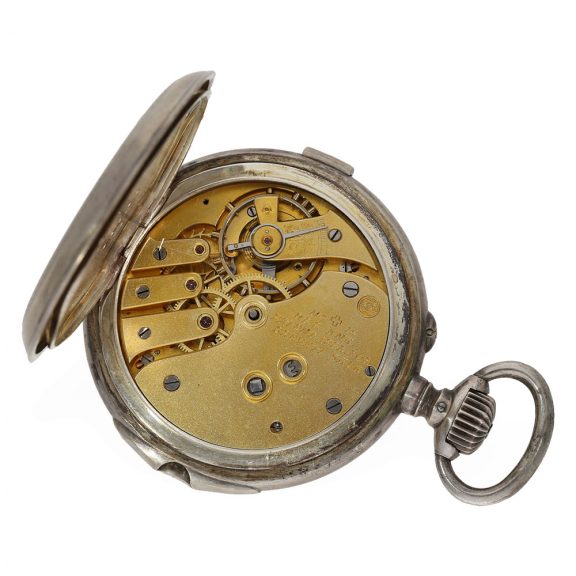
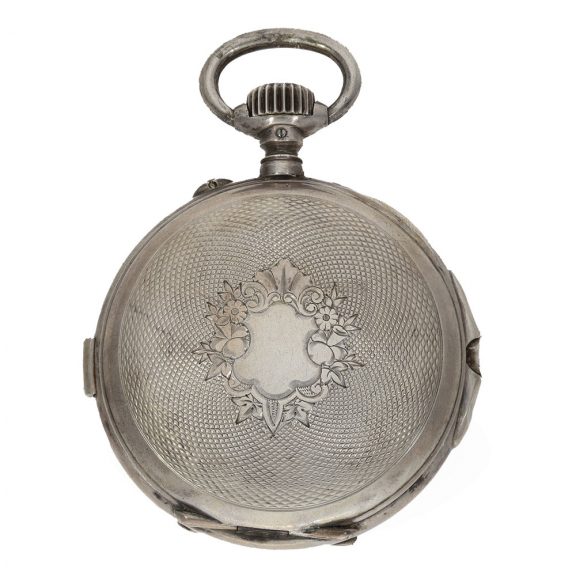
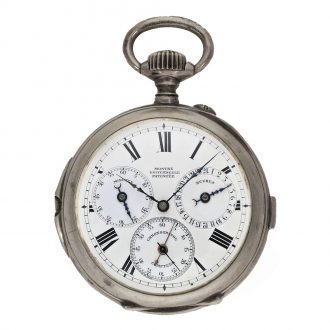
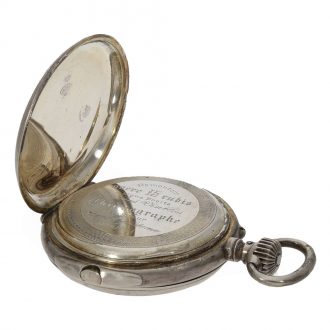
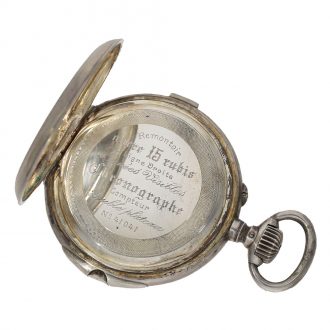
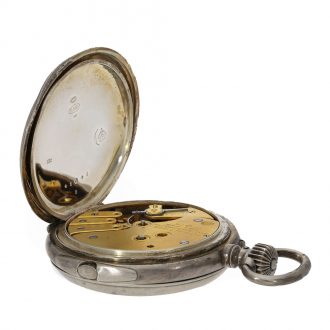
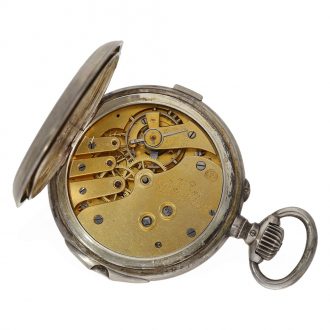
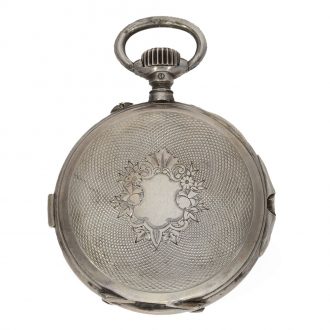
A technically interesting split seconds chronograph “Montre Universelle”, made by Hermann Oskar Bovet in Bienne, Switzerland, circa 1890. The numbered case of this watch is crafted from silver, has an engine turned back with an empty cartouche in the center and the cuvette is inscribed with details of the movement. The case also has a pusher on the right side to start and stop and a pusher on the left side to reset. The white enamel dial is marked Montre Universelle Patentée, has Roman hour numerals, subsidiary dials for 24 hours, counting seconds and minutes and the minutes at respectively 3, 6 and 9 o’clock and blued steel hands. The patented movement has 15 rubies, a strait line lever escapement and a split seconds chronograph.
Case and cuvette have matching numbers and movement is signed.
–
Diameter: 54 mm
–
Weight: 119 g
–
Signed: Hermann Oskar Bovet, Bienne
–
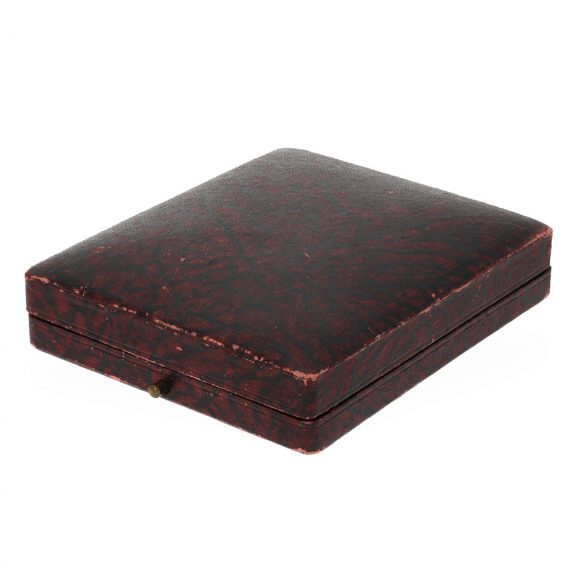
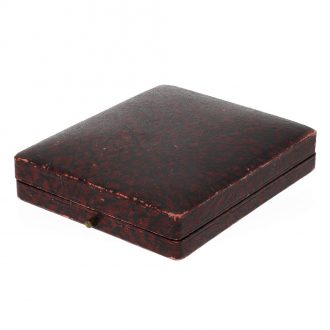
This chronograph was considered remarkable in its time and the patent was filed in 1888. The watch comes in a sales box from Becker, a jewelry in Hamburg, Germany.
–
Bovet
Swiss watchmaker Hermann Oskar Bovet, mostly known as Hermann was born in Bienne (Biel) and baptized on September 26, 1848. He was the son of Friederich Bovet (also called Fritz) and Euphrasie Bourquin. Friederich Bovet founded F. Bovet & Cie in Bienne’s “new quarter”. Friederich Bovet is often confused with Frédéric Dit Fritz Bovet (1824-1913), the son of Charles Alphonse Bovet. Hermann Oskar Bovet took over in 1888 the company F. Bovet & Cie. and was located at Zentralstrasse 13 in Bienne.
–
Hermann Oskar Bovet specialized in the production of chronographs and stopwatches. He received an Imperial Patent No. 46073 class 83 in the German Empire on June 5, 1888, for a chronograph construction. The patent for the United Kingdom No. 11625 was granted on August 11, 1888, as was the early Swiss Patent No.12, A Swiss Patent No.12. This was followed by U.S. Patent No. 396,914 on January 29, 1889. In October 1889, Hermann Bovet received another Swiss patent with the No.1527 for a “Montre à double chronographe”. In addition to a watch factory, Hermann Bovet also owned a log splitter and sawmill in Biel, where a serious accident happened on May 18, 1887. The log splitter and sawmill were brought to court by Jakob Bühler.
–
Hermann Oskar Bovet died unexpectedly without descendants on May 6, 1891, in Bienne, at 42. Due to his age, the father, Friedrich Bovet, could no longer continue the business. Hermann Bovet’s business was closed by auction on September 28, 1891; even Hermann Bovet’s private legacy was up for sale.
–
Jewelry Becker
The legacy of Juwelier Becker – A story of resilience
On November 9, 1875, W. Becker & Co. Albert Becker opened a jewelry store at Niedernstraße 5 in Hamburg.
Jewelry BECKER, a company with a rich history, has faced numerous challenges over the years but has always emerged stronger and determined. Despite the devastation of World War II, BECKER was able to triple its store space, increase its sales and build a team of 50 employees in just a few years. Even after a serious fire at the headquarters in December 2005, a banner on the facade confidently proclaimed: “130 years of expertise and diversity will not be easily lost in the fire.”
–
After over 145 years in business and with the third generation at the helm, BECKER’s success is often attributed to its commitment to quality products and services, a wide range, expert advice and competitive prices. With a proven track record, BECKER is the first port of call for buying watches and jewelry in Hamburg.
Signed: Hermann Oskar Bovet, Bienne
Share this page: