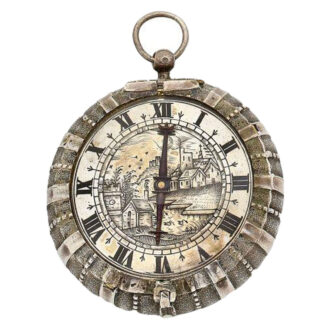
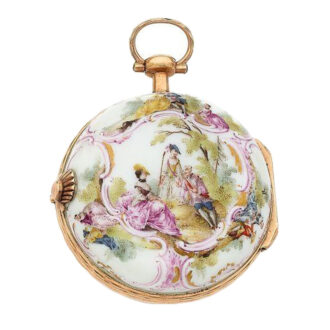
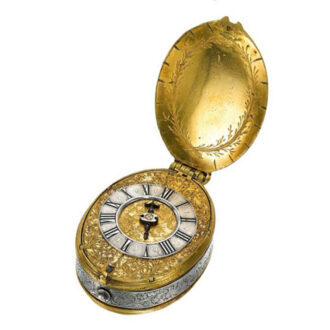
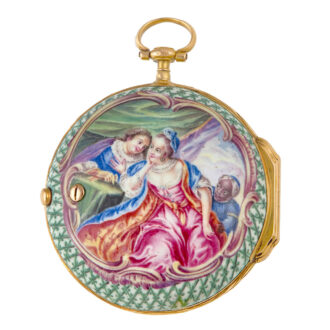
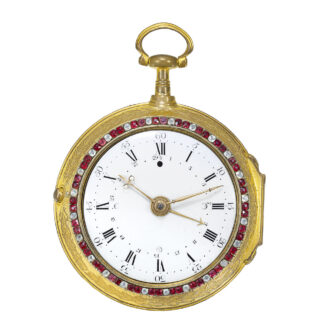
English astronomic made for the Chinese market Circa 1780
- Kenmerk
- TA2030
- Diameter
- 58 mm
- Estimate
- € 9.500 - 16.000
- Price sold
- € 10.050
Gilt-brass double-dialled pocket watch
–
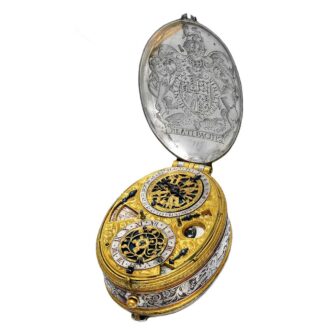
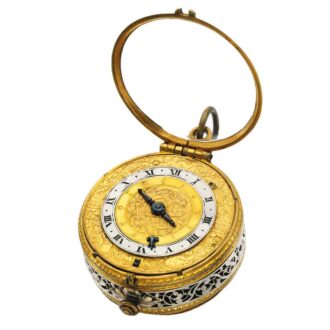
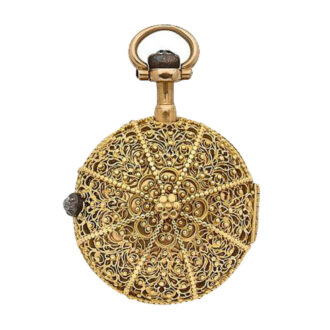
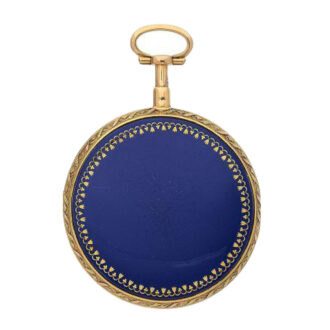
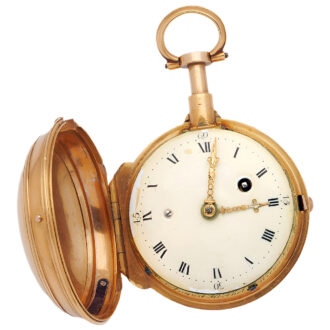
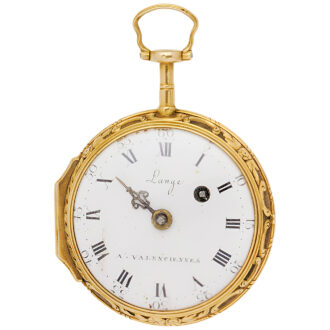
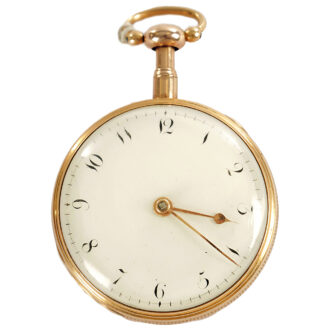
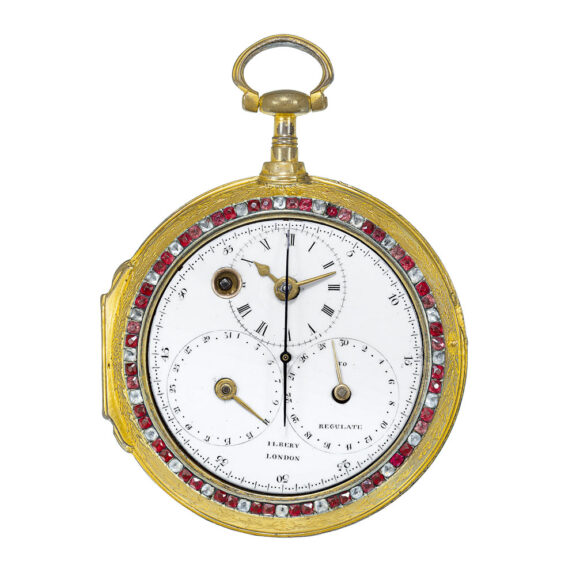
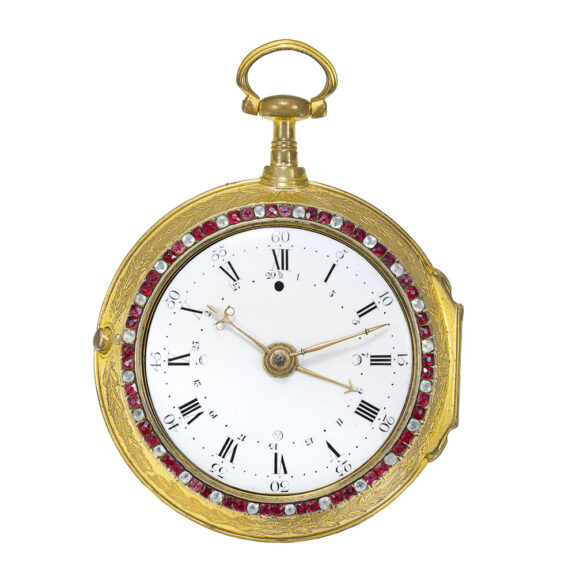
A fine and rare, gilt brass and paste-set, an astronomic, double-dialled pocket watch, circa 1780. With two independent mean time dials, centre seconds, calendar and lunar calendar with indications for the waxing and waning of the moon. Made for the Chinese market. The case has a foliate chased and engraved band, both sides glazed, the bezels set with red and white pastes. The first dial: white enamel, regulator-type, eccentric mean time dial with radial Roman numerals, outer minute track, outer seconds dial with a fifth of a second division and Arabic five-second numerals, subsidiary date and regulation dials.
–
The second dial: white enamel, radial Roman numerals, outer dot minute divisions and Arabic five-minute numerals, inner lunar calendar with symbols indicating the waxing and waning of the moon. Gold beetle and poker and spade hands, arrow hand for the lunar calendar. A gilt brass full plate movement with tapered cylindrical pillars, fusee with chain, verge escapement, three-arm steel balance, flat balance spring, regulation via the dial, seconds stop slide under the bezel. Dial signed.
–
Diameter: 58 mm
–
Signed: Ilbery London
–
William Ilbery (ca. 1760-1839) was active in London from 1780 in Goswell Street, he moved to Duncan Terrace towards the end of the 18th century. Following James Cox in London and Jaquet Droz in Switzerland, he also specialised in the production of luxury watches for the Chinese Market. His early production was very much in the English style, featuring a full plate movement and an English type single wheel duplex escapement. However, for his highest quality watches, he incorporated a spring detent escapement. Later, the watch movements he produced were much inspired by the Lepine calibre with a free-standing barrel, as were Jaquet Droz’s Swiss production signed in London and that of William Anthony, who worked in London. The cases of his watches were sumptuously decorated by the best Genevan enamelers, such as Jean-Francois-Victor Dupont, who usually signed his work, and Jean-Louis Richter, who signed rarely.
–
He organized the production in Switzerland, mainly in Fleurier, of profusely engraved movements for the Asian market. He was followed in this by makers such as Bovet and Juvet who also worked in Fleurier (Val de Travers). Ilbery can therefore be considered one of the most representative makers of Chinese watches. Does he seem to have maintained close contact with the continental trade since a watch was signed Ilbery Paris is known and Ilbery & Son are recorded in London and Fleurier.
Signed: Ilbery London
Share this page: