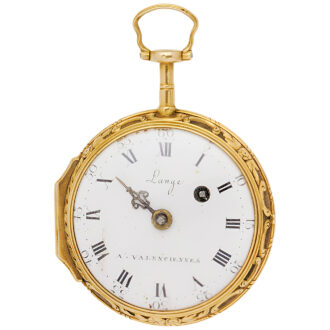
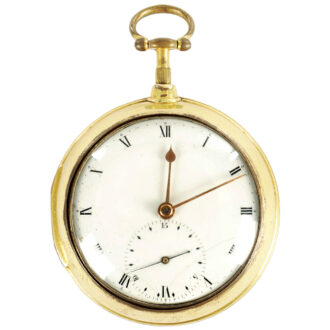
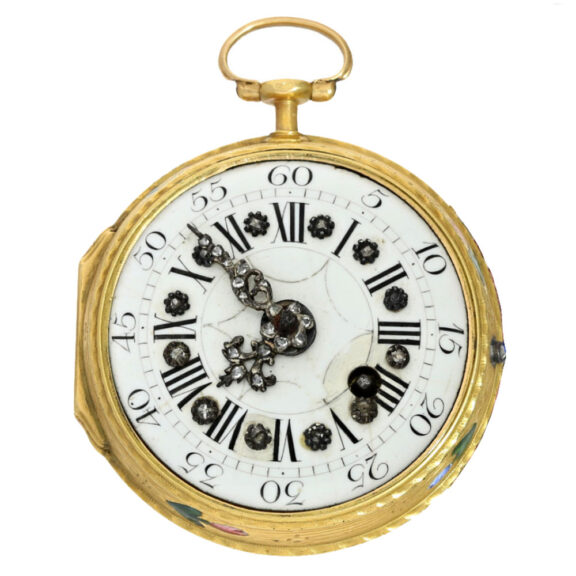
French 20 carat gold and enamel verge pocket watch Circa 1760
- Kenmerk
- CA0065
- Diameter
- 38 mm
- Estimate
- € 4.000 - 8.000
- Price sold
- € 3.700
Gold enamelled ladies’ watch
–
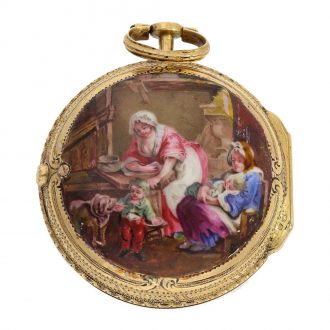
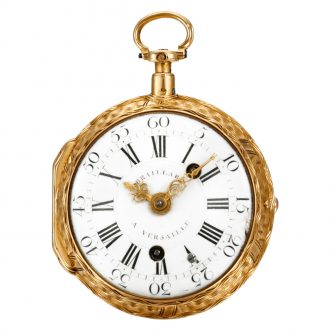
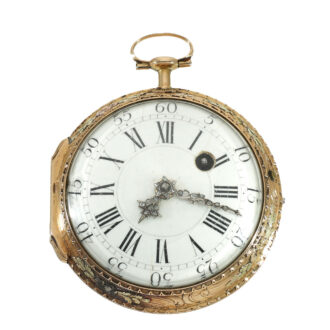
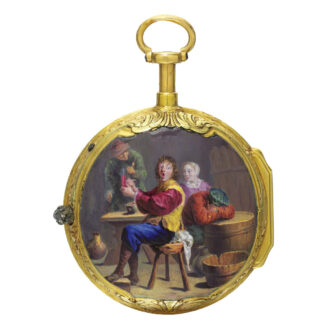
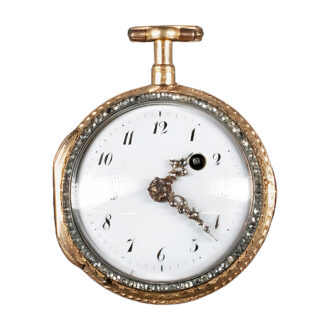
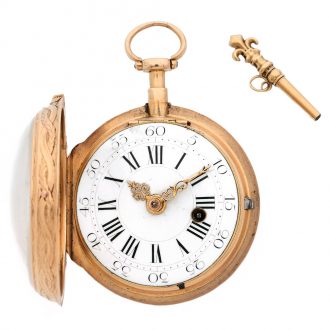
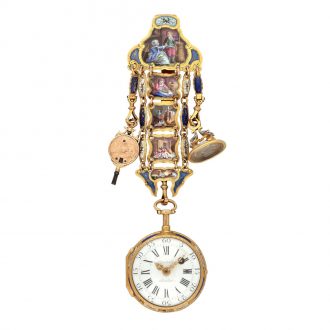
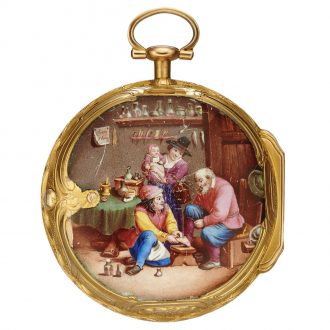
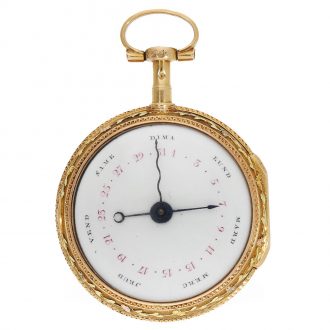
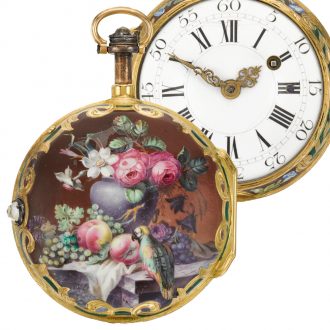
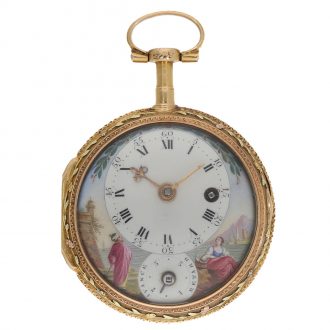
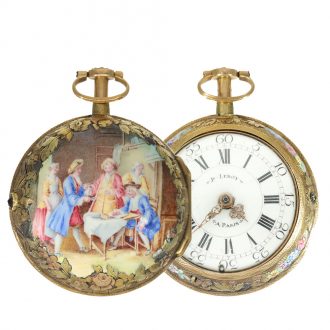
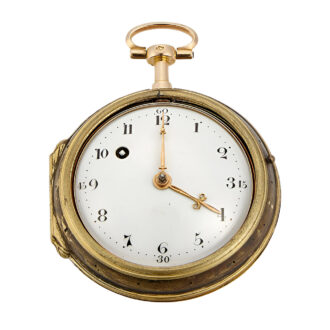
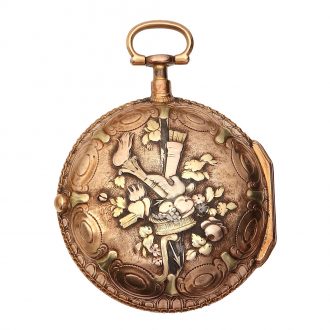
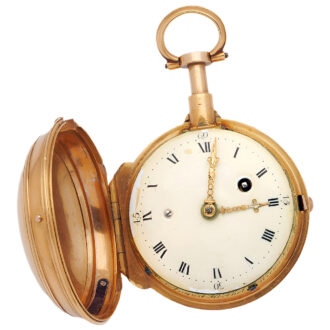
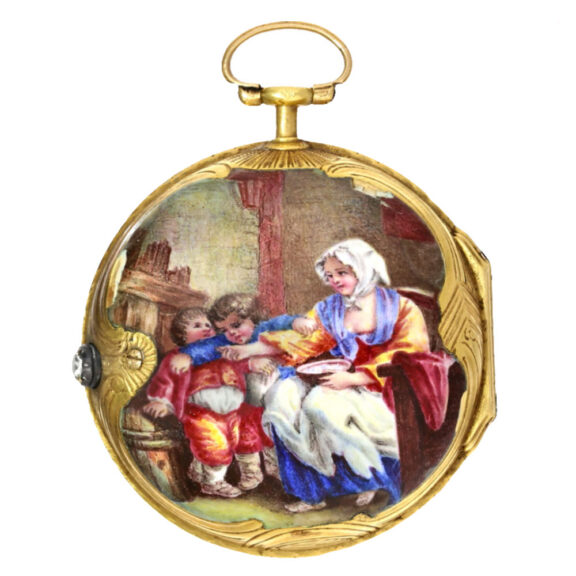
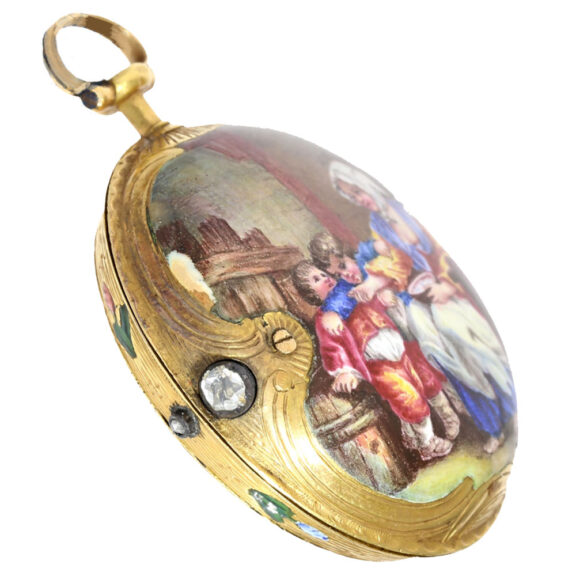
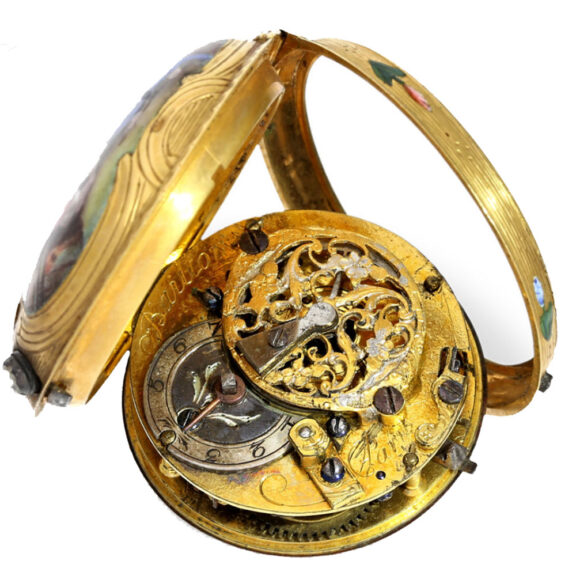
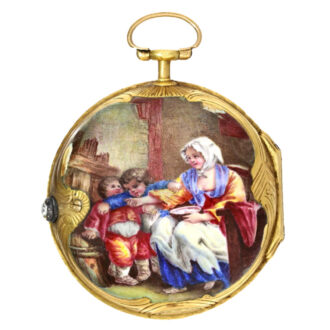
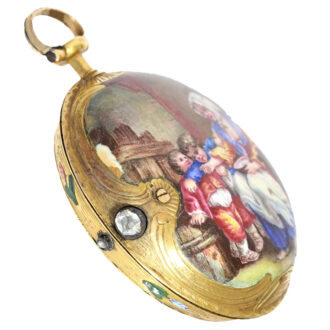
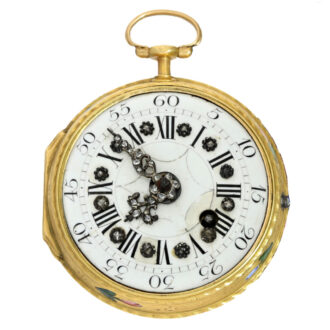
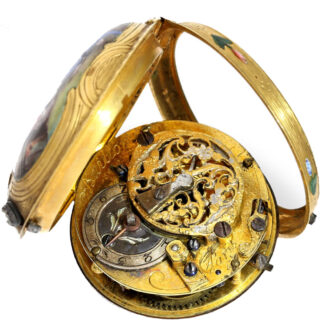
A French 20 carat gold and enamel open faced pocket watch made by Jean-Baptiste Baillon in Paris, circa 1760. The fire gilded full plate movement with a verge escapement, pierced and engraved cock, and silver regulator disc. White enamel dial with Roman hours, stone set half hour markers, an outer minute track, outermost Arabic five minute numerals and open work diamond set hands. The case back with a polychrome enamel kitchen scene depicting a mother and her two children, the opening button is set with a large diamond. Movement signed.
–
Diameter: 38 mm
–
Weight: 40 g
–
Signed: Baillon A Paris
–
Jean-Baptiste III Albert Baillon (de Fontenay) was one of the most skilled and innovative watchmakers of his day. As one of the most important watchmakers of the 18th century, he was no doubt the most famous member of an important horological dynasty. His father, Jean-Baptiste II, a Parisian maître and his grandfather, Jean-Baptiste I from Rouen, were both clock and watchmakers, as was his own son, Jean-Baptiste IV.
–
His success was largely due to his ability to organize a vast and thriving private factory in Saint-Germain-en-Laye, which was unique in the history of 18th century horology. It remained in use until 1765, when Baillon closed it. Renowned horologist Ferdinand Berthoud was impressed by its scale and the quality of the pieces produced.
–
Baillon supplied the most illustrious clientele, not least the French and Spanish royal family, the Garde-Meuble de la Couronne, as well as distinguished members of the Court and the cream of Parisian society.
–
He was received as a master watchmaker in 1727. In 1738, he secured his first important appointment as Valet de Chambre-Horloger Ordinaire de la Reine (Maria Leczinska, wife of Lodewijk XV). Sometime before 1748, he was made Premier Valet de Chambre de la Reine and in 1770, Premier Valet de Chambre and Valet de Chambre-Horloger Ordinaire de la Dauphine Marie-Antoinette. By 1738, he was established, appropriately, in the Place Dauphine, and after 1751 in the Rue Dauphine.
–
Baillon used only the finest cases and dials. The latter were supplied by Antoine-Nicolas Martinière and Chaillou, while his cases were supplied by Jean-Baptiste Osmond, Balthazar Lieutaud, the Caffiéris, Vandernasse, Edmé Roy and especially Jean-Joseph de Saint-Germain.
–
He achieved almost unprecedented success and became the richest watchmaker in Europe. At the time of his death on April 8th, 1772, his fortune was valued at 384,000 livres. His collection of fine and decorative arts was auctioned on June 16th, 1772, while his remaining stock, valued at 55,970 livres, was offered for sale on February 23rd, 1773. The sale included 126 finished watches, totalling 31,174 livres and 127 finished watch movements at 8,732 livres. His clocks, with a total value of 14,618 livres, included 86 clocks, 20 clock movements, seven marquetry clock cases, one porcelain clock case and eight bronze cases.
–
Today, one can admire Baillon’s work in some of the world’s most prestigious collections in Paris, Toulouse, Brussels, Florence, London and New York.
Signed: Baillon A Paris
Share this page: