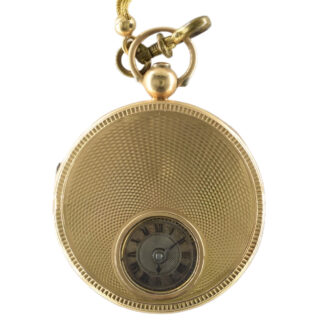
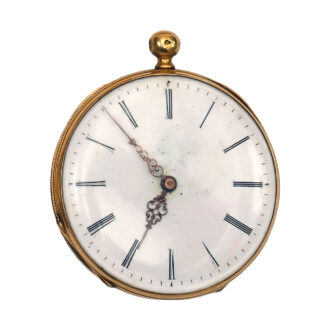
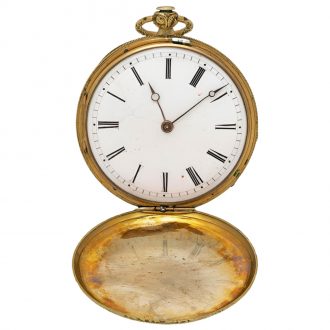
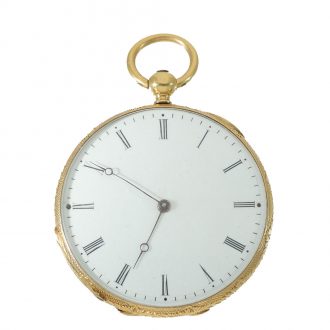
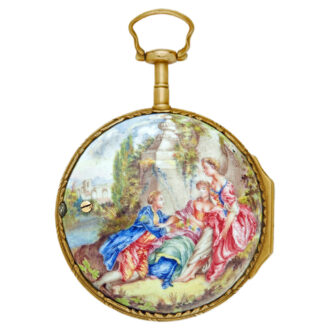
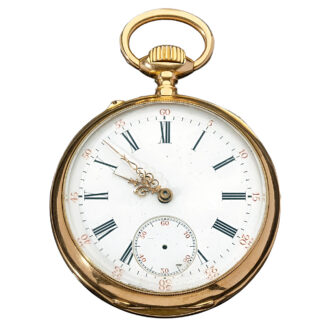
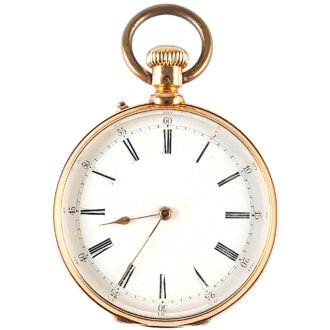
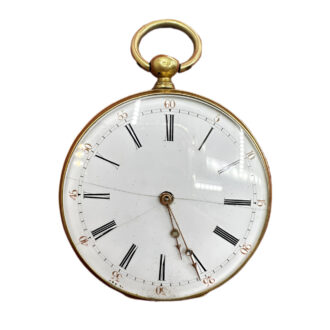
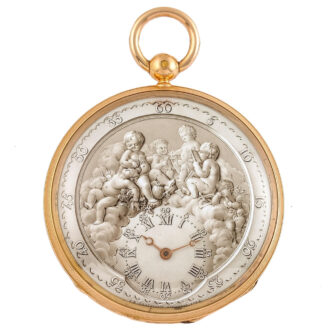
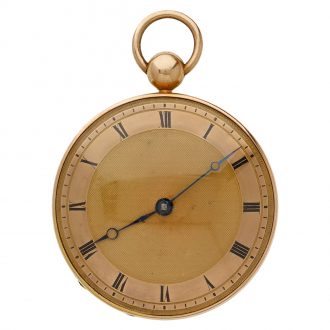
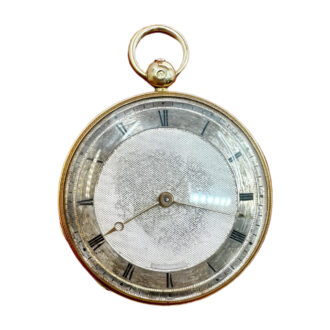
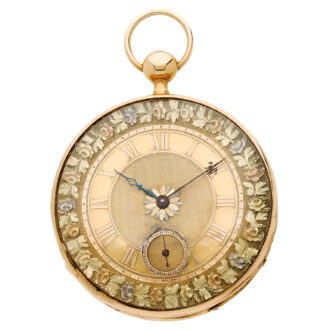
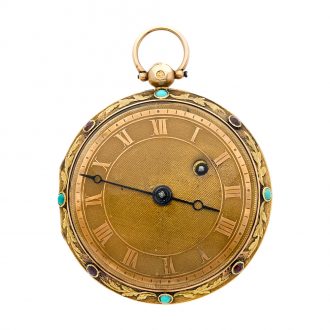
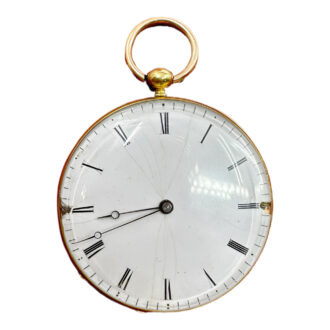
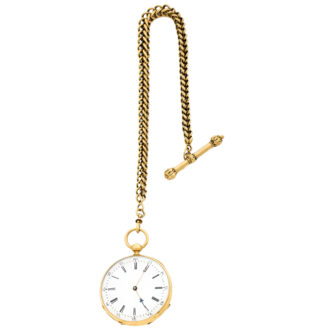
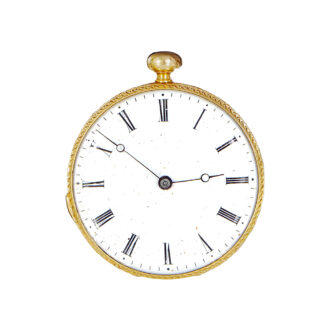
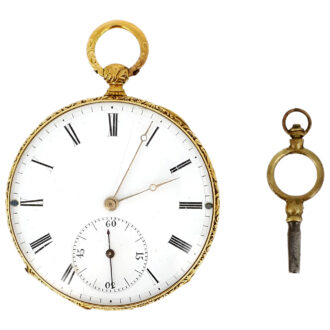
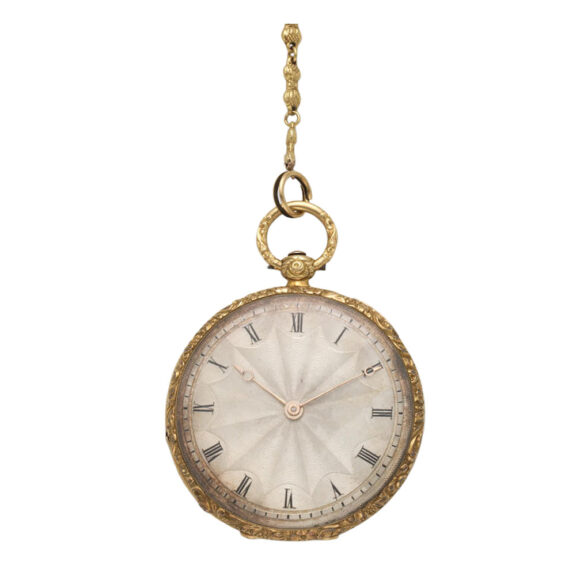
French 18 carat gold open face cylinder watch Circa 1850
- Kenmerk
- BB0396
- Diameter
- 38 mm
- Estimate
- € 1.250 - 2.000
- Price sold
- -
Gold open face pocket watch by Breguet & Fils
–
A French gold key wind pocket watch by Breguet & Fils, circa 1850. Cylinder movement, 3-arm balance. Guilloché engraved silvered dial, black Roman numerals, black outer minute track and gilt Breguet hands. 18 Carat engine turned hinged open face case, foliate engraved bezels. Signed cuvette. With chain and key.
–
Diameter: 38 mm
–
Signed: Bregeut & Fils
–
Abraham-Louis Breguet is born on 10 January 1747 in the Swiss town Neuchâtel (German: Neuenburg, formerly: Neufchâtel), which then belongs to the Kingdom of Prussia.He completes an apprenticeship with his stepfather Joseph Tattet in Neuchâtel and from about 1763 in Versailles.He then works in Paris, probably with Ferdinand Berthoud and Jean Antoine Lépine, before he opens his own workshop there in about 1775. Initially the focus is on the finissage of foreign ebauche movements, but soon follows the production of pocket watches with his own movements, in the style of Lépine.In 1784 he is accepted into the guild as a master watchmaker and in 1785 he becomes purveyor of King Louis XVI. After the beginning of the revolution, in 1793, Breguet fled from France back to Neuchâtel. During a stay in London, contacts were made to the chronometer maker John Arnold, from which developed a friendship. In 1795 he returned to Paris.In 1808 his son Louis enters the firm as a partner and continues it after Breguet’s death. Since then the manufacture is named „Breguet et fils“.
–
A French gold key wind pocket watch by Breguet & Fils, circa 1850. Cylinder movement, 3-arm balance. Guilloché engraved silvered dial, black Roman numerals, black outer minute track and gilt Breguet hands. 18 Carat engine turned hinged open face case, foliate engraved bezels. Signed cuvette. With chain and key.
–
Diameter: 38 mm
–
Signed: Bregeut & Fils
–
Abraham-Louis Breguet is born on 10 January 1747 in the Swiss town Neuchâtel (German: Neuenburg, formerly: Neufchâtel), which then belongs to the Kingdom of Prussia.He completes an apprenticeship with his stepfather Joseph Tattet in Neuchâtel and from about 1763 in Versailles.He then works in Paris, probably with Ferdinand Berthoud and Jean Antoine Lépine, before he opens his own workshop there in about 1775. Initially the focus is on the finissage of foreign ebauche movements, but soon follows the production of pocket watches with his own movements, in the style of Lépine.In 1784 he is accepted into the guild as a master watchmaker and in 1785 he becomes purveyor of King Louis XVI. After the beginning of the revolution, in 1793, Breguet fled from France back to Neuchâtel. During a stay in London, contacts were made to the chronometer maker John Arnold, from which developed a friendship. In 1795 he returned to Paris.In 1808 his son Louis enters the firm as a partner and continues it after Breguet’s death. Since then the manufacture is named „Breguet et fils“.
Signed: Breguet & Fils
Share this page: