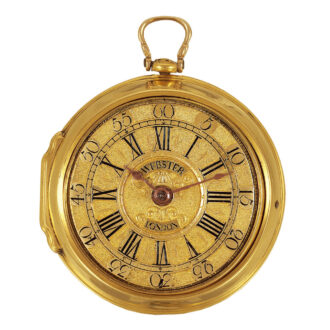
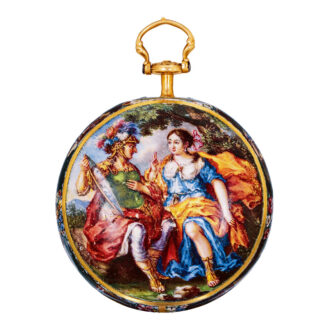
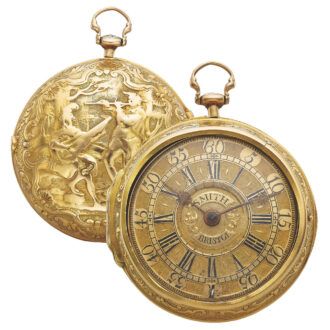
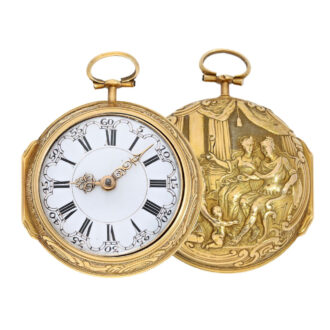
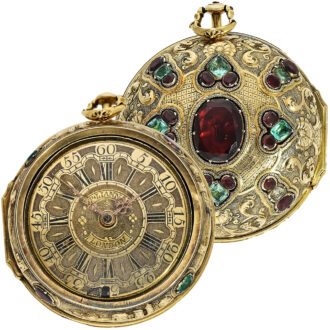
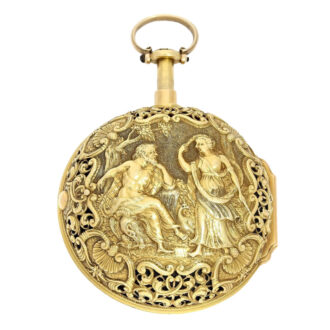
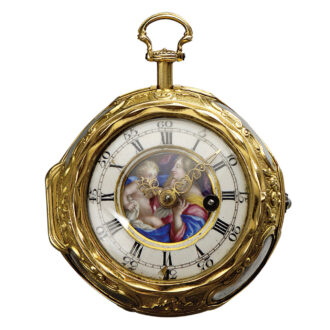
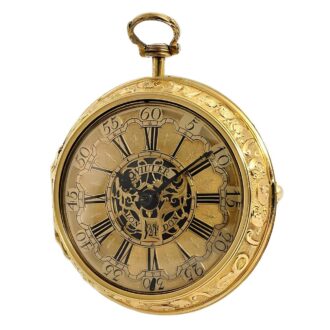
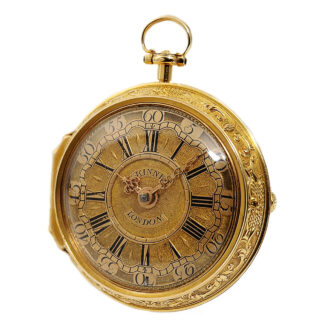
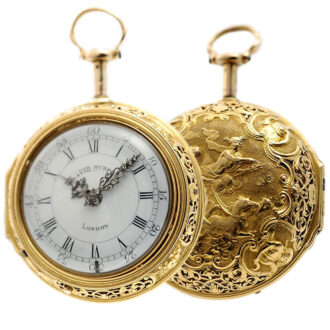
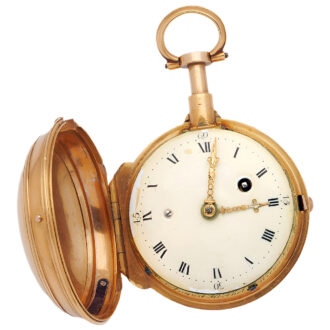
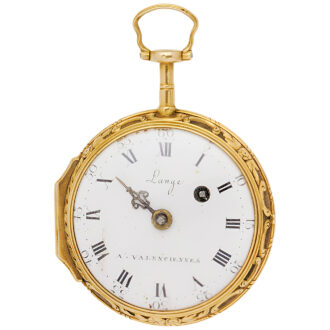
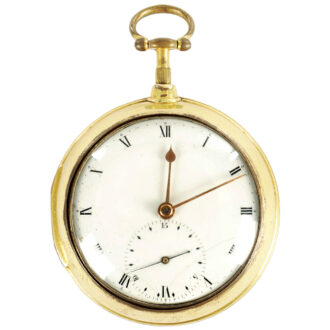
English early gold dumb quarter repeating watch Circa 1730
- Kenmerk
- SA0121
- Diameter
- 47 mm
- Estimate
- € 7.500 - 12.500
- Price sold
- -
Gold open faced dumb quarter repeating cylinder
–
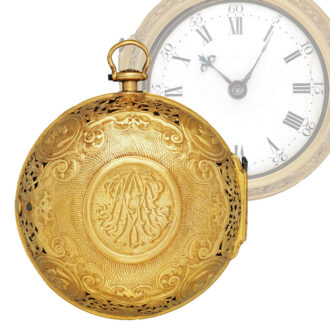
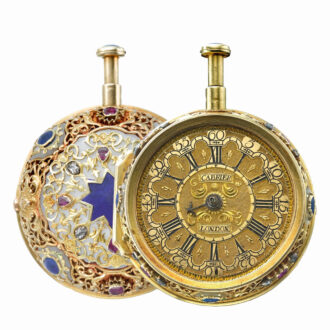
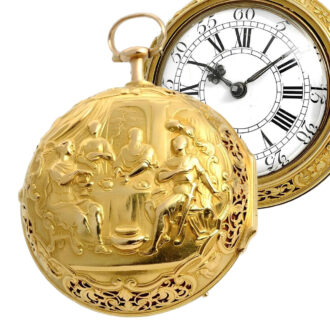
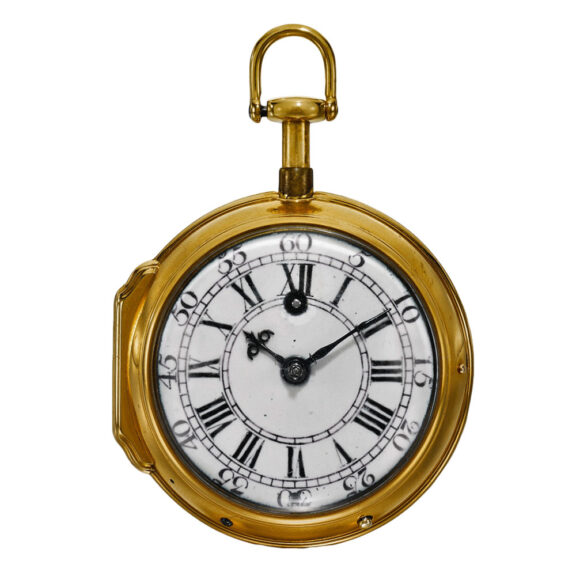
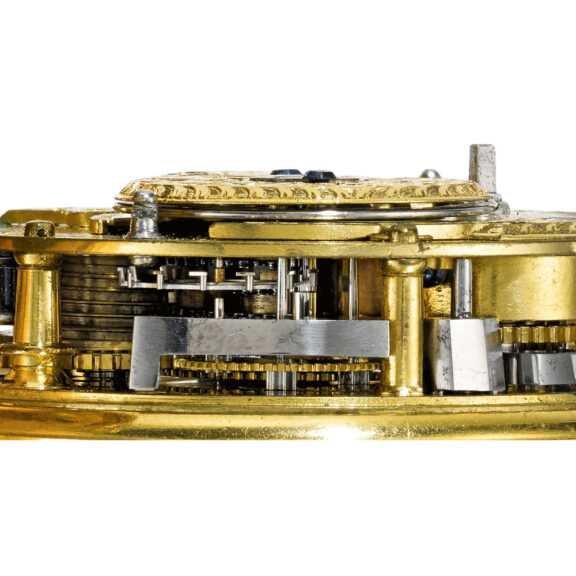
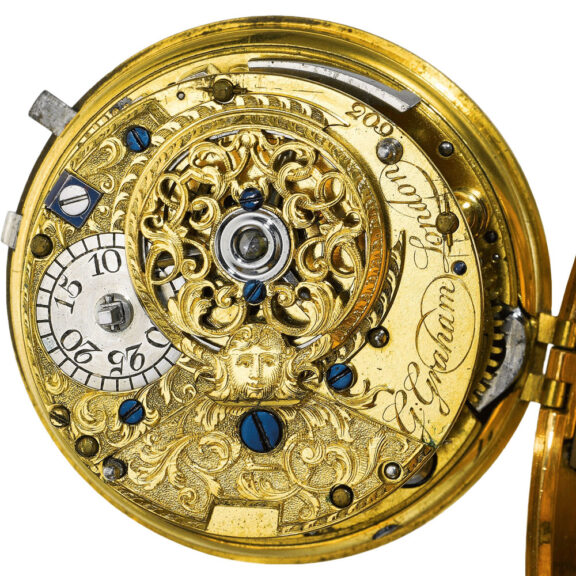
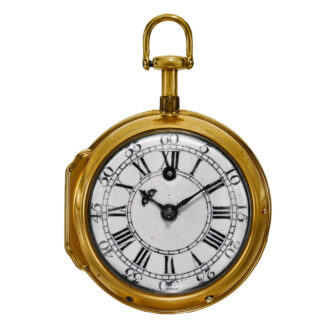
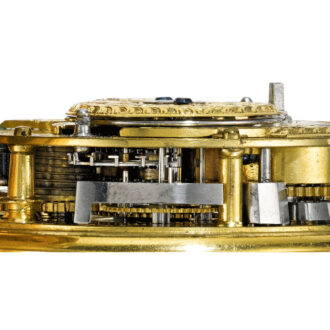
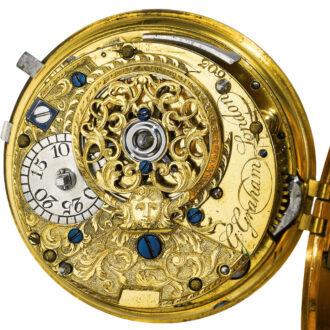
An English unusual and early gold open faced dumb quarter repeating cylinder watch of small size, circa 1730. Gilded full plate movement, cylinder escapement with steel wheel, balance cock pierced and engraved with foliate scrolls and a mask at the neck, diamond endstone, fusee and chain, cylindrical pillars, the hammers striking the inside of the gilt metal dust cap, the dust cap signed Geo. Graham London and scratch numbered beneath, the movement signed George Graham London.
Restored white enamel dial with Roman numerals, outer Arabic minute ring and blued steel beetle & poker hands, winding through the dial. The case back is centred by a large decorative intertwined and reversed monogram EJW within a circular border, signed ram F, pulse piece to the bezel at 5 o’clock, maker’s mark JW incuse beneath a star for John Ward and numbered
–
Diameter: 47 mm
–
Signed: George Graham London
–
George Graham was born on July 7th, 1673, maybe 1675 in Kirklinton, Cumberland and he died on November 16th, 1751. He was an English clockmaker, inventor and geophysicist, and a Fellow of the Royal Society. Further a Quaker like his mentor Thomas Tompion, Graham left Cumberland in 1688 for London to work with Tompion. He later married Tompion’s niece, Elizabeth Tompion. Graham is credited with inventing several design improvements to the pendulum clock, inventing the mercury pendulum and also the orrery, a mechanical model of the Solar system that illustrates or predicts the relative positions and motions of the planets and moons. He was made Master of the Worshipful Company of Clockmakers in 1722. Between 1730 and 1738, Graham had as an apprentice Thomas Mudge who went on to be an eminent watchmaker in his own right and invented the lever escapement, an important development for pocket watches. Graham was introduced to John Harisson on the latter’s arrival in London and became a long-time advisor and supporter of Harrison’s work on a marine chronometer. He was also widely acquainted with practical astronomy, invented many valuable astronomical instruments, and improved others.
–
There remains some uncertainty as to when the first dumb quarter repeating watch was made. This watch clearly predates Julien Le Roy’s claim for priority of the invention and is certainly an early example of this form of repeating work. As there is no provision in the numbered case for a bell, it is apparent that this is not a later modification.
–
Montre à toc. A ‘dumb’ repeater watch in which a hammer strikes the inside of the case to produce a muffled sound. Invented by Julian Le Roy in 1740.
Signed: George Graham London
Share this page: