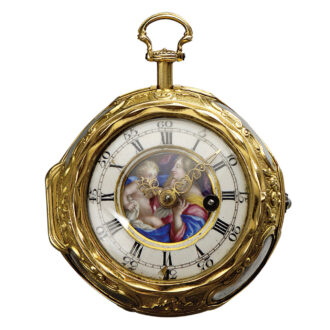
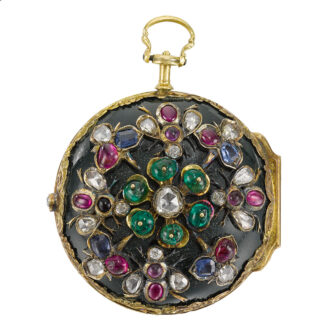
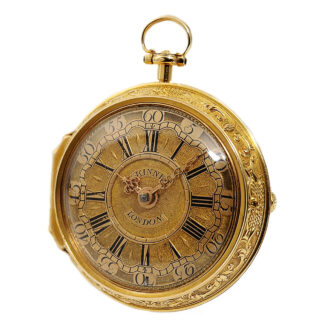
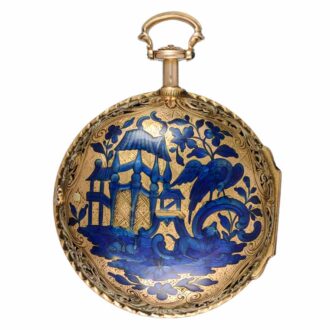
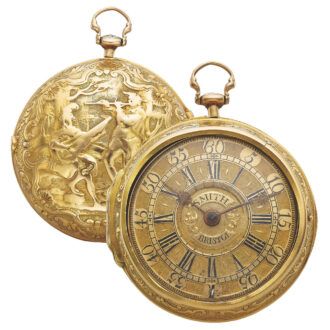
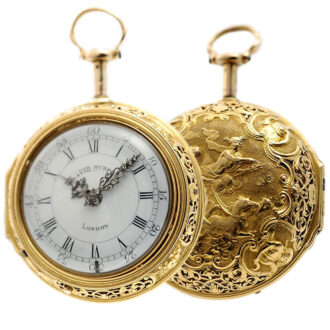
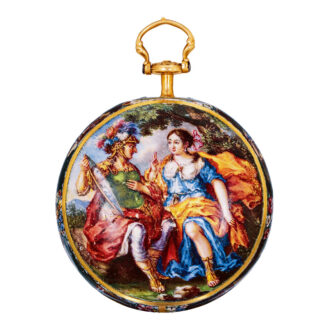
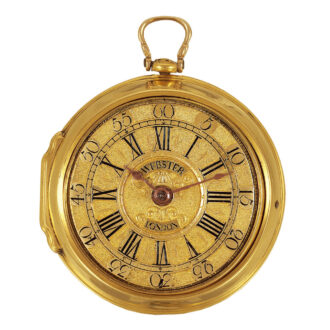
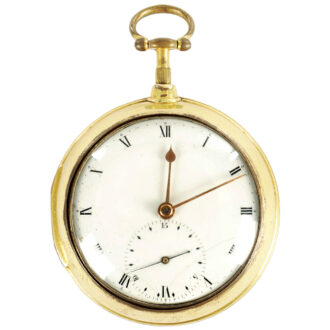
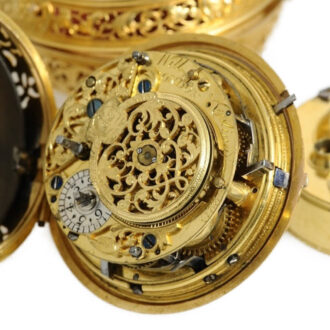
English repeating watch with outer Repoussé case Circa 1730
- Kenmerk
- AD4321
- Diameter
- 49 mm
- Estimate
- € 5.000 - 9.000
- Price sold
- € 4.650
Gold open faced pocket watch by William Kipling
–
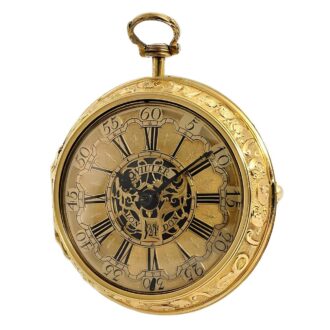
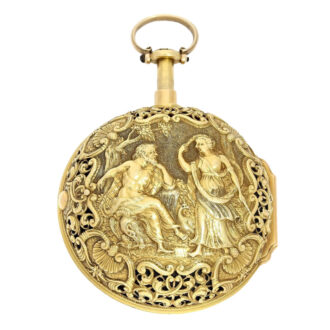
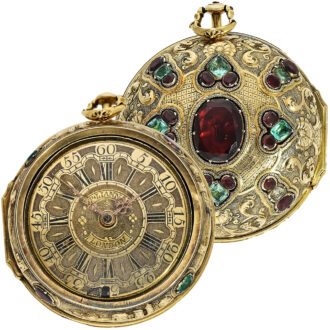
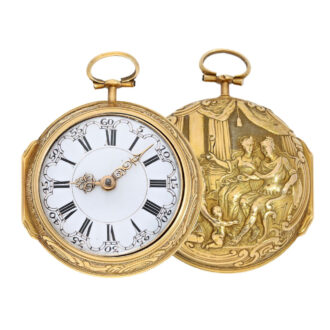
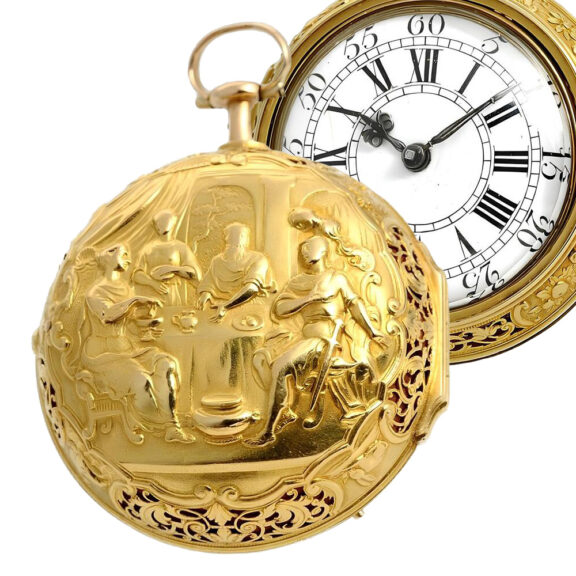
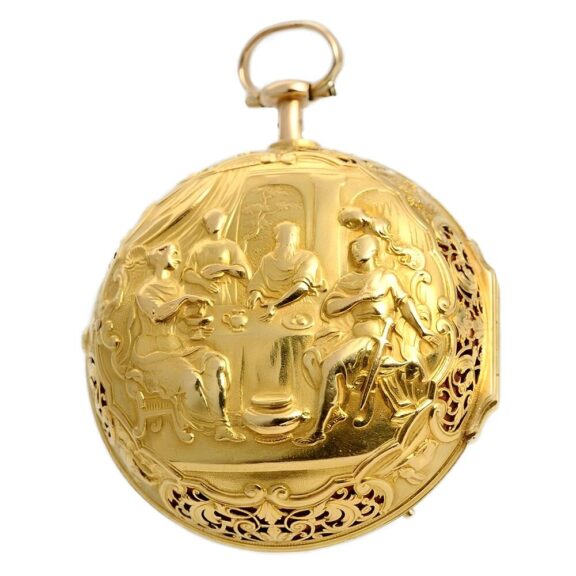
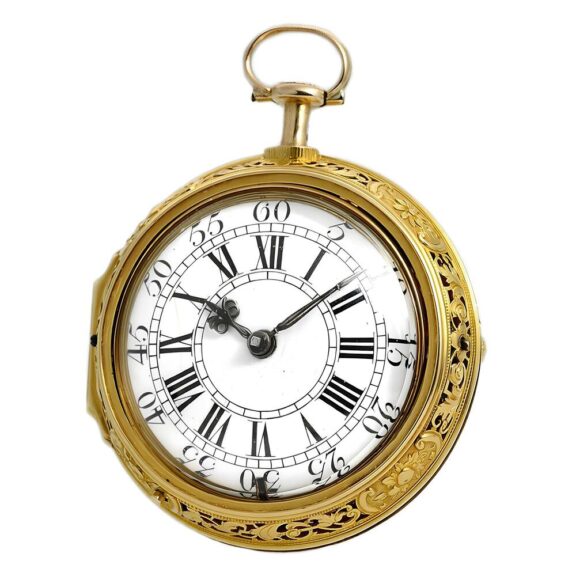
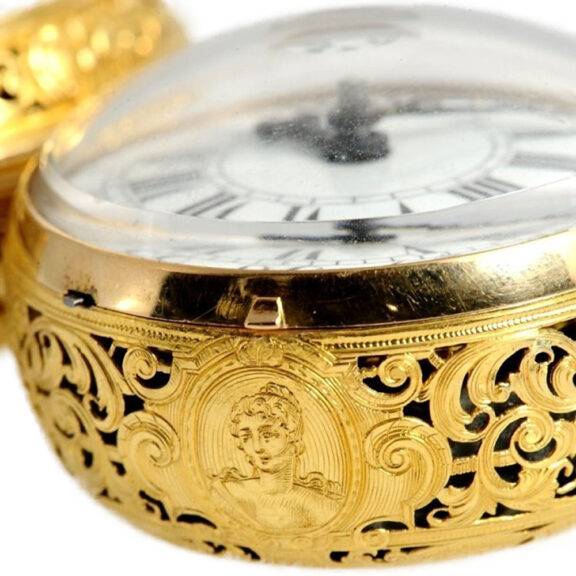
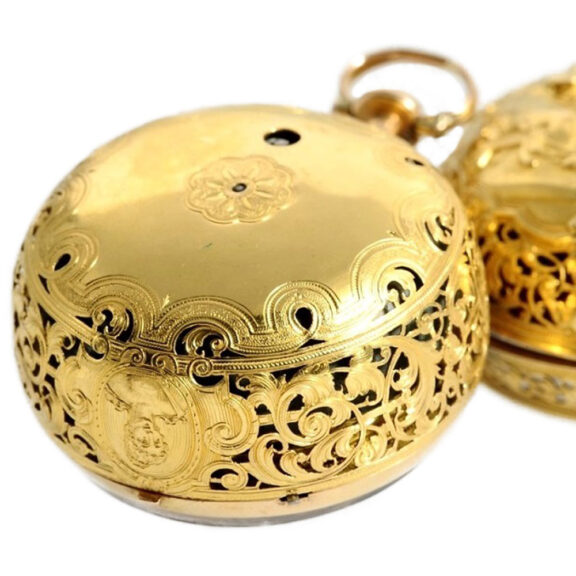
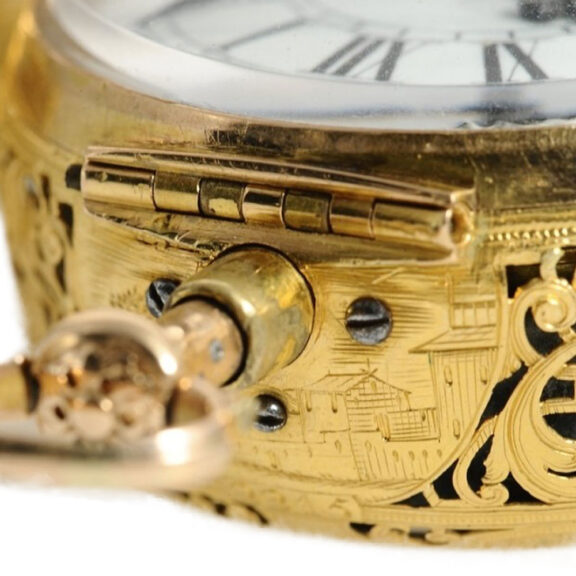
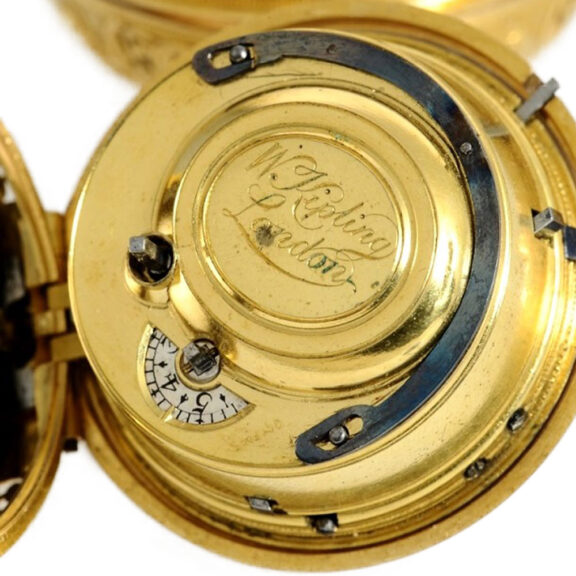
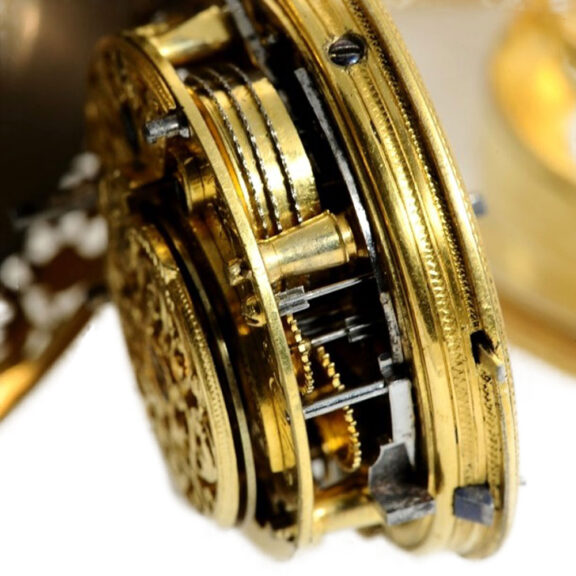
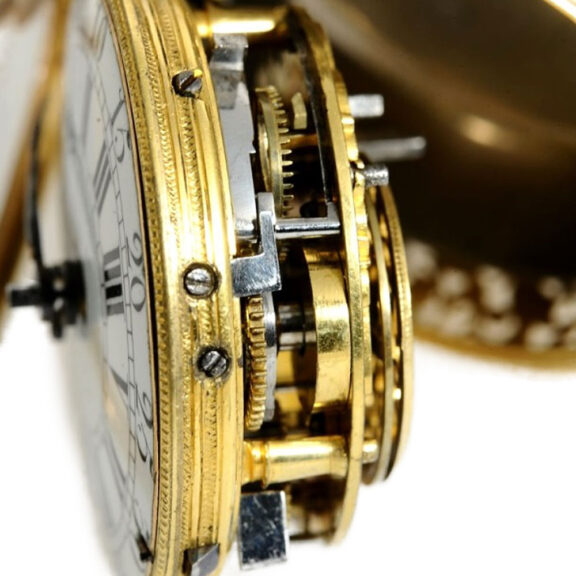
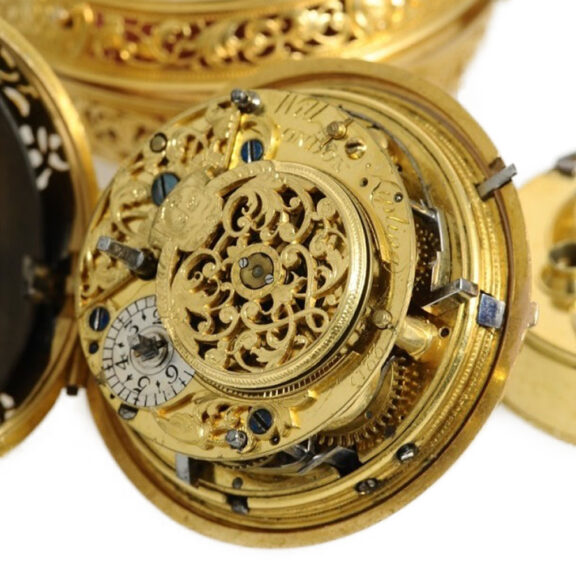
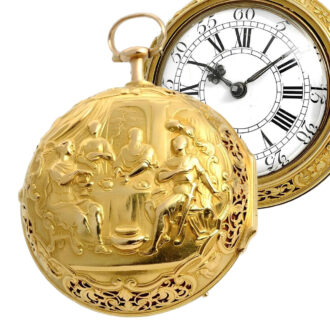
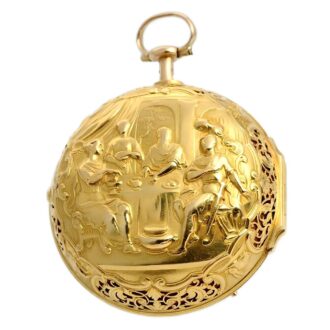
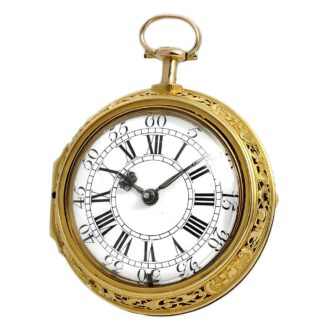
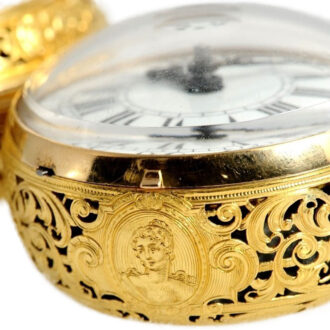
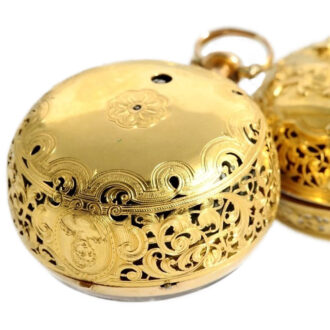
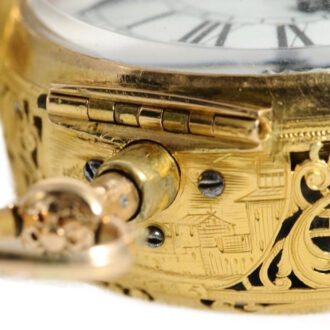
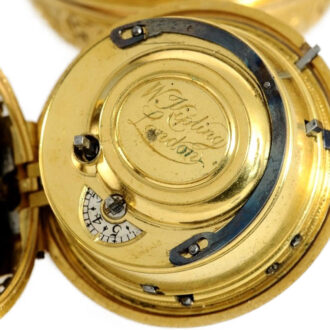
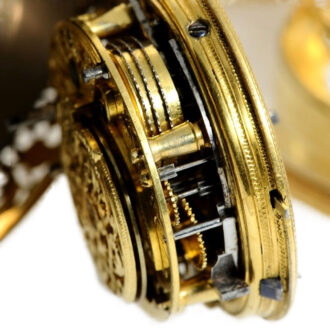
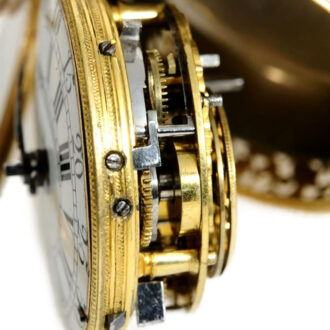
A fine English pair cased quarter repeating verge pocket watch with outer Repoussé case The Banquet of Antony and Cleopatra, circa 1730. The watch comprises two cases. The outer case is 22-carat gold and features floral piercing and engravings, vignettes and symbols for the four elements, a goutte, and a mythological Repoussé scene of The Banquet of Antony and Cleopatra. It also has a large lateral hinge. The inner case is also made of 22-carat gold and has a pierced and florally engraved border with foliate scrolls and medallions bearing an engraved portrait of a noble lady and a castle. It bears a signed movement protection cap and a bell. The dial is enamel and has radial Roman hour numerals, radial Arabic minute numerals, and blued steel, Poker and beetle hands. The movement is a full plate design, with a keywind mechanism with a fire gilt finish. It features applied floral decorations, a chain/fusee system, two hammers, baluster movement pillars, a three-arm brass balance, and a very finely engraved pierced balance cock adorned with a mascaron motif.
–
Diameter: 49 mm
–
Weight: 135 g
–
Signed: William Kipling, London
–
The Banquet of Antony and Cleopatra
There are numerous stories about Cleopatra, but one of the most well-known is the tale of her playful bet with Antony. It is said that Cleopatra wagered that she could spend ten million sestertii on a lavish dinner, which Antony accepted. However, when the dinner was served, it was a simple and unremarkable meal, causing Antony to mock her. Cleopatra then ordered a cup of strong vinegar for the second course, and to Antony’s surprise, she dropped one of her priceless pearl earrings into the cup. As the pearl dissolved in the vinegar, she drank it. Pliny the Elder, who lived about 100 years after the banquet, was the first person to report this story. Although calcium carbonate in pearls does dissolve in vinegar, it is a slow process, unless the pearl is first crushed.
–
William Kipling was a watchmaker who worked in Broad Street, near Ratcliff Cross, London, from 1705 to 1737. He continued to work until 1750. He was the son of Richard Kipling, a dealer in Romaldkirk, Yorkshire, and Jane Hutchinson. William was born in early 1681, and his father passed away in October of the same year. His mother remarried in 1690 and sent William to London. There, he became an apprentice to Thomas Johnson, a member of the Blacksmiths Company, in 1695. It is believed that Thomas Johnson was also a watchmaker. William finished his apprenticeship with Thomas Johnson and then took over the business. Later, he married Elizabeth Johnson, daughter of Thomas. William Kipling was also a member of the Blacksmiths Company and trained new watchmakers. He was not a member of the Clockmakers Company. William worked with his son, John Kipling, who was born in 1722 and died in 1750. Clocks with the signature William and John Kipling date from this period. After John’s death, William sold his business and retired. Charles Bosley took over the business. Clocks with the inscription Charles Bosley, successr. To Mr. Kipling. London was produced during this time. In addition to pocket watches, floor clocks, and lantern clocks, William Kipling made and sold.
Signed: William Kipling, London
Share this page: