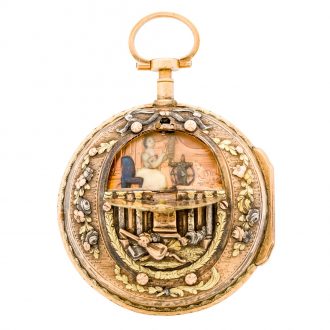
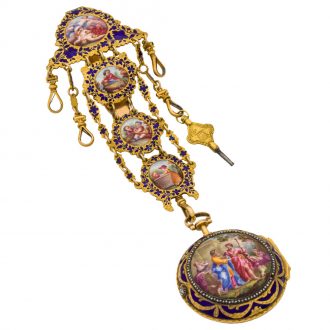
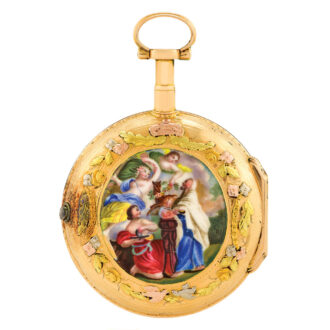
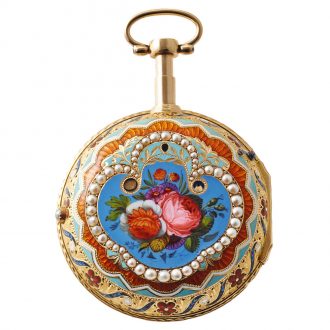
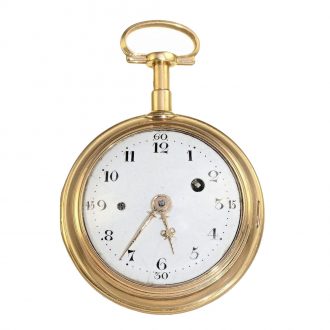
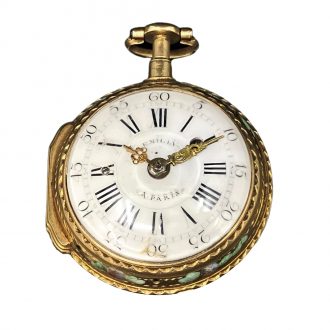
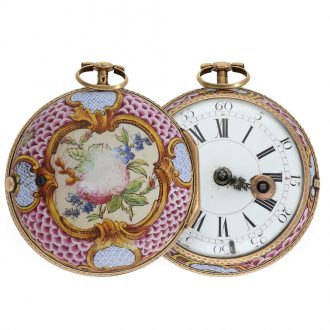
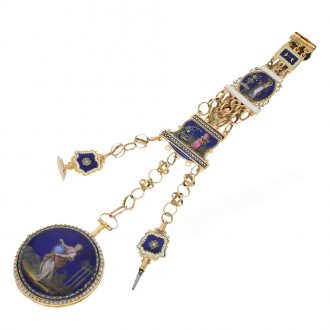
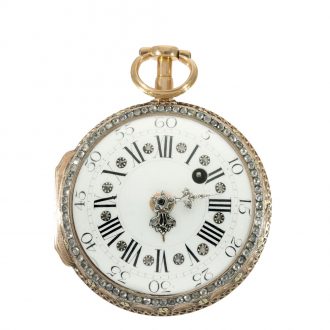
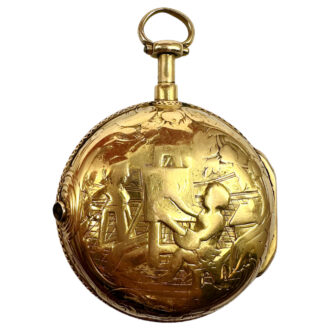
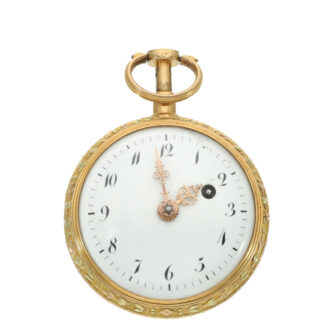
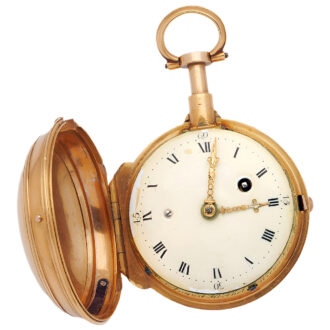
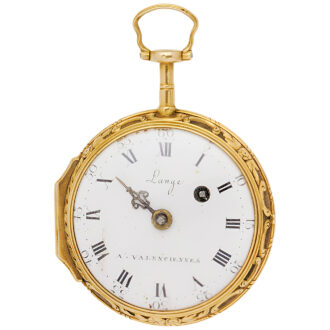
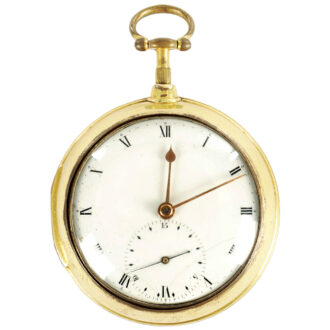
French gold, paste set open faced pendant watch Circa 1770
- Kenmerk
- BA0638
- Diameter
- 36 mm
- Estimate
- € 3.000 - 5.500
- Price sold
- € 2.950
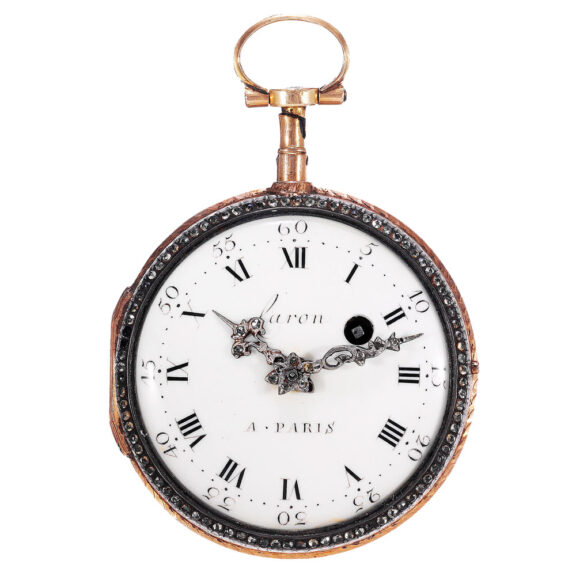
Gold and paste set glazed verge watch Caron à Paris
–
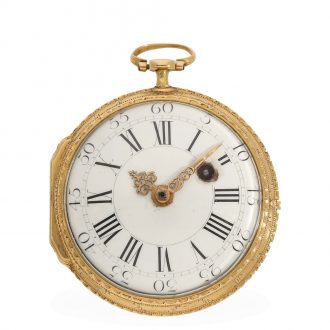
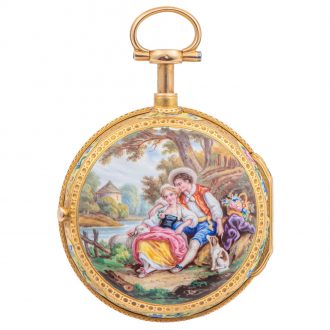
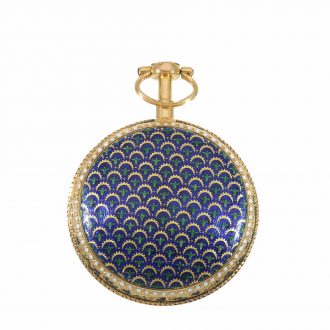
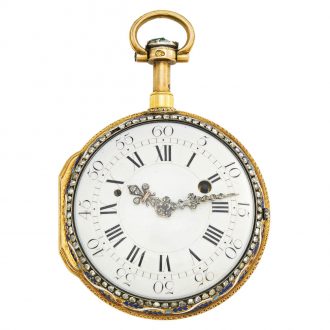
A very fine French gold and paste set open faced pendant watch with a painted on enamel portrait of a lady, circa 1770. Hinged, frosted and engraved gilt skeletonized plate movement with conical pillars, fusee and chain, verge escapement with micrometric potence adjustment, three armed brass balance with blued steel flat balance spring, index regulator on the edge, triangular single footed solid engraved cock, paste set silver filigree applied plate set with an oval painted on enamel portrait of a young lady wearing a pink dress and straw hat with a blue ribbon. White enamel dial with Roman numerals, outer dot minute divisions with five minute Arabic numerals and original paste set Louis XV hands. Louis XIV case, glazed on both sides, paste set bezels, band engraved with a repeated pattern. Dial signed.
–
Diameter: 36 mm
–
Signed: Caron à Paris
–
Pierre-Augustin Caron, born in Paris in 1732, apprenticed to his father André Charles, he was involved in the famous dispute with Le Paute over the invention of the double virgule escapement. –
Double Virgule Escapement. The double virgule escapement was the subject of one of the biggest horological scandals of 18th century France. In 1753, horloger du Roi, Jean-André Le Paute published a description of a new escapement for watches derived from the pin wheel escapement which had been used with great success in clocks. The new escapement, the details of which were given in Le Paute’s book, was called the ‘double virgule’ escapement. However, the 21 year old Pierre-Augustin Caron, son of another horloger du Roi, André-Charles Caron, wrote in an open letter to the Mercure de France that in July 1753 he had shown Le Paute the escapement, of his own invention, and that Le Paute had copied it and claimed it for his own. The affair caused such a stir that the matter was referred to the Academie Royale des Sciences and on March 4, 1754 they ruled in favor of Caron as the inventor. In December 1754, watchmaker Jean Romilly presented another version of the double virgule to the Academy, which that institution decided had been invented independently of Caron. Therefore both watchmakers were credited with its invention. Although the double virgule produced good results it was very rarely used, probably because of the difficulty of making it and its extreme fragility. The present watch has the version of the double virgule as invented by Romilly. Today watches with this escapement are extremely rare.
Signed: Caron à Paris
Share this page: