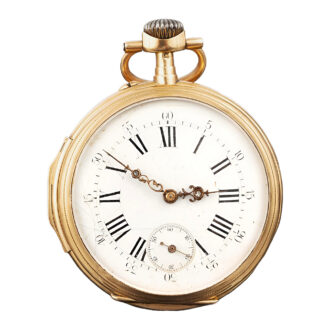
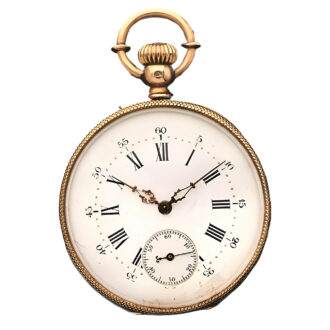
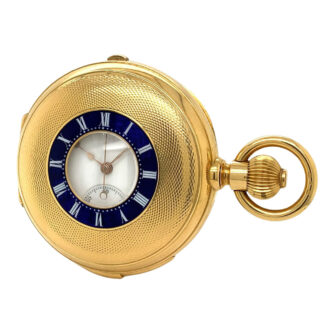
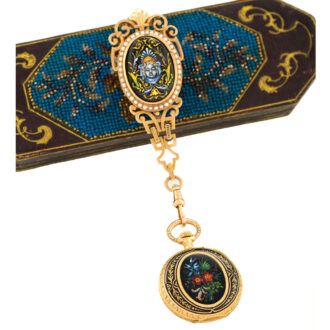
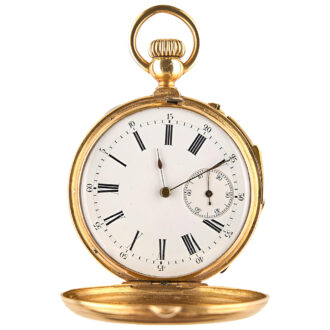
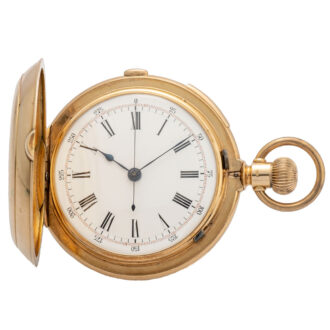
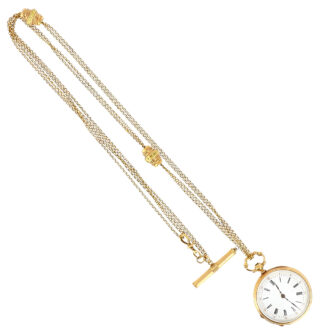
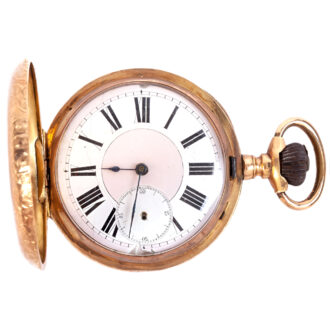
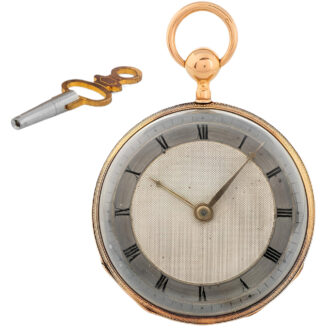
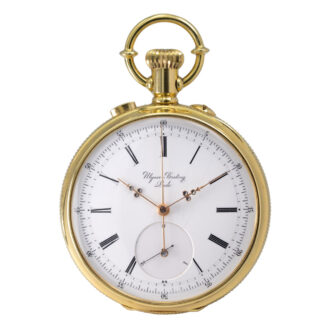
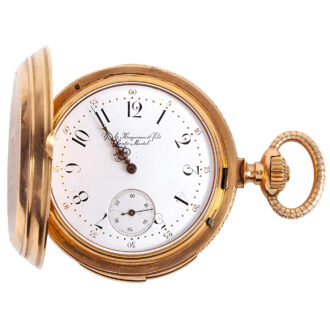
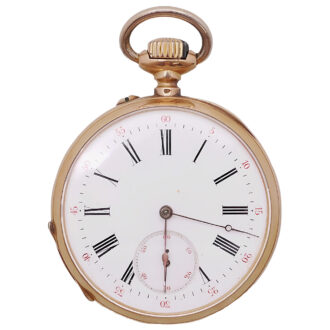
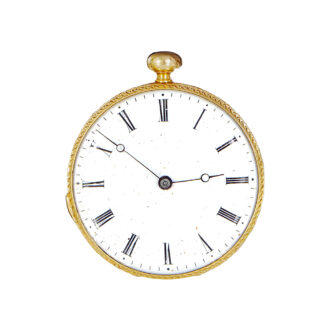
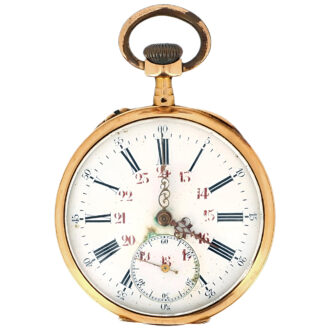
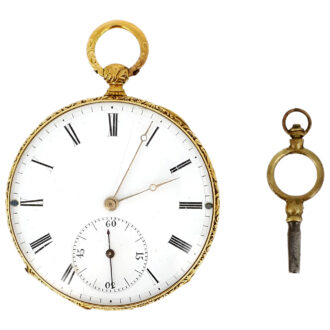
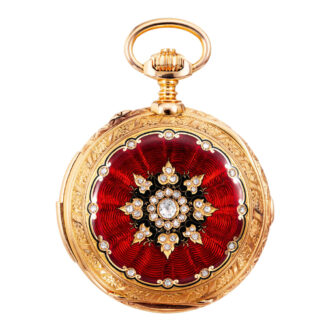
Rare Swiss 18K rose gold complicated lever watch Circa 1890
- Kenmerk
- BA1669
- Diameter
- 58 mm
- Estimate
- € 40.000 - 70.000
- Price sold
- € 52.800
Rose gold, diamond- and ruby-set pocket watch attributed to LeCoultre
–
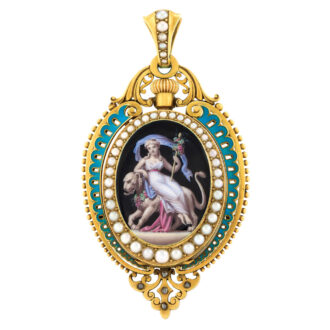
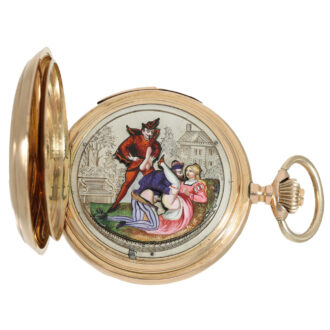
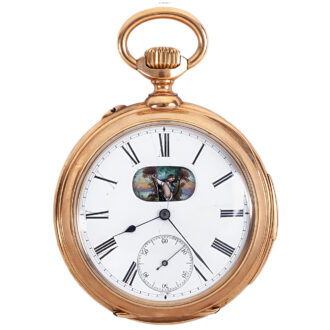
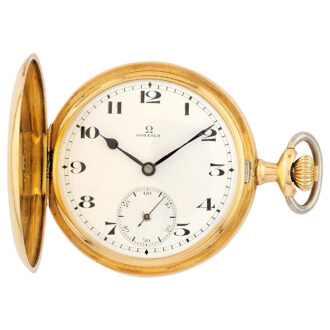
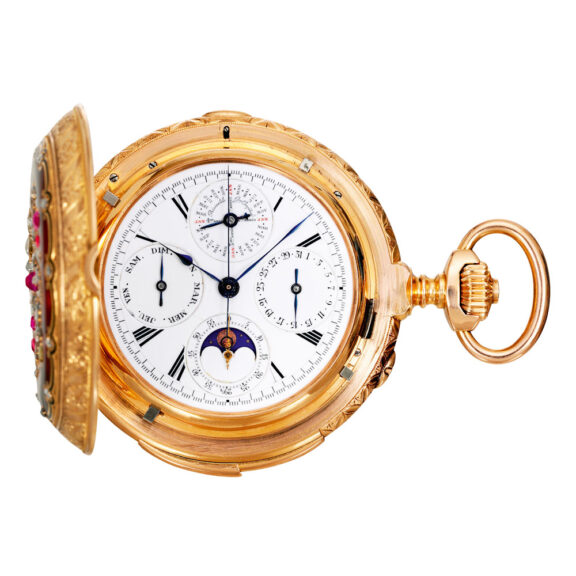
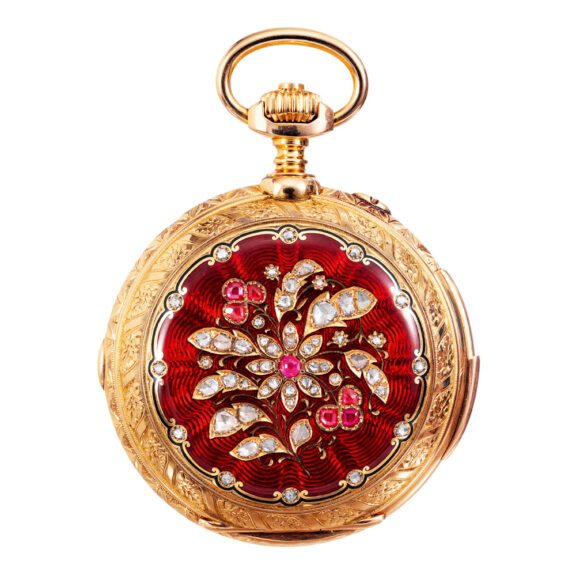
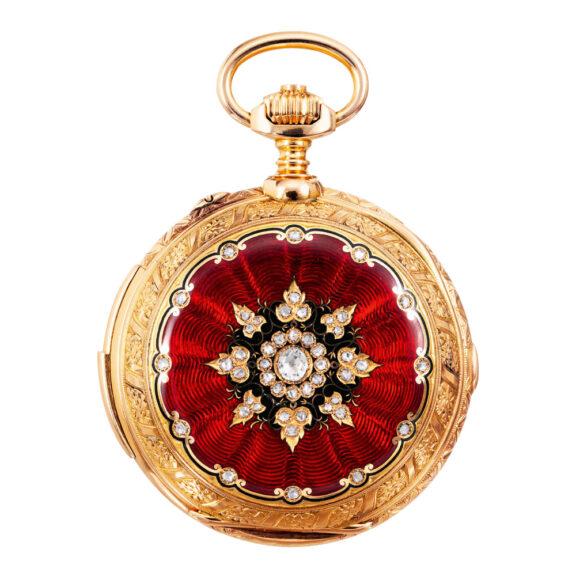
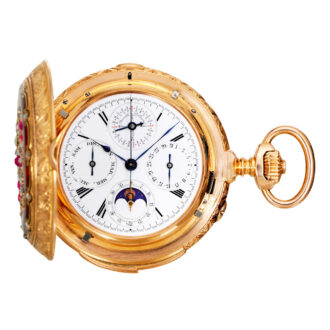
A very fine, rare, large and heavy Swiss 18 carat rose gold, diamond- and ruby-set hunting cased minute repeating keyless lever pocket watch with perpetual calendar, chronograph, phases of the moon and lunar calendar, circa 1890. Retailed by Hauserzivy & Cie, Mexico-Paris. Rhodium-plated movement, 35 jewels, counterpoised straight-line lever escapement, cut bimetallic compensation balance, blued steel Breguet balance spring with overcoil, index regulator, visible chronograph work, repeating on gongs activated by a slide on the band. Gold hinged cuvette with engine-turned border and engraved and enamelled with the technical details. Glazed gold-rimmed cover to view the movement. White enamel dial with Roman numerals, outer minute track and concentric five-seconds divisions, subsidiary dials for the date, days of the week, 4-year cycle and seconds, aperture for the moon phases with a lunar calendar at the edge and original blued steel spade hands. Massive case, the front decorated with translucent red enamel and set with a rose-cut diamond and ruby flower spray, engraved border and band, the back cover decorated to match with a rose-cut diamond-set star. Cuvette signed by the retailer, case numbered.
–
Diameter: 58 mm
–
Signed: No name
–
A perpetual calendar is a calendar mechanism which, unlike a simple calendar, automatically adjusts to the correct day of the month by accounting for the varying durations of each month, as well as self-correcting for the 29th of February during leap years. Audemars Piguet is said to have been the first to produce wristwatches with perpetual calendar and moon phases, in 1924. In 1925, Patek Philippe modified a lady’s pendant watch with perpetual calendar to produce the world’s first instantaneous changing perpetual calendar wristwatch with leap year indication.
–
A minute repeating watch tells the time both visually and audibly. A slide on the side of the case, usually near the 9, will activate two hammers in the movement. These hammers strike two gongs curled within the case. First one hammer strikes a gong of lower tonality, it will count out the hours. Then both hammers will strike both gongs alternatively to count out the quarter hours after that hour, and then the second hammer alone striking a gong of higher tonality will count out the minutes after that quarter-hour. The repeating mechanism was developed by Daniel Quare. In 1687, he had patented a mechanism that sounded the hours and the quarter hours. The early repeaters used bells. At the end of the 18th century, two bent-wire gongs became the more popular mechanism. In 1892, the first-minute repeater wristwatch was produced by Omega, a model with a round-shaped case.
Share this page: