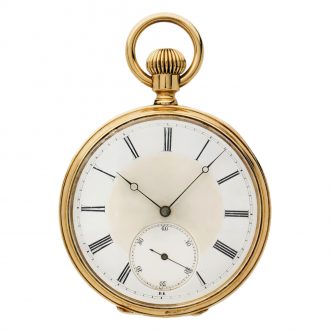
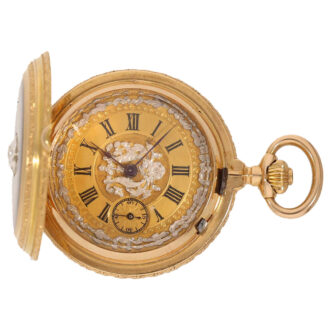
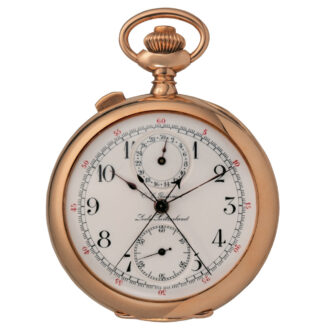
Swiss gold chronograph with 30-minute register Circa 1880
- Kenmerk
- BA0498
- Diameter
- 52 mm
- Estimate
- € 25.000 - 40.000
- Price sold
- € 31.700
Enamel attributed to Louis Rosselet
–
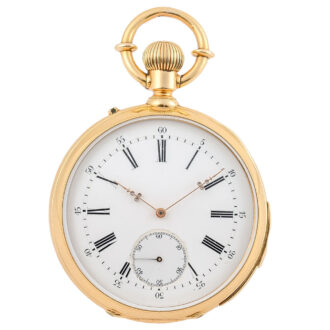
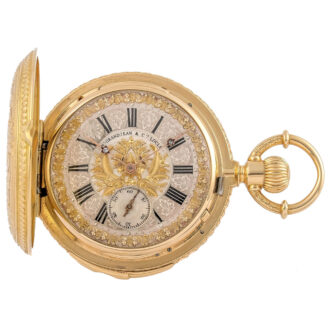
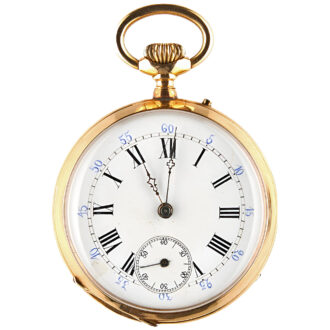
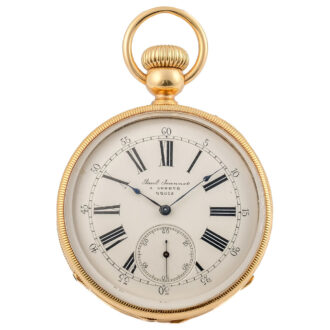
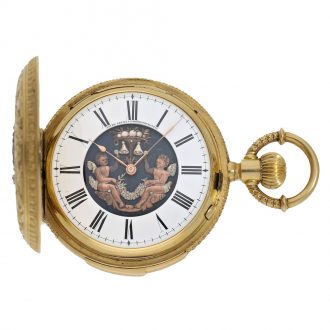
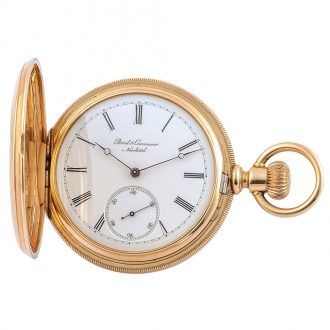
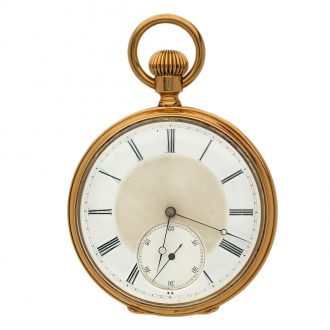
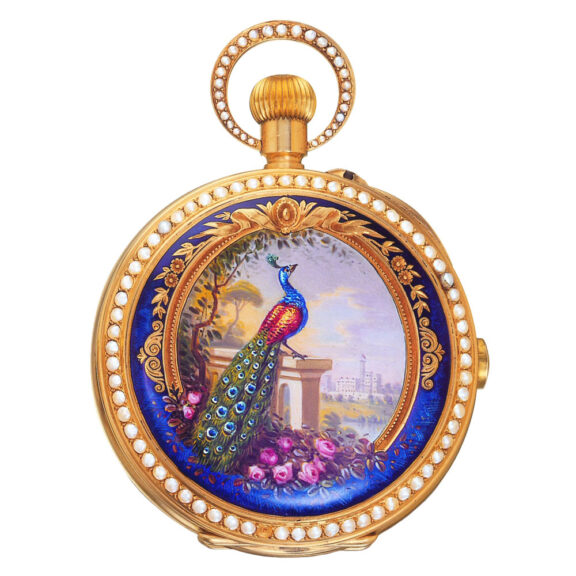
A very fine Swiss 18 carat gold, enamel and pearl-set hunting cased keyless lever chronograph watch with a 30-minute register made for the Indian market, circa 1880. A Tribute to Queen Victoria. Frosted gilt 3/4 plate movement in English style, 15 jewels, lateral counterpoised lever escapement, cut bimetallic compensation balance with Breguet balance spring. Hinged gold cuvette. White enamel dial with Roman numerals, outer minute divisions, outermost chronograph track divided into fifths, minute register at 3, subsidiary sunk seconds at 9 and original gold spade hands. The case back with a polychrome enamel scene depicting a peacock by a lake with Windsor castle in the background, the front with a very finely painted on enamel portrait of the young Queen Victoria, Windsor castle in the background, pearl-set bezels and bow.
–
Diameter: 52 mm
–
Signed: No name
–
Louis Rosselet. A well-known enamel painter of the second half of the 19th and the early 20th century, he specialized in country scenes, landscapes and portrait miniatures and often worked for the Chinese and Indian markets. He is known for his flower bouquets and the ‘Peacock by a lake’ scene depicted in the present watch. Rosselet is recorded as having worked at Place du Temple 171 in 1857.
–
Queen Victoria, (1819 – 1901). Born on 24 May 1819, the only child of Edward, Duke of Kent and Victoria Maria Louisa of Saxe-Coburg. In 1837, at the age of 18, she succeeded her uncle William IV. In 1840 Victoria married her first cousin, Albert of Saxe-Coburg Gotha. For the next 20 years, they lived in close harmony and had a family of nine children, many of whom married into the European monarchy. Albert’s interests in the arts and sciences inspired the celebratory Great Exhibition of 1851, held at the Crystal Palace. The proceeds from the exhibition led to the foundation of some of Britain’s greatest public museums, including the Victoria and Albert institutions that fueled national pride, while reflecting the Queen’s personal ethics and vision. After Albert’s death from typhoid in 1861, Victoria remained in mourning for the rest of her life. The most notable achievement of her long reign was probably the expansion of the British Empire, which doubled in size, comprising India of which she became Empress in 1877, Australia, Canada and parts of Africa and the South Pacific. Although she retired to the Isle of Wight after the death of her beloved husband and tended to remain hidden from the public eye, she emerged from this seclusion to celebrate her Golden and Diamond jubilees, even making a royal visit to France – the first by a ruling British monarch since 1431. Victoria died on 22 January 1901. Her reign dominated most of the 19th century.
Share this page: