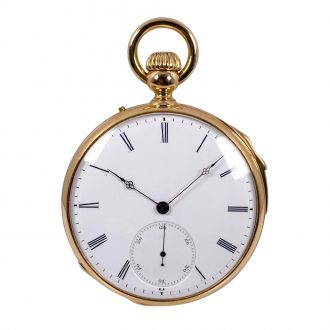
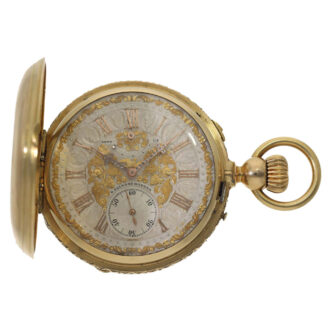
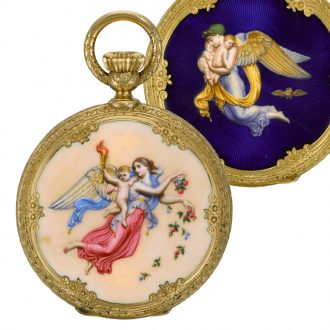
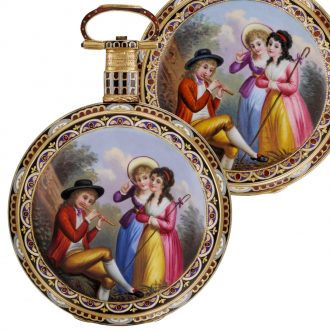
Extremely rare gold pendant watch with brooch Circa 1865
- Kenmerk
- BA1053
- Diameter
- 20 mm
- Estimate
- € 12.000 - 22.500
- Price sold
- € 15.050
Gold, enamel and diamond set full hunter by Czapek & Cie
–
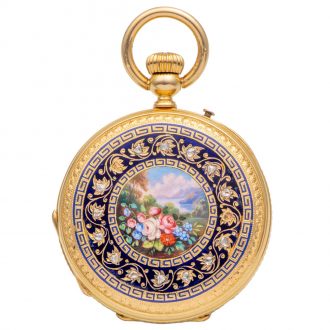
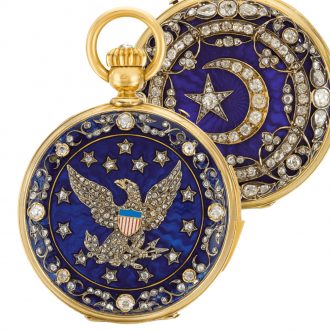
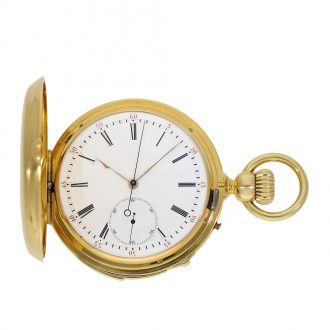
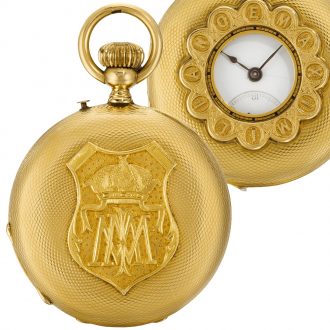
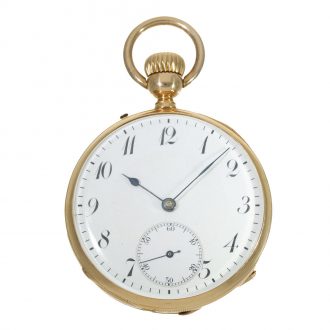
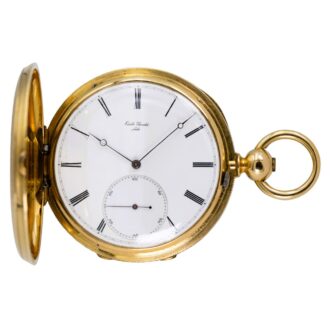
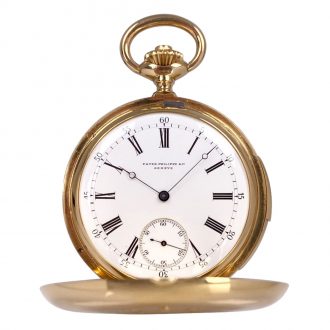
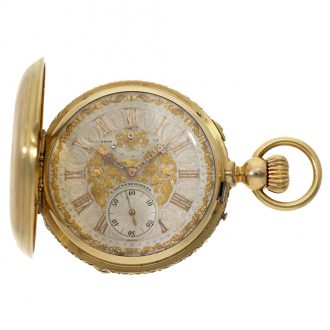
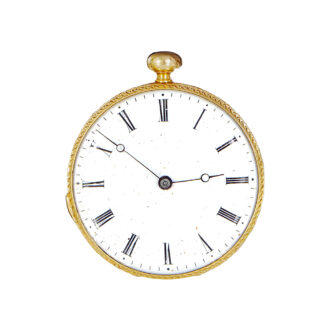
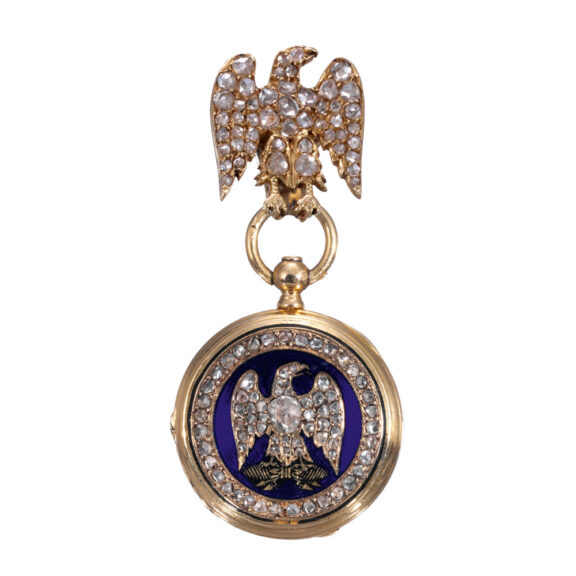
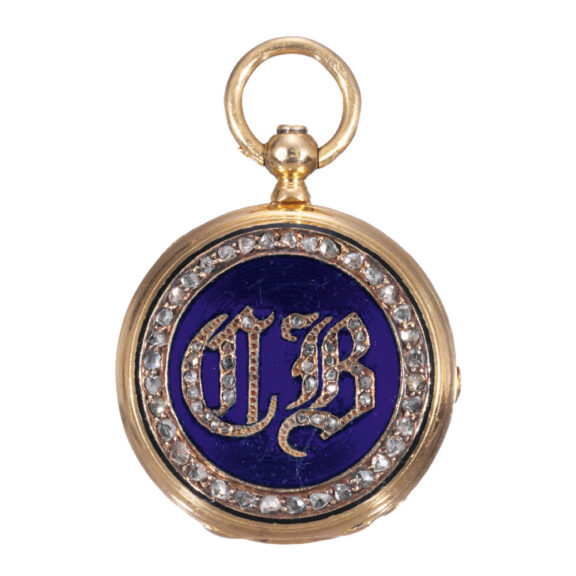
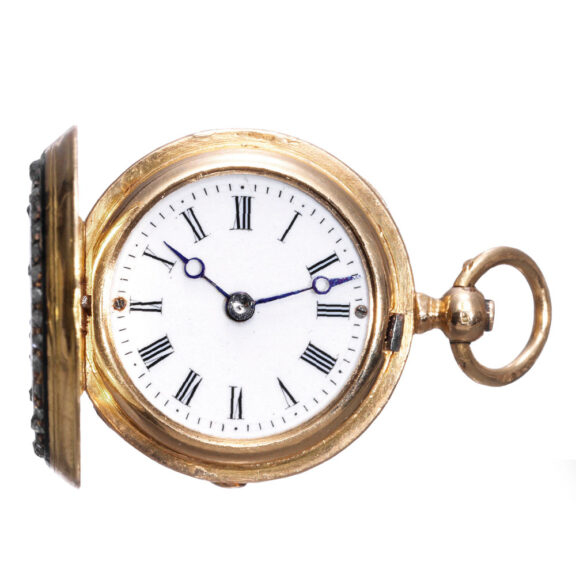
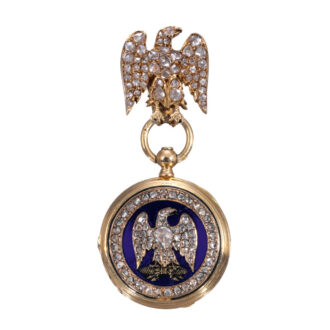
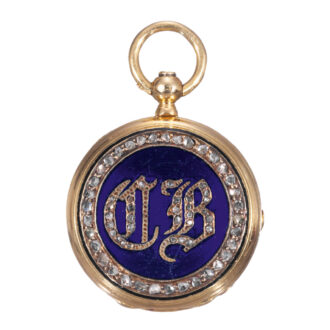
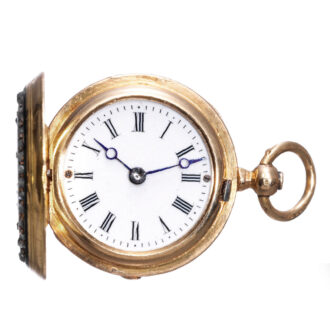
A very fine and extremely rare Swiss/French 18 carat gold, enamel and diamond set hunting cased miniature pendant watch with a gold, enamel and diamond set brooch fitting in the form of the French Imperial Eagle, probably a personal gift of Napoleon III, circa 1865. Frosted gilt movement, bar caliber, 8 jewels, cylinder escapement, plain three armed gilt balance, flat balance spring, index regulator. Gold hinged cuvette. White enamel dial with Roman numerals, outer minute divisions and replaced blued steel Breguet hands. The front of the case with rose cut diamond set initials CB on a royal blue translucent enamel ground, rose cut diamond set border, the back decorated with the French Imperial eagle in rose cut diamonds and with black champlevé thunderbolts, translucent royal blue enamel ground, rose cut diamond set border, polished band and borders. Cuvette signed.
–
Diameter: 20 mm
–
Signed: Czapek & Cie à Genève et Place Vendôme 28 Paris
–
This extremely beautiful watch and brooch is exceptional not only for its small size but for the very rich decoration of the case, which is almost unique in a miniature watch. The firm of Czapek & Cie was at 28, Place Vendome for only nine years, between 1860 and 1869, so dating the watch to within this period, it is also significant that Juliusz Gruzewski, Czapek’s partner, was a personal friend of Napoleon III, a fact which no doubt allowed him to become watchmaker to the Emperor. The French Imperial eagle emblem was used by Napoleon III between 1852 and 1870, this coupled with the miniature size and luxurious decoration, make it almost certain to have been a personal and private gift of the Emperor. The initials ‘CB’ incorporated into the design of the case could refer to the Emperor himself as Charles Bonaparte or may perhaps be the initials of one of his mistresses, the Countess de Beauregard.
–
The French Imperial Eagle. The bird of Jupiter and symbol of imperial Rome has been associated from earliest antiquity with military victory. An eagle clutching a thunderbolt was one of the symbols of Napoleon I.
–
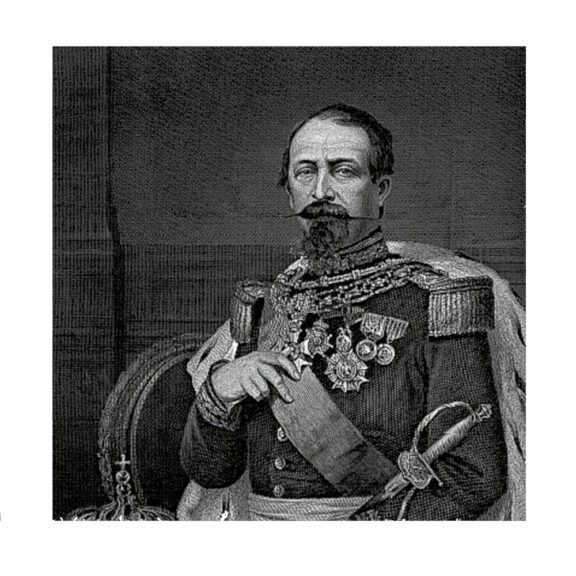
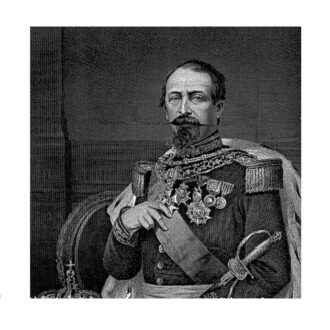
Charles Louis Napoléon Bonaparte, Napoléon III (1808-1873) was President of the French Republic from 1848 to 1851, then from 2 December 1851 to 2 December 1852 the ruler of a dictatorial government, then Emperor of the French under the name Napoléon III, to 1870. He was the last monarch to rule France. The nephew of Napoleon, he spent his youth in exile in Switzerland and Germany (1815-1830). With the death in 1832 of Napoleon’s son, Napoléon-François- Charles-Joseph Bonaparte, duke von Reichstadt, he became the claimant to the French throne. After an abortive coup d’état, he was exiled by King Louis-Philippe to the U.S. After another attempted coup (1840), he was arrested, tried and imprisoned. He escaped to England (1846) and returned to Paris (1848), where he was elected to the national assembly. He evoked the legend of Napoleon to win the popular vote as president of the Second Republic. Attempting to expand his power, he staged a coup in 1851, in 1852, as Napoleon III, he became emperor of the Second Empire. Seeking to re-establish French power, he led France into the Crimean War and helped negotiate the treaty at the Congress of Paris (1856). He sided with Sicily against Austria (1859) and was victorious at the Battle of Solferino He aided Italy in achieving unity and annexed Savoy and Nice (1860). He promoted liberalized policies within France, which enjoyed prosperity during much of his reign. In the 1860’s he gradually introduced political liberalization. He expected material rewards from his ‘Latin empire’ after installing Maximilian as Emperor of Mexico (1864-1867) but was disappointed. He kept France neutral in the Austro-Prussian War (1866), but in 1870 Otto von Bismarck contrived to involve France in the disastrous Franco-Prussian War. After leading his troops to defeat in the Battle of Sedan (September 1870), Napoleon surrendered and was deposed as emperor. He went into exile in England and died there in 1873.
Signed: Czapek & Cie à Genève et Place Vendôme 28 Paris
Share this page: