Historical Swiss gold watch with five complications Circa 1865
- Kenmerk
- TA5255
- Diameter
- 42 mm
- Estimate
- € 25.000 - 50.000
- Price sold
- € 28.500
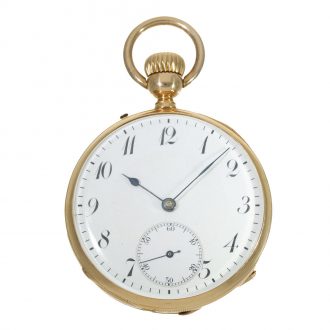
Gold watch made for Matías Fernández Peña Madrid
–
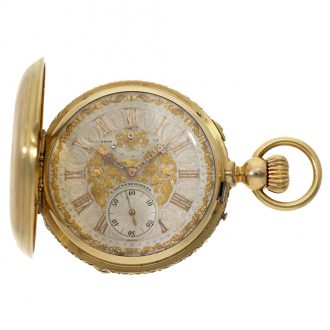
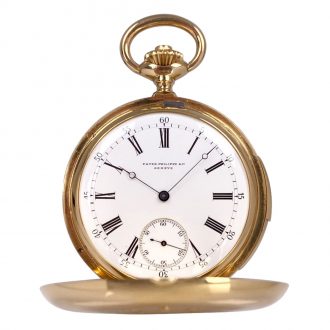
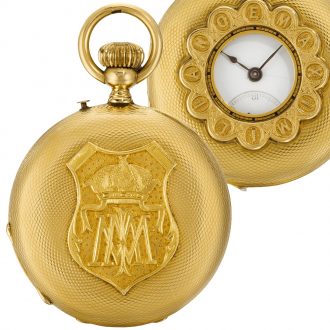
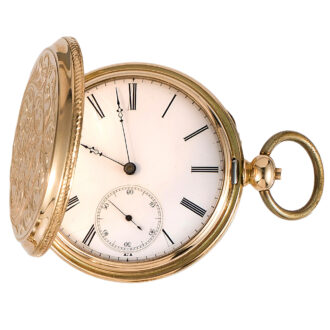
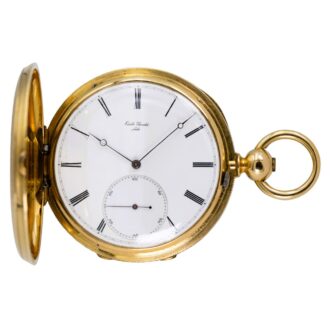
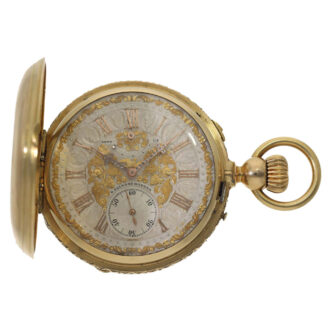
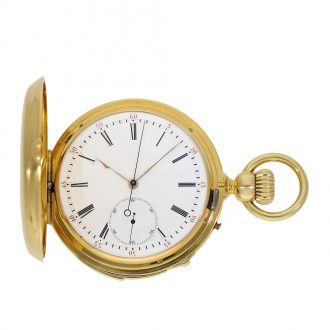
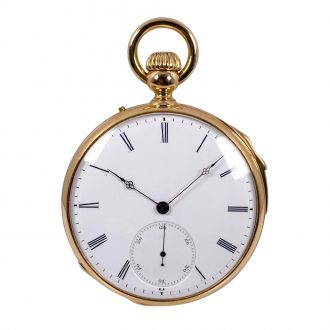
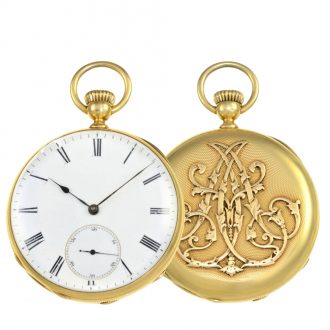
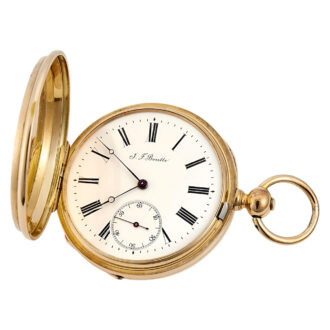
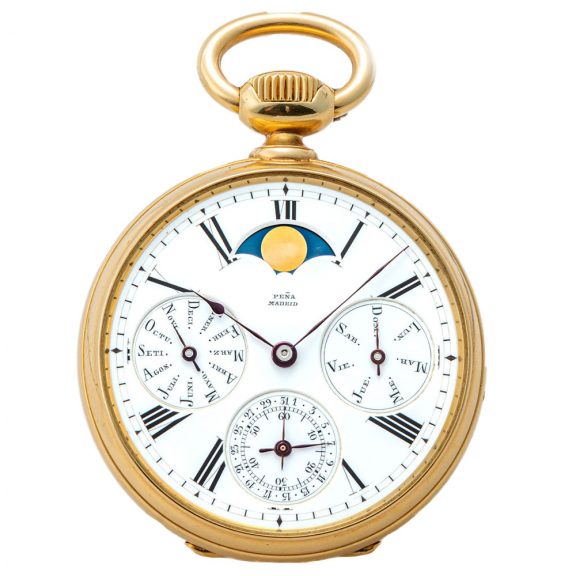
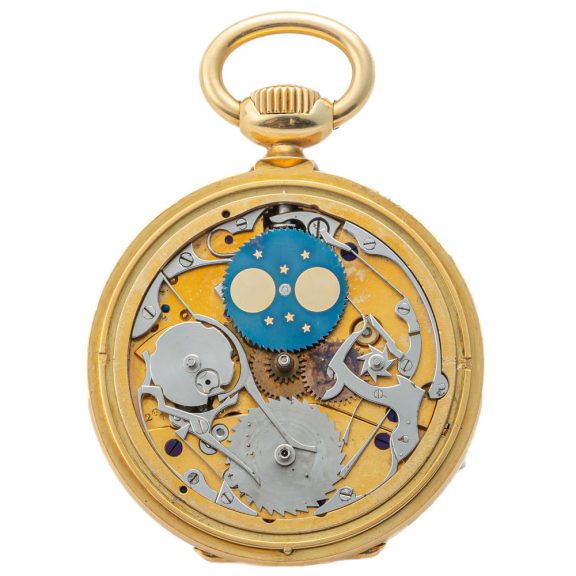
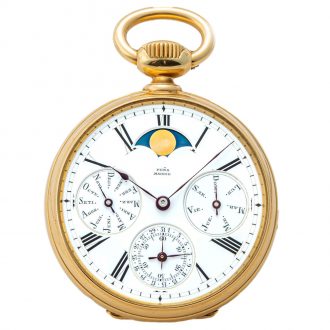
A historical Swiss 18 carat yellow gold open faced keyless pocket watch made by Patek Philippe in Geneva, circa 1865. White enamel dial with radial Roman numerals, blued steel Spade hands, with subsidiary seconds at 6 and five horological complications: Half-instantaneous perpetual calendar, date of the month (subsidiary dial at 6 o’clock), day of the week (subsidiary dial at 3 o’clock; indications given in Spanish), month of the year (subsidiary dial at 9 o’clock; indications given in Spanish), phases of the moon (aperture at 12 o’clock). The case back is glazed; the gilded brass cuvette was pierced with five holes intended to fix a cypher. A gilded brass movement, going barrel, straight line equilibrated lever escapement, cut bimetallic balance with gold poising screws and blued steel hairspring with terminal curve, polished steel index regulator.
–
Diameter: 42 mm
–
Signed: Patek Philippe Geneva
–
Accompanied by a copy of the extract from the archives.
–
The movement of this watch is probably based on an ébauche (blank) from the workshops of Louis Audemars, one of the usual suppliers of the Genevan manufacture. The Louis Audemars house was founded in 1811 by Louis-Benjamin Audemars (1782-1833), in the hamlet of Crêt-Meylan, near Le Brassus, in the Vallée de Joux (Canton de Vaud). This type of perpetual calendar with display of leap years, whether with the indication of the exact duration of each month for the 48 months of the cycle, including February 29th every four years, was designed and developed since 1860 by Charles-Henri Audemars (1829-1906), the youngest son of the founder of the horological manufacture.
–
Then it replaces the pocket watches with a retrograde perpetual calendar (more difficult to use and more expensive in manufacturing cost), of which Eugène-Constant Lecoultre (1819-1882), originally from Le Chenit (Vallée de Joux), has made a speciality in Geneva and gradually imposes itself throughout the watch industry. Even if this invention is much earlier, the new perpetual calendar mechanism is extensively described and illustrated in July 1885 in the Journal Suisse d’Horlogerie (Swiss Journal of Watchmaking, founded in Geneva in 1876), allowing all watchmakers to build such a watch.
–
This system, which is known as traînant (dragging), is then improved with the invention in 1889 of the instantaneous and simultaneous jump of the date-discs by the Genevan manufacture Patek, Philippe & Cie (Swiss patent invention No. 1 018, of May 23, 1889). As with other inventions of his (winding and time-setting to the pendant, independent deadbeat seconds, bi-directional winding, etc.), Adrien Philippe (1815-1894) published his creations very late; they were the subject of a very long gestation period and of numerous improvements due to experience. It is therefore understandable to see on this watch that the calendar mechanism is a half-instantaneous jump; on the other hand, it is difficult to say whether this improvement is due to the workshops of Louis Audemars or those of Patek Philippe. Very quickly, these two manufacturers built their perpetual calendars on additional plates (easier to disassemble and reassemble for the watchmaker’s adjustments), allowing them to be incorporated on watches with a repeater on demand or other horological complications.
–
Louis Audemars house remains in the history of watchmaking as one of the greatest manufacturers of all time, having realised, under its name or that of other watchmakers, some of the most beautiful watches in the world of the years 1860-1880. The orders for ébauches(blank movements) received by this workshop enabled many of the great houses (notably Breguet and Patek Philippe) to create masterpieces that marked the history of watchmaking in the second half of the 19th century and the beginning of the 20th century. This did not prevent the master watchmakers of these manufacturers from improving and creating other marvels.
Signed: Peña Madrid
Share this page: