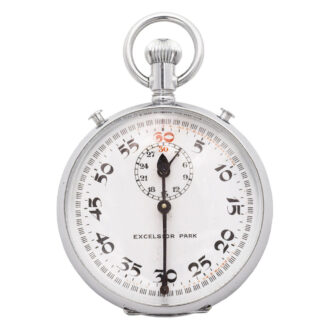
Swiss stainless steel lever split-seconds chronograph Circa 1930
- Kenmerk
- BA3066
- Diameter
- 53 mm
- Estimate
- € 1.000 - 2.000
- Price sold
- -
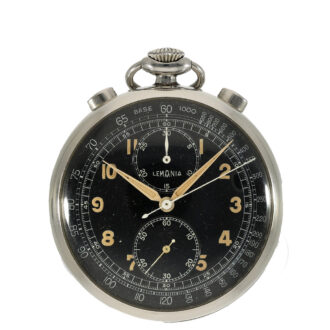
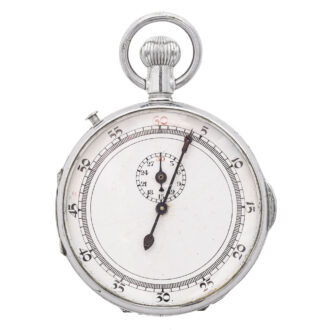
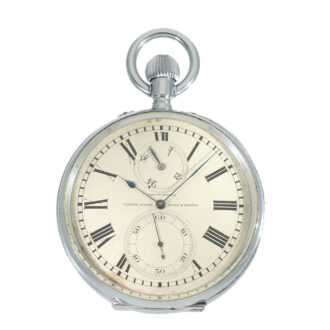
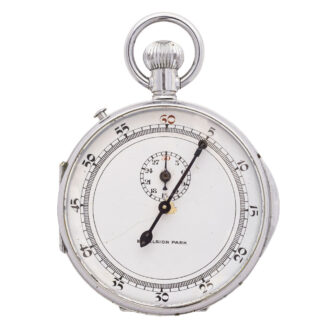
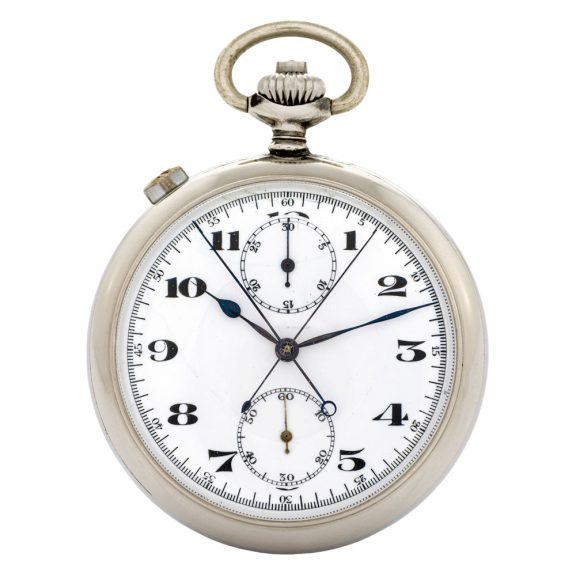
Stainless steel open faced split-seconds chronograph
–
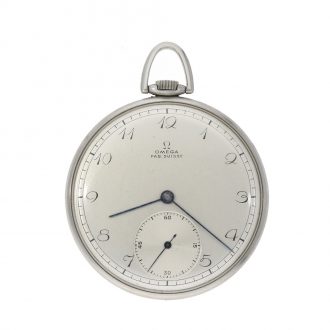
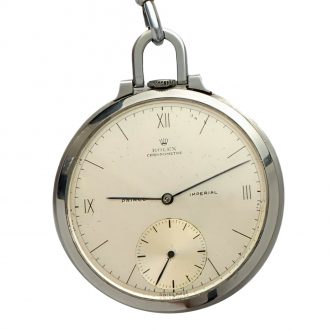
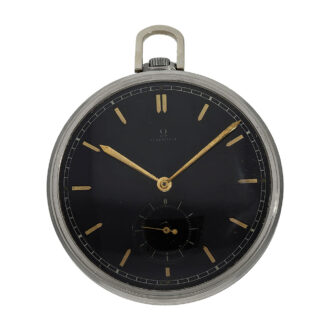
A fine Swiss stainless steel open faced keyless lever pocket watch with split-seconds chronograph and register, circa 1930. Lever movement. White enamel dial with Arabic hours, an outer minutes/seconds track with Arabic five minutes/seconds numerals, subsidiary seconds at 6 o’clock, 30-minute register at 12 and spade & whip hands. Plain case.
–
Diameter: 53 mm
–
Signed: No name
–
A split-seconds chronograph or ‘rattrapante’, is a type of chronograph watch with two coaxial superimposed centre seconds hands that are controlled by two push buttons. One push button controls the split-seconds hand to stop or join the chronograph hand. The other push buttons control both hands and all the chronograph functions. The chronograph and split-seconds hands are used for timing several events that start simultaneously but are of different durations. To operate the split-seconds chronograph, both hands are started and remain superimposed. Then at the end of the first duration, the split-seconds hand can be stopped while the chronograph hand continues to move. The duration of the first event can be read. After recording, the split-seconds hand can be released to instantly move and join the chronograph hand, synchronizing with it and thus being ready for another recording. At the end of each event, the hands then can be stopped and returned to zero.
The split-seconds chronograph, in its present form, was first introduced in 1880. Split seconds chronograph wristwatches came on the market circa 1922 by Patek Philippe (the first known wristwatch of this kind was Patek Philippe No. 124824, case No. 235326. This timepiece appeared five years prior to the official release of the split-seconds chronograph, making Patek Philippe the first manufacturer to create this complication in a wristwatch. As they require a highly complicated and technical mechanism, these watches are desirable, very collectable and extremely difficult to produce accounting for their rarity.
Share this page: