Highly important gold repeating musical automaton Circa 1815
- Kenmerk
- BA0829
- Diameter
- 61 mm
- Estimate
- € 60.000 - 120.000
- Price sold
- -
Enamel attributed to Jean-Abraham Lissignol
–
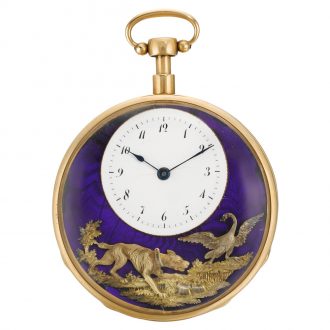
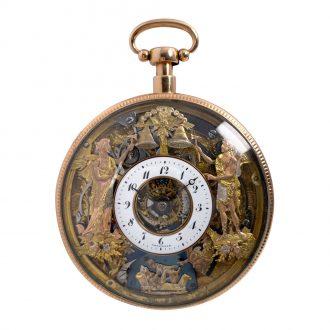
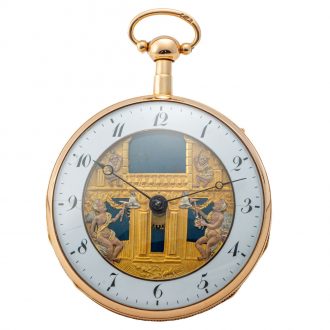
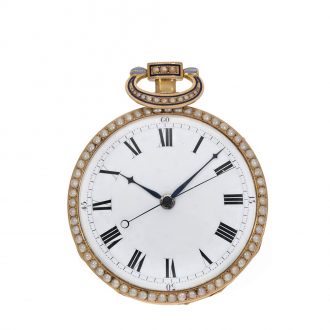
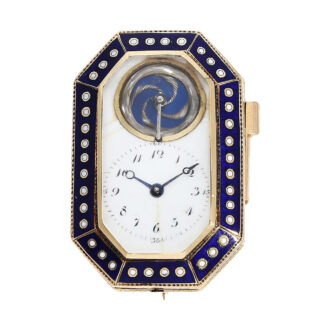
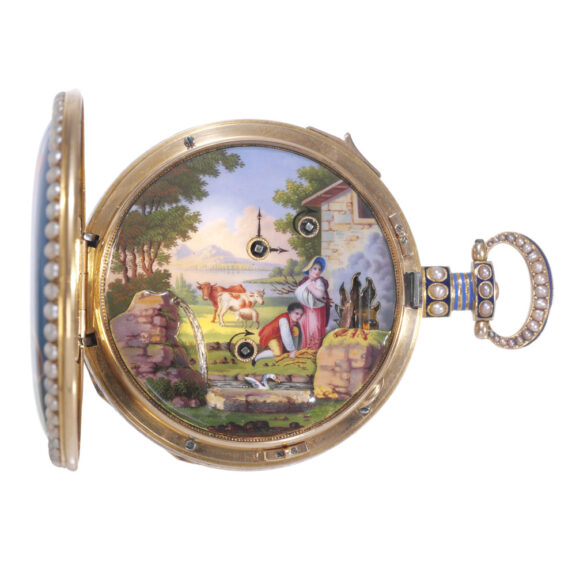
An extraordinarily fine, magnificent and highly important, large Swiss gold, enamel and pearl set quarter repeating musical center seconds cylinder pocket watch with automaton of a goose dipping on moving water, an extremely rare fire automaton with moving flames and a curved automaton waterfall and pool activated when the music plays, playing music on the hour or at will, circa 1815. Matte gilt movement with standing barrel for the going train, cylinder escapement, three armed balance, flat balance spring, index regulator, repeating with two hammers on two square section gongs activated by a slide on the band, slides for music and silence and music start and stop on the rim beneath the back cover. Musical movement: Sur plateau, with large fixed brass barrel, pinned brass disc with detachable bridge playing on one side with two steel combs fixed at opposite sides of the disc, each comb with eleven tuned vibrating teeth, pinned detent spring against the hour wheel for hourly activation of the music. Automaton movement: driven by a brass wheel mounted with a steel cam geared via a pinion driven by the teeth on the circumference of the pinned musical disc, the goose automated by means of a steel rack lever arm acting against the cam, separate brass plate holding the red twisted glass and brass rods for the fire flames with magnified lenses in front, driven by wheels and cannon pinions, the waterfalls and pool given the effect of moving water by means of a rotating silvered disc engine turned with a swirling pattern. Hinged glazed gold rimmed cover over the automaton scene with apertures for the winding and hand setting.
–
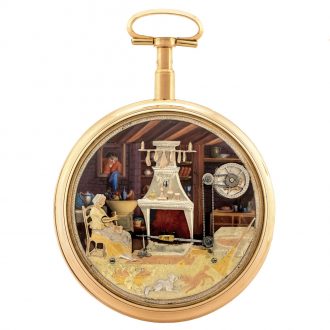
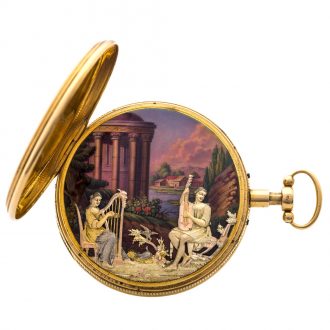
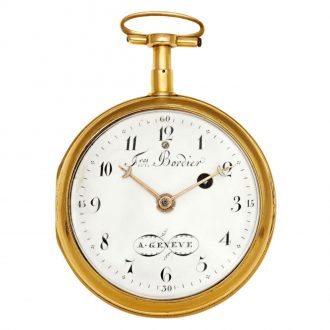
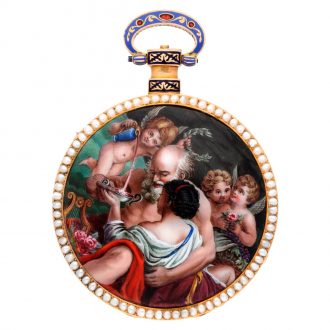
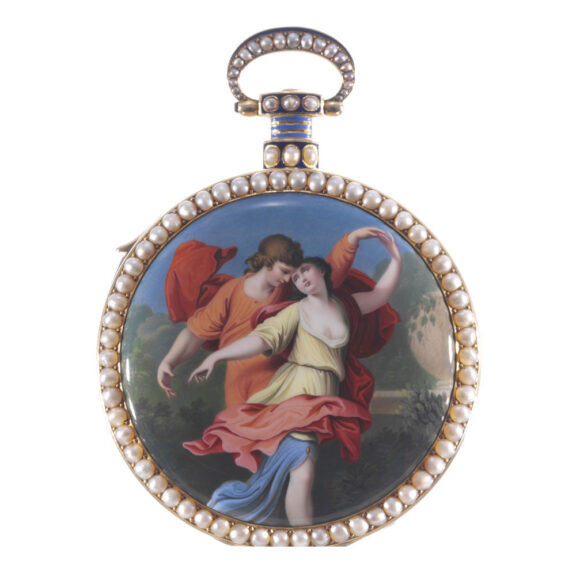
White enamel dial with Roman numerals, outer minute track with dot seconds divisions and Arabic fifteen second numerals, secured by a single screw and original gilt lozenge hands. The case back set with a magnificently painted on enamel panel depicting a young couple in classical dress performing an elegant dance in a garden landscape, border set with large split pearls, back opening to reveal the finely painted on enamel automaton Swiss rustic scene of a young country couple by a cottage putting branches on a fire with automaton flames, a Swiss mountain lake scene with cows and a sheep in the background, in the foreground a small rocky pool with two twisted glass rods imitating the water and an automaton painted on enamel goose which dips forward into the water, to the left hand side a waterfall with curved glass rod imitating the water, bezel set with large split pearls, pendant and bow decorated with royal blue and pale blue champlevé enamel and set with split pearls, wide band inlaid with mauve opaque champlevé enamel, engraved gold leaves with green enamel and gold flowerheads with translucent royal blue enamel petals and red centers.
–
Diameter: 61 mm
–
Signed: No name
–
This watch is one of the finest and most important ever made for the Chinese market, the enamel painting set into the case is surely one of the most breathtaking ever painted by a Genevan enameler since the 17th century. The artist has successfully captured the movement and grace of the figures and the painting has a three dimensional quality that makes this work among the very finest early 19th century enamels in existence. The subjects chosen for the decoration of enamels for watch cases by the Swiss enamellers were usually taken from engravings of the original works in European collections. There were several engravers who specialised in copying these paintings for engravings, perhaps the most famous being Franceso Bartolozzi (1727-1815), several scenes on Swiss enamel watches can be identified as being directly taken form his work. The most popular subjects were those from classical mythology whose allusions and allegories were readily recognised by people at the time but are to modern eyes sometimes obscure, the other main type of scene that was particularly appreciated by the Chinese was of idealized European rustic simplicity and country pursuits. The present watch combines both the classical enamel of the case and the rustic enamel automaton scene in one watch. The artists whose work was repeatedly copied by the Geneva enamellers from engravings included Élisabeth Vigée-Le Brun (1755-1842), whose painting of ‘Peace restoring Abundance’ perhaps had some influence in the present enamel, Angelica Kauffmann (1741-1807), Pierre-Paul Prud’hon (1758-1823), Giovanni Battista Cipriani (1727-1785) and Anton Raphael Mengs (1728-1779). The enamel scene on the present watch is unusual in that the figures are almost full length rather than bust or half length, as if seen from a distance. The flesh tones and ’roundedness’ of the limbs give the picture a much more three dimensional appearance than most enamels of this period which leads to the question of attribution. Of course only one or two enamel painters were even capable of making a work of this quality, one was Jean-Abraham Lissignol (1749-1819) the others, Henri-Albert Adam (1766-1820) or Isaac Adam (1768- 1841). It seems likely after comparison with other examples of his work that this enamel is by Lissignol.
Jean Abraham Lissignol was a Swiss painter, revolutionary and one of the finest enamellers of his time. He was born in Geneva on May 7th, 1749 and died in Plainpalais on June 28th, 1819. He was the pupil of Jean-Marc Roux and later became his partner. Specialized in snuff boxes and watch cases, he worked for Jaquet-Droz & Leschot, the Rochat Brothers and John Rich.
Share this page: