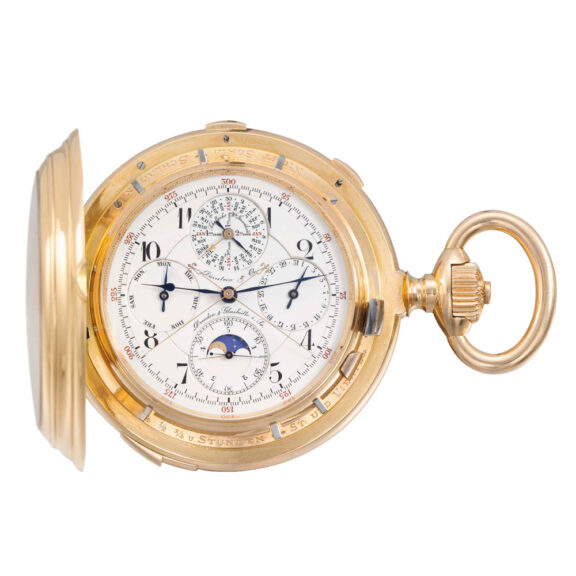
German 18K pink gold grande complication watch Circa 1891
- Kenmerk
- CH1390
- Diameter
- 68 mm
- Estimate
- € 300.000 - 600.000
- Price sold
- € 354.000
Pink gold hunting cased keyless lever grande complication watch
–
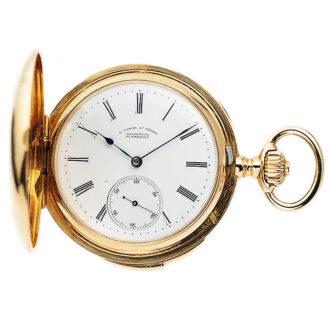
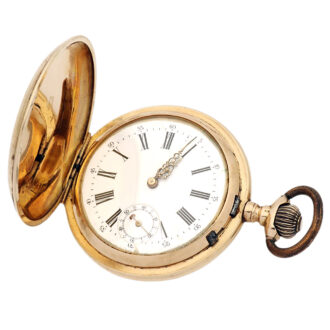
An exceptional, historically important and most probably unique German 18 carat pink gold hunting cased pocket watch. It combines minute repeating, grande and petite sonnerie, a perpetual calendar with moon phases, and a split seconds chronograph with an instantaneous 30 minute recorder and flying fifths of a second. It was made by Dürrstein & Co. and the Glashütte Uhrenfabrik Union in Glashütte, with a movement attributed to Audemars Piguet. It bears no. 47’373; work began in 1891, and it was sold in 1893.
–
Movement
It has a 20 ligne two train, fully jewelled, gilt finished movement with a lever escapement and bidirectional winding. It has gold chatons, a bimetallic compensation balance with gold poising screws, a micrometre regulator, a diamond endstone, and a finely chased balance cock decorated with foliage. The minute repeater and the grande and petite sonnerie strike on two gongs with two hammers. The movement is protected by a glazed dust cover and a gold cuvette. It is signed Glashütte Uhrenfabrik Union on the backplate and Dürrstein & Co. Glashütte and Dresden under the dial.
–
Dial
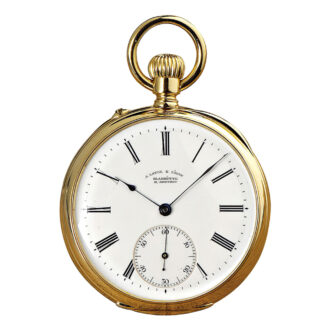
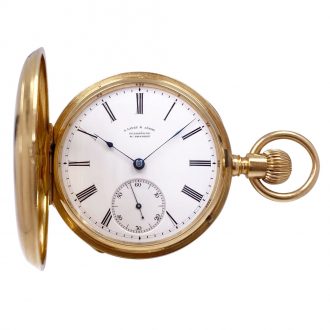
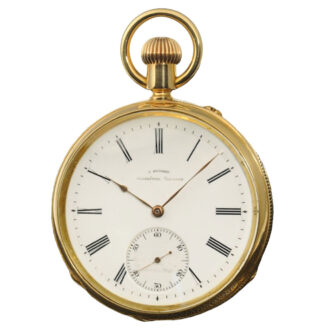
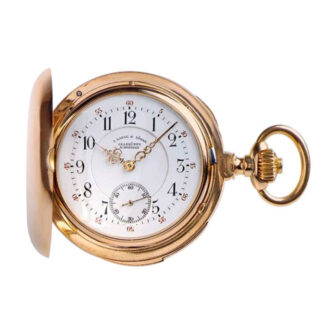
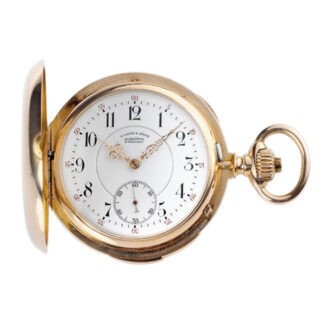
The white enamel dial shows black Arabic numerals for the hours, an outer scale for 300 units with red numerals, and blued steel spade hands. The centre is sunk, with four sunk subsidiary dials. At 12 o’clock, a combined dial shows the months over a four year leap year cycle and contains the instantaneous 30 minute recorder. It is inscribed Schaltjahr (leap year) and Wte Immerwährend (perpetual). At 9 o’clock, a subsidiary dial shows the day of the week in German. At 3 o’clock, a subsidiary dial shows the date. At 6 o’clock, a subsidiary dial combines the moon phases with the constant seconds and the flying fifths of a second. The dial is signed Dürrstein & Co., Dresden & Glashütte i. Sa.
–
Case
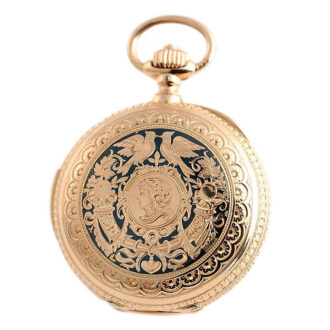
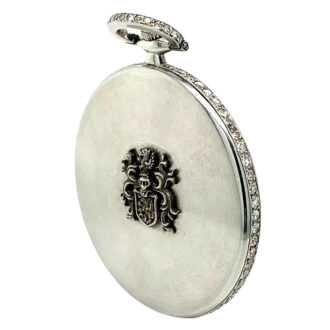
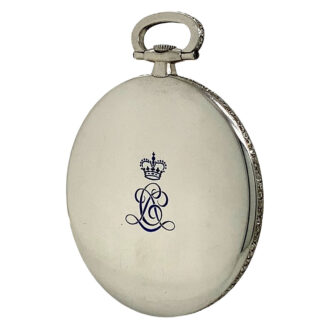
The timepiece is housed in a heavy round 18 carat pink gold hunting case with a stepped bezel and rim. The reverse is engraved at the centre with the coat of arms of the Hungarian noble family Csáky de Kereszteg. The band has a trip repeating slide and two buttons for the split seconds chronograph, and the case has a fluted winding crown and a round suspension bow. The striking is selected with six levers under the bezel. They are engraved 1/4 1/2 3/4 u. Stunden (quarters, halves, three quarters and hours) and St. und Viertel (hours and quarters) for grande and petite sonnerie, and Nicht schlagen (do not strike) and Schlagen (strike) for silent and striking. The case and cuvette are numbered.
–
The watch comes in a later fitted red Morocco leather presentation box. The box is stamped by the retailer Schuch L. Utóda És Szlavik, Budapest, and the cover bears the applied gilt metal coat of arms of Csáky de Kereszteg. The box also holds a watch shaped glazed medallion with a handwritten note and an entrance ticket for the 1893 World’s Columbian Exposition in Chicago. A cardboard note stamped Hausmann & Co., Roma has a drawing explaining the watch’s functions.
–
Diameter: 68 mm
–
Weight: 300 g
–
Signed: Dürrstein & Co., Dresden & Glashütte i. Sa.
–
This watch was the showpiece of the newly founded Glashütte Uhrenfabrik Union at the 1893 World’s Columbian Exposition in Chicago. At the time, it was thought to be the first watch ever made with this combination of complications, and so the most complicated watch in the world. Johannes Dürrstein had planned the project well ahead and started production in 1891. After two years of laborious and costly work, the watch was finished just in time for the exhibition. There it sold for 5,000 Marks, the price of a villa in Dresden at the time. The dial still carries the Dürrstein & Co. signature, used before Uhrenfabrik Union was founded on 1 January 1893, while the movement already carries the new factory’s name. This shows how the two firms were connected.
–
Glashütte makers often bought their most complicated ébauches (unfinished movements) from Switzerland because demand exceeded their production capacity, not because they lacked the skill. Audemars Piguet, often through Louis-Elisée Piguet, supplied 35 such movements to Glashütte between 1895 and 1912. No Audemars Piguet numbers or marks were found on this watch, but its layout and quality point clearly to that source. The movement was finished by Julius Bergter and Martin Simmchen, who later became Union’s director and master watchmaker. Union probably made eight grande complication watches, six of which are known today. Because they differ in dial signature, case decoration and the engraving of the striking levers, each one can be regarded as unique. The second watch of the series was presented in 1895 as the “Jubiläumsuhr” (anniversary watch), for the 50th anniversary of watchmaking in Glashütte.
–
The coat of arms on the case and the box show that the watch belonged to Károly Emmánuel de Csáky (1852–1919), Bishop of Vác (Waitzen) from 1900 until his death. The ticket for “Chicago Day” (9 October 1893) suggests that he or his family bought it at the exhibition. Through his successor, Monsignor Árpád István Hanauer, the bishop left the watch to Achille Ratti, later Pope Pius XI. Ratti then served as apostolic visitor in Poland. According to the handwritten note in the medallion, the Pope gave the watch to his personal physician, Dr Aminta Milani, on 2 November 1937. After that, its whereabouts were unknown until it appeared at auction on 16 May 2006. The Christie’s sale of 11 November 2013 was only the second time it had been offered to the public since it was first sold in 1893.
–
Johannes Dürrstein trained at the wholesaler Ludwig & Fries and worked as a travelling salesman for a Swiss watchmaker. In 1874 he and his brother Friedrich founded the watch wholesaler Dürrstein & Compagnie in Glashütte. On 1 January 1893 he founded the Uhrenfabrik Union, which aimed to make only the finest and most accurate watches. On request, these could include chronometers, tourbillons and perpetual calendars, with a rating certificate from the Hamburg Observatory. The stylised temple trademark followed in 1896. In 1900, Union presented the Universaluhr (Universal watch) with 18 complications at the Leipzig trade exhibition. It was long regarded as the most complicated pocket watch in the world.
–
Complications (13)
Calendar and astronomical (5)
- Perpetual calendar with four year leap year cycle (12 o’clock)
- Day of the week (9 o’clock)
- Month (12 o’clock)
- Date (3 o’clock)
- Moon phases (6 o’clock)
Chronograph (4)
- Chronograph with central seconds hand
- Split seconds
- Instantaneous 30 minute recorder (12 o’clock)
- Flying fifths of a second (6 o’clock)
Striking (3)
- Minute repeater, activated by a slide in the band
- Grande sonnerie
- Petite sonnerie
Winding (1)
- Twin barrel bidirectional winding
Signed: Dürrstein & Co Dresden & Glashütte i.SA
Share this page: