Historically important German complicated lever Circa 1891
- Kenmerk
- CH1390
- Diameter
- 68 mm
- Estimate
- € 300.000 - 600.000
- Price sold
- € 354.000
Exceptional, historically Grande Complication watch
–
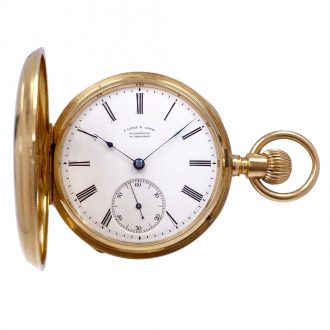
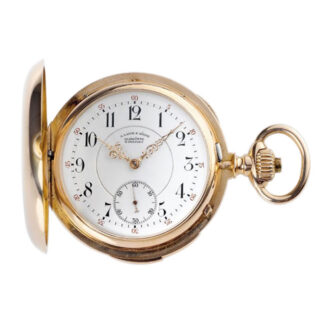
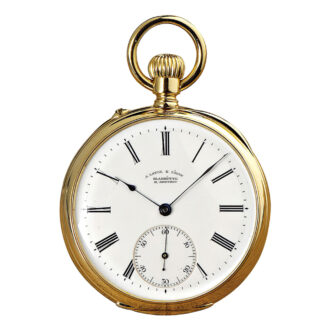
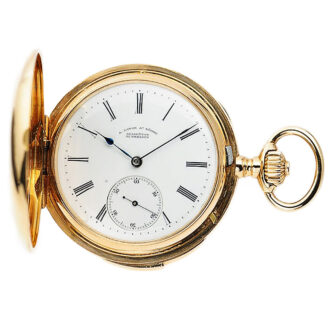
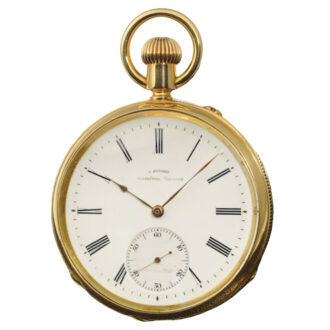
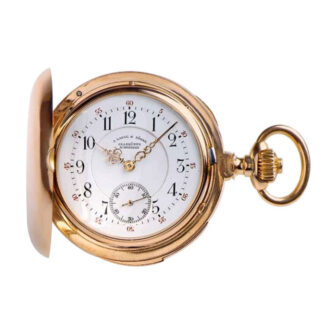
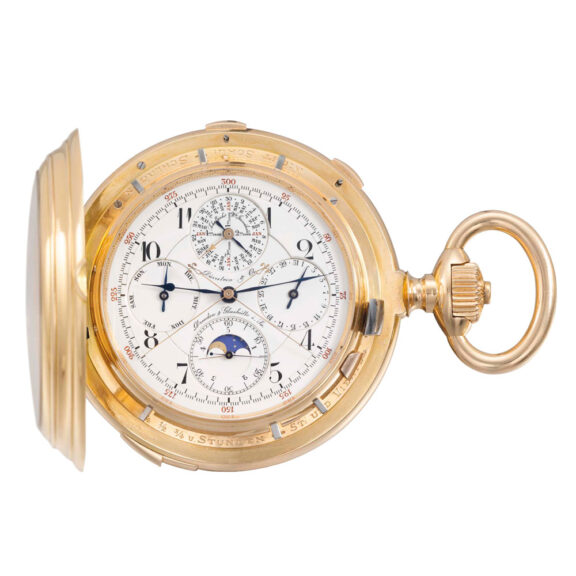
An exceptional, historically important and most certainly unique German 18 carat rose gold hunting cased minute repeating perpetual calendar split seconds chronograph keyless lever watch with moon phases, instantaneous minute recorder, flying fifths of a second, grande and petite sonnerie clockwatch, (manufacture started) circa 1891. Sold in 1893. Two train fully jewelled gilt finished lever movement by Audemars Piguet, bi-directional winding, gold chatons, bimetallic compensation balance with gold poising screws, micrometer regulator, diamond endstone, finely chased engraved foliage decorated balance cock, minute repeating and grande and petite sonnerie striking on two hammers onto two gongs, glazed dust cover. Gold cuvette. White enamel dial with Arabic numerals, outer scale calibrated for 300 units, blued steel spade hands, sunk center and four sunken subsidiary dials for month, leap year and instantaneous 30 minutes recorder inscribed Schaltjahr Wte Immerwährend, day, date and moon phases, lunar calendar, constant seconds and flying fifths of a second.
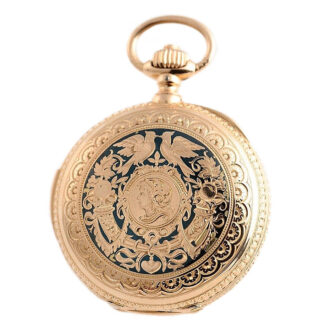
Heavy case, stepped bezel and rim, reverse centred by the engraved coat-of-arms of the Hungarian noble family Csáky de Kereszteg, trip repeating slide and two buttons for the split seconds chronograph mechanism in the band, striking mechanism selected by six levers under the bezel for ‘1/4 1/2 3/4 u. Stunden’ and ‘St. und Viertel’ (grande and petite sonnerie) and ‘nicht schlag’ and ‘schlagen’ (silence/strike. Case and cuvette numbered, dial signed Dürrstein & Co Dresden & Glashütte i.SA, movement signed Glashütte Uhrenfabrik Union on the backplate and Dürrstein & Co Glashütte & Dresden underneath the dial.
–
Diameter: 68 mm
–
Signed: Dürrstein & Co Dresden & Glashütte i.SA
–
Several evidences lead to the conclusion that the present watch was the property of the Hungarian bishop Károly Emmánuel de Csáky, notably the engraved coat-of-arms of the noble family Csáky de Kereszteg engraved on the case back and applied to the cover of the presentation box. He presumably bequeathed it to Achille Ratti, future Pope Pius XI, at the time of Csáky’s death the apostolic visitor (unofficial papal representative) of Pope Benedict XV in Poland. The watch was handed over by Monsignor Hanauer, the successor of bishop Csáky. In 1937, the Holy Father bestowed it to his personal physician Dr. Amanti Milani, certainly as a token of gratitude for the devotional care as he had been suffering for some time already.
–
The note contained in the medallion accompanying the watch bears an inscription in Italian, presumably handwritten by Pope Pius XI, stating to one side:
‘Cronografo prezioso donato al S.P. p ult.a vol.t di Msr. Csaki Vesc.o d. Vác p.m.l. Mr. Hanauer, Pius PP XI’ – ‘Precious chronograph given to the Holy Father by last will of Monsignor Csaki Bishop of Vác by the hand of Monsignor Hanauer, his successor’.
–
The handwritten inscription to the back of the note states ‘donato al Dr Milani 2 XI 37’ – ‘given to Dr. Milani 2 November 1937’.
–
Károly Emmánuel de Csáky (1852-1919) was the Bishop of Vác or Waitzen in German from 1900 until his death in 1919. He was succeeded by Árpád István Hanauer (1919-1942).
–
Dr. Aminta Milani was the personal physician of pope Pius XI (and later Pius XII).
–
The presence of the original entrance ticket for the ‘Chicago Day’ (9 October 1893) of the World’s Columbian Exposition accompanying the watch supports the assumption that it was bought on this day from Dürrstein, either by the future Bishop Károly Emmánuel de Csáky himself or by a member of his family for him. Amongst aristocrats, dignitaries and the wealthy of the time it was fashionable to travel and the attendance of a fair of such repute would have wonderfully befitted one’s social status.
–
Following the bestowing of the watch to Dr. Milani in 1937, the whereabouts of the present ‘Grande Complication’ remain unknown until its appearance at public auction on 16 May 2006. Offered only for the second time in public on November 11th, 2013 since its first sale in 1893.
–
Pope Pius XI, born Ambrogio Damiano Achille Ratti (31 May 1857 – 10 February 1939), was the head of the Catholic Church from 6 February 1922 to his death in 1939. He was sovereign of Vatican City from its creation as an independent state on 11 February 1929. He took as his papal motto, ‘Pax Christi in Regno Christi’ – ‘The Peace of Christ in the Kingdom of Christ’.
Signed: Dürrstein & Co Dresden & Glashütte i.SA
Share this page: