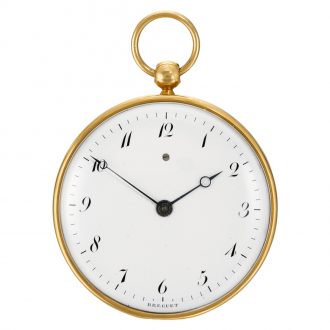
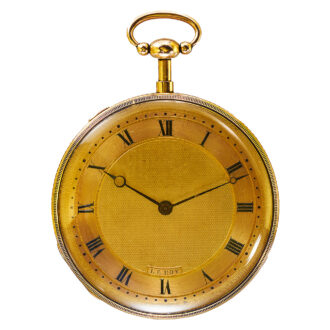
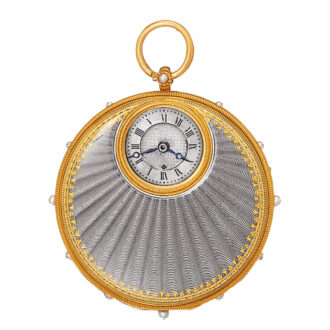
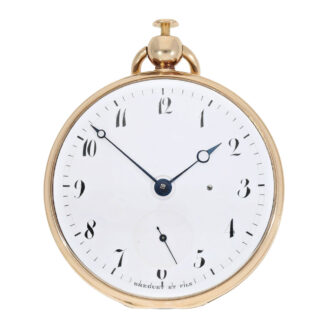
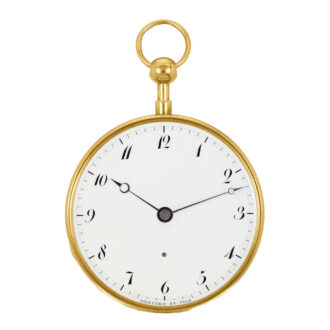
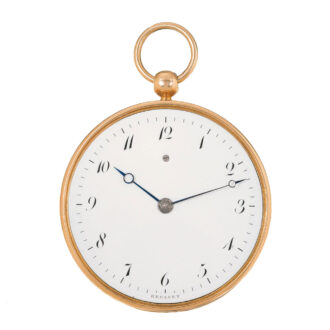
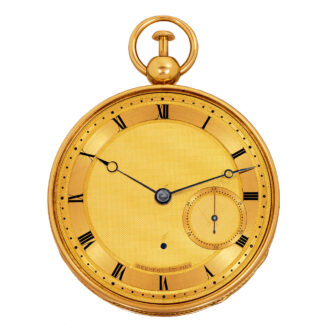
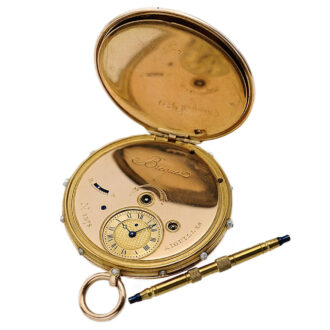
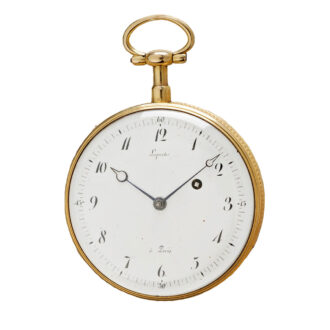
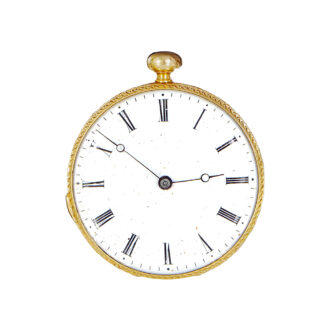
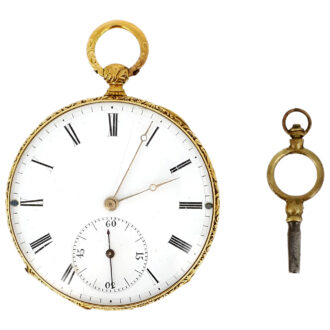
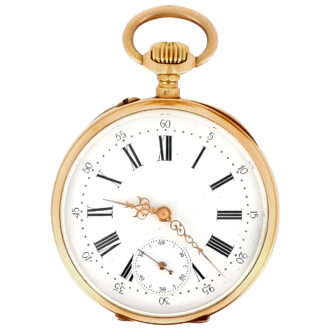
Historically important French 18k gold chronometer Circa 1809
- Kenmerk
- CH1589
- Diameter
- 66 mm
- Estimate
- € 500.000 - 1000.000
- Price sold
- € 673.200
Exceptional open faced chronometer by Breguet
–
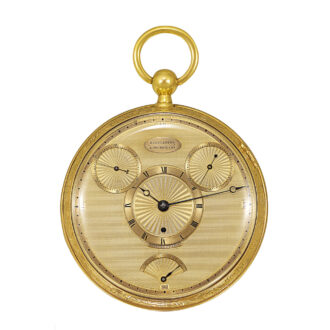
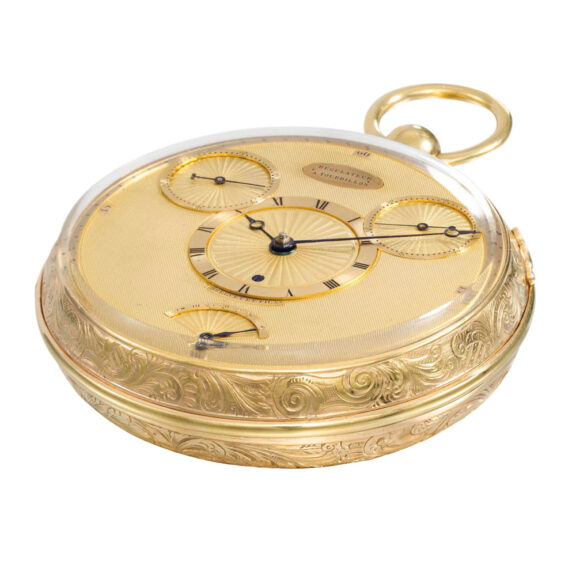
An exceptional and historically important French 18 carat gold open faced pocket chronometer with four minute tourbillon, échappement naturel, double subsidiary seconds, power reserve and stop seconds feature, circa 1809. Sold to Comte Potocki through Monsieur Moreau in St. Petersburg on 12 February 1809 for the sum of 4,600 Francs. Montre garde-temps à tourbillon. Gilded brass movement, semi elliptical backplate, reverse fusée with maintaining power, échappement naturel of unusual design with 12 toothed and 3 toothed escape wheels, the lever with single banking spring allowing even rest on both escape wheels, three armed bimetallic compensation balance with an oscillation rate of 21,600 vibrations per hour, blued steel balance spring with terminal curve, all mounted in the two armed tourbillon cage driven from the second wheel pinion and revolving once every four minutes.
–
Gold cuvette. Engine turned solid gold regulator dial, outer dot minute and Arabic 15 minute divisions, small hour dial with Roman numerals on plain chapter ring, blued steel Breguet hands, elongated minute hand, two small subsidiary seconds dials flanking the hour dial, fan shaped power reserve sector calibrated for 35 hours, all with engine turned sunburst decorated sunken centres. Large case, hidden hinges, finely engraved scroll and foliage decorated bezel and rim, back centred by the engraved arms of Comte Potocki, the tourbillon carriage stopped by a lever in the bezel, allowing the precise setting of the time. Case No. 1282 by Amy Gros, gold dial by Tavernier signed Breguet et Fils, movement signed Breguet No. 1176.
–
Diameter: 65.5 mm
–
Signed: Breguet et Fils
–
This piece is an outstanding and historically important 18 carat gold open faced pocket chronometer with four minute tourbillon, échappement naturel, double subsidiary seconds, power reserve, stop seconds feature and gold regulator dial, sold to the Polish nobleman Count Stanislas Potocki through Monsieur Moreau in St. Petersburg on 12 February 1809 for the sum of 4,600 Francs. Abraham-Louis Breguet’s very first four minute tourbillon and only his third tourbillon watch ever made.
–
Count Stanislas Kostka Potocki (1755 -1821). The Polish nobleman, politician, writer, collector and patron of the arts was one of the most emblematic figures of the Age of Enlightenment in his country. A member of an old noble Polish family and son of General Eustachy Potocki, Stanislas was educated at the Warsaw Collegium Nobilium before studying literature and the arts in Wilanow. On 2 June 1776, he married Princess Aleksandra Lubomirska, the daughter of Stanislas Lubomirski, a Grand Marshall of the Crown, also one of Breguet’s faithful clients. In 1792, he became a General of the Army, participating in the Russo-Polish war of 1792, for the defense of the constitution of 3 May 1791. Count Potocki furthermore held the knighthood of the White Eagle and the Saint Stanislas Merits and was Great Master of the Polish Freemasons. From 1792 to 1797, he lived abroad, having left his country after its first dismemberment. He was arrested in Carlsbad after the uprising of Kosciuszko, then lived in captivity for eight months in Josephstadt. When the Great Duchy of Warsaw was created he became the Senator Palatine, Head of the Council of State and of the Council of Ministers. Napoleon made him Minister of Culture and Education, and he retained these posts even after the annexation of the Polish Kingdom by Russia in 1815. Potocki founded the University of Warsaw in 1816 and was elected President of the Senate in 1818, a post which he held until 1820. An art lover and avid collector, he devoted his fortune to promoting literature, sciences and arts, and built up a beautiful collection of paintings, Etruscan vases and engravings in his home, Wilanow Palace.
–
The equestrian portrait of him, painted by Jacques-Louis David whom Potocki met while the artist was at the Academy in Rome, is considered to be one of David’s masterpieces. This portrait, inspired by equestrian portraits by Van Dyck, was one of only three paintings David took along with him when he left Rome to return to Paris. It is now on view in Wilanow, Potocki’s family home which during his life lay on the outskirts of the city, and is now located within Warsaw. Wilanow Palace, renowned for its beauty, was known as ‘the Polish Versailles’. In 1805, in a visionary move, Potocki opened his art collection and a portion of the castle to the public, thus making Wilanow one of Poland’s earliest museums. Count Stanislas Polocki died on 14 September 1821 and was buried at Wilanow.
Signed: Breguet et Fils
Share this page: