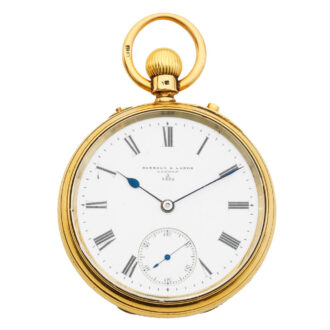
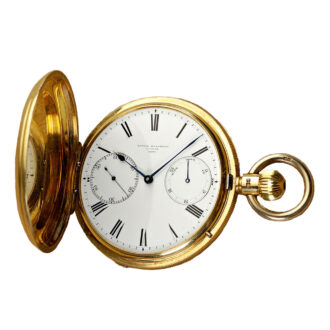
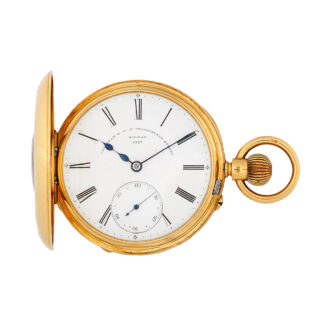
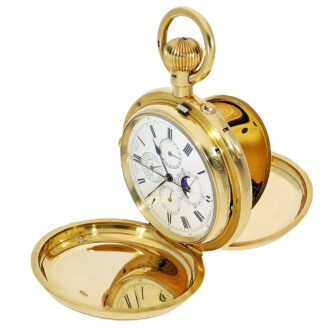
English astronomic Grande Complication pocket watch Circa 1884
- Kenmerk
- AS1862
- Diameter
- 69 mm
- Estimate
- € 60.000 - 125.000
- Price sold
- € 58.600
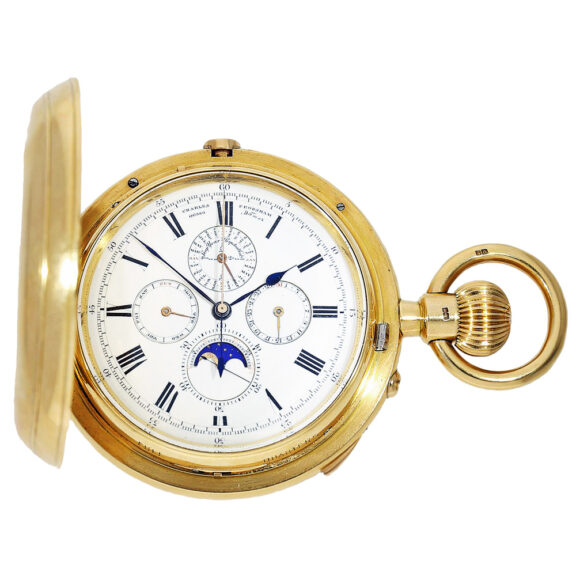
Gold astronomical hunter with 14 complications by Charles Frodsham
–
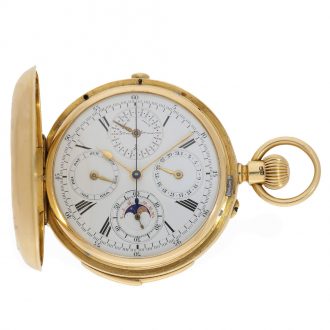
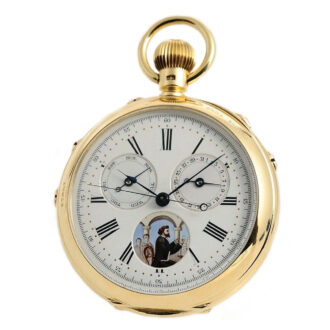
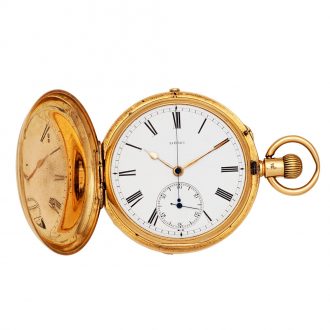
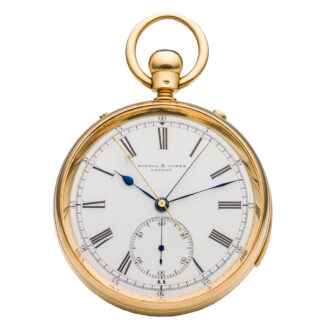
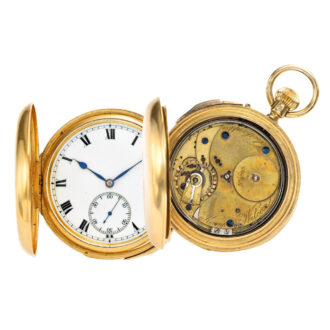
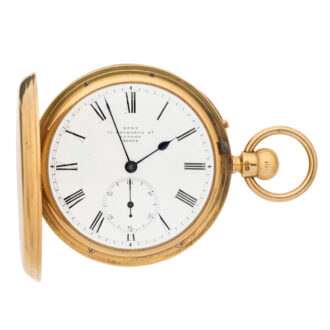
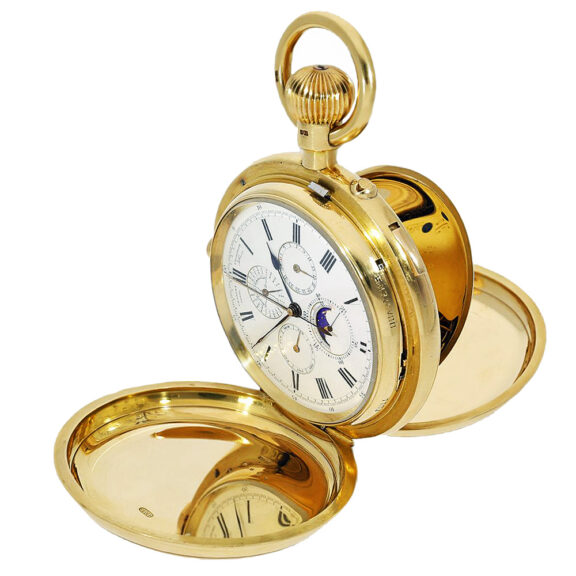
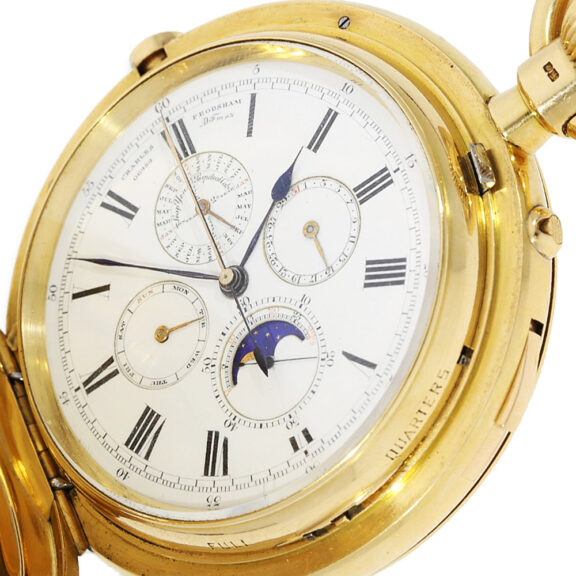
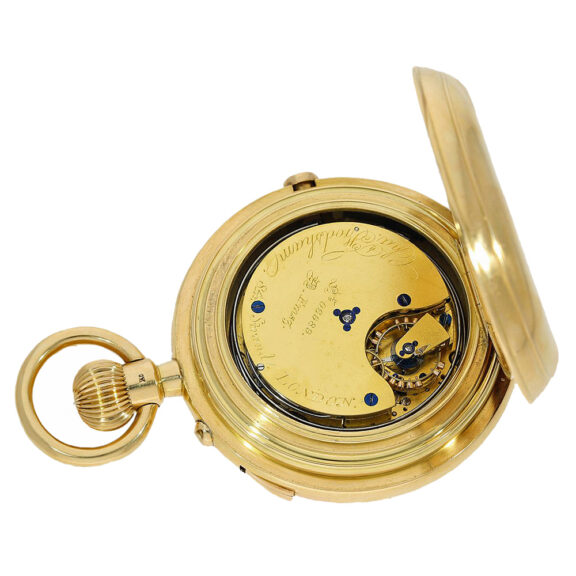
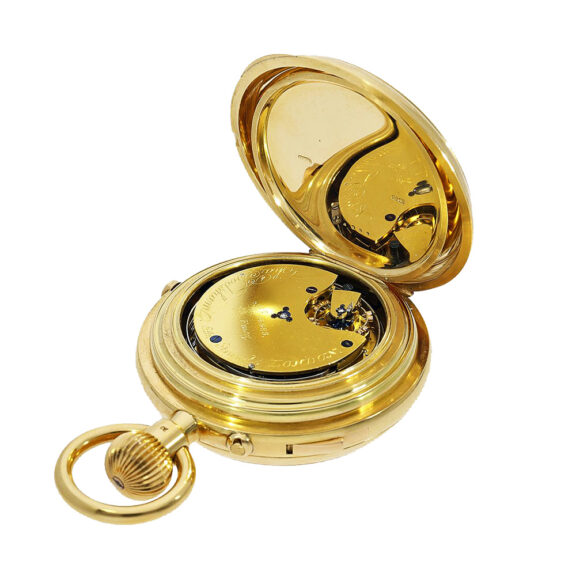
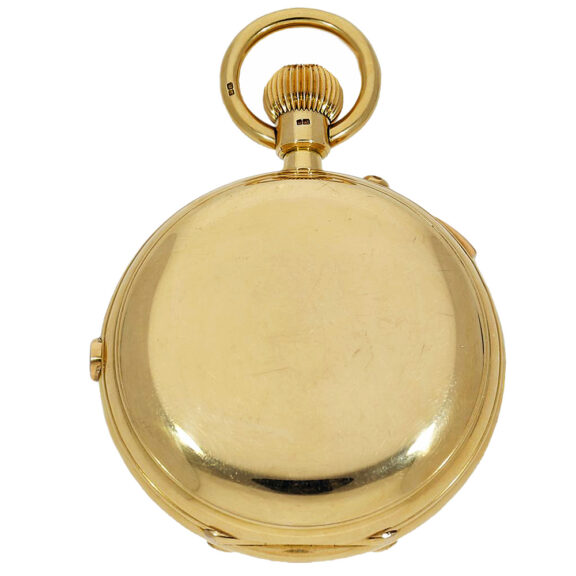
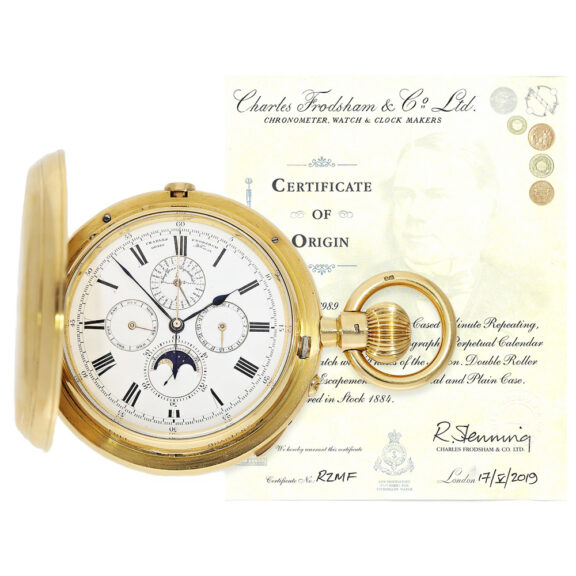
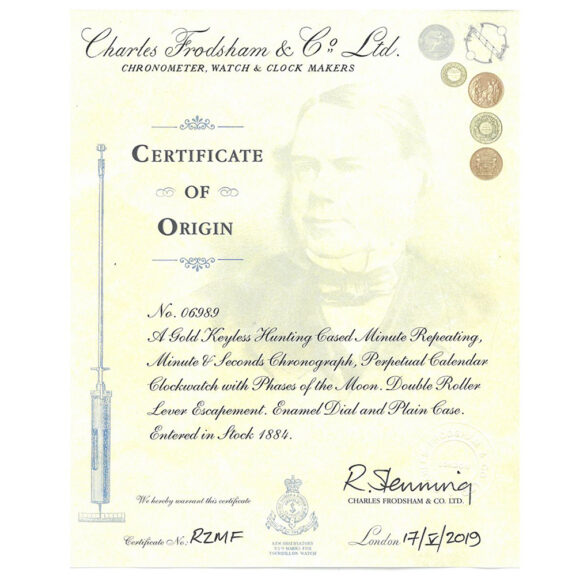
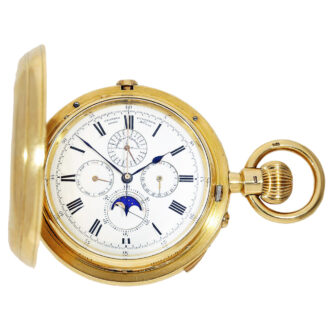
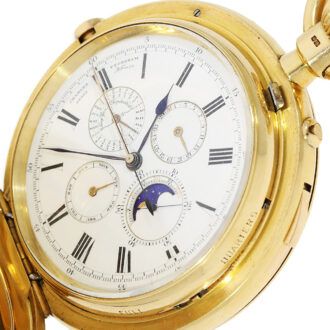
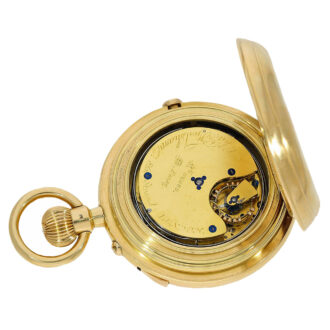
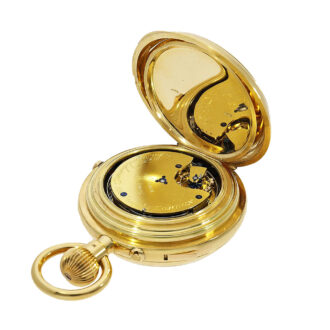
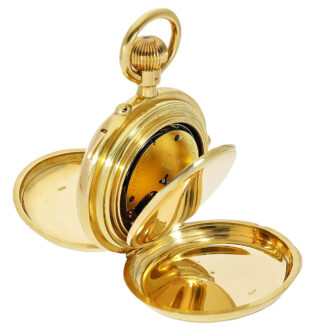
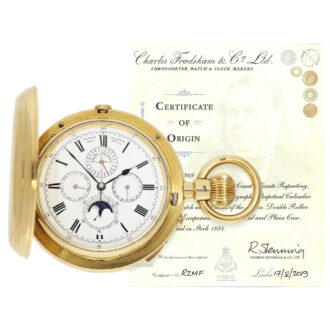
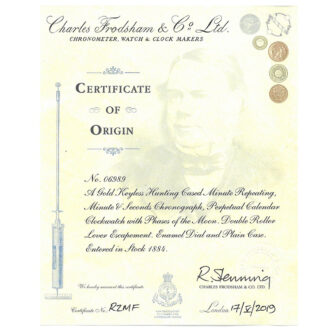
A heavy and massive English 18 carat hunting cased keyless lever two train grande and petite sonnerie clock watch with trip minute repetition, perpetual calendar with moon phases, and chronograph with central register, circa 1884. One of the most impressive pocket watches ever made in England, London, with the extract from the archives. The movement features a gilded three quarter plate, lever escapement, free sprung bimetallic compensation balance, diamond endstone, and a centre pinion wheel with a diamond endstone. It is signed Chas. Frodsham, 84 Strand, London, and numbered 06989. The dial is white enamel with Roman numerals and an outer Arabic minute ring with additional calibrations for chronograph seconds. It also has blued steel spade hands for time and chronograph seconds, a gold central minute recording hand, and four sunken subsidiary dials for day, month with a four year leap cycle, date, and subsidiary seconds combined with an aperture for moon phases. The dial is signed Charles Frodsham, 06989.
–
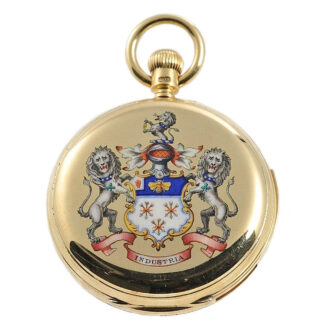
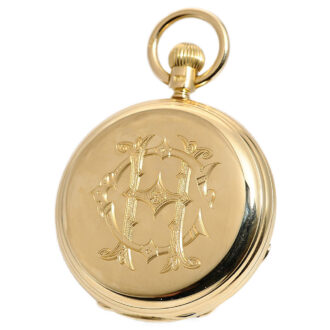
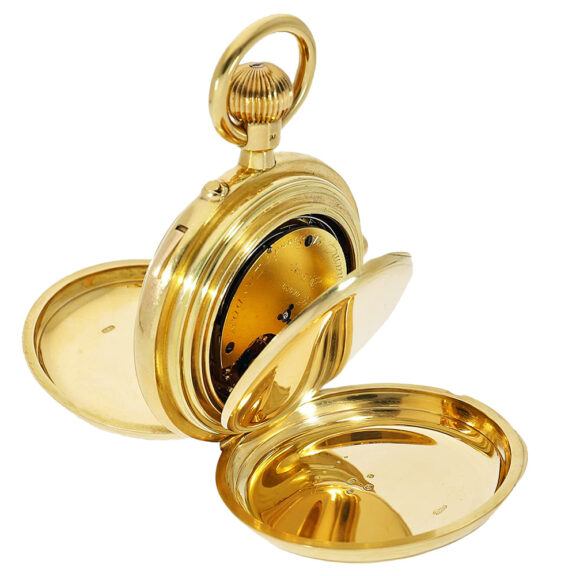
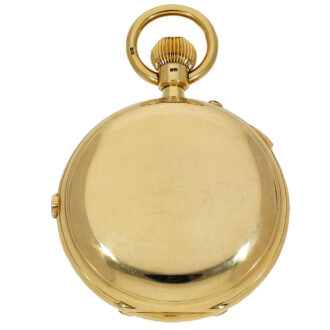
The case is made of 18k yellow gold. It features slides beneath the bezel for strike/silent and for chiming full/quarters, a large plain gold pendant and gold bow, plain polished covers, a large chronograph pusher to the band, and a short trip repeating slide. There are four calendar correctors beneath the bezel, slides for strike/silent and full/quarters for Grande and Petite sonnerie. The case is hallmarked 1884, and the case and cuvette bear the maker’s mark HMF for Harrison Mill Frodsham, with the pendant bearing the maker’s mark AS for Alfred Stram.
–
Diameter: 69 mm
–
Weight: 449 g
–
Signed: Chas. Frodsham, 84 Strand, London
–
This watch is designed to impress, with its remarkable size and weight of 449 g. The case is heavy due to the thick central body with broad multiple steps. The two-train movement is highly complex, and the use of an additional central hand for registering chronograph minutes to the edge of the dial is unusual and noteworthy.
–
The subsidiary day dial has a faint hairline crack running from the centre to the edge, and another faint hairline from the outside of the day dial to the edge of the main dial. Apart from that, the dial is in good overall condition. The case also remains in good overall condition, with scratches and marks consistent with the age and wear of the timepiece. The movement is running, with the chronograph, perpetual calendar, and sonnerie chiming and repeating mechanism all in working order.
–
Pocket watches with 14 complications are rare. Particularly noteworthy are, besides the Grande & Petite Sonnerie, the Trip Minute Repeater, as also found in Patek Philippe watches, and especially, the central 60 minute counter for the chronograph. With almost 450 grams, it is one of the heaviest ‘Grande Complication’ pocket watches ever made.
–
Charles Frodsham was one of the most important English chronometer makers. In 1830, he handed in a marine chronometer for testing at the Royal Greenwich Observatory and achieved a second prize. Frodsham was a member of the Royal Society from 1834. He took over the company John Arnold & Co., in London in 1843. Frodsham was vice president of the British Horological Institute for a time and became a member of the Worshipful Company of Clockmakers in 1845. In 1854, he was appointed Royal Court Watchmaker and Purveyor to the Court. A year later, he was Master of the Clockmakers Company.
Signed: Charles Frodsham
Share this page: