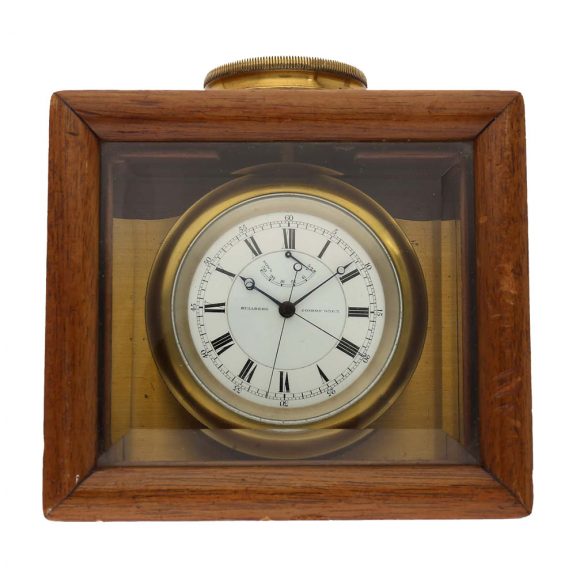
English extraordinarily rare brass chronometer Circa 1923
- Kenmerk
- HC1827
- Diameter
- -
- Estimate
- € 12.500 - 25.000
- Price sold
- € 15.500
Chronometer with split seconds chronograph
–
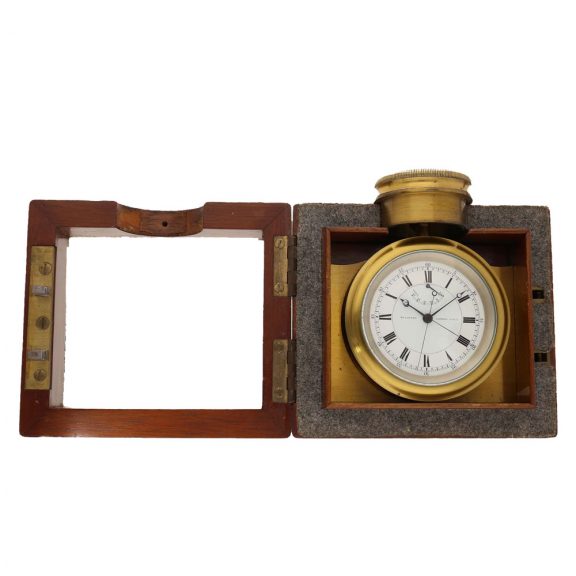
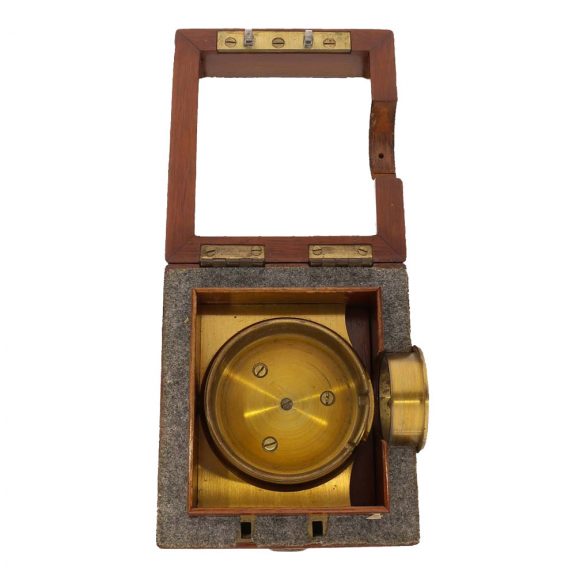
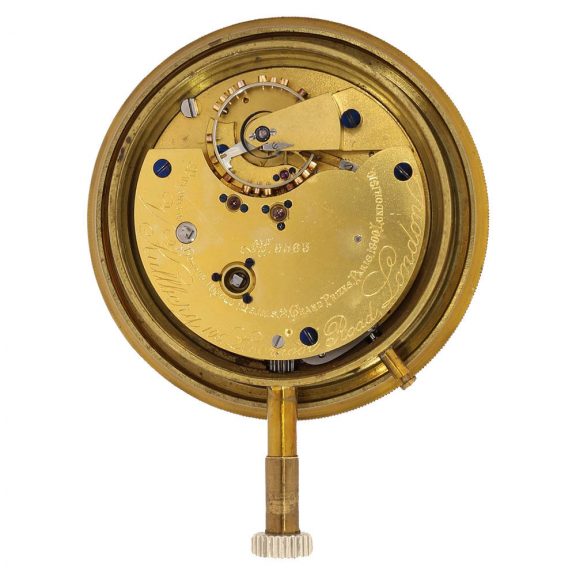
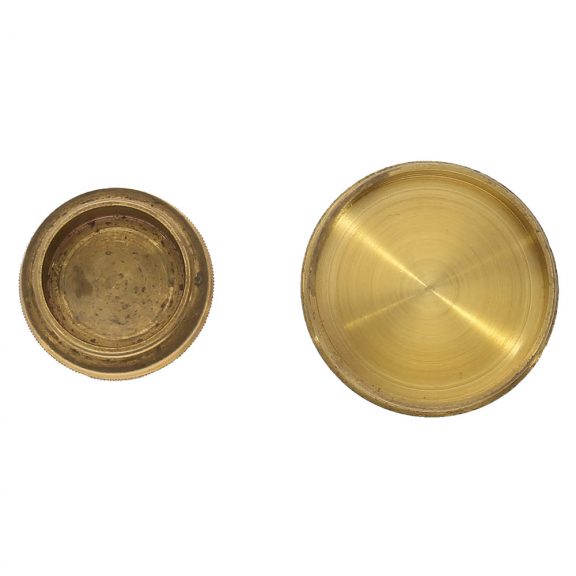
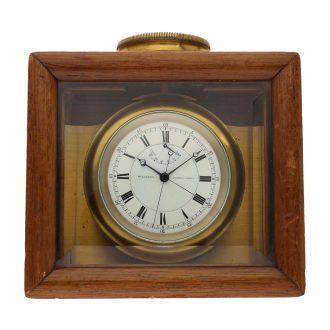
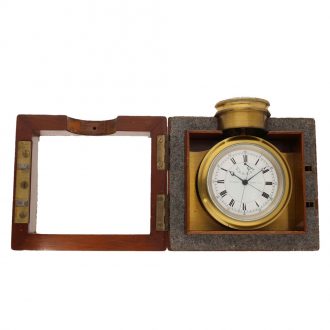
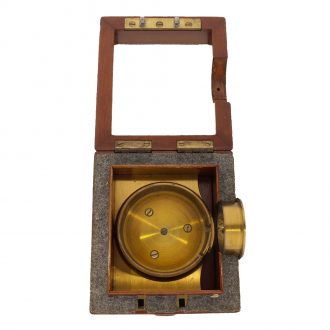
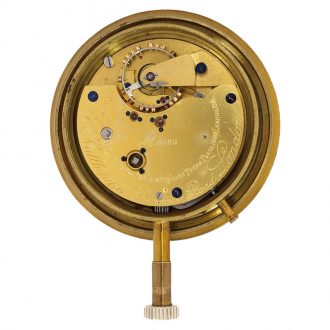
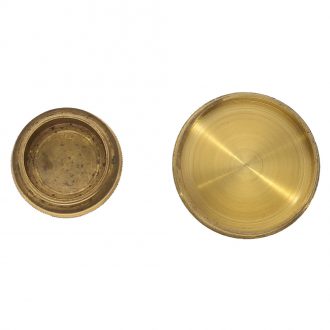
An extraordinarily rare expedition chronometer equipped with a split seconds chronograph and power reserve indicator made for Major Rivers by Victor Kullberg in London, circa 1923. The watch is housed in a glazed mahogany box and features a case with laterally screw secured crown protection and a double screwed construction. Its numbered white enamel dial displays Roman hours, an outer minute track, fifth of a second divisions, outermost Arabic five minute numerals, a power reserve indicator at 12 o’clock and blued steel hands. The numbered movement is fitted with a spring detent chronometer escapement and diamond end stone.
The dial and movement have matching numbers and are signed.
–
Dimensions: 105 x 95 x 55 mm
–
Signed: Kullberg 105 Liverpool Road London
–
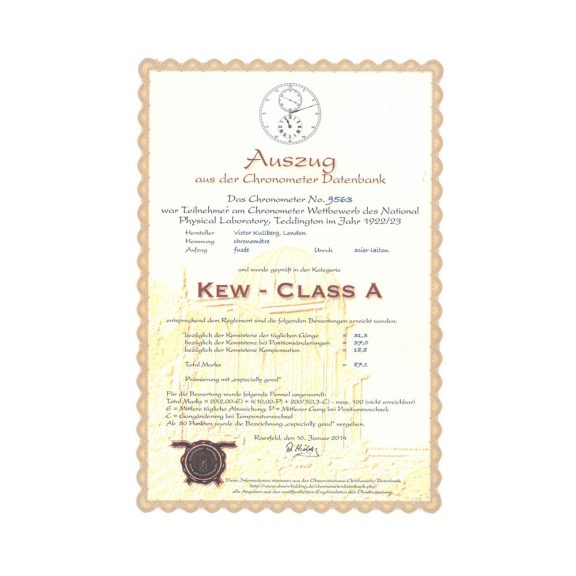
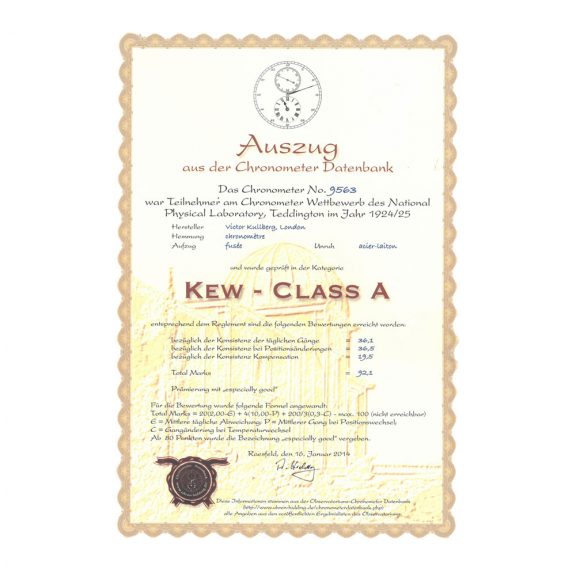
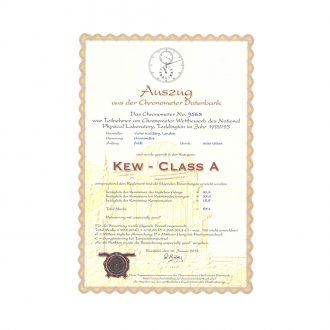
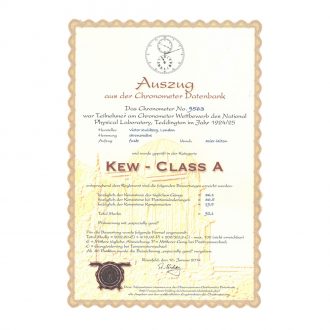
The unusual, special mahogany box of this timepiece indicates that this highly sensitive chronometer had to withstand extreme conditions, so it was probably used as a portable chronometer on expeditions. It comes with two Extracts from the Chronometer database showing it was tested in category Kew class A of the National Physical Laboratory, Teddington, chronometer competition in 1922/1923 and 1924/1925, and was awarded the rating especially good both times, in 1925, with the sensational result of 92.1 out of 100 points. A copy of the original archive documents for this watch, sold in 1923 to a Major Rivers, is also available.
–
In principle, Observatory chronometers with complications are very, very rare, especially with a split seconds chronograph. Built in 1769 for King George III, the Observatory began testing timepieces in the 1850s, giving rise to the Kew certificate ‘A’, which is awarded to watches with excellent timing results. Chronometer testing at the Observatory continued until 1912, when the testing process was moved to the National Physical Laboratory in nearby Teddington.
–
Kullberg
Victor Kullberg (1824–1890) was one of the most celebrated and successful horologists of the 19th century, known for his high quality marine and pocket chronometers. He was a Swedish emigrant who established his business in London and gained an international reputation for his precision timepieces.
–
Kullberg trained in Sweden and Denmark before moving to London in 1851 after attending the Great Exhibition. He quickly became well known for his exceptional escapement work.
–
His main workshop was at 105 Liverpool Road, Islington, London, N1. He made chronometers and movements for London retailers, the Admiralty, the Royal Navy and foreign governments.
–
Kullberg earned numerous gold and silver medals at exhibitions. He was highly successful at the Greenwich Trials, winning first place ten times between 1862 and 1890. His technical contributions included developments in compensation balances and improvements to keyless winding for pocket watches.
–
Following Kullberg’s death in 1890, the firm continued under his nephew Peter John Wennerström and later Sanfrid Lundquist, trading as V. Kullberg. The business at 105 Liverpool Road operated until the premises were destroyed in 1940. The firm’s records are now part of the Clockmakers’ Company Library at the London Metropolitan Archives.
Signed: Kullberg 105 Liverpool Road London
Share this page: