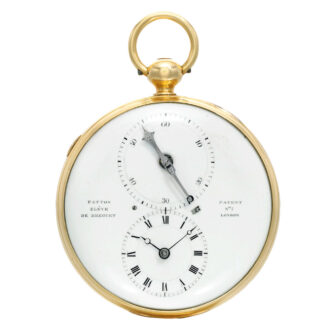
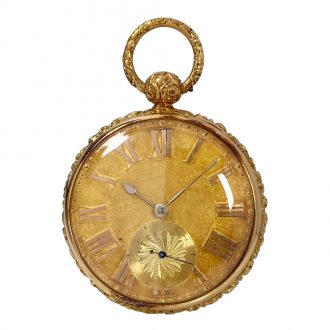
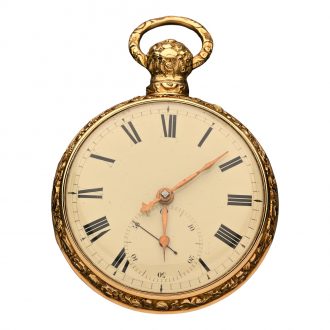
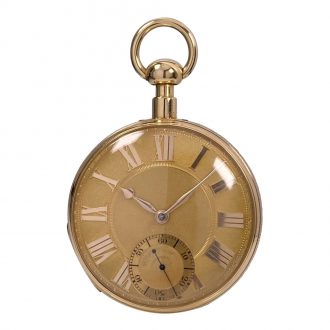
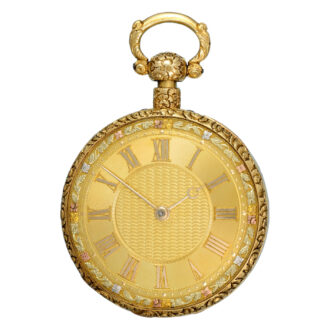
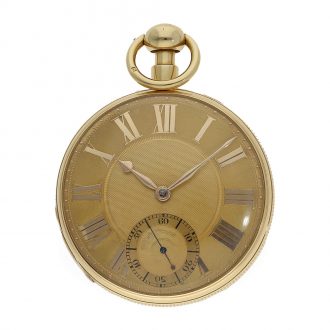
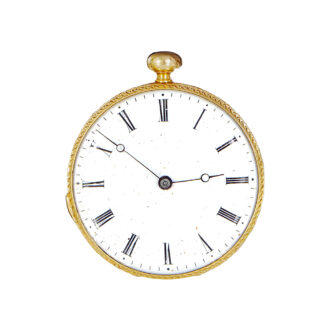
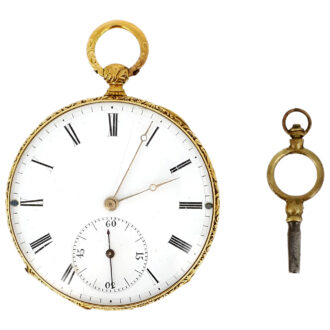
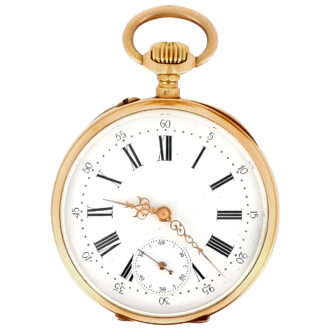
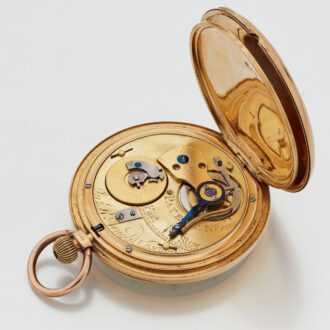
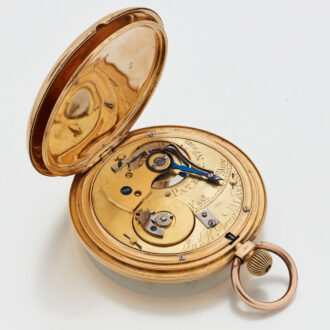
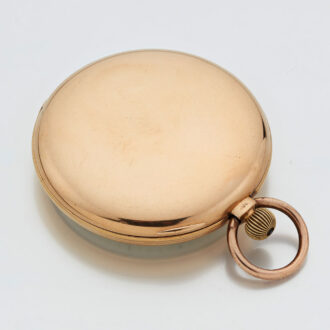
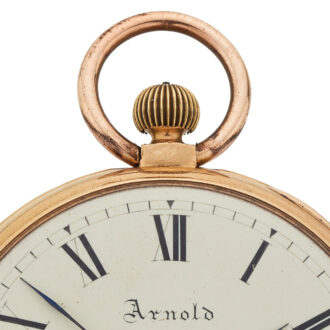
English early keyless wind gold cylinder watch Circa 1823
- Kenmerk
- GF0314
- Diameter
- -
- Estimate
- € 5.500 - 9.000
- Price sold
- € 7.000
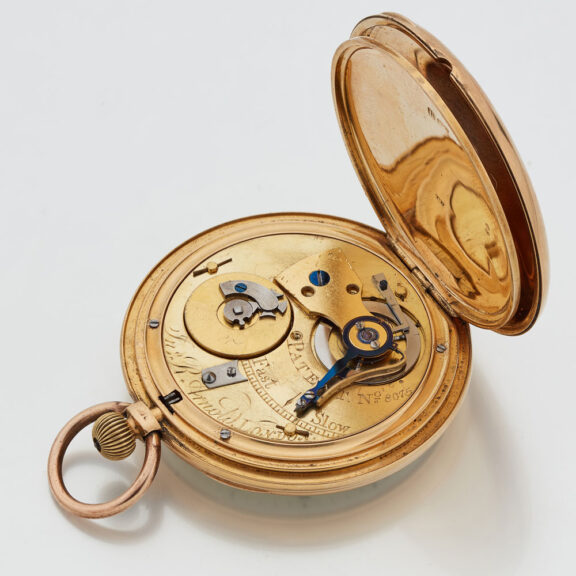
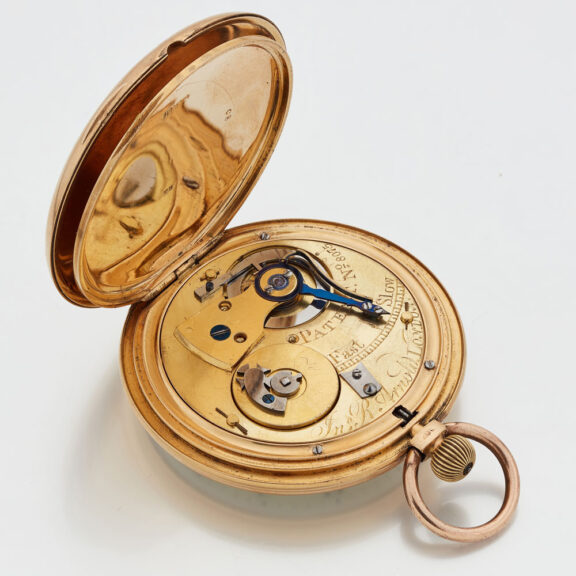
Gold ruby cylinder watch with early Prest patent keyless winding
–
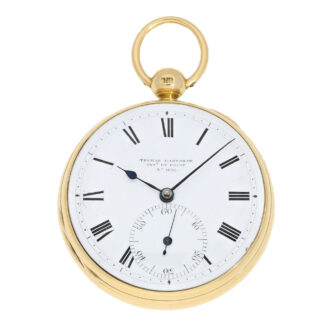
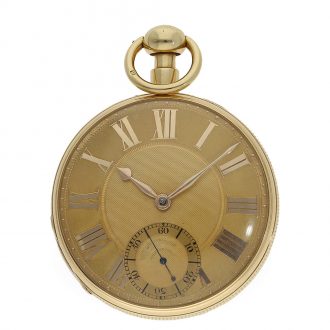
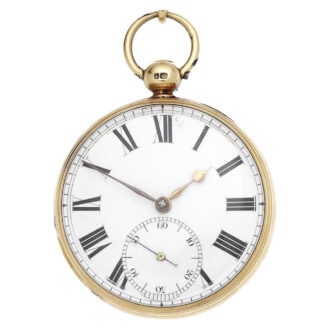
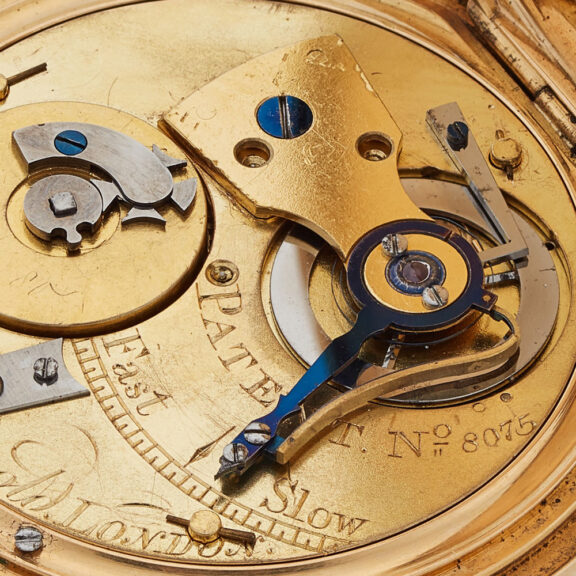
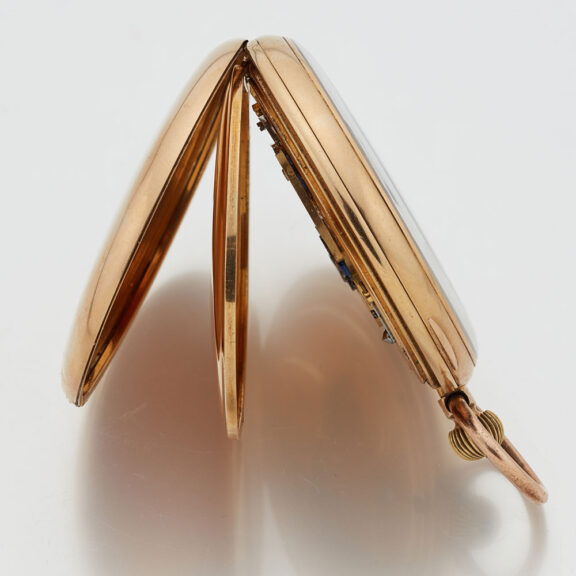
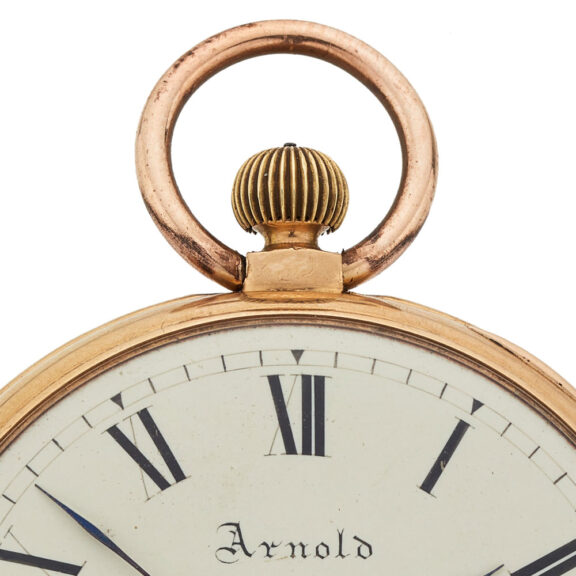
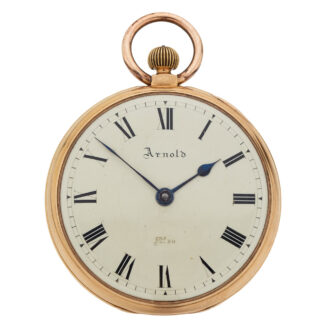
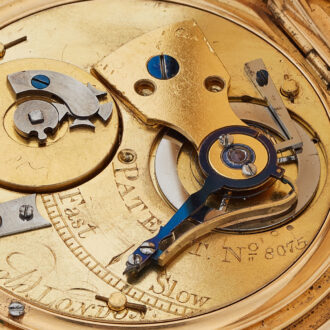
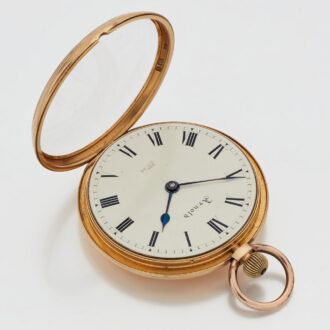
A rare English 18 carat gold open faced ruby cylinder watch with early Prest patent keyless winding, Arnold’s workshops produced about 210 watches with this patented winding system, circa 1823, gilded full plate movement, ruby cylinder escapement, broad flat steel three-arm balance, ruby endstone, large blued steel regulation arm indicating on broad semi-circular scale engraved ongoing barrel bridge, signed Jno. R Arnold, London and marked patent.
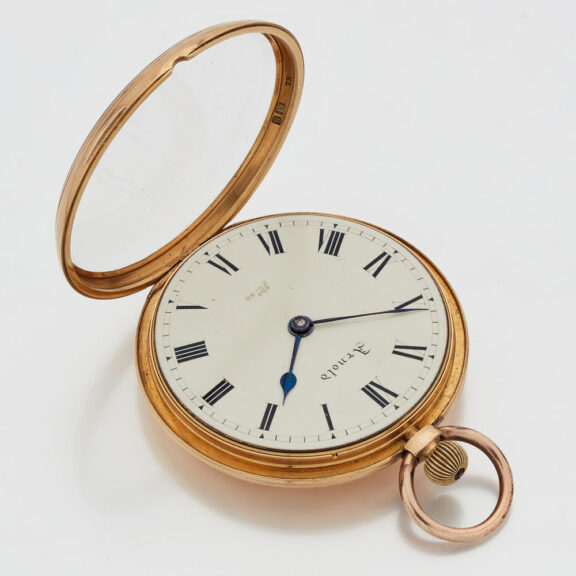
Off white dial, Roman numerals, outer minute ring, blued spade hands.
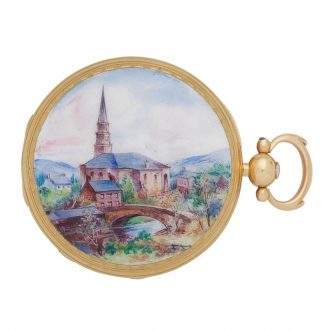
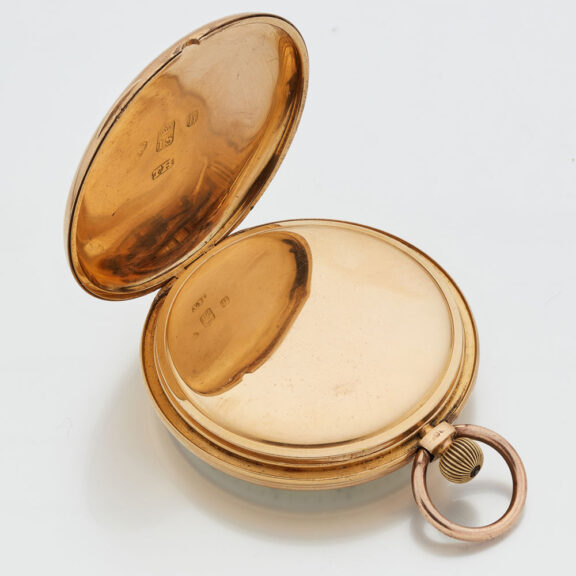
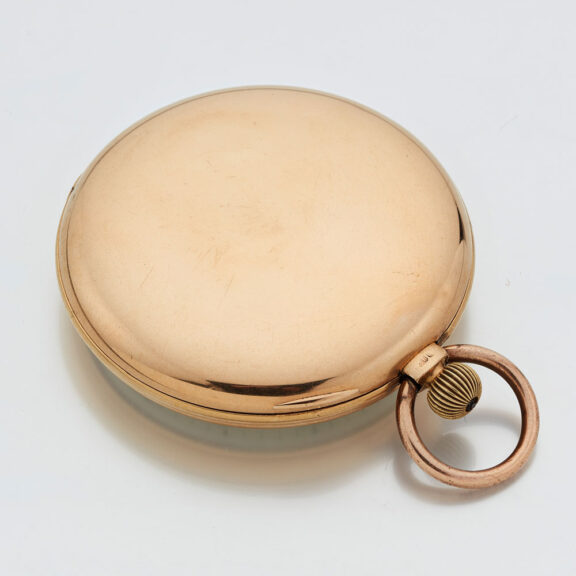
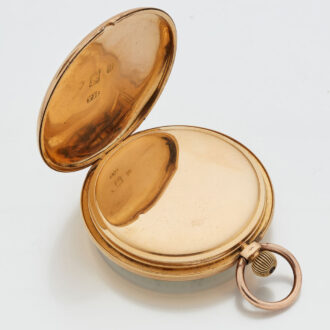
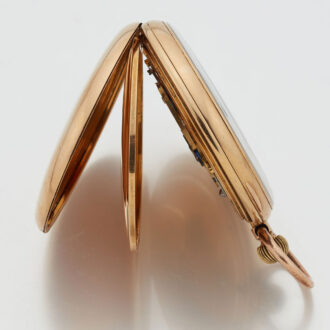
Gold case, plain back, plain band, case with maker’s mark TH in rectangular cameo for Thomas Hardy.
–
Diameter: 51 mm
–
Weight: 103 g
–
Signed: Jno. R Arnold London
–
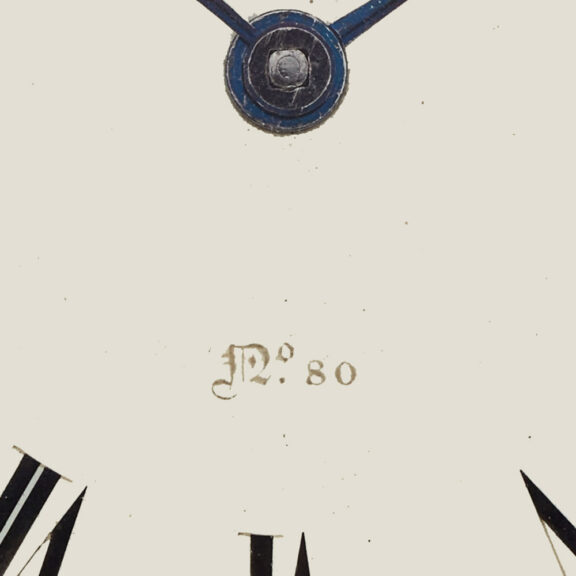
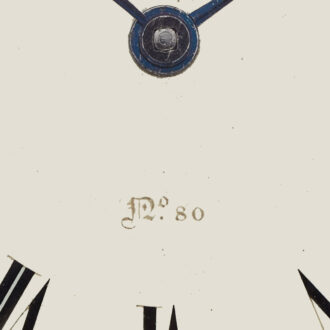
Thomas Prest was John Roger Arnold’s foreman. Prest was granted patent no. 4501 for his keyless winding system on 20th October, 1820. This watch, numbered 80, has the London hallmark for 1823-1824 and is one of the 210 watches with the keyless system that survived time.
Thomas Prest’s keyless system is discussed, together with an illustration of his patent drawings, in an article by Michael Gibbons for Antiquarian Horology: English Keyless Winding Watches. The patent only allowed for the winding of the watch and not the hand-setting. The development of keyless winding was one of the greatest advances in mechanical horology and Prest’s system marked an important step in its evolution.
–
John Roger Arnold (1769 – 1843)
He was born in 1769 as the son of the watchmaker John Arnold. The craft of watchmaking he began in 1783, first apprenticing with his father and from 1792 on with Abraham-Louis Breguet. He was admitted to the Freedom of the Clockmakers Company in 1796 and became a Master in 1817. After the death of his father, John Roger continued the company on his own until 1830. In this year he moved to Strand 48 and started a 10-year partnership with E.J. Dent; business went well during this time and the partners had the possibility to research and experiment, in particular, they investigated the influence of magnetism on chronometers. When the partnership ended in 1840, Arnold continued his work until his death in 1843.
–
Reference 0035000
Signed: Jno. R Arnold London
Share this page: