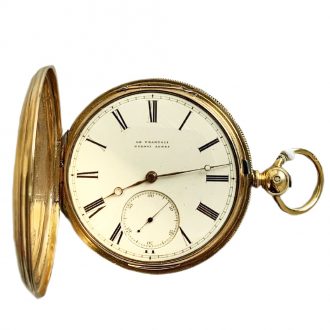
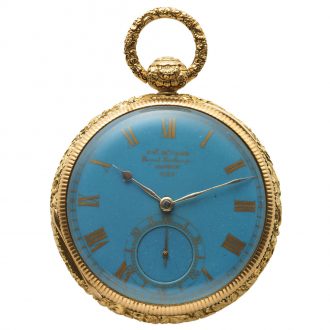
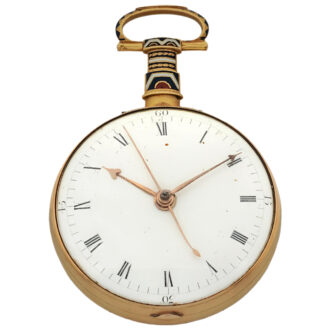
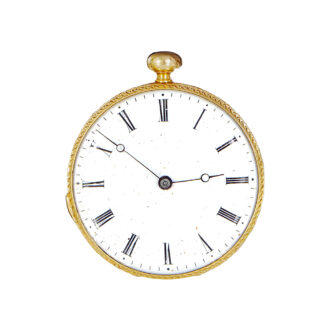
Very fine English duplex made for the Chinese market Circa 1820
- Kenmerk
- PD0314
- Diameter
- 60 mm
- Estimate
- € 40.000 - 70.000
- Price sold
- € 61.250
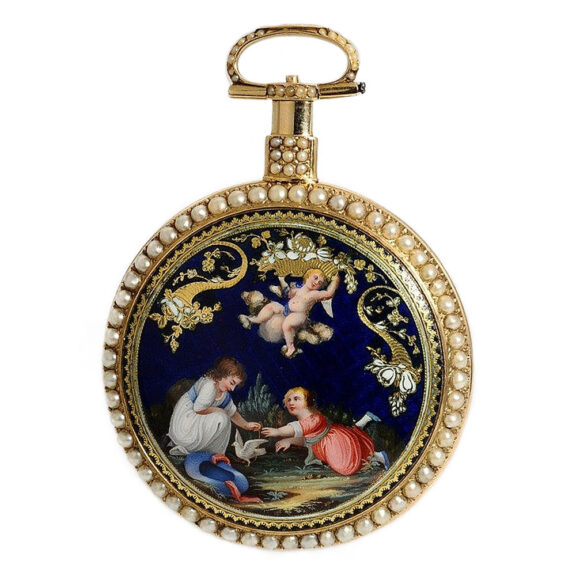
Gold, enamel and half pearl-set watch
–
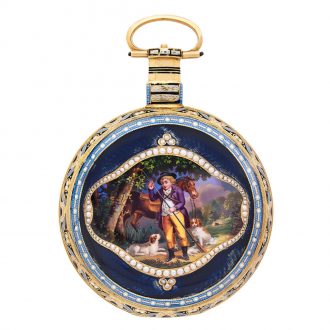
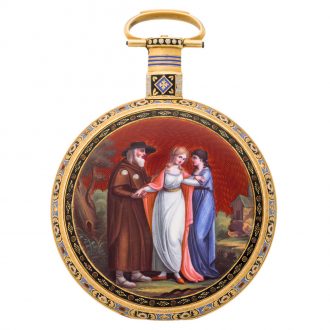
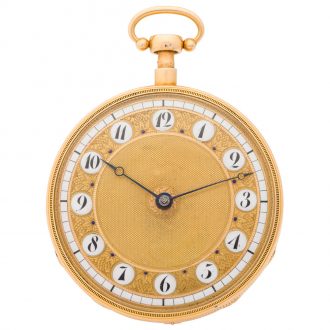
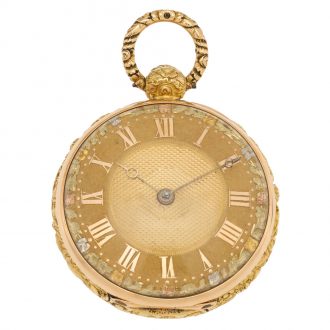
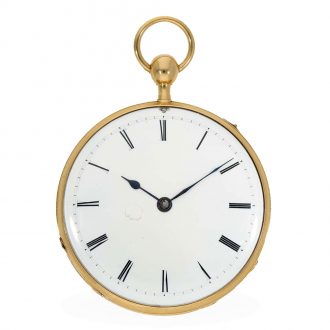
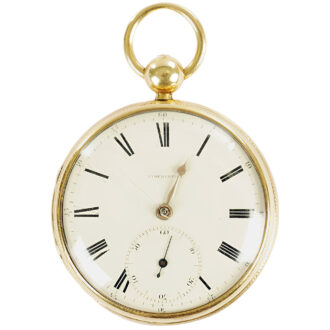
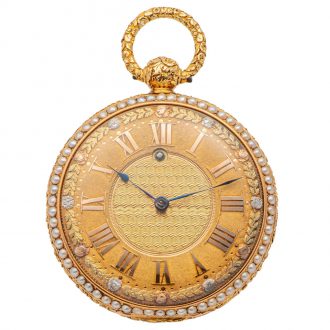
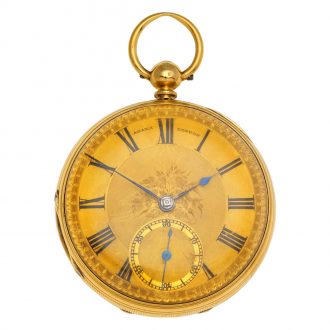
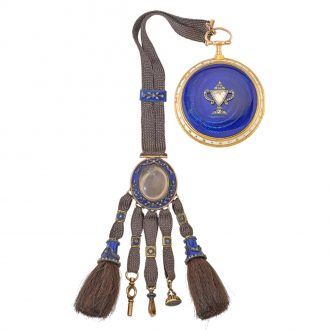
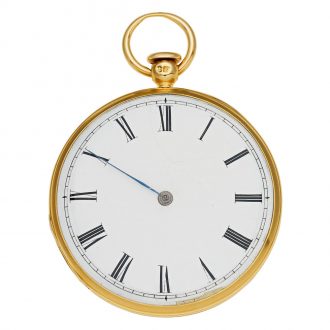
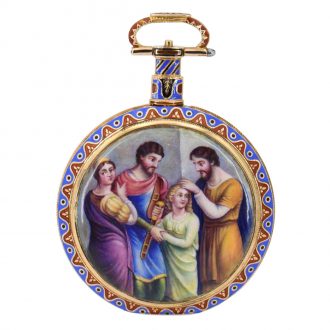
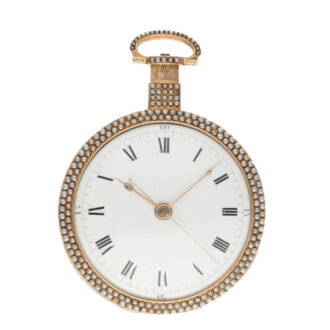
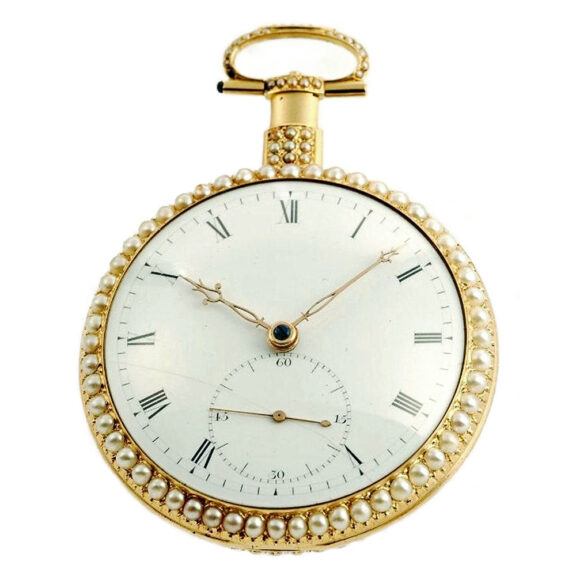
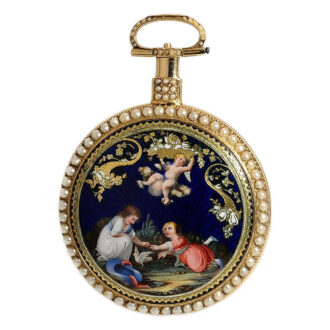
A very fine English 18K gold, enamel and half pearl-set open faced duplex pocket watch made for the Chinese market, circa 1820. The case back with a polychrome enamel pastoral scene on an engine-turned translucent cobalt blue ground showing two children playing with a dove, a putto floats above them on a cloud and holds an engraved wicker basket filled with white enamel flowers, engraved cornucopias on each side filled with white enamel flowers, both bezels, pendant and bow are set with half-pearls. A lavishly engraved gold dome. White enamel dial with radial Roman hours, extra seconds and filigree gold hands. Gilt bridge movement, lavishly orally engraved, keywind, going barrel, duplex escapement, five-arm steel balance, pierced balance cock, chatoned diamond endstone on balance.
–
Diameter: 60 mm
–
Weight: 141 g
–
Signed: Ilbery, London
–
William Ilbery, circa 1760-1839, was active in London from 1780 in Goswell Street, he moved to Duncan Terrace towards the end of the 18th century. After James Cox in London and Jaquet-Droz in Switzerland, he also specialized in producing luxury watches for the Chinese market. His early production was very much in the English style, featuring a full plate movement and an English-type single-wheel duplex escapement. However, for his highest-quality watches, he incorporated a spring detent escapement. Later, the watch movements he produced were much inspired by the Lépine calibre with a free-standing barrel, as were Jaquet-Droz’s Swiss production signed in London and that of William Anthony, who worked in London. The cases of his watches were sumptuously decorated by the best Genevan enamellers, such as Jean-Francois-Victor Dupont, who usually signed his work, and Jean-Louis Richter, who signed rarely. He organized the production in Switzerland, mainly in Fleurier, of profusely engraved movements for the Asian market. He was followed in this by makers such as Bovet and Juvet who also worked in Fleurier (Val de Travers). Ilbery can therefore be considered one of the most representative makers of ‘Chinese’ watches. He seems to have maintained close contacts with the continental trade since a watch signed ‘Ilbery Paris’ is known while Ilbery & Son are recorded in London and Fleurier, as well as in Canton.
Signed: Ilbery London
Share this page: