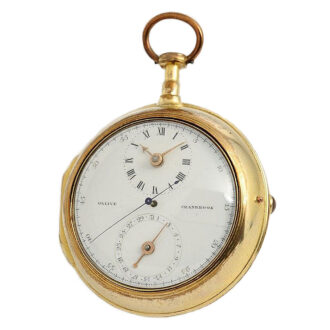
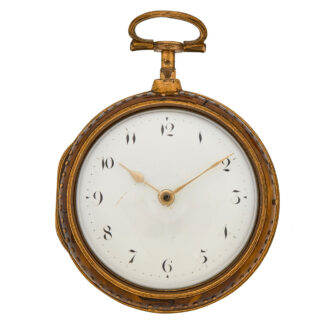
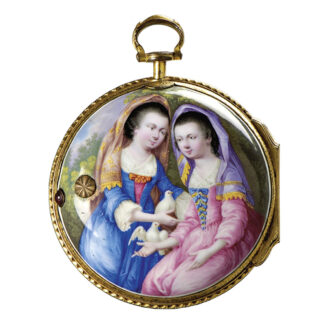
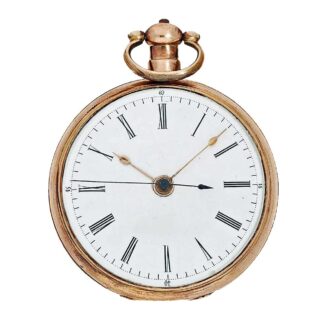
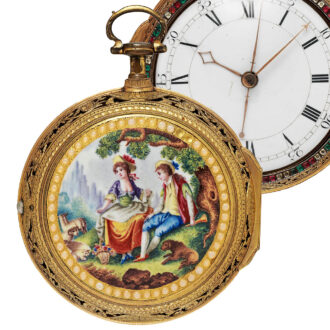
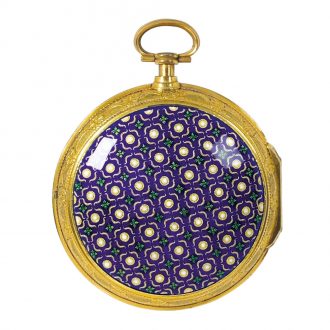
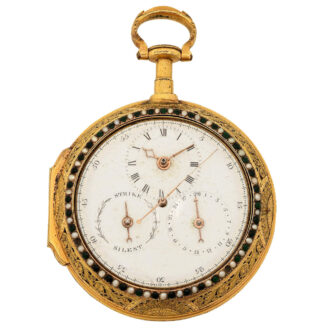
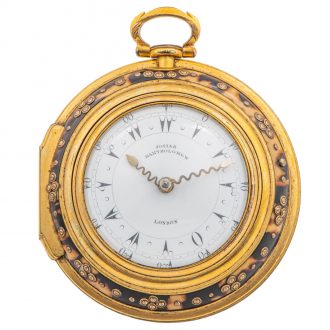
English 8 day chronometer in gilt metal case Circa 1800
- Kenmerk
- SA0343
- Diameter
- 81 mm
- Estimate
- € 4.500 - 10.000
- Price sold
- -
8 Day going gilt metal chronometer with spring detent escapement
–
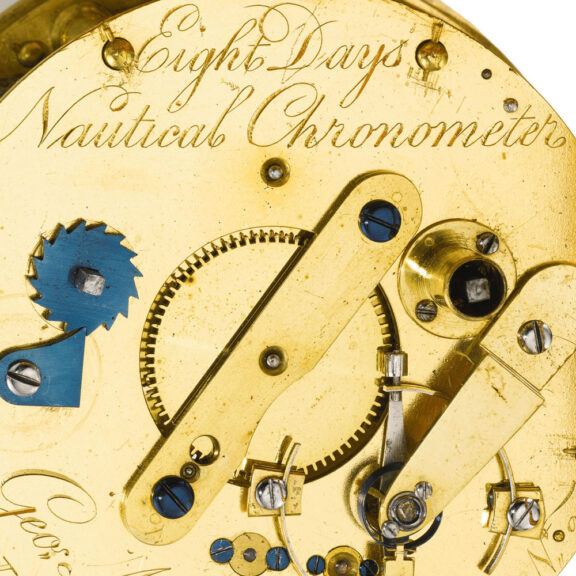
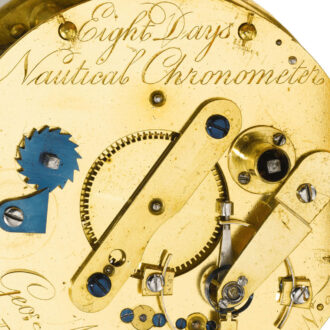
An English massive 8 day going gilt metal consular cased marine chronometer with spring detent escapement, circa 1800, gilded full plate movement engraved ‘Eight Days Marine Chronometer’, Earnshaw-type spring detent escapement, compensated balance with two arms, brass wedge-shaped weights with screw adjustment and timing screws, blued steel helical spring, diamond endstone, fusee and chain, cylindrical pillars, signed Geo. Margetts, Inv. et Fecit, London.
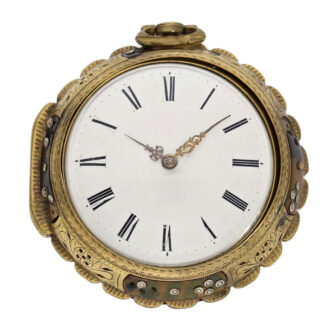
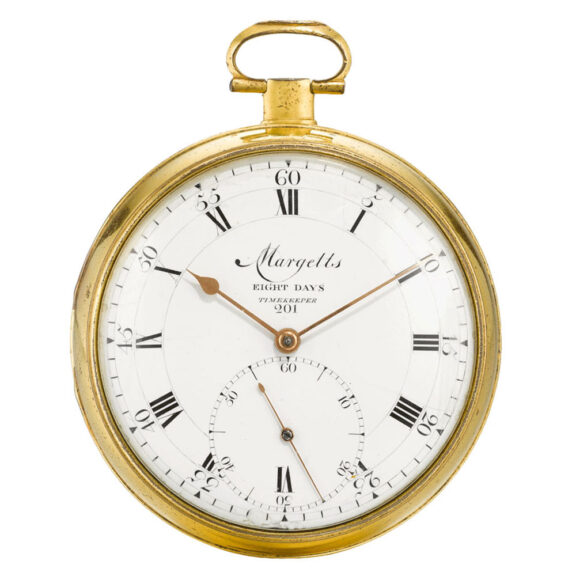
White enamel dial, Roman numerals, outer Arabic minute ring, large subsidiary seconds, gold spade hands, signed Margetts Eight Days Timekeeper.
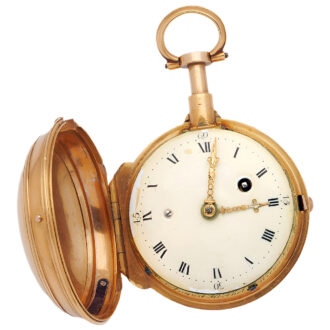
Massive gilt metal consular case, the back cover opening to reveal a fixed cuvette with winding aperture, short ‘Regency’ pendant.
–
Diameter: 81 mm
–
Signed: Geo. Margetts Inv. et Fecit London
–
This large and impressive nautical marine chronometer is one of three similar pieces by Margetts that are known, the other two being nos. 203 and 204. Each of the three have Earnshaw type spring detent escapements, helical springs, and two arm compensated balances. Both numbers 203 and 204 have been previously sold at Sotheby’s: No. 203 was formerly in the Time Museum collection and sold at Sotheby’s New York, 13th/14th October 2004, lot 630, and No. 204 was sold at Sotheby’s London, 2nd December 1995, lot 36. The backplates of numbers 203 and 204 are strikingly similar, each is signed in a block type face and capital letters “Eight Days Timekeeper” with the signature, “Margetts,” in script, whilst the numbers respectively of 203 & 204 are engraved to their barrel bridges. By contrast, the present piece, no. 201, is more elaborately detailed with a script engraving specifically detailing its marine intention and reading “Eight Days Nautical Chronometer” it is also signed more fully Geo. Margetts and with the traditional legend of “Inv. et Fecit” beside the number. All three of these chronometers are housed in gilt metal cases of similar diameter and almost certainly share the case maker’s mark of WH, probably William Howard II (the present lot and no. 203 have this maker’s mark, however, no. 204’s mark was not mentioned at the time of sale in 1995). Nos. 201 and 204 have enamel dials, whilst no. 203 has a silvered dial.
George Margetts was born in Woodstock, Oxfordshire on 17th June 1748. It is thought that he was apprenticed as a clockmaker locally, perhaps working for the first 10 years of his career close to Woodstock. Margetts was made free of the Clockmakers’ Company in 1779, by which time he had presumably moved to London. He was elected to the Livery of the Clockmakers’ Company in 1799. Margetts, was a petitioner to the Board of Longitude on several occasions, with the goal to secure funds for his various projects that related to finding Longitude and improvements in astronomy. The Board did grant him some funding as did the East India Company. The latter he supplied with tables to assist navigators. Though little is known about his life, he remains remembered for his astronomical watches and eight-day chronometers. Margetts died at home in 1804 after a time spent in St. Luke’s lunatic asylum. For further information on Margetts, see Anthony J Turner, “New Light on George Margetts”, Antiquarian Horology.
With a double ended key for winding and hand set
Signed: Geo. Margetts Inv. et Fecit, London
Share this page: