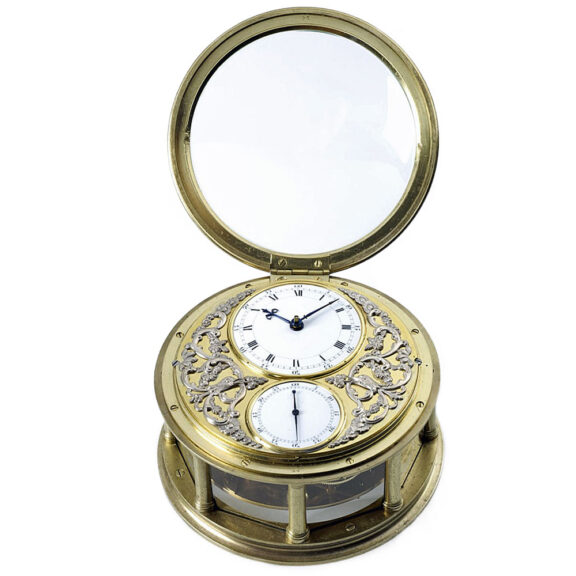
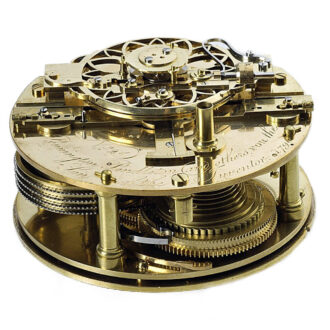
English one day ship’s chronometer of museum quality Circa 1796
- Kenmerk
- AD8577
- Diameter
- 124 mm
- Estimate
- € 400.000 - 600.000
- Price sold
- € 471.200
Brass ship’s chronometer by Pennington & Pendleton / Thomas Mudge
–
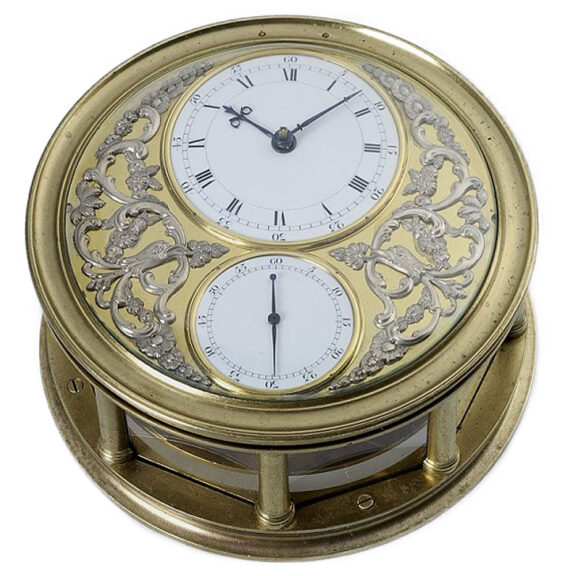
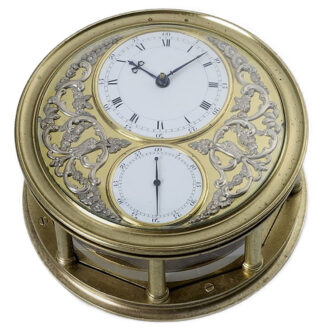
An English, one day ship’s chronometer of museum quality, built according to the designs of Thomas Mudge, circa 1796.
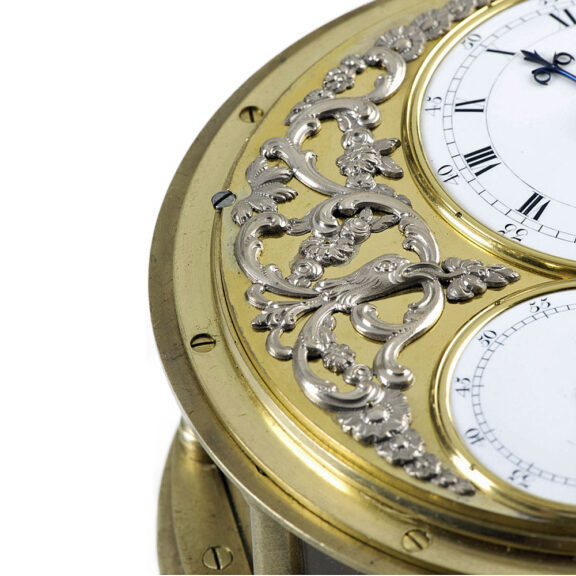
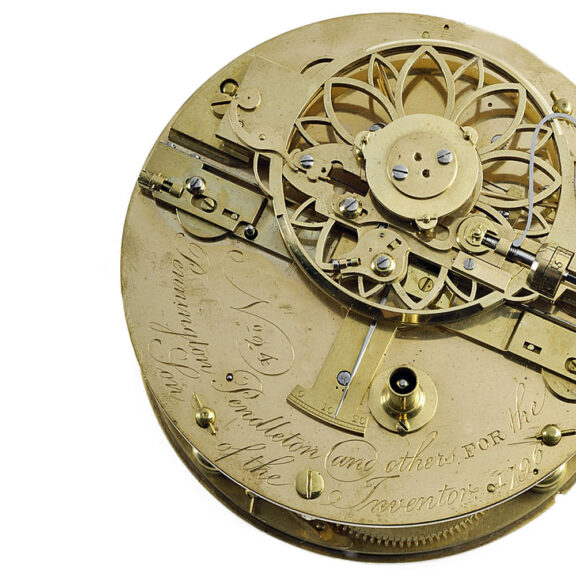
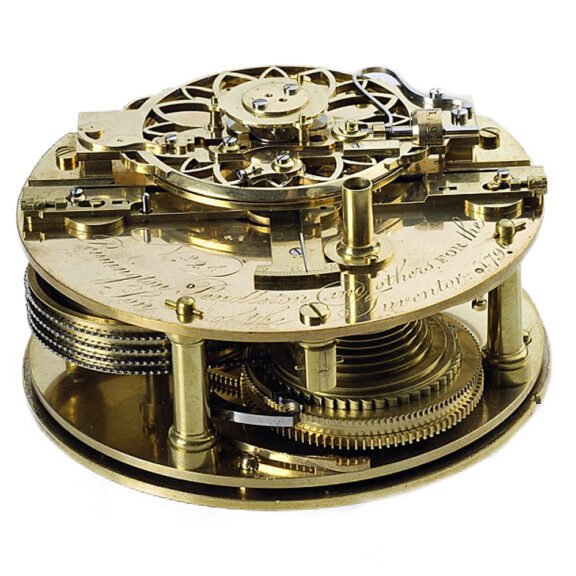
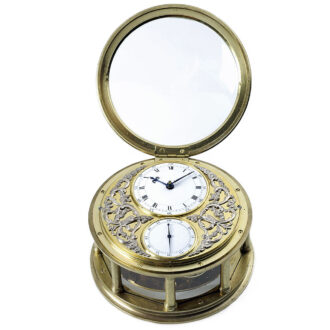
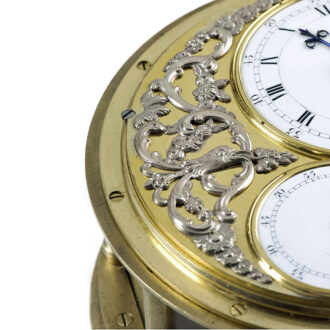
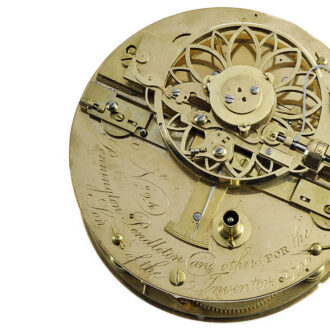
The case is brass and glazed on all sides with moulded pillars and convex glazed. The dial has two applied enamel dials with gilt frames on a gilt ground plate, very fine applied foliate scrolls, radial Roman hours, Arabic minutes, and blued Poker & Beetle hands. And the signed, brass movement has moulded pillars, chain/fusee fitted with Harrison’s maintaining power, finely polished six-spoked wheels, Thomas Mudge’s remontoir escapement after drafts by Johan Jakob Huber, fifteen-toothed escapement wheel, large polished three-arm brass balance, steel balance staff mounted between four steel rollers to reduce friction, openwork geometric balance bridge, temperature compensation of the lower blued balance spring by way of two straight bimetallic segments on slides with adjustment screws on each side, fine adjustment of the upper blued balance spring using a square and an indexing screw using a slide and lever system, and engraved scale with regulator’s hand.
–
Diameter: 124 mm
–
Dimensions: 124 x 60 mm
Signed: Pennington, Pendleton and others for the Son of the Inventor 1796
–
This chronometer is one of the few in the series that was fitted with an escapement after the original design by Thomas Mudge Snr. However, the production costs for the design were very high and most of the watches by ‘Pennington, Pendleton and Others’ were fitted later with a chronometer escapement in the style of Earnshaw
–
Thomas Mudge (1715-94)
The first timekeeper Thomas Mudge designed with a constant force escapement was built in 1774 and intended as a competitor for the longitude prize of 20,000 pounds the British Parliament was offering. Mudge later produced another two models of the same type but none of his chronometers was recognized and rewarded; Mudge died an embittered man.
–
About a year before his death his son had formed a partnership with William Howells and Robert Pennington; he planned to build timekeepers according to his father’s specifications in a factory. Mudge the Elder was supervising the production of the chronometers until his death later in the year. The first pieces were accordingly signed, Howells and Pennington for Thomas Mudge. However, only eight chronometers were produced in the first 18 months and in 1796 Mudge the Younger took on additional staff to increase production; Howells and Mudge did not see eye to eye on this though and ended their partnership. Unfortunately for Mudge, the premises belonged to Howells, so that he had to look to move his business to another location.
–
After his agreement with Mudge had finished, Howells went into production with Paul Philip Barraud and George Jamison and they began building simplified versions of Thomas Mudge’s original drafts. Once he had established his new workshop, Mudge Jr. took on the escapement maker Richard Pendleton and intended him to work with Robert Pennington on the creation of chronometers according to his father’s designs. Howells’ team as well as Mudge Jr. both saw themselves as the legitimate successors of Mudge Sr.’s work, so there are two separate series from series no. 9 on. However, neither company was really fortunate in their endeavours and Mudge was forced to close his factory in 1798 – only 19 more chronometers had been produced by then so that the total came to 27. Howells’ business was even less productive and closed in 1799 after making only seven timekeepers.
Signed: Pennington, Pendleton and others
Share this page: