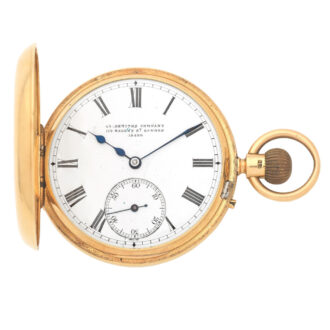
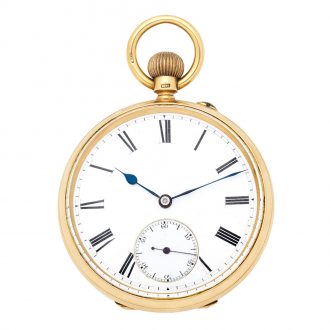
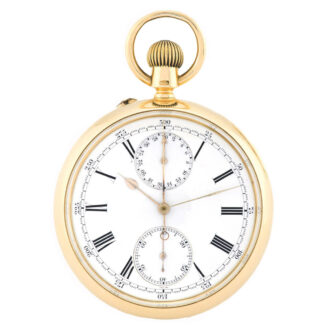
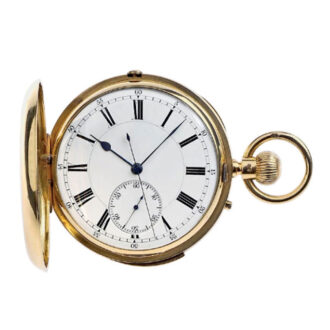
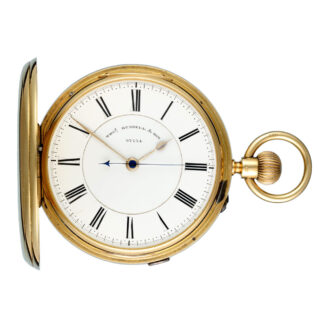
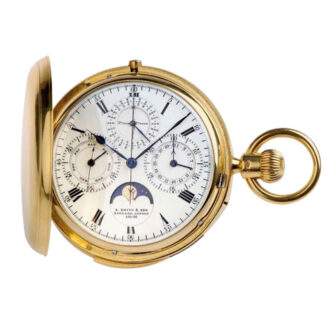
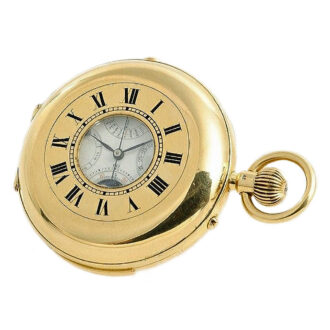
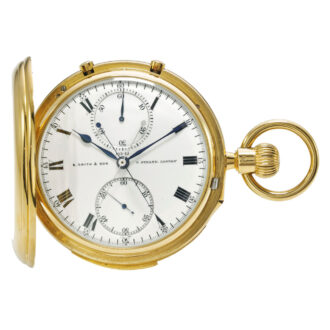
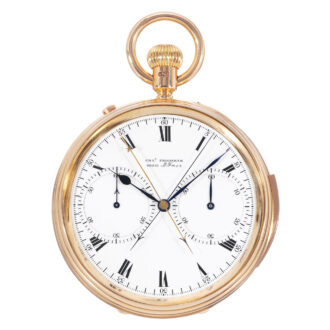
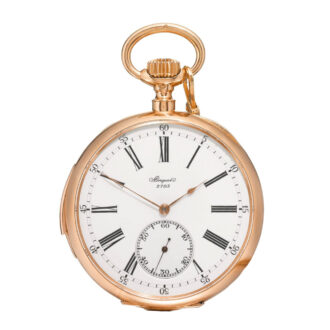
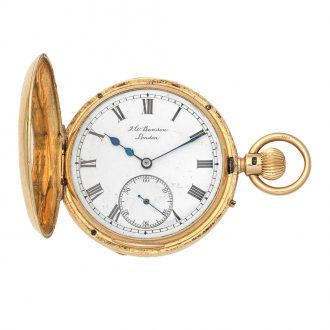
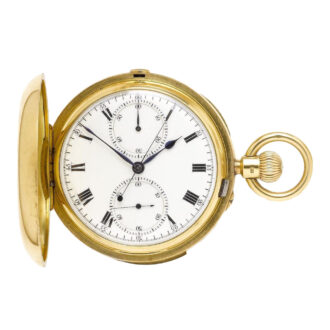
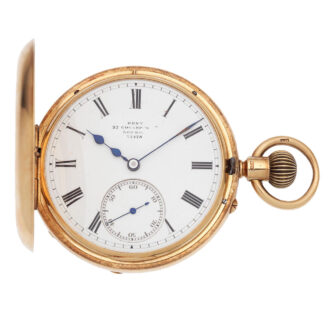
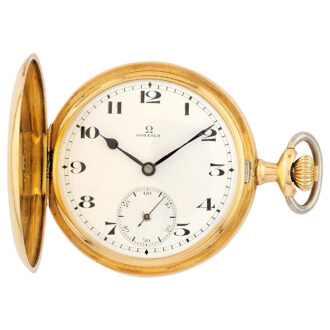
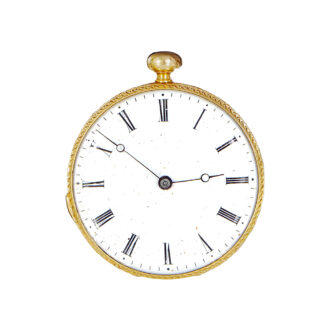
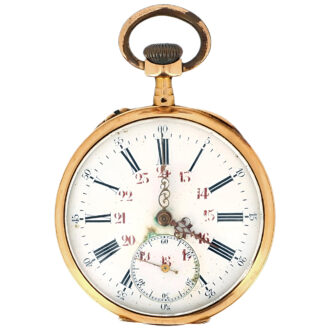
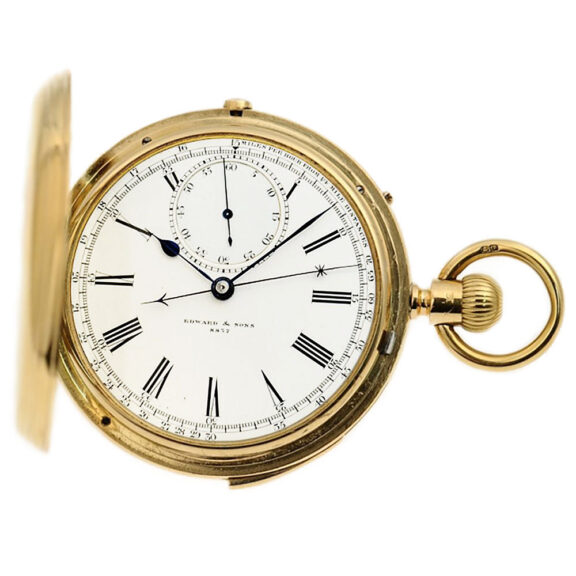
English repeater with chronograph and tachy scale Circa 1898
- Kenmerk
- AD8376
- Diameter
- 53 mm
- Estimate
- € 5.500 - 10.000
- Price sold
- -
Gold heavy repeating hunting cased pocket watch by George Edward & Sons
–
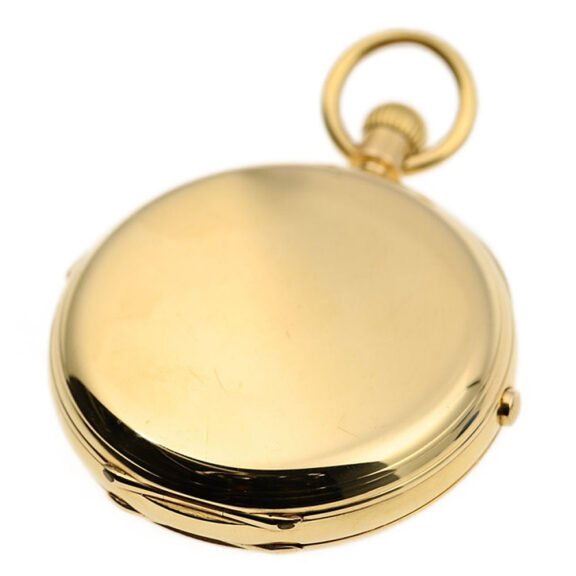
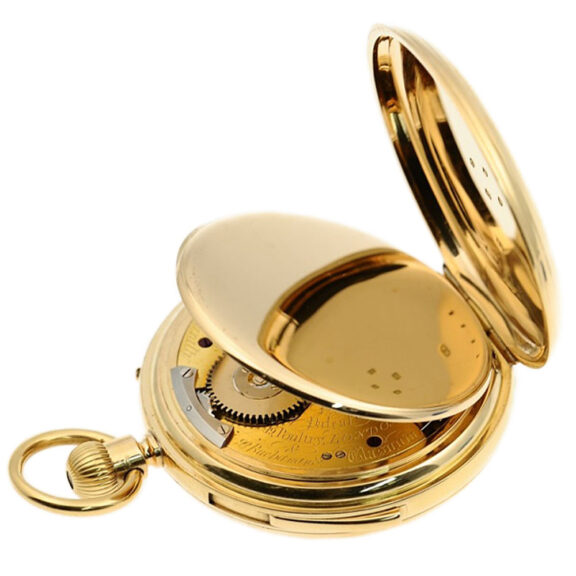
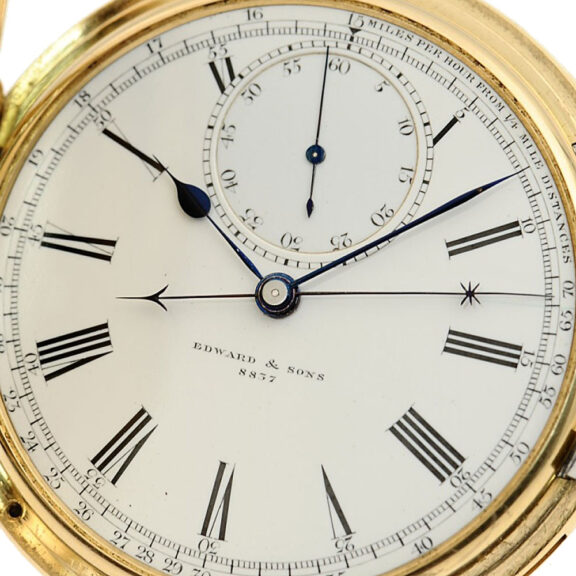
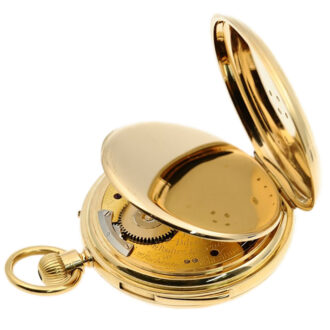
A very fine, English/Scottish, heavy minute repeating hunting case pocket watch with chronograph and tachymeter, circa 1898.
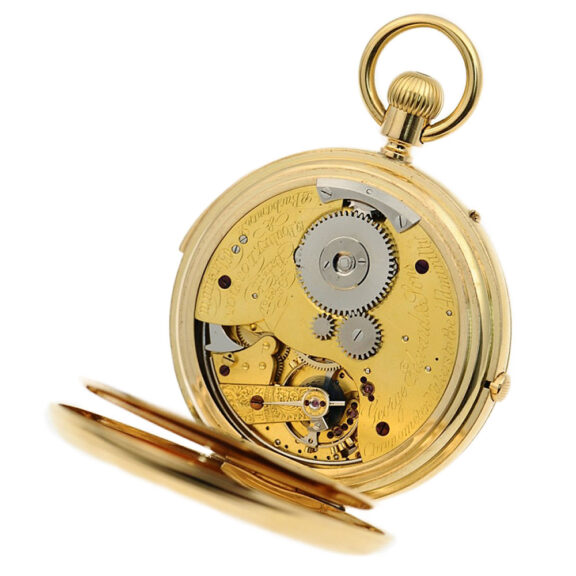
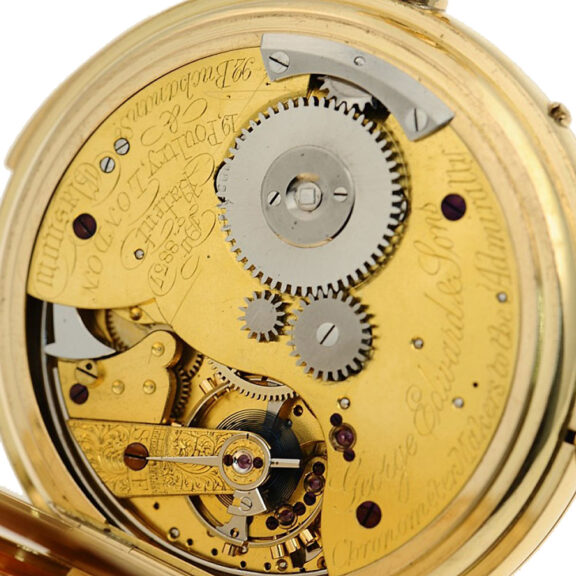
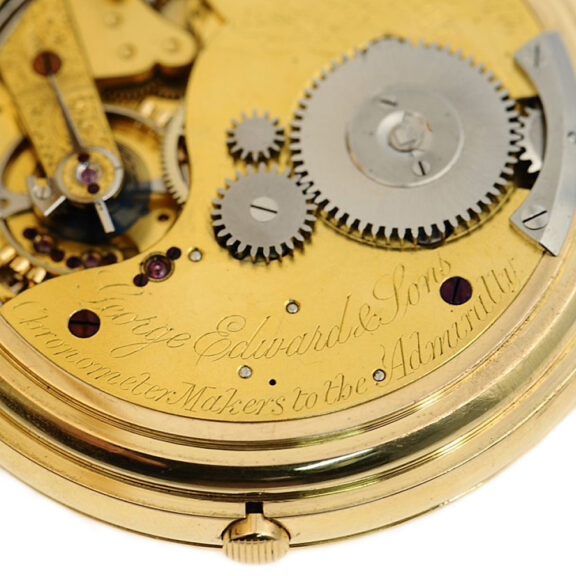
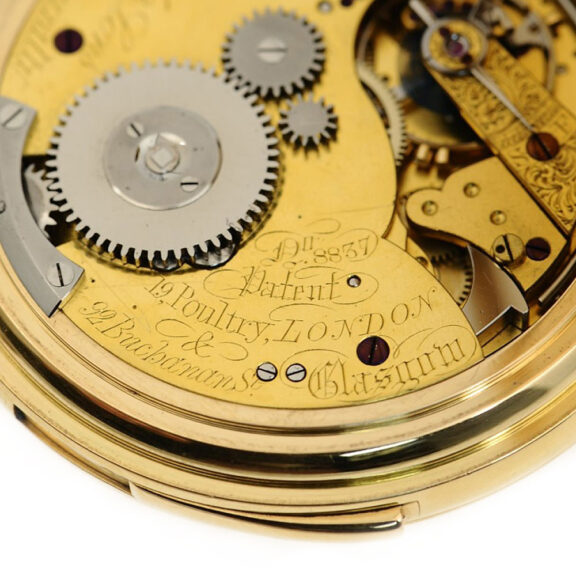
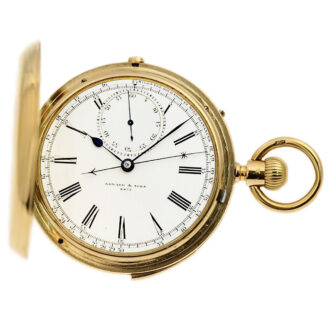
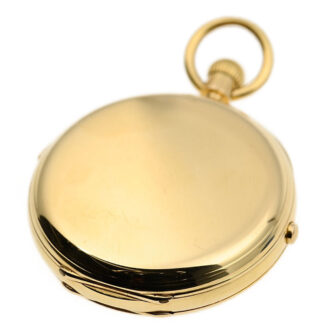
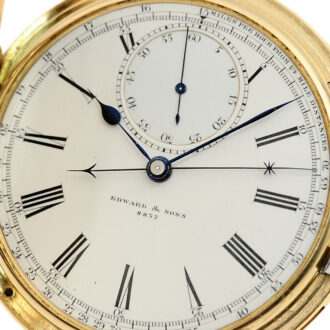
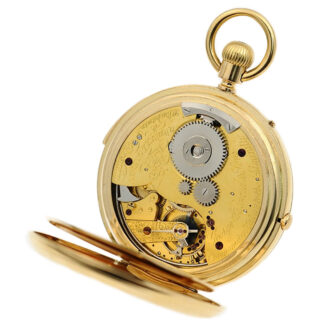
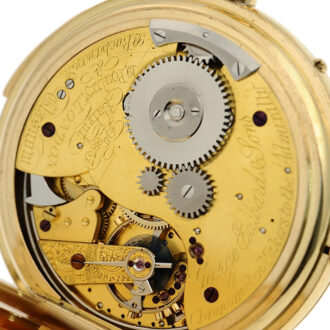
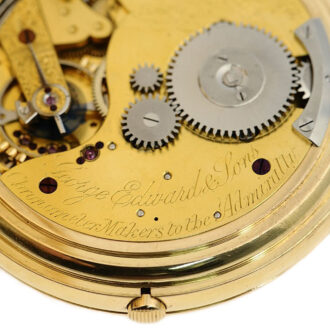
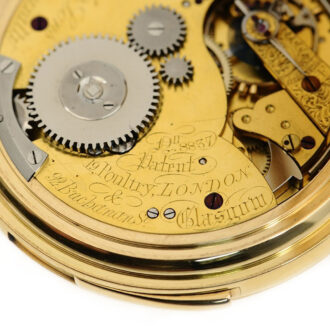
18 Carat gold, polished case with a gold dome, case maker’s punch mark AN (Alexis Nicole of Nicole & Norbier, entered 1 May 1865), pusher for chronograph at 12 and slide for repeating mechanism. Signed enamel dial with Roman radial hours, 60-minute counter, tachymeter, blued spade hands and centre chronograph hand. 3/4 plate movement, Nielsen calibre, frosted and gilt, with two hammers / two gongs, screwed chatons, English lever escapement, gold screw compensation balance and fine florally engraved balance cock. Movement signed: PATENT George Edward & Sons, Chronometer Makers to the Admiralty, 19, Poultry, London & 92 Buchanan St., Glasgow.
–
Diameter: 53 mm
–
Weight: 153 g
–
Signed: George Edward & Sons
–
George Edward & Sons was founded in 1837 by George Edward in Glasgow. In 1863 the company was located at 92 Buchanan Street (Royal Bank Buildings); later, the business was expanded to 96. In 1874 a shop was opened in London at Mansion House Buildings, on 19 Cheapside Poultry. The company represented in Scotland the Pulsynetic Electric impulses clocking Ghent and Co. The company was also a supplier of chronometers for the Admiralty (Chronometer Makers to the Admiralty). The company was continued as Edward & Sons by George Edward Jr., David Herbert Edward, and Arthur Edward. In 1925the company became an Ltd (limited liability company). Telephone: 7683 City (2 lines). Telegrams and Cables: “Edward, Glasgow.” Bankers: British Linen Co. Bank. In 1963 the company in Glasgow relocated to 46 St. Vincent Street and was later taken over by the Mappin & Webb group.
–
A tachymeter is a scale sometimes inscribed around the rim of an analogue watch with a chronograph. It can be used to conveniently compute the frequency in hours of an event of a known second-defined period, such as speed (distance over hours) based on travel time (seconds over distance) or measure distance based on speed. The spacings between the marks on the tachymeter dial are therefore proportional to 1⁄t, where t is the elapsed time.
The function performed by a tachymeter is independent of the unit of distance (e.g. statute miles, nautical miles, kilometres, metres etc.) as long as the same unit of length is used for all calculations. It can also be used to measure the frequency of any regular event in occurrences per hour, such as the units output by an industrial process. A tachymeter is simply a means of converting elapsed time (in seconds per unit) to rate (in units per hour).
Signed: George Edward & Sons
Share this page: