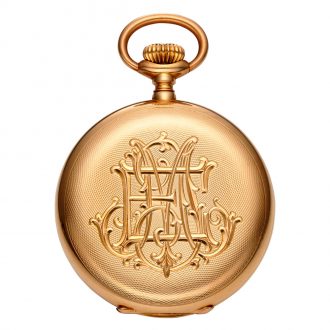
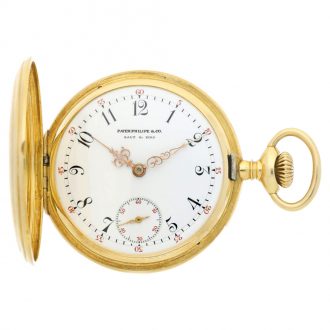
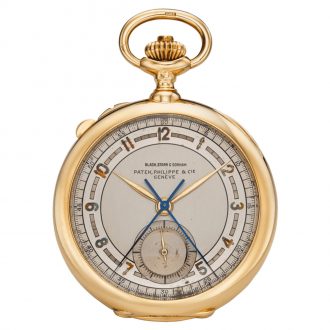
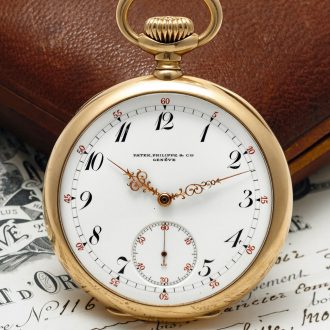
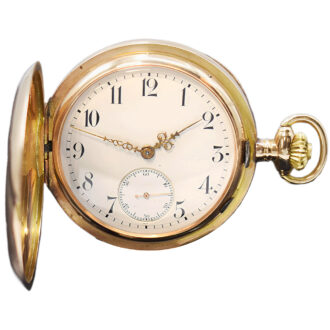
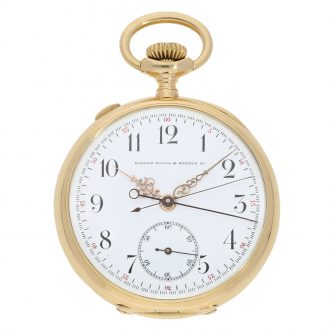
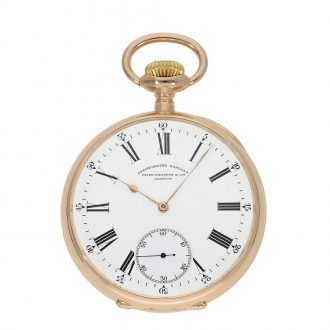
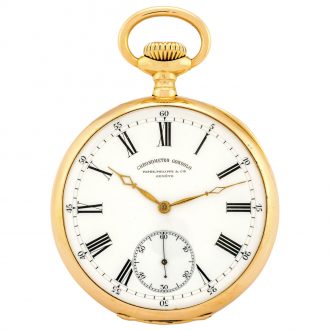
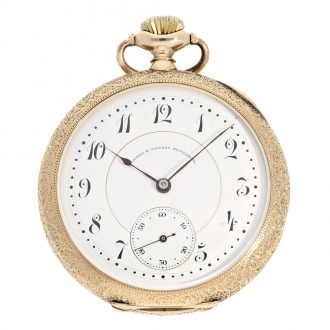
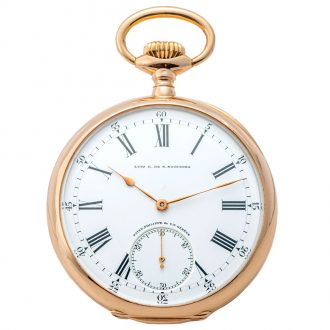
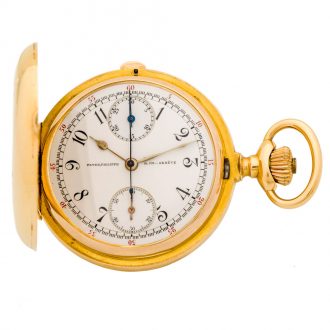
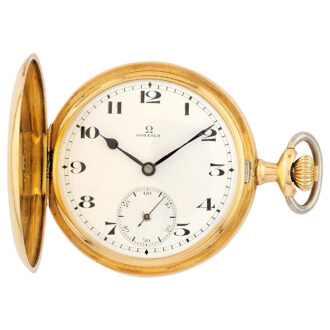
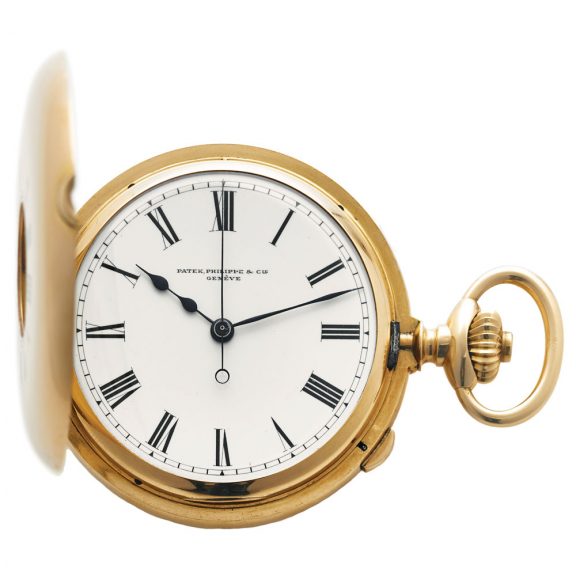
Swiss gold half hunting keyless pocket watch Circa 1904


- Kenmerk
- TA4682
- Diameter
- 53 mm
- Estimate
- € 15.000 - 30.000
- Price sold
- € 25.900
Gold watch with dead centre seconds
–
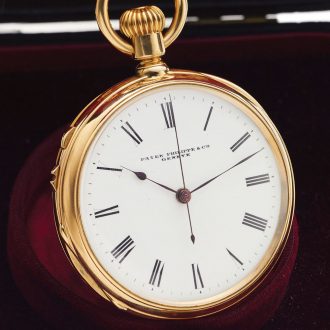
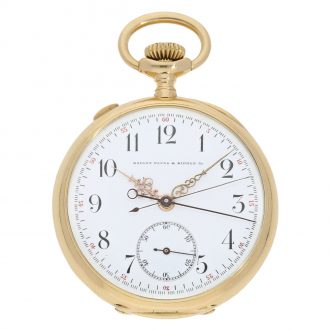
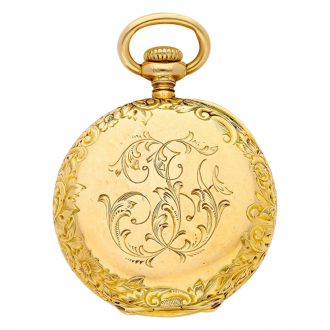
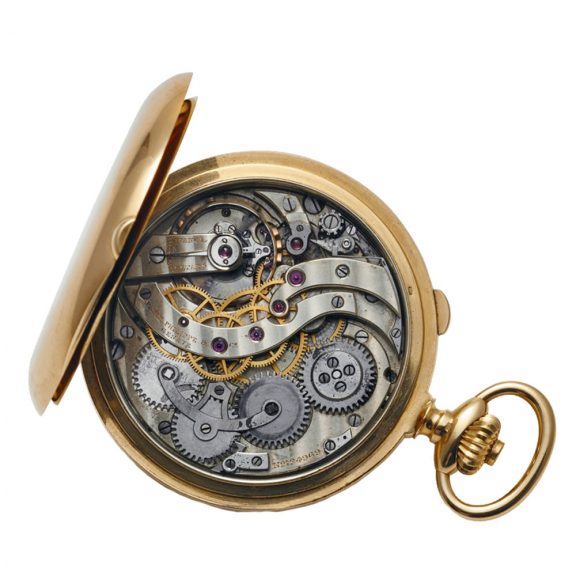
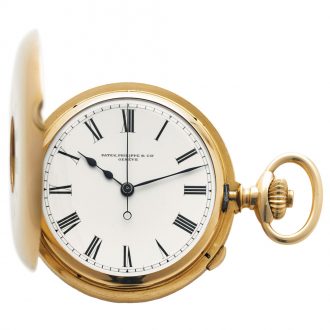
A Swiss 18 carat yellow gold, half hunting cased, two train keyless pocket watch with independent dead centre seconds, circa 1904. A polished case, the front cover with Royal blue enamel radial Roman numerals and an inner minute track, activating pushbutton at four o’clock in the band. Hinged gold cuvette with engraved dedication. White enamel dial, radial Roman numerals, outer minute track and blued steel spade hands. Rhodium plated movement, 27 jewels, straight line counterpoised and calibrated lever escapement, cut bimetallic compensation balance with gold screws, blued steel Breguet balance spring, index regulator, a flirt mounted on the last pinion of the independent dead seconds train engaging escape wheel pinion allowing one second jumps, Adrien Philippe’s patented winding system. Dial, case and movement signed.
–
Diameter: 53 mm
–
Signed: Patek, Philippe & Cie. Genève
–
Accompanied by the Extract from the Archives
–
In 1776, in Geneva, Moise Pouzait invented the independent dead seconds mechanism in which the movement has two trains, one conventional, and the second with a sweep seconds hand which can be stopped without stopping the main train. Adrien Philippe’s independent dead seconds mechanism differs radically from the conventional one based on Pouzait’s design. Philippe moved the entire independent train over the centre bridge, allowing more room for the going train and the balance, which is larger, resulting in better timekeeping.
–
There are fewer than two dozen recorded independent dead seconds watches by Patek Philippe, including the very first ones made by Patek and Czapek. This watch incorporates Adrien Philippe’s two patents concerning tandem winding: the first, for a free, or slipping, mainspring, patented on June 16, 1863, in France, and the second, for winding two mainsprings with one crown, Swiss patent no. 1017 of May 23, 1889. A virtually identical movement is illustrated in Patek Philippe, Genève, by Martin Huber and Alan Banbery.
Signed: Patek, Philippe & Cie. Genève
Share this page: