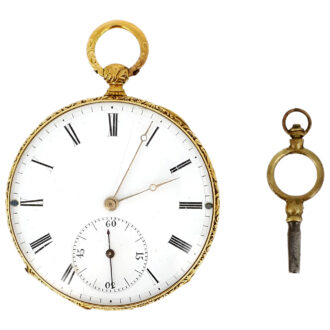
Highly important French gold with four minute tourbillon Circa 1809
- Kenmerk
- TA2024
- Diameter
- 65 mm
- Estimate
- € 350.000 - 700.000
- Price sold
- -
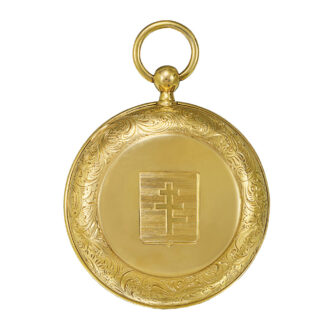
Gold watch engraved with the arms of Comte Potocki
–
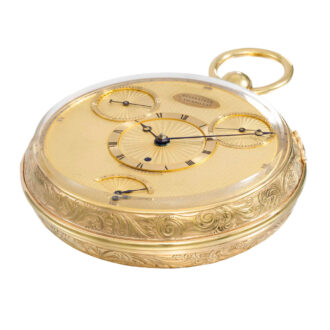
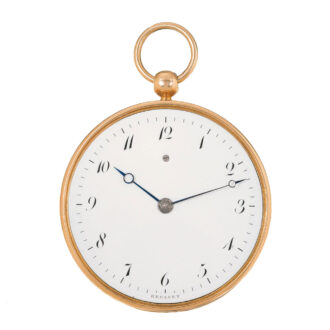
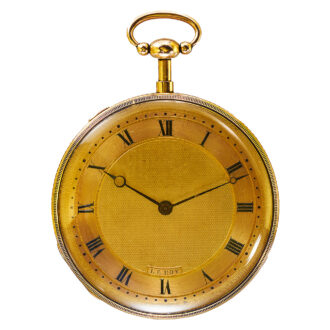
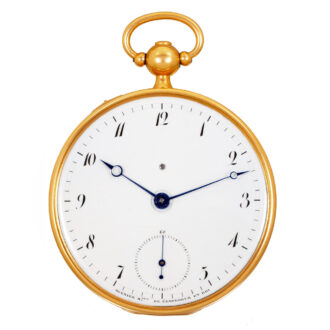
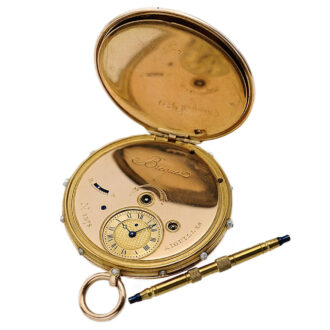
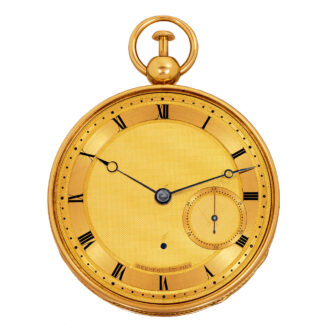
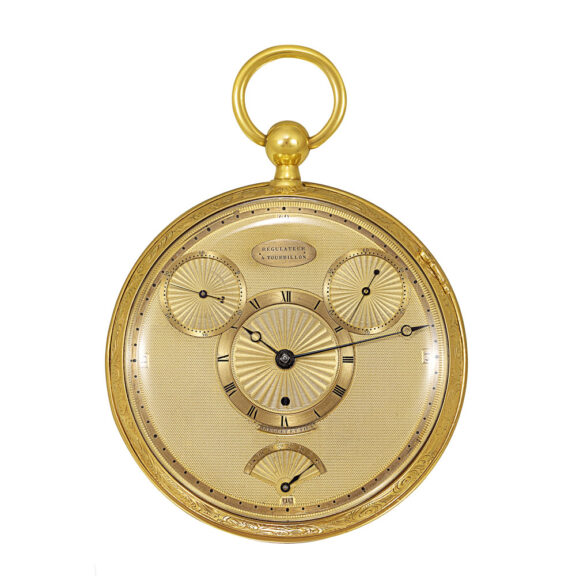
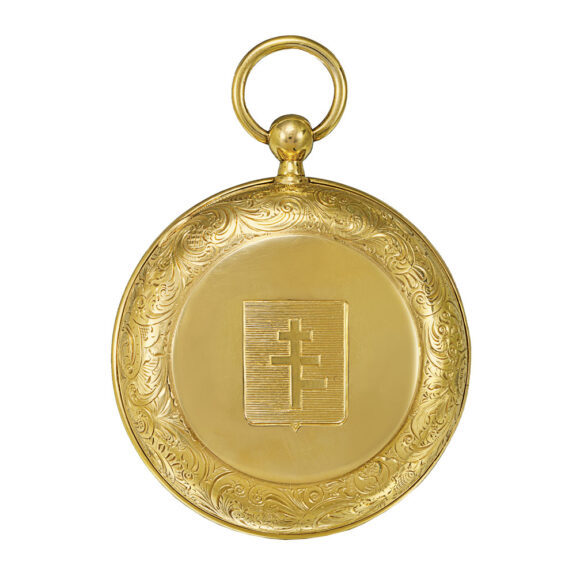
An exceptional and highly important, large French early 18 carat gold open faced pocket chronometer with a four minute tourbillon regulator, circa 1809. The first four minute tourbillon to be made by Breguet and one of the very earliest known watches with the very high oscillation rate for the period of 21,600 per hour. Sold on February 12, 1809, by Monsieur Moreau in St. Petersburg to Comte Potocki for 4600 Francs. The case is made by Amy Gros, the bezel and border are engraved with foliate scrolls, the back is engraved with the arms of Comte Potocki, a bolt on the front bezel for stopping the tourbillon carriage. Hinged gold cuvette.
–
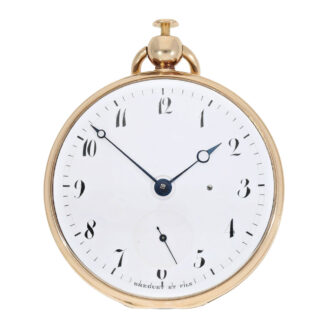
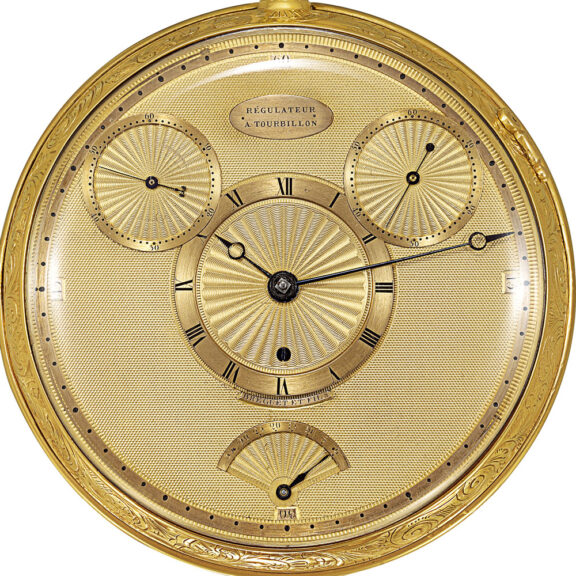
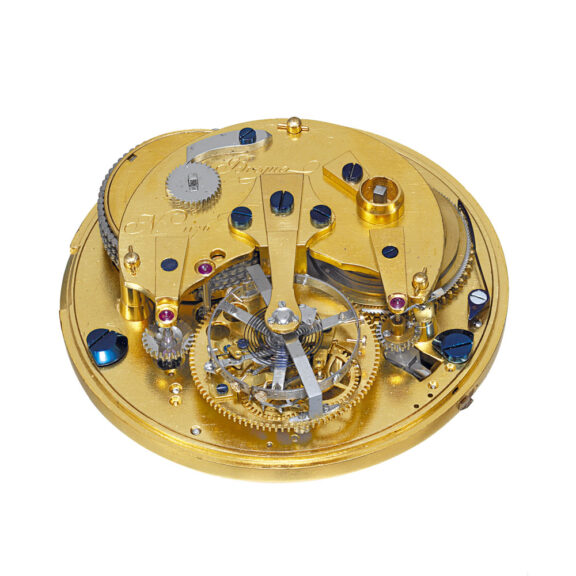
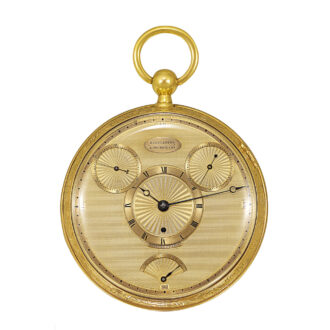
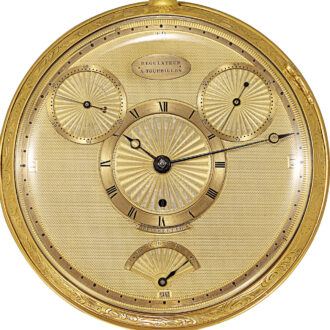
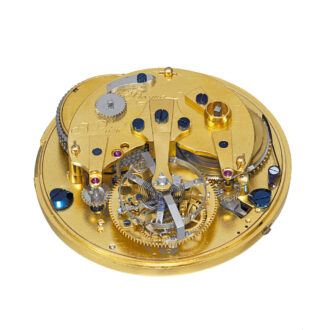
Gold engine turned dial by Tavernier, an oval reserve inscribed Régulateur a Tourbillon, a small central hour dial with radial Roman numerals on a plain reserve, outermost dot minute indexes on a plain reserve, Arabic fifteen minute numerals on outset reserves, two subsidiary seconds dials, a power reserve sector calibrated for 35 hours and blued steel Breguet hands. A gilt brass movement, small semi elliptical backplate, conical pillars secured by pins, reverse fusee with maintaining power, jewelled wheel train, escapement naturel of unusual design with a 12 toothed escape wheel and three toothed escape wheel, the lever with single banking spring allowing even rest on both escape wheels, three arm bimetallic compensation balance with an oscillation rate of 21,600 per hour, peripheral timing adjustment screws, blued steel balance spring with a terminal curve, the whole mounted in a two arm cage driven from the second wheel pinion and revolving once every four minutes. Dial and movement signed, case punched with Gros’s mark. Property of a Swiss Gentleman.
–
Diameter: 65 mm
–
Signed: Breguet Paris
–
The case is restored.
–
Literature: It is generally accepted that Breguet invented the tourbillon on his return from Switzerland in 1795, although the patent was not granted until 1801. The letter below (in literal translation) was sent by Breguet on 24 Floreal a 9 (April 14, 1801) to the minister of the interior, to present his invention: Citizen Minister, I have the honour to present to you a memo detailing a new invention, applicable to instruments for measuring time, that I have named Regulateur a tourbillon”, and I request a patent for the construction of these regulators for a period of ten years. I have succeeded, by this invention, in removing through compensation the errors due to positional differences in the centres of gravity, and by the movement of the regulator, in distributing equally the friction over all parts of the pivots of the said regulator and the holes in which they turn, in such a way that the lubrication of the contact points will always be equal even as the oil thickens, and in removing many other errors that affect, to a greater or lesser extent the accuracy of the movement, in a manner that is totally beyond the present knowledge of our art, even with an infinite period of trial and error. It is after due consideration of all these advantages, with the ability to perfect the means of fabrication and the considerable expenses I have incurred in arriving at such a point, that I have decided to apply for a patent to fix the date of my invention and to compensate myself for the expenses I have incurred. Respectfully yours, Breguet. The principle of his invention was to eliminate positional errors in a timekeeper. It consisted of mounting the escapement on a platform that revolved in a given period, most usually one, but occasionally four or six minutes. The errors were therefore regularly reproduced and cancelled each other out.
–
Breguet: The first timekeeper fitted with the newly invented tourbillon was numbered and signed on a silver plaque fitted to the tourbillon carriage: Exte. en Messd. An 8 (June/July 1800), with the backplate, signed: Ier regulateur a tourbillon. It is thought that No. 282 was never intended to leave the workshops and indeed it was not sold until 1832. Officially, Breguet’s second tourbillon, No.169, was that given by Breguet to John Roger Arnold in memory of Breguet’s friendship with his father. This watch was completed in 1808 and presented in 1809, the same year as the present tourbillon watch was sold. The present watch, No. 1176, is historically highly significant in that it has the escapement natural, but not in its final form, Breguet No. 282 & No.169 have Arnold detent and Peto cross-detent escapements respectively and therefore Breguet’s escapement naturel was certainly in the course of construction at the same time as the second Breguet tourbillon with Peto’s cross-detent and it is quite likely that it was being experimented with even before that, perhaps even as early as 1798. Probably, this watch was in reality Breguet’s actual second-ever tourbillon and the first to be fitted with the escapement natural, but No 169 was released from the workshops first, and as such is recorded in the archives as being the second tourbillon. It is recorded in the archives that the dial for No. 1176 was delivered by Tavernier on November 17, 1806, and that on January 28, 1807, Michaud received the order to engrave the plate. This proves that the movement must have been completed and no longer in its experimental stage by November 1806. The present watch, No. 1176, was, without doubt, the first of Breguet’s watches ever to be made with a four-minute tourbillon and subsequently it is one of the most historically important watches in existence, the progenitor of all other four-minute tourbillon watches. It is exciting to think that Breguet would have personally worked on this watch, along with his most important watchmaker Michel Weber. Close examination of the construction of Breguet No. 1176 has revealed that it is indeed of an experimental nature and has some unique variations in construction to those four-minute tourbillons of a later date. Firstly, the upper plate has three separate cocks instead of being in one piece – this was to allow corrections and modifications to be carried out without having to disassemble the whole movement. Secondly, examination of the escapement naturel shows some interesting features not previously noted with this escapement: the double teeth are curved in a similar way to those in Arnold escape wheels, the escape wheel actually consists of two wheels so that their relation to each other can be adjusted. The lever itself does not have the two springs usually seen in this escapement that provide the banking protection, instead, there is only one spring. This allows an even rest on both escape wheels.
–
High Frequency of Oscillation: Breguet No. 1176 illustrates how highly advanced Breguet was for his time because this watch, in common with No. 169, has a very high rate of 21,600 vibrations per hour, at a time when a rate of between 14,000 and 18,000 as usual. Breguet only used this high rate of vibration in his tourbillons until about 1815 when he implemented tourbillons using the lever escapement, it was not until the 20th Century that such a high vibration rate was used again in the movements of wristwatches. The purpose of increasing the frequency of a watch is that combined with a small diameter balance, a watch would show an improvement in rate because the balance would be less affected by the movement of the watch during wear. If for example the watch is rotated in the direction of the motion of the balance, the relative motion of the balance will be slowed. The faster the balance vibrates, the less likelihood there is of the watch being moved at the same speed and consequently, the rate is more stable. A stronger mainspring is required to maintain a higher number of vibrations, but Breguet got around this problem by slowing the carriages of his tourbillons from one minute to four minutes. The acceleration is proportionately reduced and the surplus power available is used to maintain the increased vibrations.
–
Count Stanislas Kostka Potocki (1755 -1821) was a Polish nobleman, politician, writer, collector, and patron of the arts, he was one of the most emblematic figures of the Age of Enlightenment in his country. A member of an old noble Polish family, Stanislas was the son of Eustachy Potocki, General and starost of Lwow, and Anna Katska. He was the brother of writer and politician Ignacy Potocki. On June 2, 1776, he married Princess Aleksandra Lubomirska, the daughter of a Grand Marshall of the Crown, Stanislas Lubomirski. Potocki was educated at the Warsaw Collegium Nobilium and later studied literature and the arts in Wilanow. He was Podstoli (a type of deputy) to the Crown from 1781 to 1784. In 1792, he became a General of the Army, taking part in the Russo-Polish War of 1792, for the defence of the constitution of May 3, 1791. He was a deputy of Lublin and a major figure in the patriotic party during the four-year Sejm. Count Potocki held the knighthood of the White Eagle and the Saint Stanislas Merits and was Great Master of the Polish Freemasons. He was also Nuncio of the Diet in 1776, 1786 and 1788. From 1792 to 1797, he lived abroad, having left his country after its first dismemberment. He was arrested in Carlsbad after the uprising of Kosciuszko, then lived in captivity for eight months in Josephstadt. When the Great Duchy of Warsaw was created he became the Senator Palatine, Head of the Council of State and of the Council of Ministers. Napoleon made him Minister of Culture and Education, and he retained these posts even after the annexation of the Polish Kingdom by Russia in 1815. In 1800, Potocki became one of the co-founders of the Society of Friends of Science (TPN: Towarzystwo Przyjaciól Nauk) in the Warsaw duchy. In 1807, he was made a member of the Government Commission and president of the House of Education (Izba Edukacyjna). Count Stanislas Potocki by Jacques-Louis David In 1809, he became the president of the State Council (Rada Stanu) and the Council of Ministers (Rada Ministrów). In 1810, he became the director of the National Association for Education (Edukacji Narodowej). Potocki founded the University of Warsaw in 1816 and was elected President of the Senate in 1818, a post which he held until 1820. An art lover and avid collector, he devoted his fortune to promoting literature, sciences and arts, and built up a beautiful collection of paintings, Etruscan vases and engravings in his home, Wilanow Palace. Archaeology was another of his major interests; in 1779 and again in 1785-1786, Potocki organized archaeological digs in Italy. An author and scholar, Potocki wrote numerous works, among them “Of Eloquence and Style” in four volumes, published in Warsaw in 1815, and “Journey to Ciemnogrod”, a satirical novel in four volumes. He translated into Polish the works of the renowned German archaeologist Johann Joachim Winckelmann, concerning the art of antiquity. The equestrian portrait of him, painted by Jacques-Louis David whom Potocki met while the artist was at the Academy in Rome, is considered to be one of David’s masterpieces. This portrait, inspired by equestrian portraits by Van Dyck, was one of only three paintings David took along with him when he left Rome to return to Paris. It is now on view in Wilanow, Potocki’s family home which during his life lay on the outskirts of the city, and is now located within Warsaw. Wilanow Palace, renowned for its beauty, was known as the Polish Versailles. In 1805, in a visionary move, Potocki opened his art collection and a portion of the castle to the public, thus making Wilanow one of Poland’s earliest museums. Count Stanislas Potocki died on September 14, 1821, and was buried at Wilanow.
Signed: Breguet Paris
Share this page: