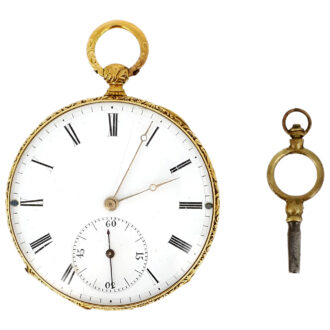
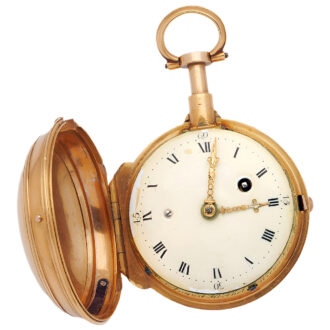
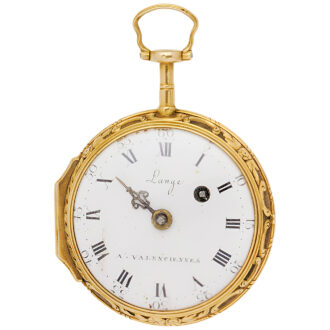
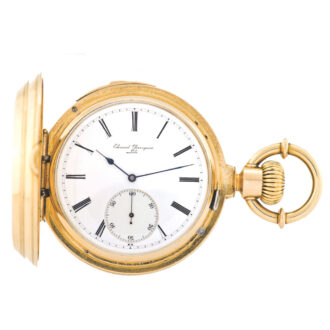
Rare Swiss two minute tourbillon double dialled watch Circa 1875
- Kenmerk
- HA0329
- Diameter
- 57 mm
- Estimate
- € 75.000 - 150.000
- Price sold
- € 80.700
Large and heavy gold quarter repeating hunting cased pocket watch
–
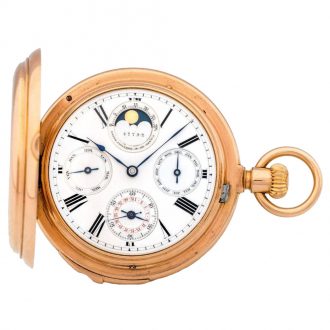
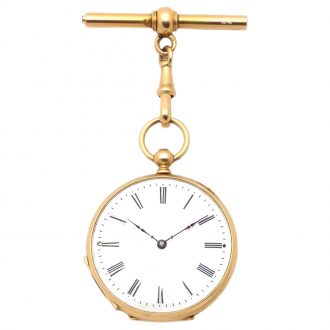
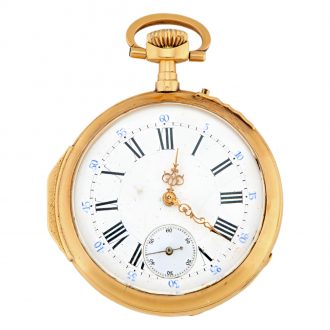
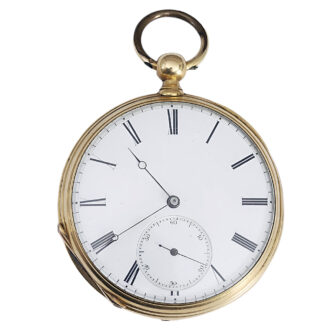
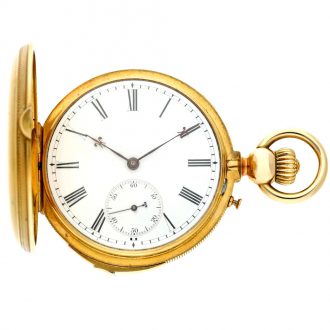
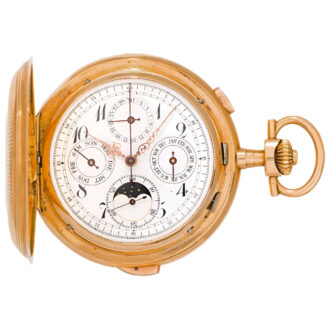
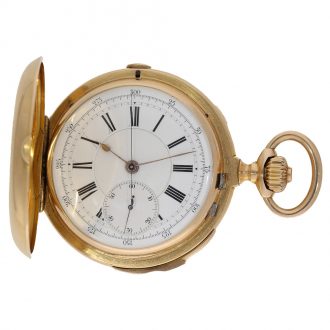
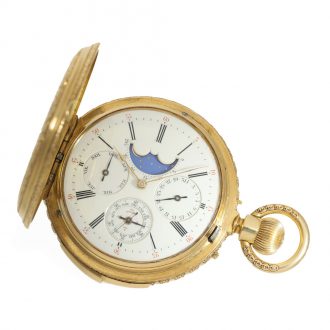
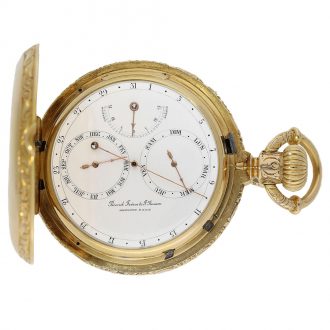
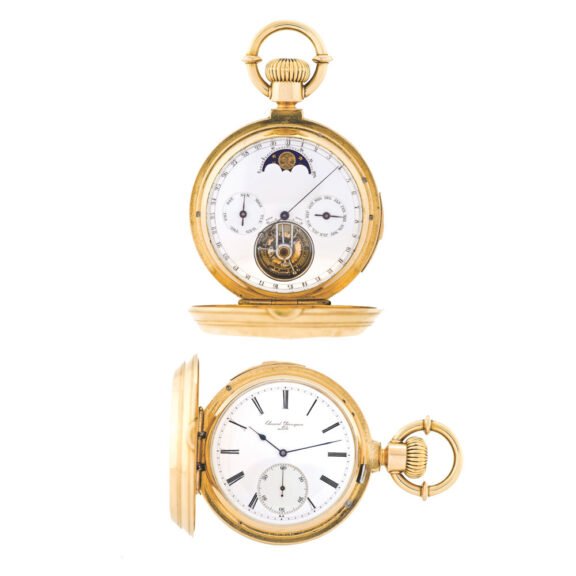
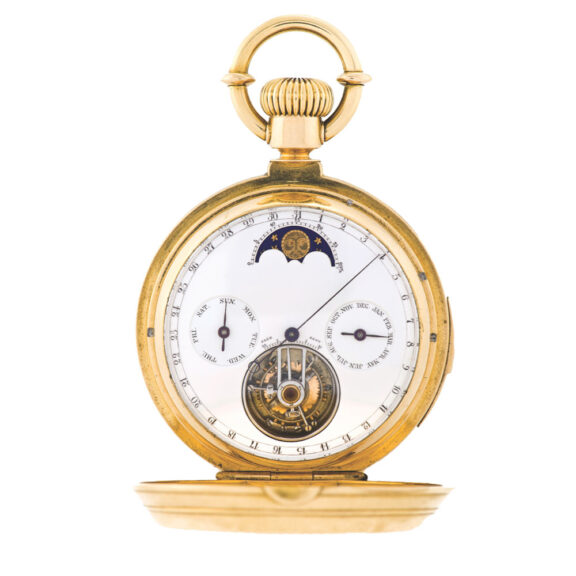
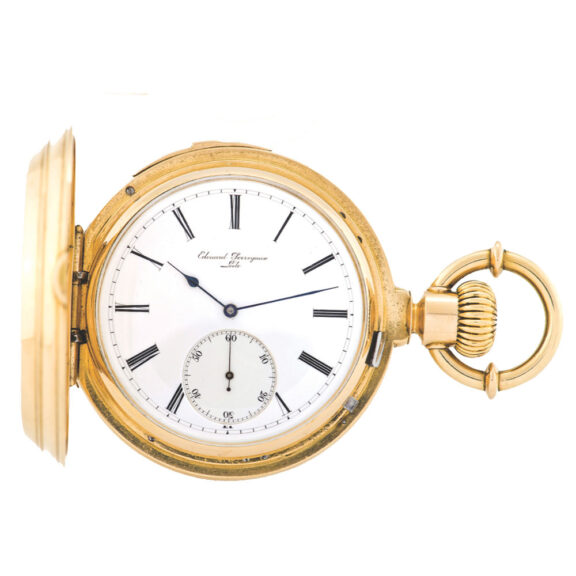
A very fine and exceptionally rare, large and heavy, 18 Carat yellow gold, quarter-repeating, double dialled, hunting cased, keyless pocket watch with visible two minute tourbillon, triple date calendar, moon phases and moon’s age indication. Made by Edouard Perregaux, Locle, Switzerland, Circa 1875. Three body, massive, bassine et filets and polished case with master mark FDB, large pendant and bow, glazed gold rimmed bezels with calendar and moon setting levers protruding on the calendar side.
Meantime dial: white enamel with radial narrow Roman numerals, outer minute track, subsidiary seconds and blued steel spade hands. Calendar dial: white enamel with an aperture for the tourbillon with a regulation scale on the edge, outer date ring, subsidiary dials for the days of the weeks and the months, aperture for the moon phases with moon’s age indication on the circumference and blued steel calendar hands. Matte gilt movement with jewelled straight-line lever escapement, cut bimetallic compensation balance with meantime and temperature adjustment screws, upper pivot jewel with screwed chaton, blued steel Breguet balance spring, tourbillon carriage with three equidistant polished steel arms and two minute rotation period, index regulator on the polished steel bridge, the seconds hand driven by the tourbillon via a train of three additional wheels held by a bridge on the dial plate, a fine spring meshing with the seconds wheel itself to reduce recoil, repeating on gongs activated by a slide on the band.
Dial signed, case numbered, dial plate also punch numbered 6954.
–
Diameter: 56.5 mm
–
Thickness: 21 mm
–
Signed: Edouard Perregaux, Locle
–
THE TOURBILLON It is generally accepted that Breguet invented the tourbillon on his return from Switzerland in 1795, although the patent was not granted until 1801. The principle of his invention was to eliminate positional errors in a timekeeper. It consisted of mounting the escapement on a platform which revolved in a given period, most usually one, but occasionally four or six minutes. The errors were therefore regularly reproduced and cancelled each other out
EDOUARD PERREGAUX (1819-1878) Edouard Perregaux won 8th prize at the Neuchâtel Observatory in 1875 with a pocket chronometer. In 1876 at Neuchâtel, his company won a new prize for makers submitting at least a dozen pocket chronometers having the best mean time. In that contest they also won Fourth and Sixth Prizes for chronometers with lever escapements. They won First Prize (with five others) in the International Chronometer Contest held at the Geneva Observatory in 1876 at the Centenary of the Société des Arts. In 1877 the firm won Second and Third Prizes at Neuchâtel in Category C, pocket chronometers with lever escapements.
The tourbillon with two minute rotation is exceptionally rare. Only one other example of a pocket watch with two minute tourbillon can be traced to date, a watch signed E. Buffat dating from about 1865 and thought to have been made for Napoleon III, see: ‘Le Tourbillon’, Reinhard Meis, 1990, p. 119. The present watch appears to be the only example where the tourbillon is visible a rarity in any tourbillon pocket watch. The purpose of a tourbillon rotating at a slower rate than the usual one minute is that the timekeeping rate is more stable especially with a small diameter balance so that during use the watch is unlikely to be moved from position to position faster than the vibration of the balance, this combined with the tourbillon’s rotation stabilizes positional errors. In the early 19th century Breguet made a small number of tourbillons with carriages rotating at four and sometimes six minutes. Although the timekeeping qualities of tourbillons with reduced acceleration were superior, the complexities of making such watches (non-standard wheel tooth counts and trains) and the subsequent cost involved outweighed the advantages for wider commercial use. As such, any 19th century tourbillon pocket watch with a carriage rotation of other than one minute is regarded as a great rarity.
The present watch is also particularly unusual in several other ways. It has the additional features of quarter-repeating and triple date calendar and moon phases, none of which (due to any possible adverse effects on timekeeping) are usually found on a precision watch. Because the tourbillon has a two minute rotation, the subsidiary seconds hand cannot, therefore, be driven directly but requires a small train of a further three wheels to achieve the 60 second rotation. Interestingly, the seconds wheel itself is regulated by a fine curved spring acting against each tooth as it passes.
It is certainly possible that because this watch has the combination of two dials, a visible two minute tourbillon, a repeating calendar and moon phases it was made for exhibition purposes.
Signed: Edouard Perregaux, Locle
Share this page: