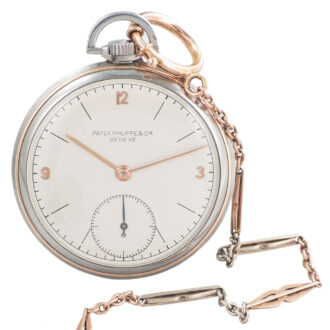
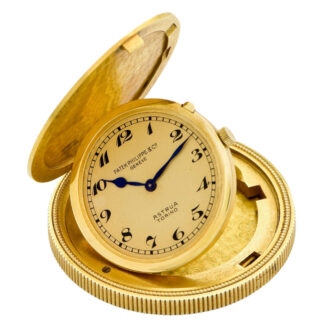
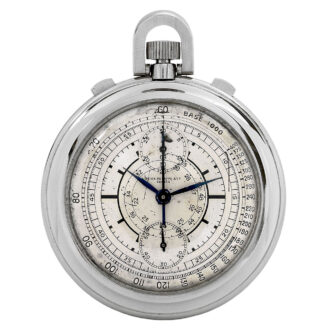
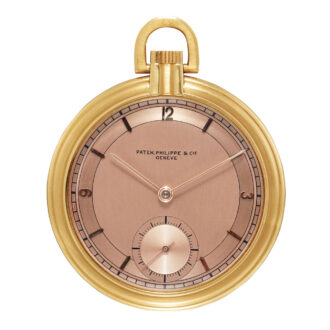
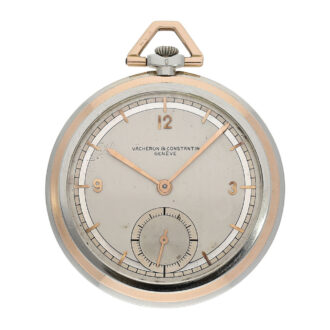
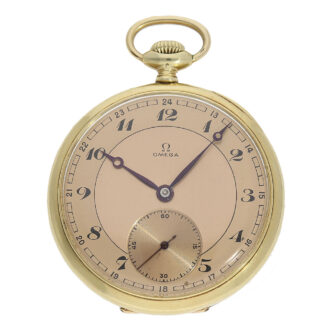
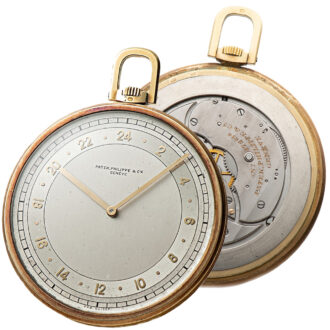
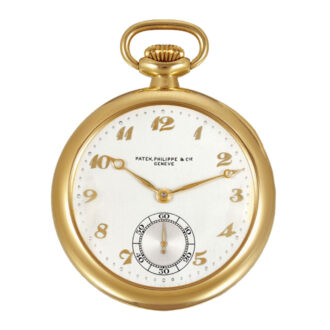
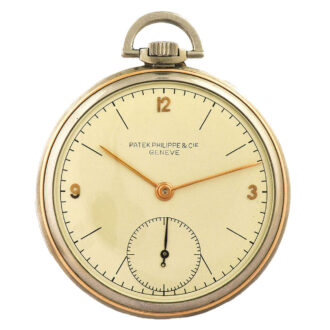
Fine stainless steel and 14 Carat pink gold pocket watch Circa 1938
- Kenmerk
- HA0016
- Diameter
- 38 mm
- Estimate
- € 3.000 - 6.000
- Price sold
- -
Fine and rare stainless steel and gold keyless dress watch
–
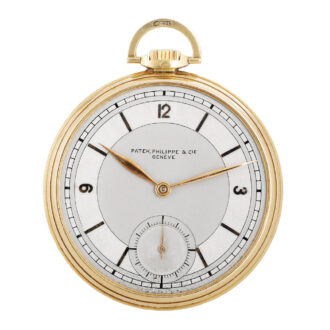
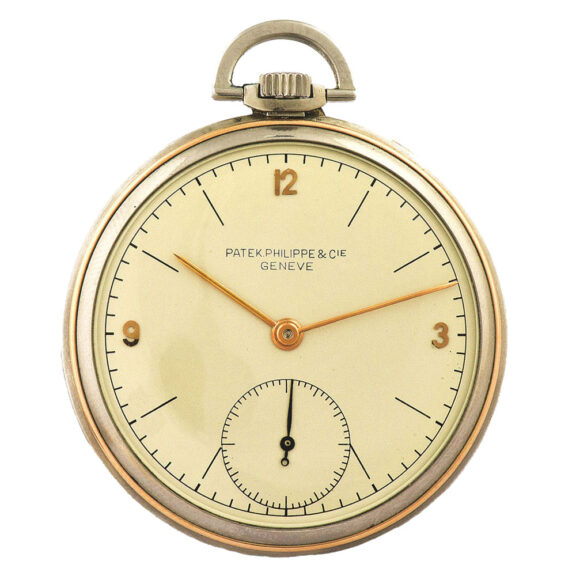
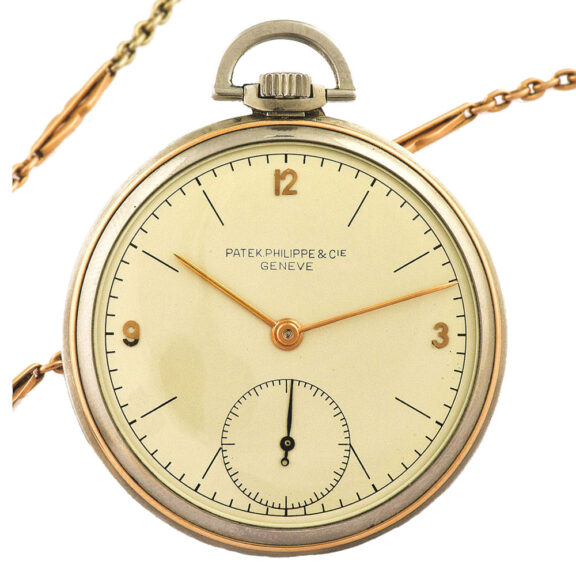
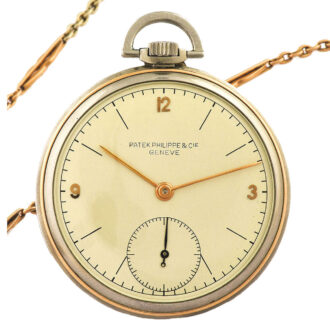
A fine stainless steel (Staybrite) and pink gold keyless dress watch. Accompanied by a chain. Made circa 1938 by Philippe & Cie, Genève.
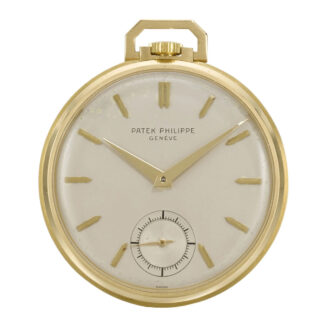
Three body, polished case with stepped steel and pink gold bezel. Case back with an outer pink gold ring. Matte silver dial with applied pink gold Arabic numerals and painted black baton indexes, outer minute track and subsidiary guilloché seconds dial. Pink gold baton hands.
Rhodium-plated stamped movement with the seal of Geneva quality mark, Geneva Striping decoration, 18 jewels, straight-line lever escapement, cut bimetallic compensation balance, blued steel Breguet balance spring and a swanneck micrometre regulator.
Dial, case and movement signed.
–
Diameter: 38 mm
–
Signed: Patek Philippe & Cie Genève
–
Geneva stripes are also known as “Côtes de Genève” or even “Geneva waves”, and are perhaps among the best known of all the movement decorations. You’ll find them on various movement plates as well as on rotors. You will also find them on cheap, budget mass-produced movements, as well as expensive hand made movements. This is partly because the technique is easily adaptable to automatic CNC machines. This finishing technique do not require a human touch to achieve those signature stripes.
With Geneva stripes (or indeed, one of the many variations) being so commonplace in movement finishing, it’s easy to forget that finishes are not a purely aesthetic element. They actually serve two essential purposes. The first is obvious and the one we assume to be the sole raison d’etre: to enhance the beauty of the movement and its individual components.
The other reason for some movement finishing techniques is a little less apparent. In fact, while I’d heard about it many moons ago, I had actually dismissed it as an old wives’ tale. That was until Fratello’s resident watchmaker, Rob Nudds, confirmed to me that it was actually true. Geneva stripes’ signature grooves and channels have a fine, rough surface that enables them to pick up and trap dust. Keeping dust on the outside of the movement, rather than on the inside where it could wreak havoc on the sensitive, moving parts, is far more logical than you might initially think. It’s a fine example of form and function balancing the scales.
Signed: Patek Philippe & Cie, Genève
Share this page: