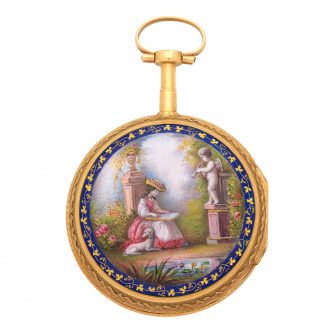
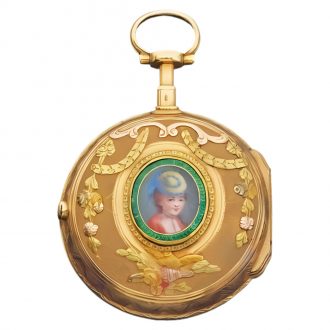
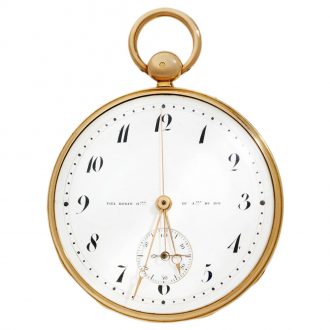
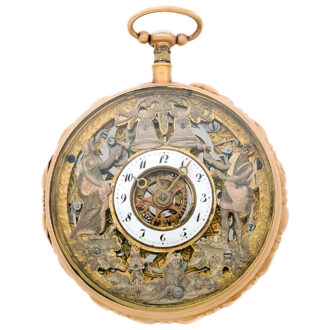
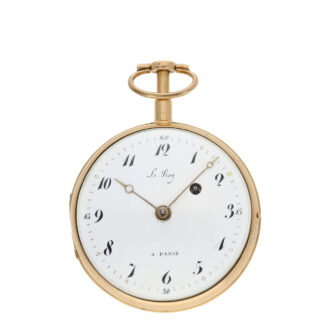
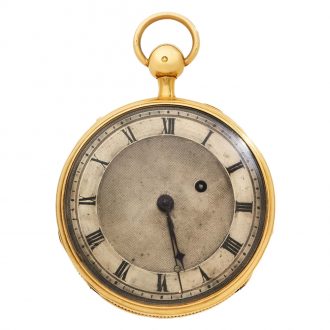
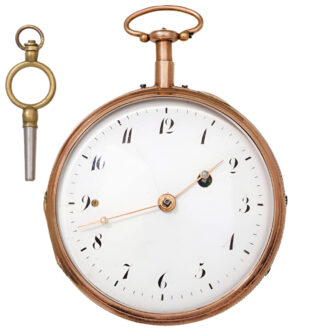
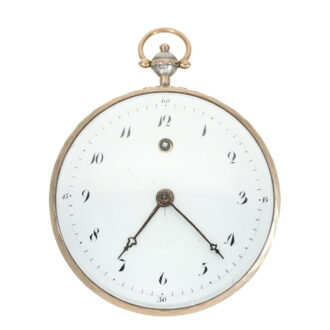
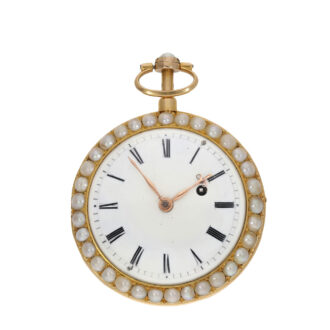
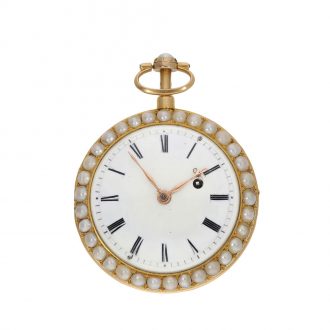
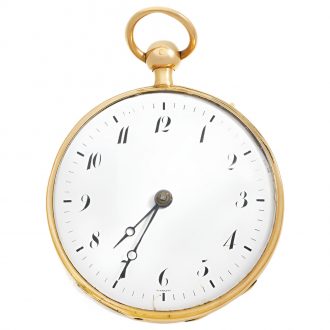
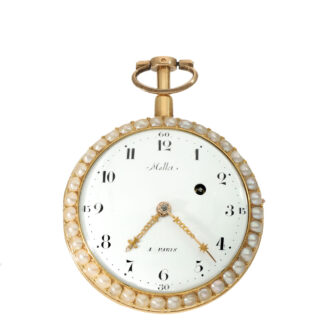
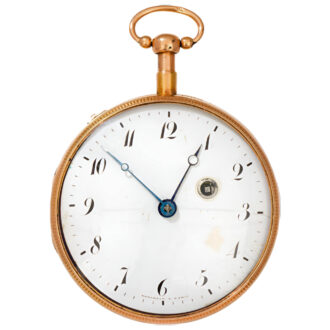
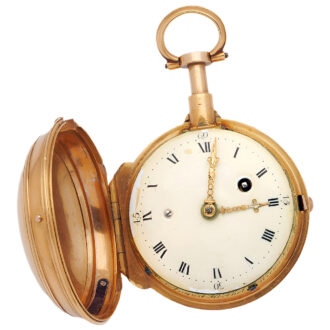
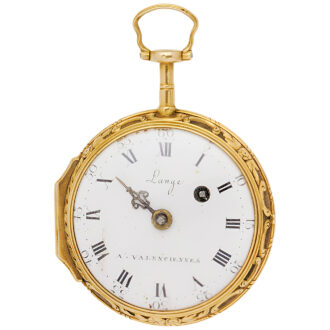
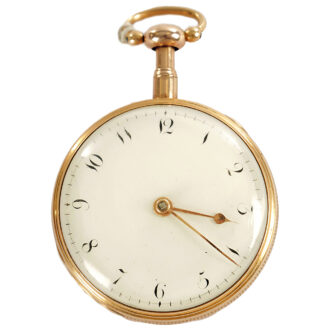
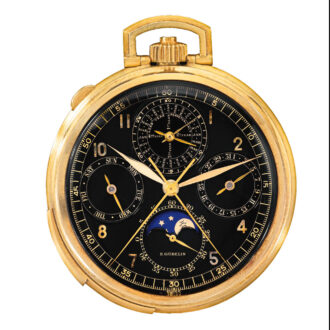
French 18 carat gold key wound pocket watch Circa 1800
- Kenmerk
- HC2234
- Diameter
- 50 mm
- Estimate
- € 2.250 - 4.000
- Price sold
- € 1.850
Gold à goutte watch
–
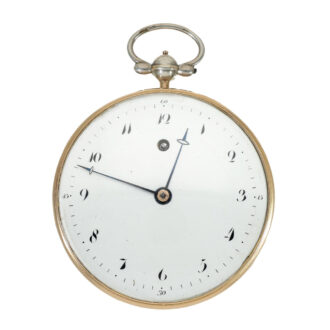
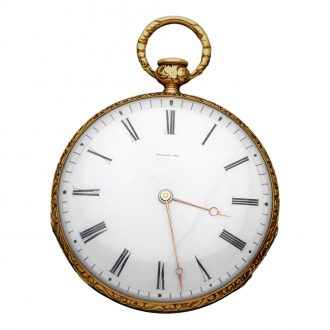
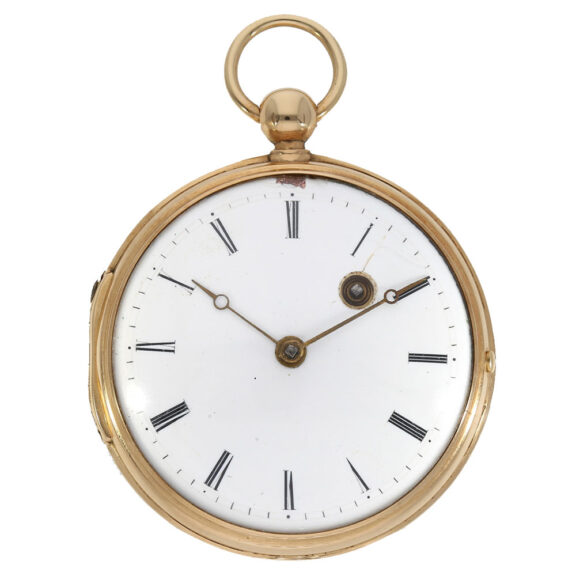
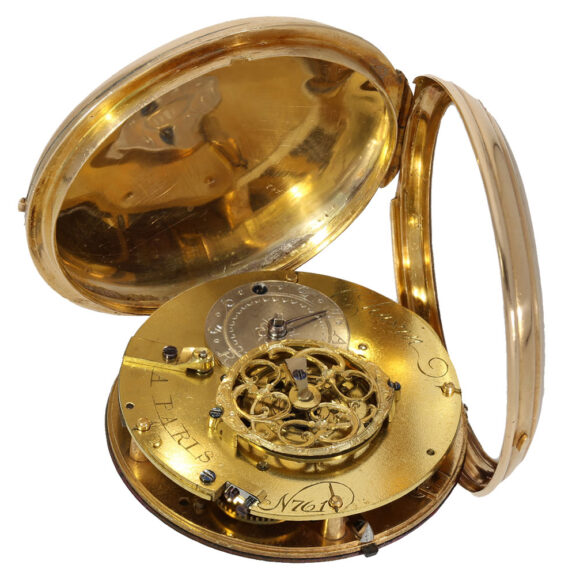
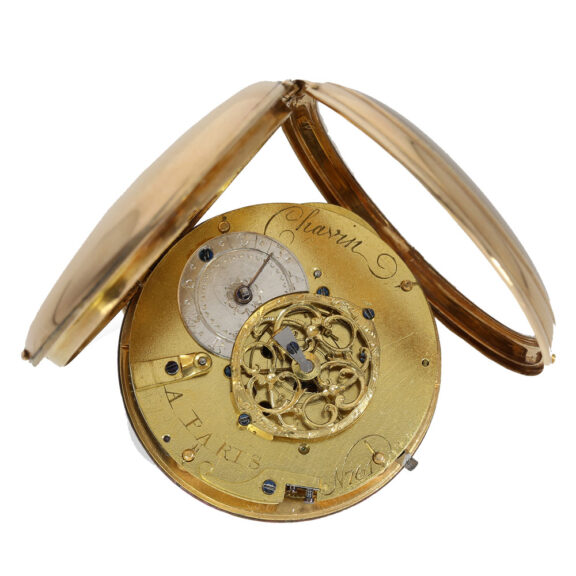
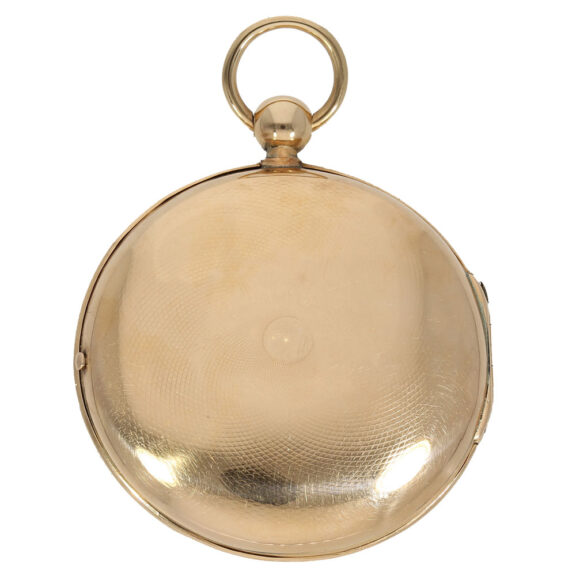
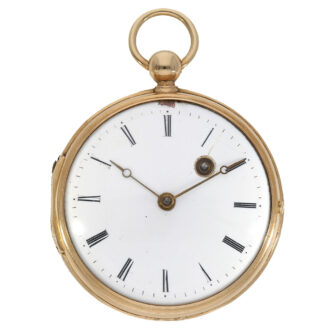
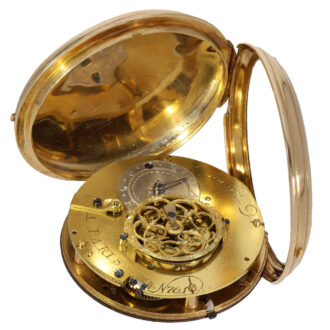
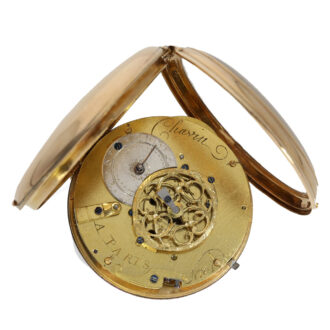
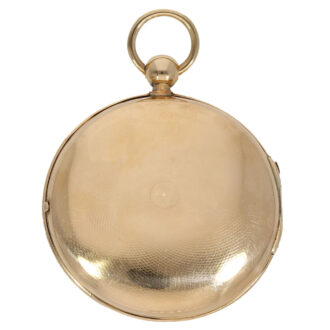
A gold verge pocket watch, made by Jean-Baptiste Chavin in Paris, France, circa 1800. The watch features an 18 carat gold case with an engine turned back lid. The white enamel dial features an outer minute and hour track with elongated black Roman hour numerals, delicate, golden open tipped Breguet hands (frequently called “moon” hands due to the distinct hollow crescent design near the tips) and a circular winding hole, confirming that this watch uses a key wound movement, typical for a verge fusee mechanism of this era. The gilt brass numbered movement is equipped with a verge escapement, a gilt balance cock, silver regulator dial and several dark, heat treated blued steel screws that secure the various bridge components to the main plate.
The movement is signed.
–
Diameter: 50 mm
–
Weight: 75 g
–
Signed: Chavin à Paris
–
Chavin
The history of the Chavin watchmaking business is not the story of a single monolithic company, but rather a multi generational family dynasty of French master craftsmen. Originating as a modest cottage industry in the rural mountains, it eventually expanded its trade into France’s major luxury capitals, including Paris, Grenoble, and Lyon.
–
Jean-Baptiste Chavin emerged as one of the first highly regarded local émailleurs (enamel dial makers). The family business initially built its reputation not on fully assembled watches, but on high quality enamel dials and brass movements supplied to larger regional clocks (such as Comtoise and Capucine clocks). He expanded his business network to Paris during the late Louis XVI and Napoleonic eras and leveraged the prestigious “à Paris” signature on high end gold verge fusee pocket watches to sell directly to the upper classes.
–
Following the demise of Jean-Baptiste Chavin in the early 19th century, the business did not shut down; instead, it underwent a planned generational transition and geographic expansion led directly by his immediate family heirs.
–
At the end of the 19th century, the family lacked direct horological heirs willing or able to manage the physical factory. They formally sold the entirety of their business assets, manufacturing tooling, and architectural patents to the French industrial horology firm Badier & Paulin. For decades after the acquisition, the new owners signed their heavy church and municipal clocks as “Badier & Paulin, Successeurs de Chavin” (Successors of Chavin) to capitalise on the immense regional trust and reputation Jean Baptiste and Joseph had built over the prior century.
Signed: Chavin à Paris
Share this page: