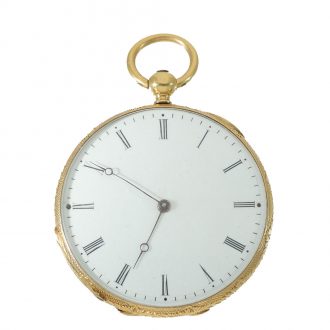
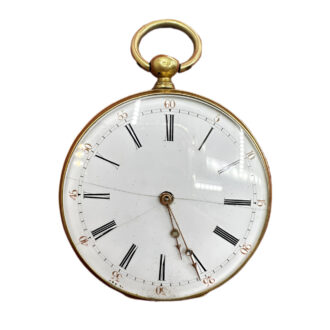
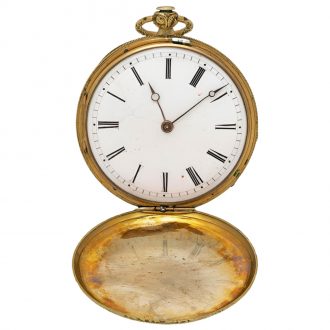
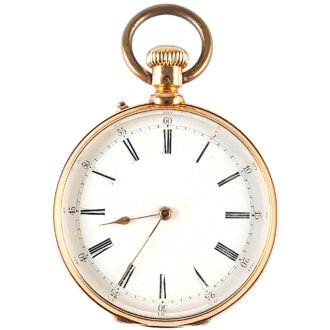
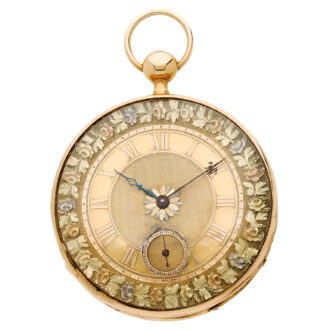
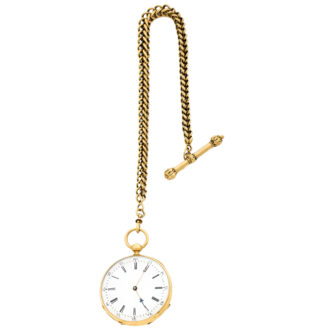
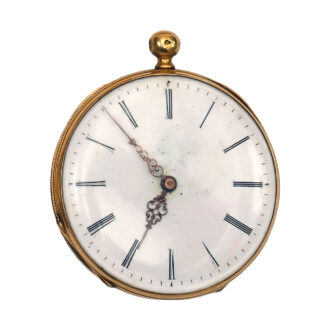
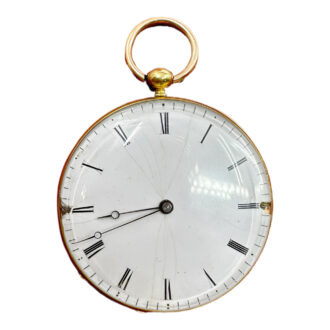
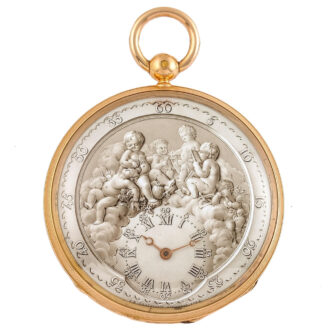
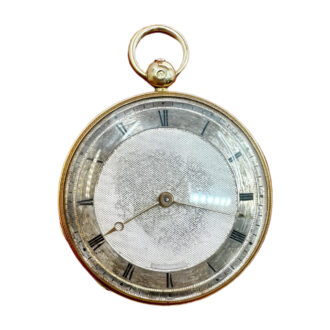
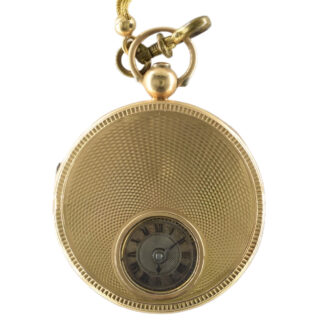
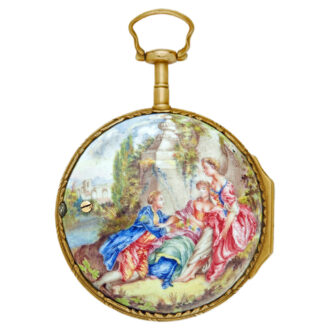
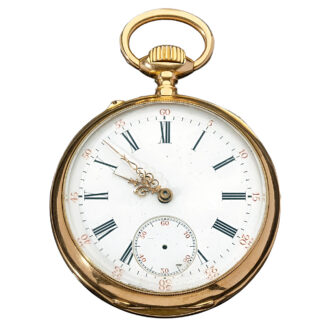
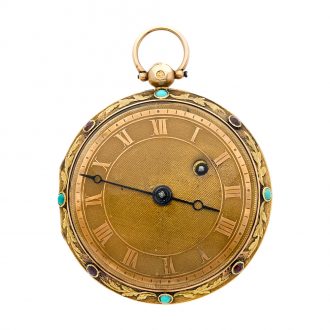
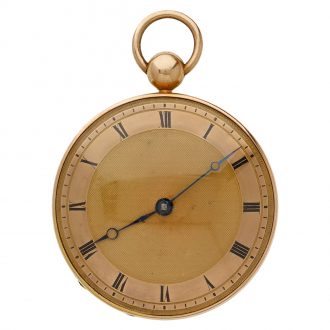
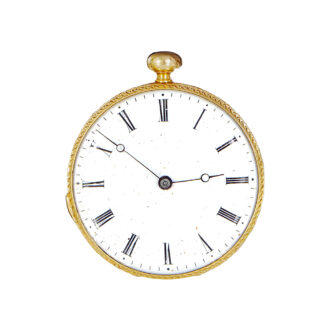
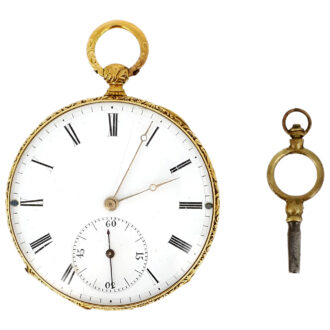
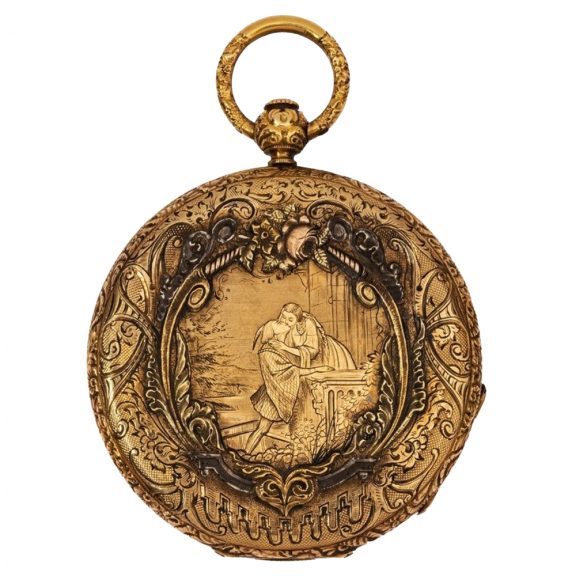
French fully decorated 18K gold hunting cased watch Circa 1850
- Kenmerk
- AL2581
- Diameter
- 46 mm
- Estimate
- € 1.250 - 2.500
- Price sold
- € 1.200
Gold full hunter pocket watch by Bolviller
–
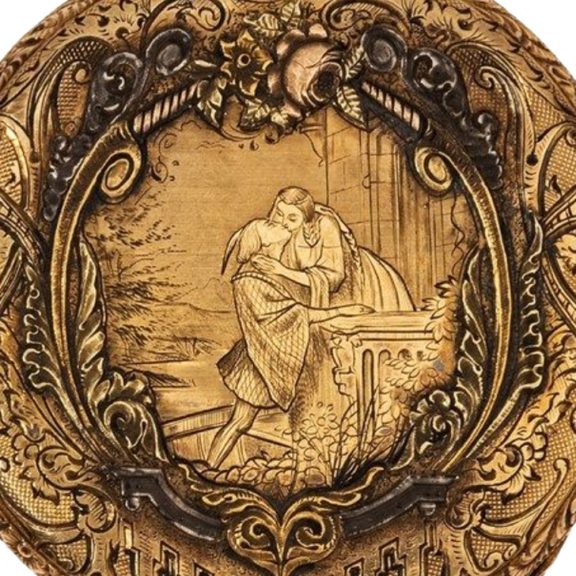
A French 18 carat yellow gold chased and engraved hunting cased pocket watch with duplex escapement, circa 1850. This watch features a movement with a duplex escapement. It has a white enamel dial with Roman numeral hour markers and a subsidiary seconds dial at 6 o’clock. The 18 carat gold case is decorated with chased and engraved figures. It is missing the hour hand and glass.
–
Diameter 45,6 mm.
–
Weight 64,7 g
–
Signed: BOLVILLER à Paris
–
Moïse Bolviller
Moïse Bolviller was a French watchmaker and jeweller who worked primarily in Paris during the mid-19th century. Around 1840, he operated at Rue Charlot, then moved to 12 Rue Vendôme from 1850 to 1860, and later established himself at Rue Béranger in 1870. It is likely that he resided at 25 Sainte-Avoye. (La Presse Paris, 1836)
–
Born on August 7, 1801, in Metz, Bolviller was the son of Isaïe Joseph Bolviller (1767–1841) and Hintche Terquenne (1777–1832). He relocated to Paris, where he married Fanny Alkan (Oppenheim) on January 4, 1822, in the 8th arrondissement. Their marriage produced a daughter, Eugènie Bolviller (1830–1907), who married jeweller Samuel Houlmann (1819–1891). They had two sons: Benjamin “Abraham” Houlmann (1851–1917) and Hector Houlmann (1856–1913), both of whom also became jewellers.
–
Bolviller frequently used ébauches from well-known makers like Jean-François Hollingue and Louis-Aimable Hollingue of the firm Holingue Frères, as well as from Japy Frères, which typically featured a central second hand. In approximately 1847, he entered into a partnership with the esteemed escapement maker Célestine Philippe Gontard, forming the company Bolviller & Gontard. In 1848, the firm was granted a patent for an escapement at 12 Rue St. Hyacinthe, St. Honoré. This partnership likely ended in 1851.
–
Moïse Bolviller passed away on December 22, 1874, in the 11th arrondissement of Paris, at the age of 73. His will, dated February 10, 1874, reveals that he was a deeply religious man.
Signed: BOLVILLER à Paris
Share this page: