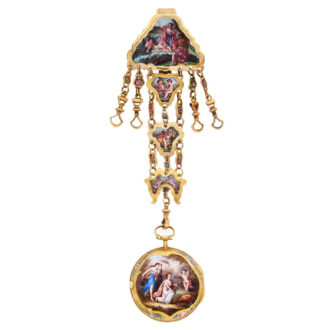
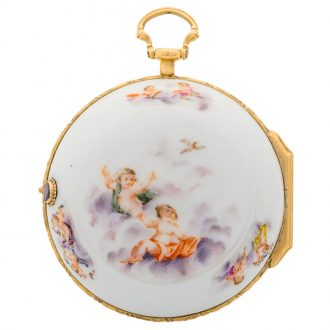
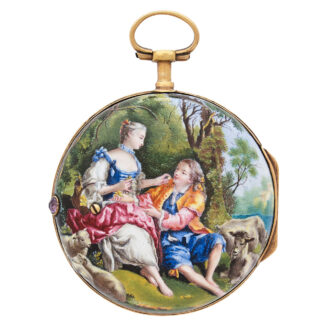
Fine French 18 caratgold and enamel verge watch Circa 1750
- Kenmerk
- FA0093
- Diameter
- 42 mm
- Estimate
- € 2.500 - 4.000
- Price sold
- -
Gold and enamel pocket watch
–
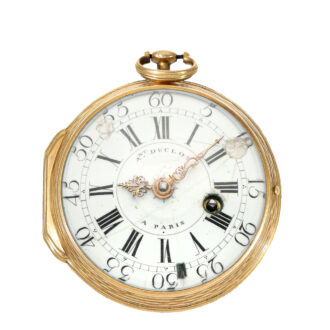
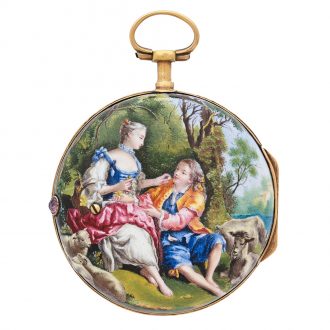
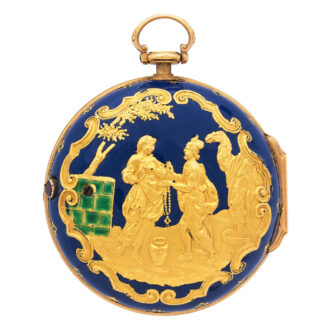
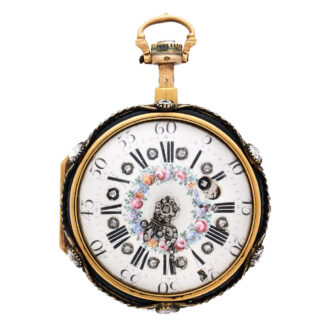
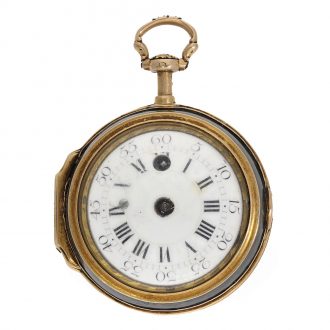
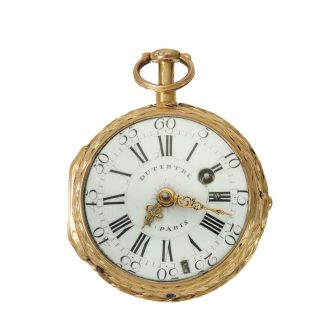
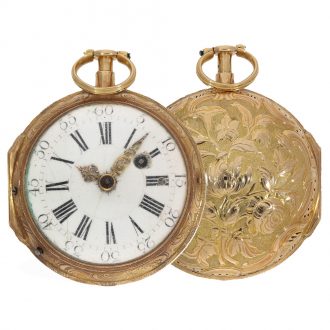
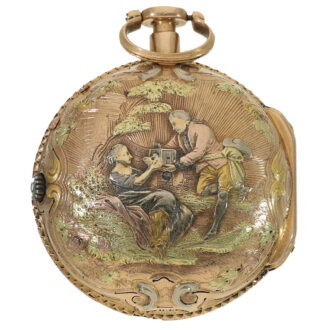
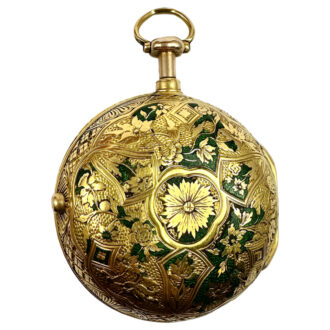
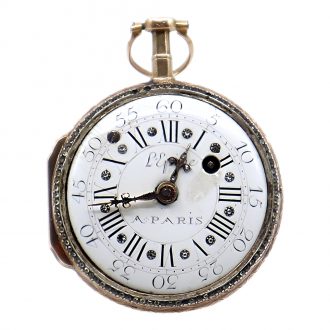
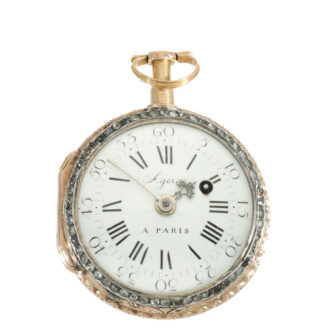
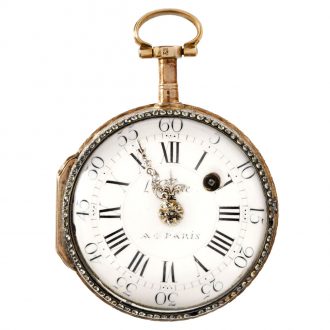
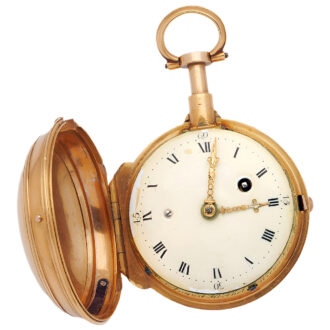
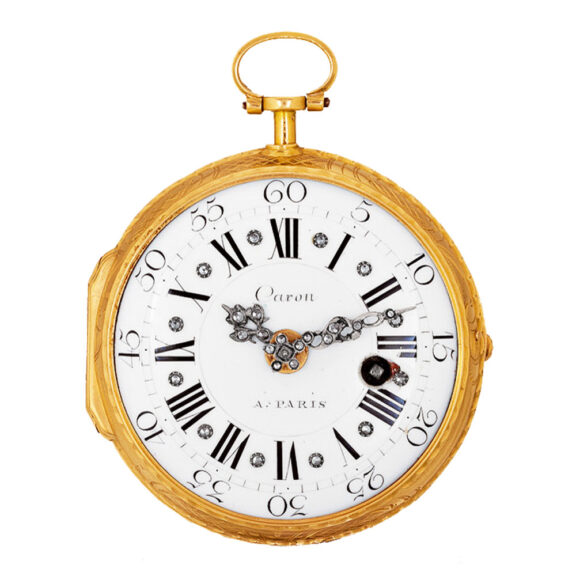
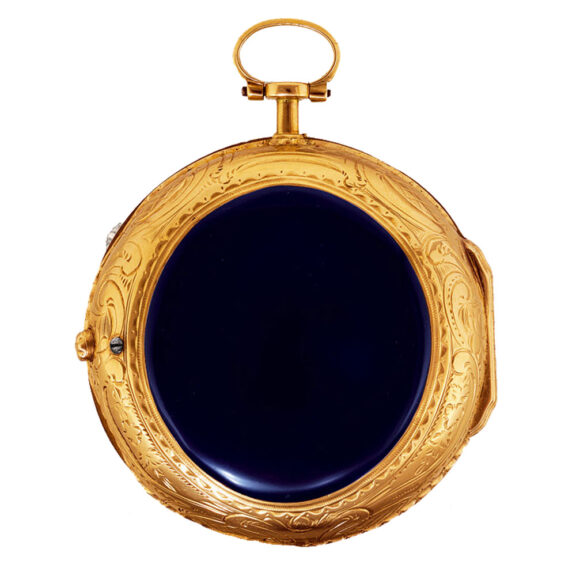
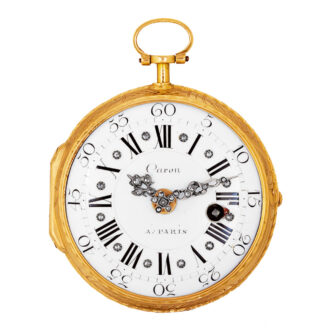
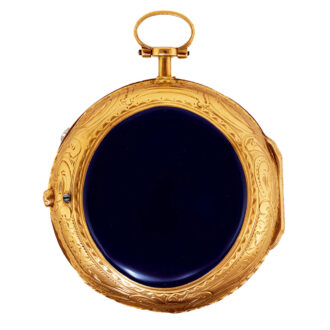
A fine and extremely rare French 18K gold and enamel pocket watch, circa 1750. Gilt brass full-plate movement with pentagonal baluster pillars, fusee and chain, verge escapement, steel balance with flat balance spring, potence adjustment, pierced and chased foliate continental balance cock, silvered regulation dial. Case with scroll and cross-hatched engraved bezel, the back with an oval panel of dark blue enamel, border decorated to match the bezel.
White enamel dial, radial Roman numerals and marcasite dot markers, outer minute track with five-minute Arabic markers, winding aperture between 3 and 4 o’clock. Pierced marcasite set hands. Dial and movement signed.
–
Diameter: 42 mm
–
Signed: Caron à Paris
–
Pierre-Augustin Caron de Beaumarchais (1732-1799) The son of a watchmaker, he became a watchmaker himself, and at the age of 19 invented an escapement mechanism still in use today. In 1756, Beaumarchais married a rich widow who died a year later. He found himself with a fortune — the first of several he made and then lost. Musically talented, in 1759 he became harp teacher to the daughters of Louis XV. For two years (1764-65), he lived in Madrid. On his return to France, he began his career as a playwright. The Barber of Seville was written in 1770, but not presented on the stage until five years later. Beaumarchais became an overnight literary success with the publication of his Memoires (1773-74). At the same time he served as a secret agent for the king. In 1775, The Barber of Seville was produced for the public, increasing his fame.
He became interested in the American Revolution and aided the revolutionary cause by organizing funds, arms, supplies, and ships. After the outbreak of the French Revolution in 1789, Beaumarchais became involved in political struggles which eventually forced him to flee the country in 1792. Beaumarchais’ comedies were not only wildly successful, they also fueled the fires of revolution which were sweeping Europe at that time. He returned to Paris in 1796 and died there in 1799.
Signed: Caron à Paris
Share this page: