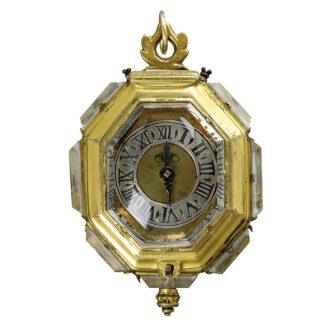
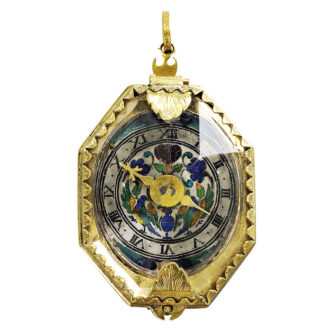
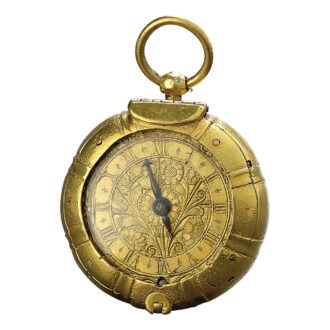
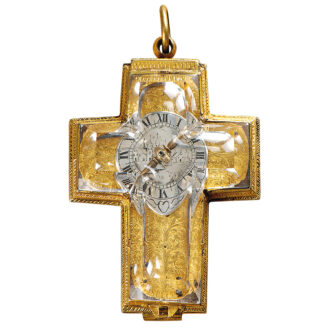
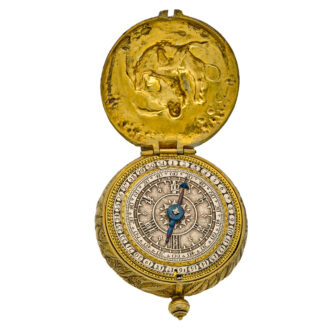
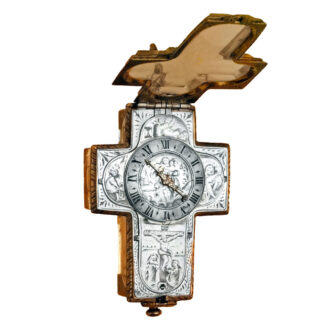
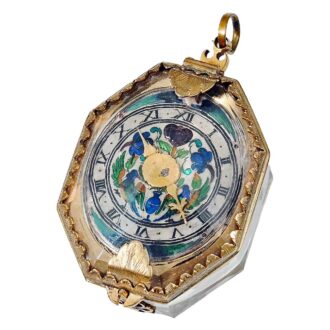
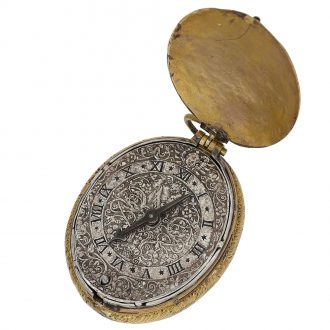
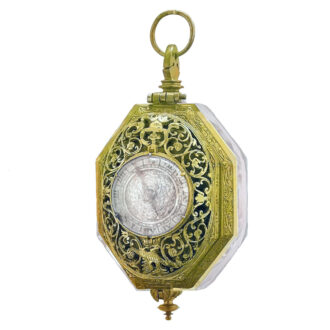
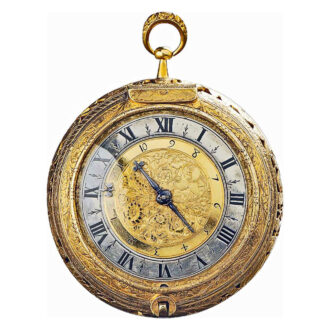
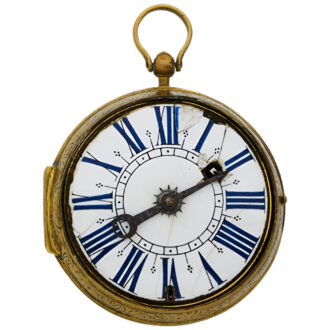
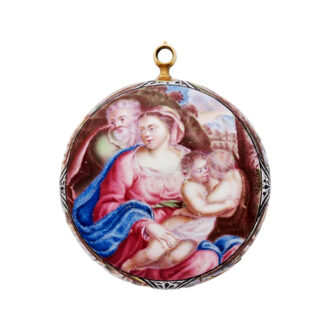
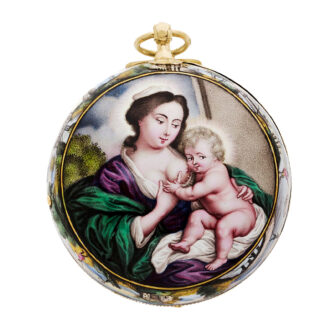
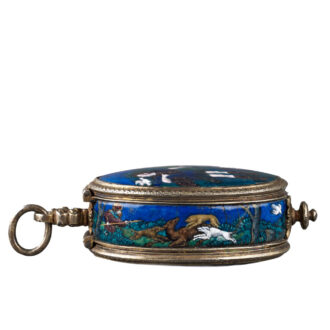
French polychrome enamel painted watch Circa 1600-1620
- Kenmerk
- AM0019
- Diameter
- 44 mm
- Estimate
- € 75.000 - 200.000
- Price sold
- -
Polychrome enamel painted watch by Nicolas Bernard
–
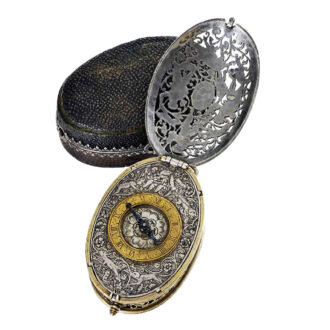
A French, brass, partly gilt and silvered, copper watch with painted enamel scenes, circa the first quarter of the 17th century.
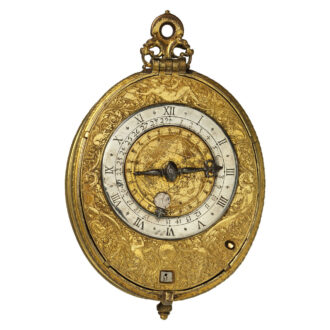
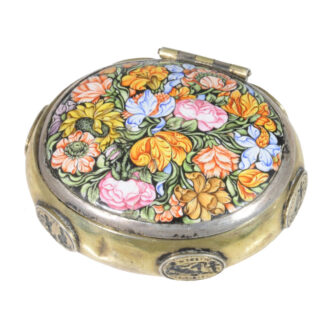
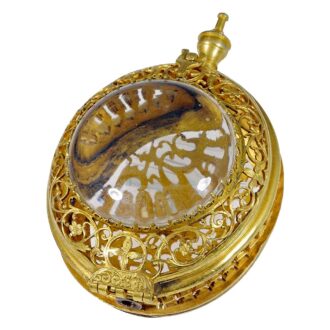
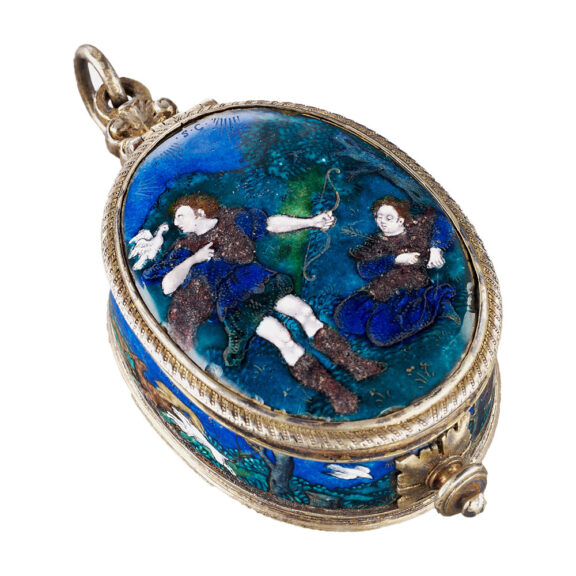
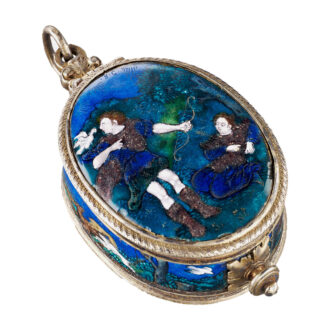
The oval case is suspended from a silver gilt, foliate form pendant and ring, and it has two hinged covers mounted in split bezels of silver gilt that, when closed, are held to the silver gilt band, or side, of the case by friction. The dial and movement are hinged to the case so that both can be made to swing out of the case together. They are held in a closed position by means of a case bolt. A silver gilt, leaf decorated ornament with a circular bosse is attached to the band of the case opposite the pendant.
–
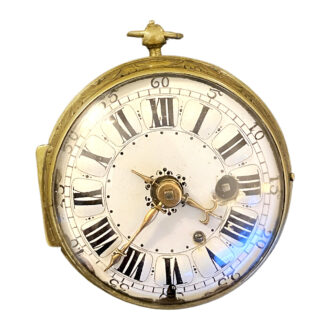
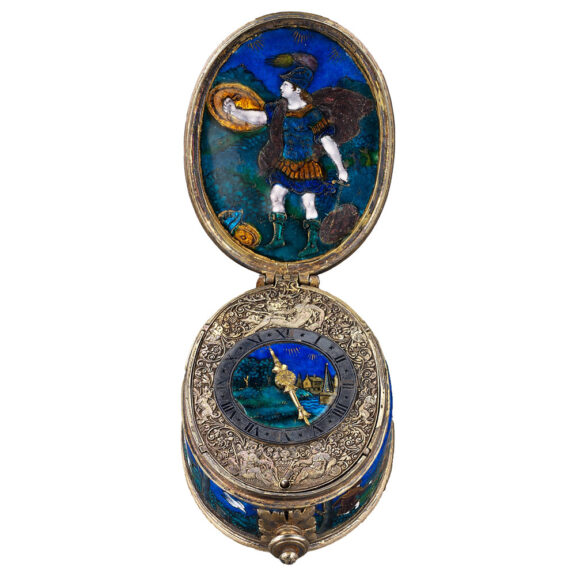
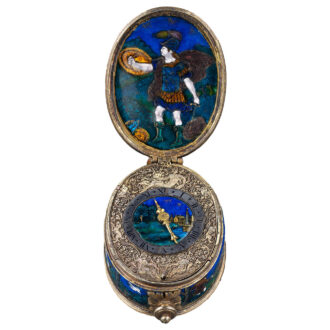
The brass dial plate and all the metal surfaces of the watch that are normally visible are richly ornamented. The dial plate is incised with a reclining nude figure of Diana with a quiver in one hand, a bow in the other, and a stag’s head above her knees. Below, there is a basket of fruit flanked by winged cupids holding a bow and arrow and a quiver, respectively. The Diana and stag group and the Cupid group are separated by floral scrolls inhabited by dogs, a rabbit, and a squirrel. In the centre of the dial plate, there is a chapter ring with black-enamelled numerals I – XII to indicate the hours and with stars for the half hours. The ring encircles an enamel plaque painted with a landscape containing a village and an obelisk-shaped monument situated near a stream. The single hand, of sculptured and gilded brass, has a long tail.
–
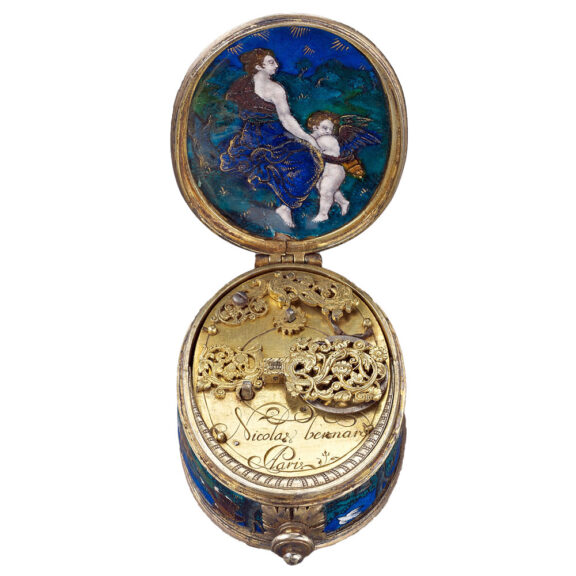
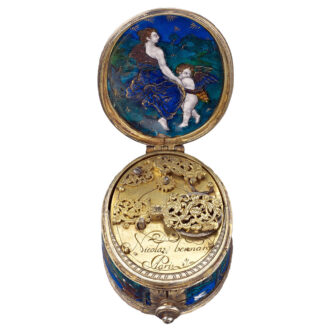
The movement consists of two oval plates held apart by four vase shaped pillars that are pinned to the back plate and contain a train of three wheels ending in an escape wheel and verge escapement regulated by a circular steel balance. The mainspring has a pierced and engraved ratchet and click set up that is screwed to the back plate of the watch. The balance cock, with its pierced and engraved table ornamented with tiny flowers and an S scroll ending in a serpent’s head and pierced and engraved foot with similar floral ornament, is pinned to a tenon projecting from the back plate of the movement. Below it is the signature: Nicolas Bernard Paris, undoubtedly forged.
–
Dimension: 80 x 44 mm
–
Signed: Nicolas Bernard Paris
–
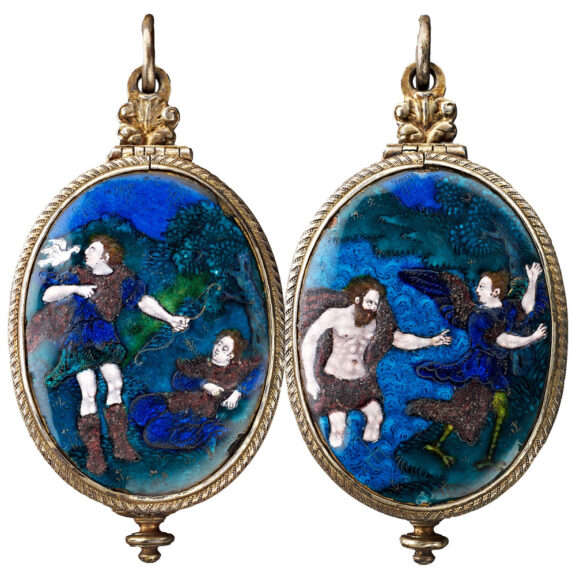
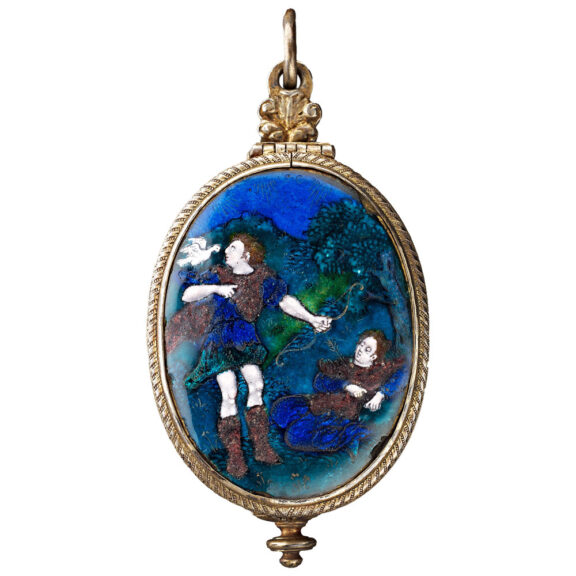
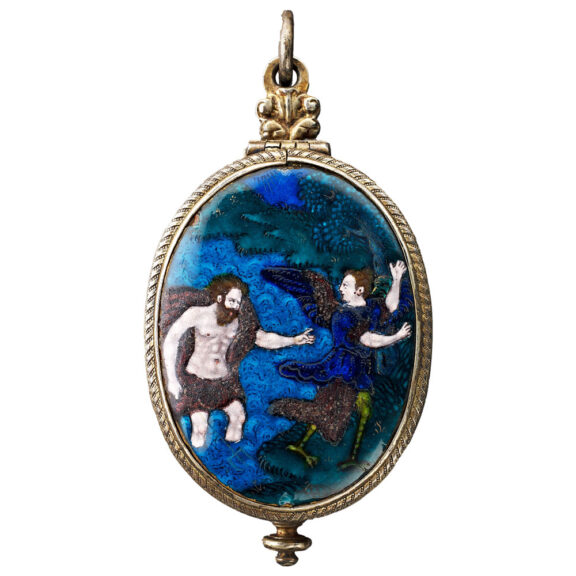
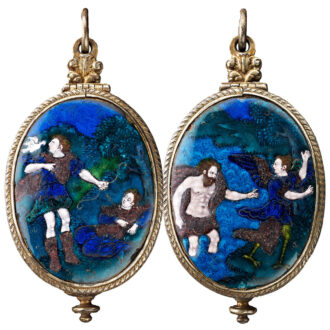
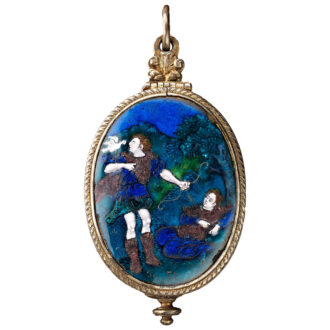
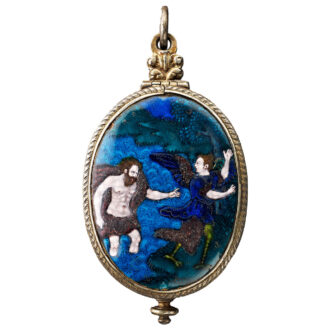
The remaining surfaces of the watch case that are normally visible consist of Limoges painted enamels. The exteriors of the front and back covers depict scenes from Book 2 of Ovid’s Metamorphoses, the front cover with the story of Apollo, the Raven, and Coronis, and the back with Neptune pursuing Coronis, who is visibly changing into a bird to escape the unwelcome advances of the god. The two scenes have been adapted from Bernard Salomon’s illustrations for the La Metamorphose d’Ovide Figuree published by Jean de Tournes in Lyon.
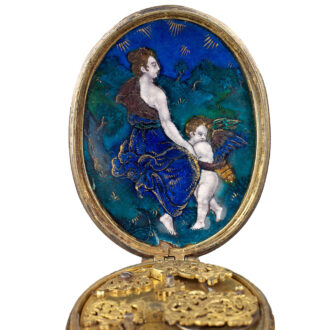
On the interior of each cover, in the space that an ordinary plaque would be covered with counter enamel of a single colour, sometimes with scattered ornament in gilt or painted enamel, there is, instead, a fully realized painted enamel scene.
–
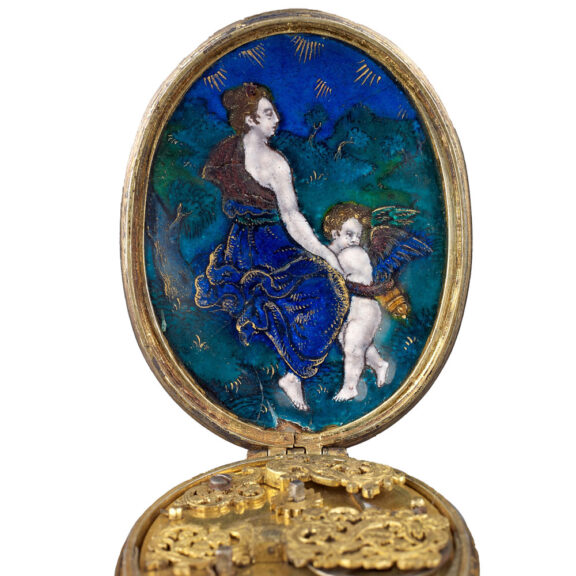
The interior of the front cover depicts the god Mars and of the back cover, Venus and Cupid. Like the scenes on the exterior of the case, these are not the original creation of the enamel painter but instead excerpts from engravings by other artists. The figure of Mars is found in reverse in the centre of an ornamental print by the Italian-born designer and engraver Étienne Delaune, who had a long career in France beginning as early as 1545.
The engraving is undated but signed with one of Delaune’s customary signatures: Stephanus Fecit. The seated goddess with a winged putto at her knee surely meant to portray Venus and Cupid owing to the context here is derived, again in reverse, from an engraving by an unidentified Italian known as the Master of the Die (Italian, active Rome, ca. 1525 – 1560). The engraving depicts the Wedding Feast of Cupid and Psyche, recounted by the Latin author Apuleius in The Golden Ass.
–
The two figures were the ones understood by the engraver to represent Psyche and Cupid, and his interpretation was repeatedly used by several enamelers in mid sixteenth century Limoges, notably by Léonard Limosin, Pierre Reymond, and the Master IC, all of whom painted the entire scene on large plates. But the odd representation of Cupid as an infant rather than a youth of marriageable age has never been satisfactorily explained. It is not surprising, therefore, that Susanne de Court seems to have recognized that the two figures could appropriately represent Venus and Cupid.
–
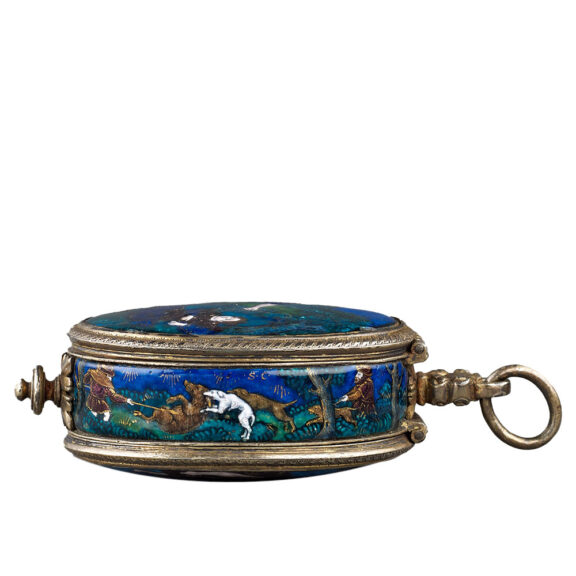
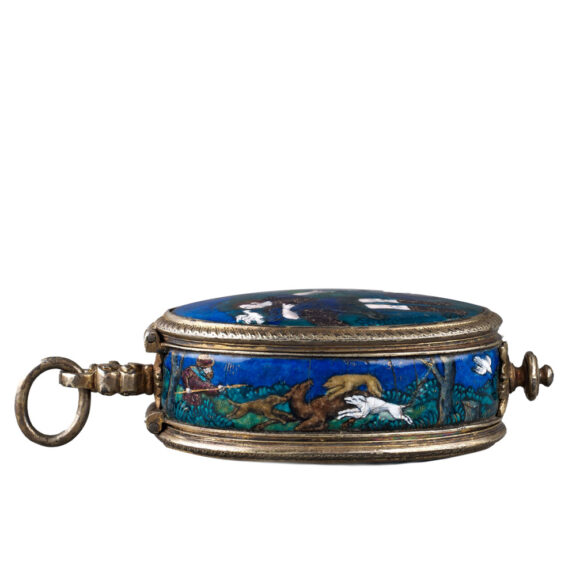
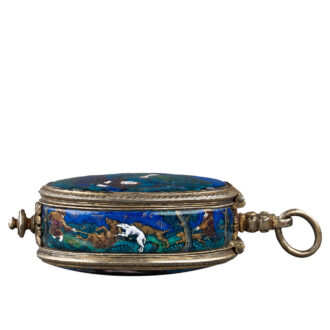
Two more enamelled plaques are attached to the band of the watch case. They are painted with hunting scenes, and these can be traced to engravings by the Nuremberg artist Virgil Solis.10 A recent study by Gregory Bailey of the enamels on the band and on the dial of the watch together with the technique of their application has shown that they are not comparable to enamels known to be the work of Susanne de Court but to be of nineteenth-century origin.
–
With these exceptions, these enamels are characteristic of Susanne de Court’s work. They rely on vivid greens and blues for the ground and sky, with smaller paillons. Opaque white is used for details where appropriate and with a thin overlay of pale salmon coloured enamel, for areas of human flesh. Details are picked out in gilt, and semicircular clusters of gilt rays are used to represent daylight. Characteristically, each plaque is signed with de Court’s initials.
–
The dating of this watch is problematic: close examination of the evidence leaves little that remains solid. While there are several clockmakers named Bernard, or Benard, known to have been working in Paris in the late sixteenth and early seventeenth centuries, there is no record of a Nicolas Bernard before 1636, when a man by that name was made a master clockmaker. A record survives of the baptism of his son, also named Nicolas, on 26 June 1642. In 1646 he was one of the signers of the statutes of the corporation of clockmakers in Paris; he is twice mentioned as a clockmaker in 1650; and as a merchant clockmaker and burgher of Paris at his death on 19 June 1670.16 His working life, then, would have been between 1636 and 1670. A number of his watches survive; some are housed in extraordinary cases, perhaps not surprising, as Bernard seems to have had connections at the French court.
Signed: Nicolas Bernard Paris
Share this page: