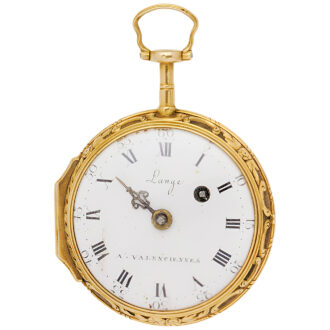
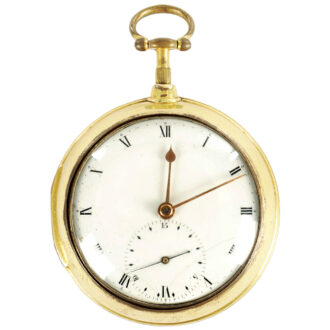
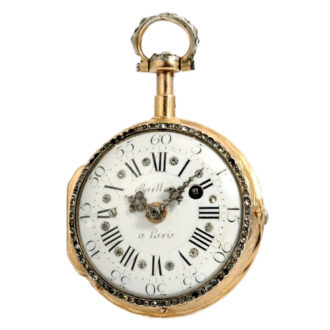
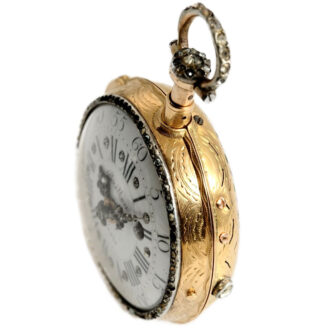
French quarter repeating verge pocket watch Circa 1750
- Kenmerk
- AD4565
- Diameter
- 40 mm
- Estimate
- € 3.500 - 7.000
- Price sold
- -
Gold open faced pocket watch by Jean Baptiste Baillon
–
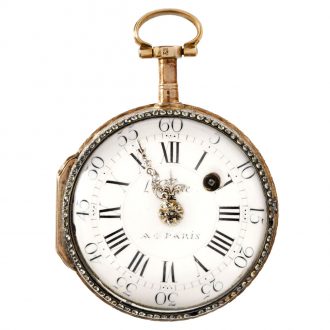
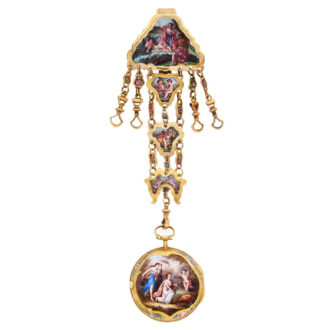
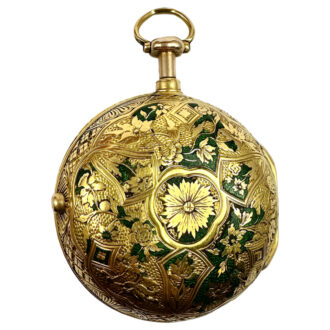
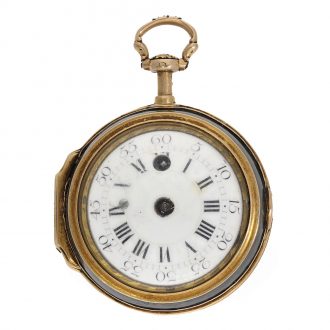
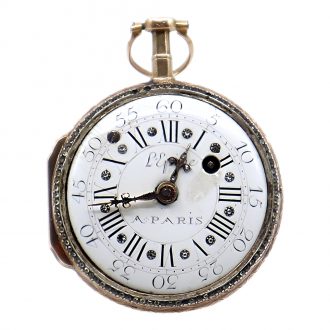
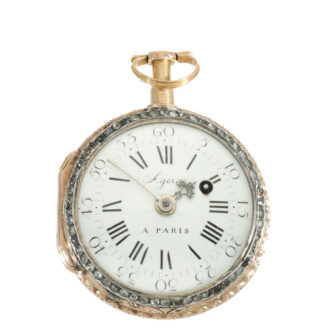
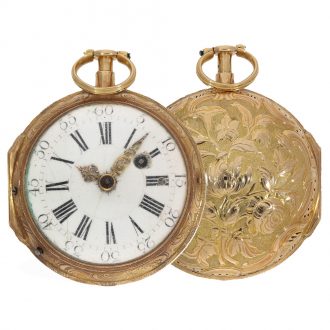
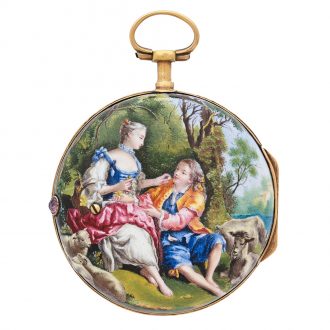
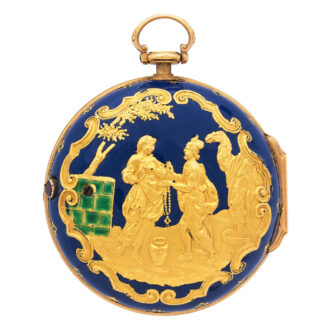
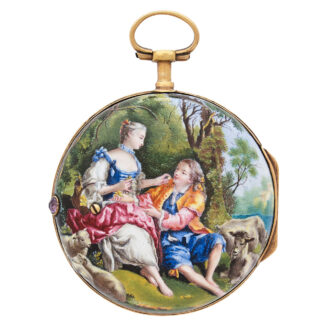
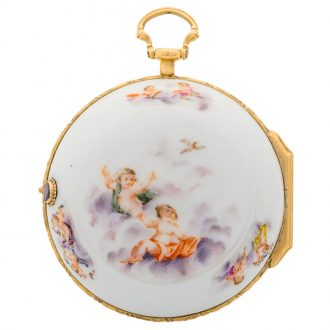
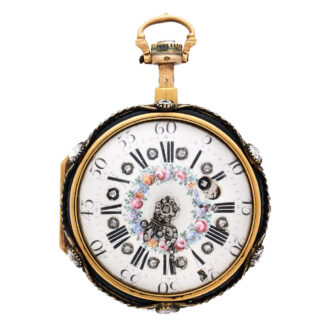
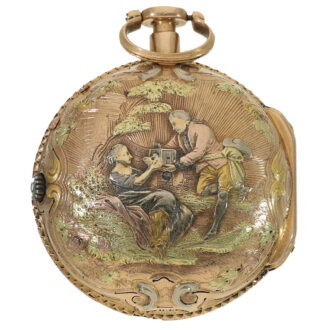
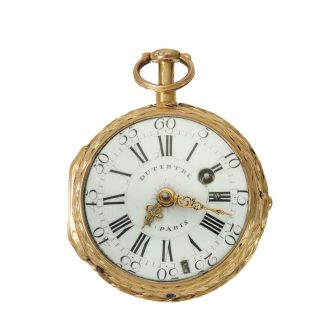
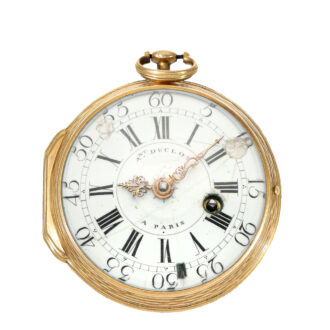
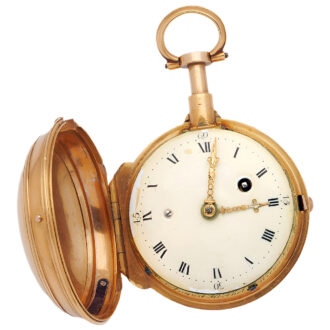
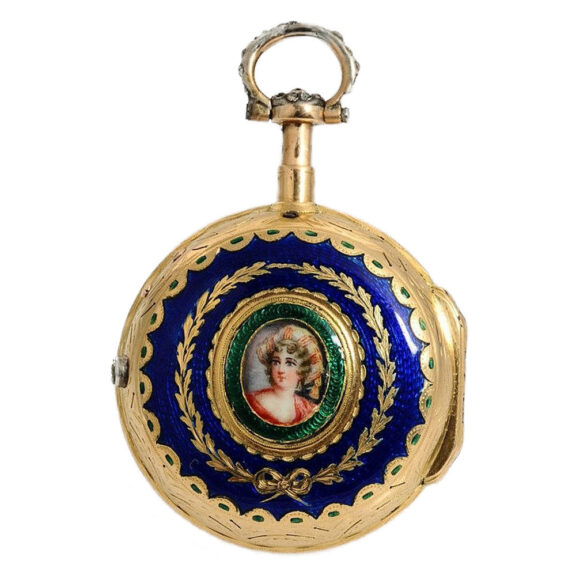
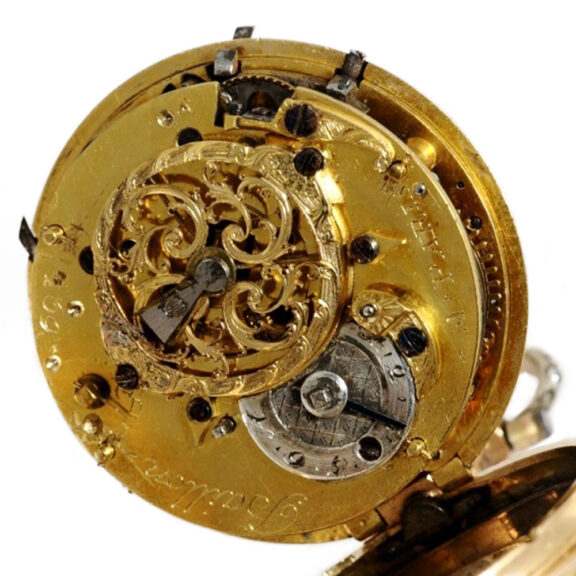
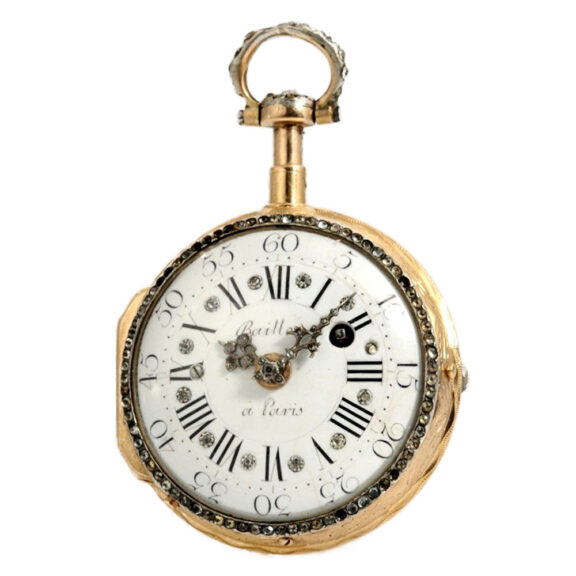
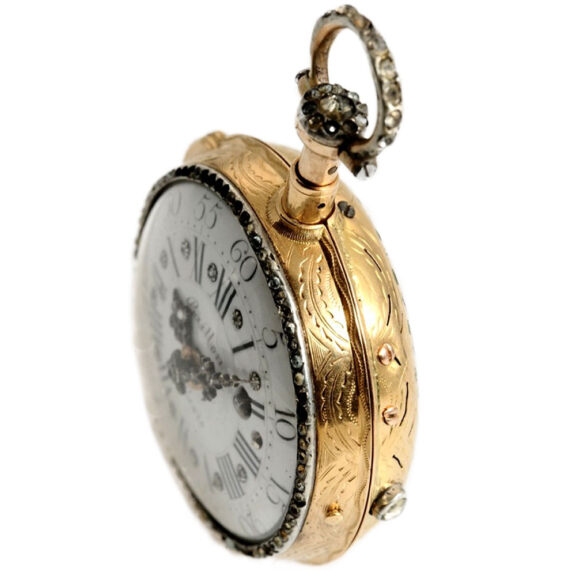
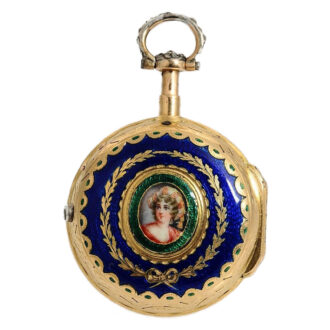
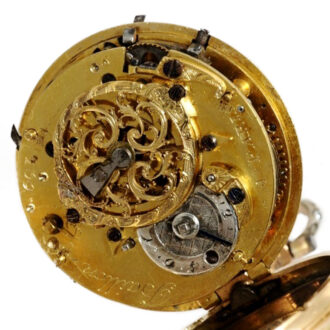
A rare French 18K gold and enamel open faced quarter repeating verge pocket watch, circa 1750. Engine-turned case back covered with translucent cobalt blue and green enamel, central a miniature portrait of a noble lady, both bezels florally engraved, the front bezel further diamond-set, diamond-set bow and thumb-piece for the repeater and rear bell. Signed white enamel dial with radial Roman hours, radial Arabic minutes and paste-set Louis XV hands. Engraved fire gilt full plate movement, keywind, chain and fusee, solid movement pillars, two hammers, three-arm brass balance and pierced balance bridge, signed.
–
Diameter: 40 mm
–
Weight: 63 g
–
Signed: Baillon à Paris
–
Jean-Baptiste Baillon (de Fontenay) was a very famous and at that time the richest watchmaker in Paris in the 18th century. He became a master watchmaker in 1727, his business was first on the Place Dauphine and later in the Rue Dauphine. He had his own workshop in Saint-Germain-en-Laye where various watchmakers worked for him, which was quite unusual at the time. The workshop was under the direction of Jean Jodin (1715-1761) from 1748 to 1757, but it was closed in 1765. Baillon was watchmaker to the Queen of France Maria Leczinska in 1738, Valet de Chambre-Horloger Ordinaire de la Reine around 1748, Premier Valet de Chambre de la Reine and from about 1770 watchmaker at the court of Queen Marie Antoinette, Premier Valet de Chambre and Valet de Chambre-Horloger Ordinaire de la Dauphine to Marie-Antoinette. Ferdinand Berthoud was very impressed with Baillon’s workshop and business, the size and excellent quality. In 1753 Berthoud wrote about Baillon’s business: “It is currently the most beautiful and richest watch shop. Diamonds are not only used on pocket watches, but also on clocks.”
Jean-Baptiste-Albert Baillon died exceptionally rich in 1772, probably at the end of March. On April 8, 1772, his fortune was valued at 384,000 Livres. His private decorative art collection was auctioned on June 16, 1772. On February 23, 1773, all stocks of watches were sold. His father was the watchmaker Jean-Baptiste Baillon II and his grandfather was watchmaker Jean-Baptiste Baillon I, who was active in Rouen. His son Jean-Baptiste IV Baillon (1752-1773) became a watchmaker in Paris too.
–
Copies of his work can be found in the Musée des Arts et Métiers, Musée du Louvre in Paris, Château de Versailles, Musée Paul-Dupuy in Toulouse, the Koninklijke Musea voor Kunst en Geschiedenis in Brussels, the Museo Galileo in Florence, Science Museum and Victoria Albert Museum in London and Metropolitan Museum of Art in New York.
Signed: Baillon à Paris
Share this page: