French 20 Carat gold and enamel verge pendant watch Circa 1650
- Kenmerk
- TA2023
- Diameter
- 46 mm
- Estimate
- € 125.000 - 250.000
- Price sold
- -
Gold verge decorated with a painted on enamel scene
–
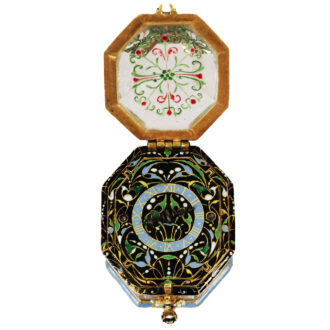
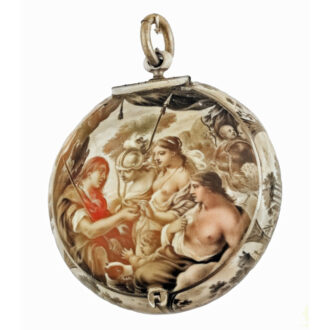
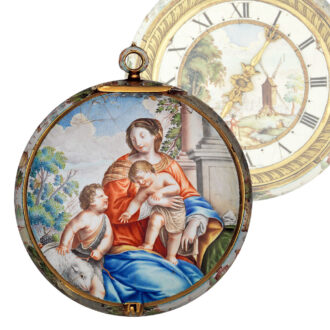
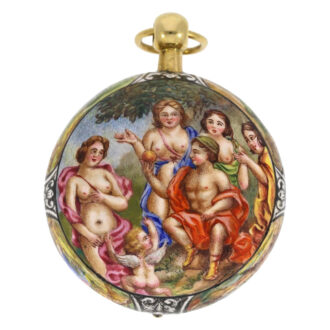
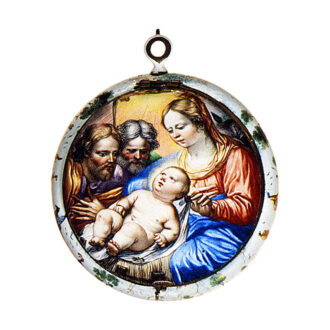
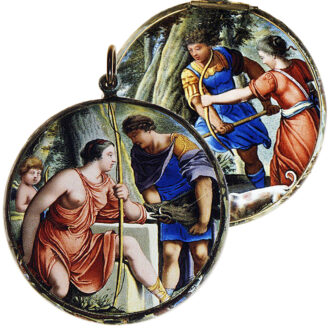
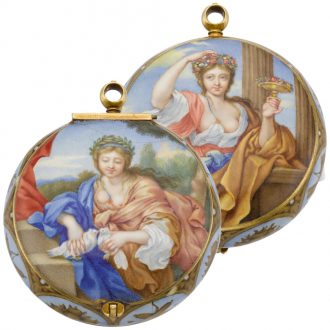
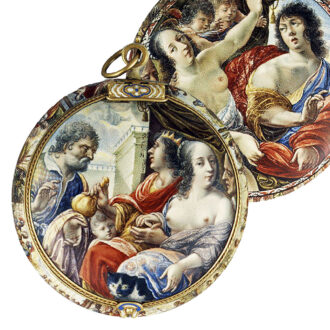
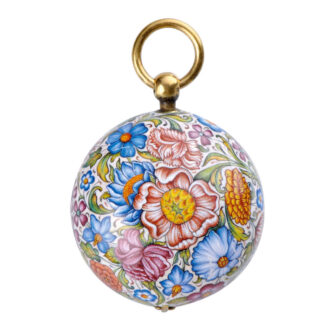
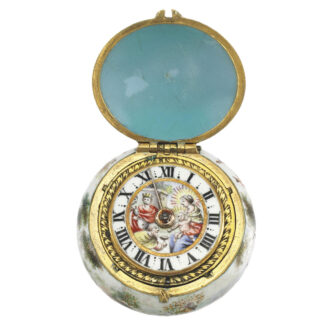
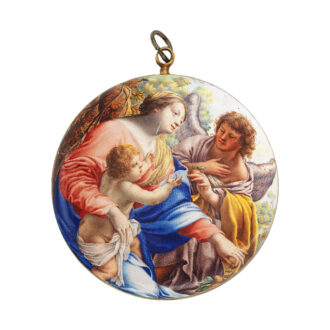
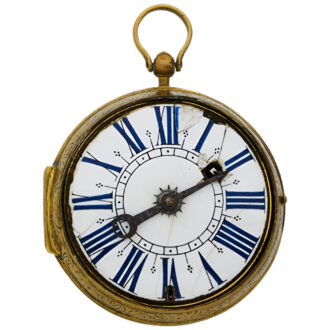
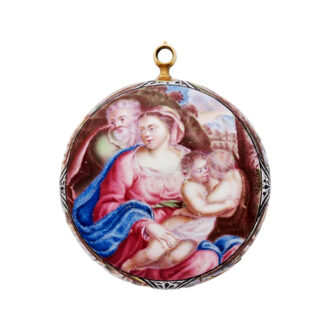
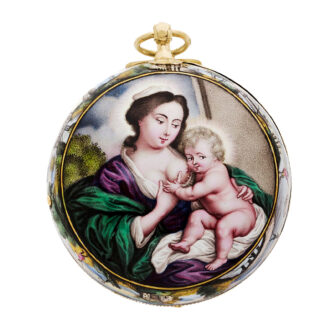
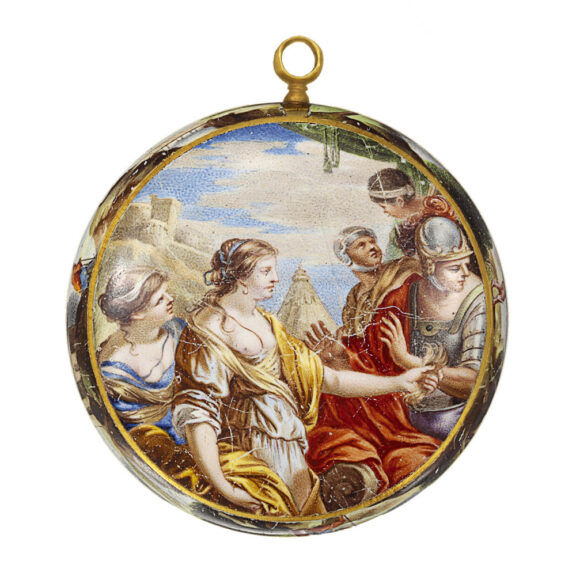
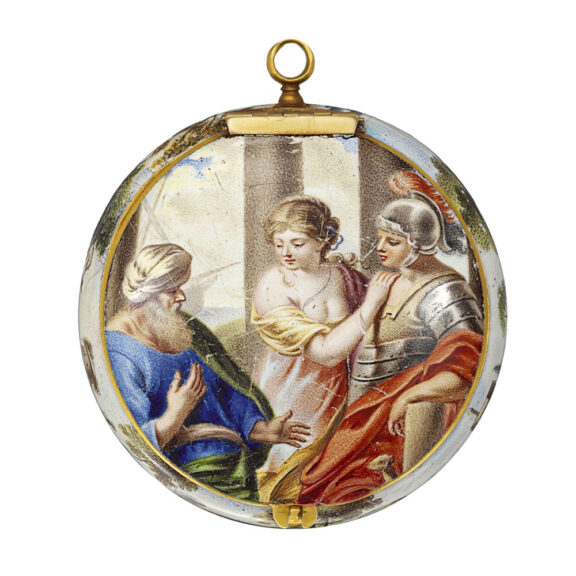
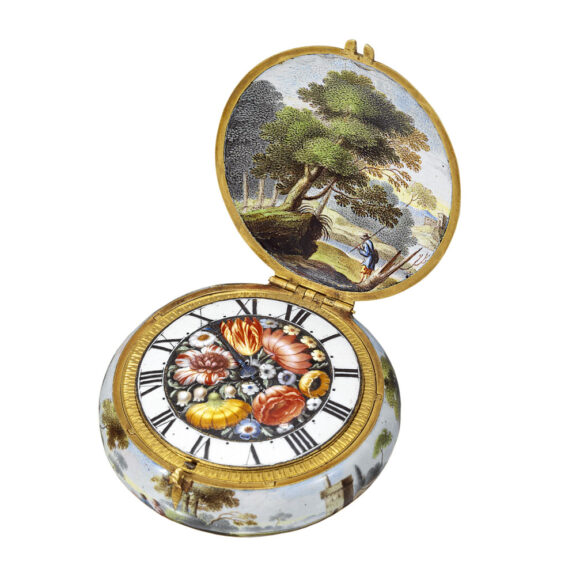
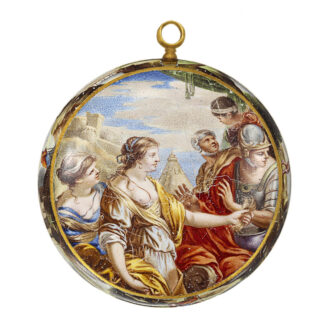
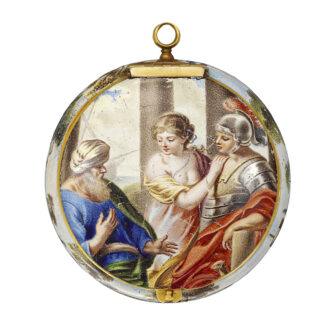
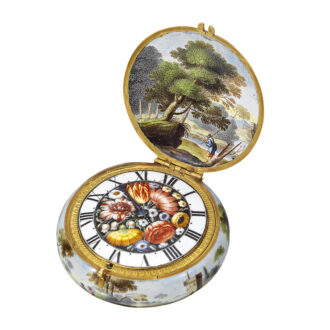
An extremely fine and equally rare French 20 Carat gold and enamel pre balance spring single handed pendant watch, circa 1650. Semiramis Called Arms by Goullons. A finely painted enamel scene depicting Semiramis receiving the news of the Babylonian revolt on the hinged cover, another polychrome enamel scene of a figure walking in a wooded landscape on the inside, the deeply curved band with a continuous arcadian landscape scene with three, four figures, the back decorated with a scene of Semiramis called to arms, the interior with a seated figure in a wooded river landscape. The enamel can be attributed to the Toutin workshop.
–
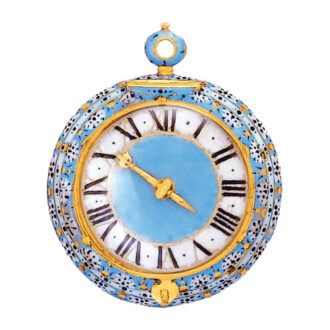
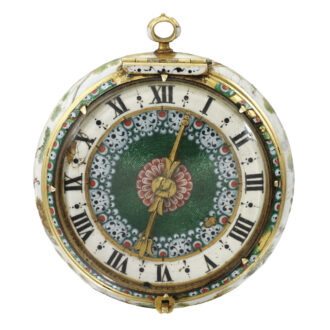
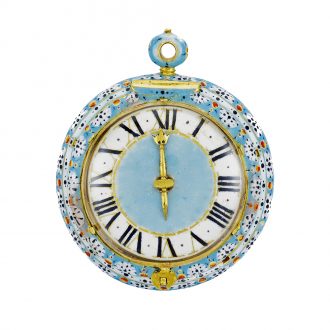
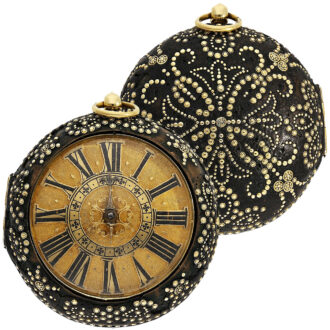
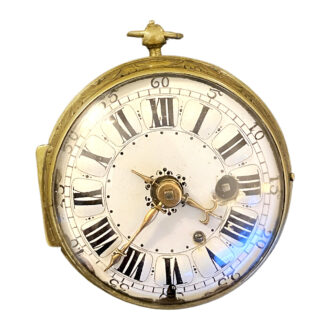
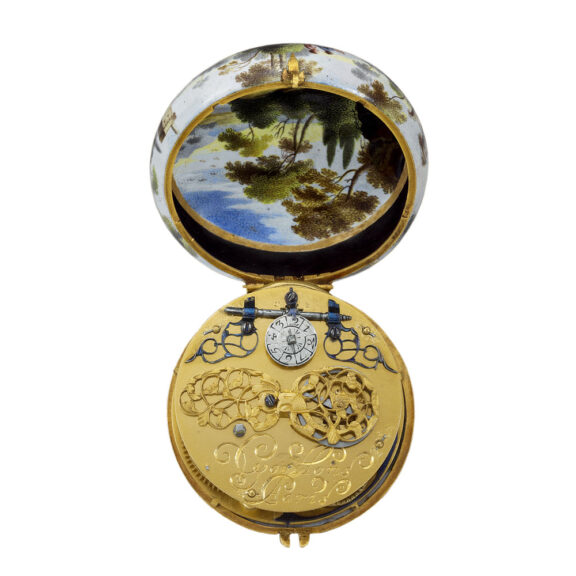
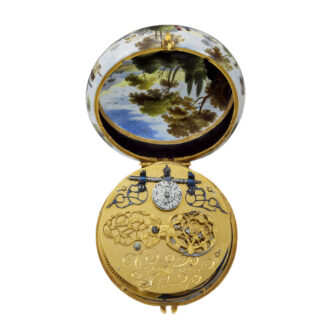
Enamel dial, white chapter ring with radial Roman hours and half hour dots, the center decorated with painted on enamel flowers including a tulip, peony, primroses and Solomon’s seal, a gilt dial plate border engraved with stylized leaves, blued steel single tulip hand. A gilt brass full plate movement without minute wheel, baluster pillars, fusee with gut, three wheel train, verge escapement, two arm steel balance without balance spring, finely pierced and engraved small cock with asymmetric pierced foliate engraved foot secured by a screw, worm and wheel setup regulator with a numbered silver disc, blued steel brackets with pierced decoration.
Movement signed.
–
Diameter: 46 mm
–
Signed: Goullons Paris
–
It is now generally accepted that the technique of painting in enamel was invented perhaps ten years before the date of 1628 cited by Félibien in his Principes de l’Architecture, de la sculpture, de la Peinture et des Autres arts qui en dépendent, published in 1676. He ascribes the invention to Jean Toutin, a goldsmith originally from Châteaudun, but who settled in Blois by 1604. Again, it seems unlikely that he was solely responsible for the invention, as the basis of the technique had already been in use in Limoges for approximately 100 years. However, it is to the craftsmen of Blois that we owe the discovery of the rich palette of colours that are so characteristic of their work. Initially, the colours were somewhat limited and the technique less well developed, hardly surprising in view of the need to fire the case numerous times and the inexperience of the first craftsmen. It seems likely that such watches were considered as priceless works of art when they first appeared, not so much to be worn, but more to be admired. It is known that the Cardinals Mazarin and Richelieu occasionally gave such watches as handsome presents to people they wished to influence. That the enamellers had a ready market for everything they could produce is supported by the fact that they seemed to have to hand the very latest engravings, and on occasion paintings, as material to copy.
–
Certain cases would appear to date to little more than a year after the original work from which they are taken. Painting in enamel, for which the Blois school is most famed, involved the construction of an exceptionally thin gold framework that was enamelled on all surfaces, the inside or counter enamel being an integral part of the structure. This case was made using a different technique. Initially, the shell would have been cast or drawn up in considerable thickness, sufficient to support the stresses involved in firing the enamels without distortion. Afterwards, the excess gold would have been recovered by scraping away the interior until only a thin skin remained. Pierre Vilar in his classic work A History of Gold and Money 1450-1920, provides an indication of the enormous value of gold at the time. By his calculation, in 1500, if all the gold in Europe were combined into a block, it would have only measured two m². Although watches of this period are rare in any case, it is certain that many would have been scrapped in subsequent years simply on account of their precious metal content. Several watches of similar size, and perhaps attributable to the same enameler, are preserved in museum collections, although very few still remain in private hands.
–
Goullons was an eminent maker responsible for making a large clock watch for the study of Cardinal Mazarin in 1663 for 200 Livres. The collection of the Musée International d’Horlogerie in La Chaux-de-Fonds has a remarkable watch by Goullons. In the Victoria and Albert Museum in London, there is a magnificent watch by him painted with the portraits of Louis XIII and Cardinal Richelieu. The Worshipful Company of Clockmakers possesses a watch by Goullons enamelled in relief with flowers and foliage.
–
Semiramis Called to arms. The decoration of this watch tells the story of Semiramis, the legendary Queen of Assyria. Interrupted at her toilette by news of a revolt, she demonstrated her determination as a ruler by immediately rushing to lead her army to crush the rebels. In the cover decoration, the Queen is interrupted by a messenger bearing the news of the revolt of the Babylonians. According to Valerius Maximus, in keeping with her imperious and war-like nature, she immediately abandoned her toilette and rushed to take up arms to quell the revolt.
Signed: Goullons Paris
Share this page: