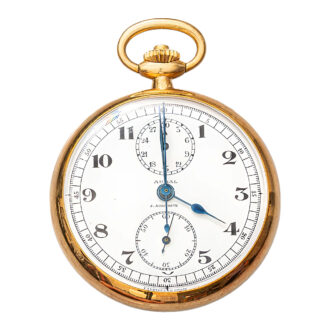
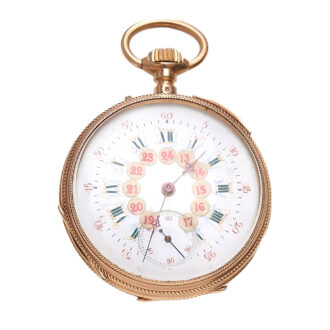
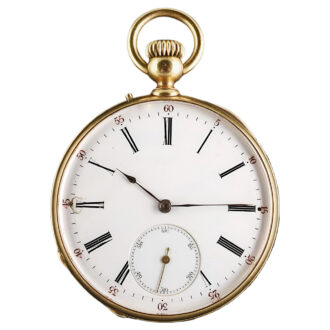
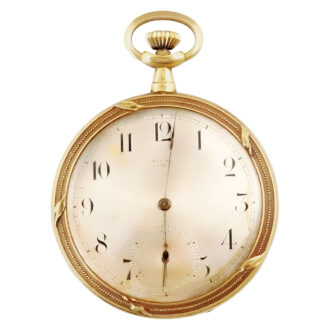
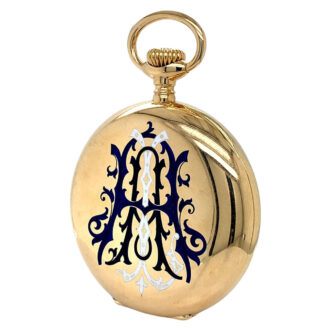
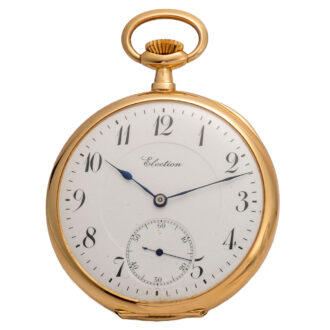
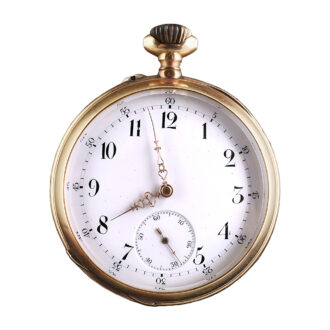
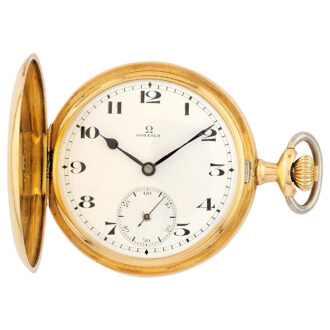
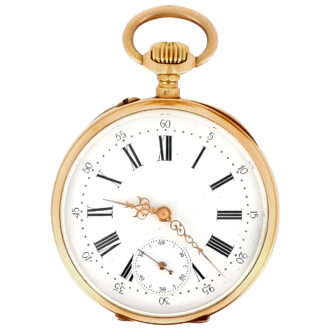
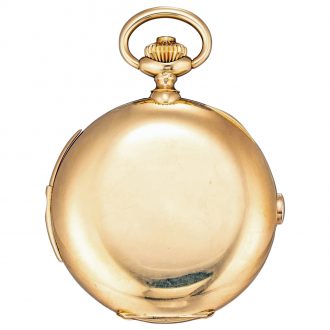
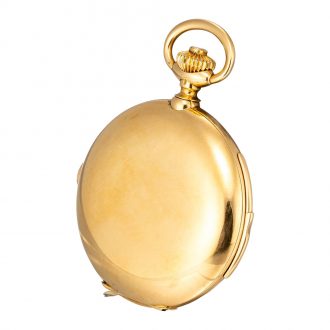
French/Swiss repeater with chronograph and register Circa 1910
- Kenmerk
- AS2005
- Diameter
- 53 mm
- Estimate
- € 4.000 - 6.000
- Price sold
- € 2.400
Yellow gold hunting cased chronograph by UTI/Utinam
–
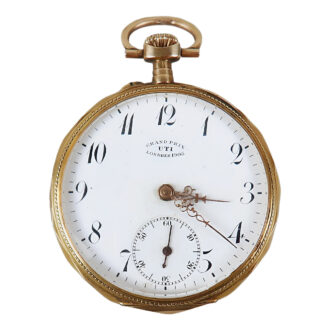
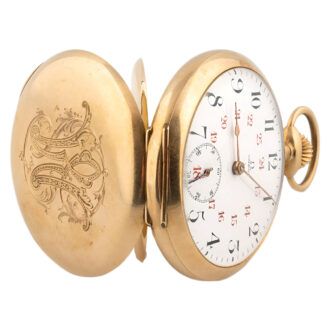
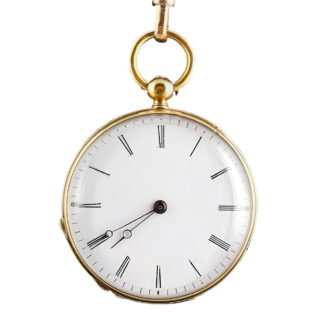
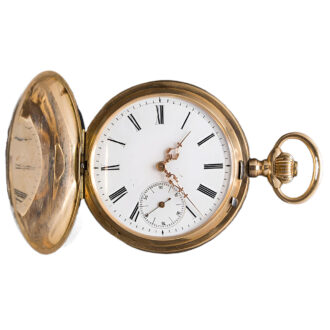
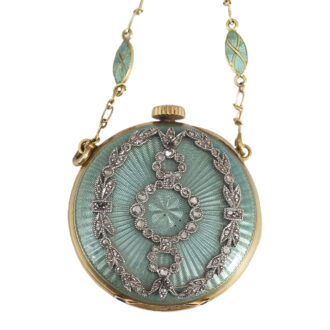
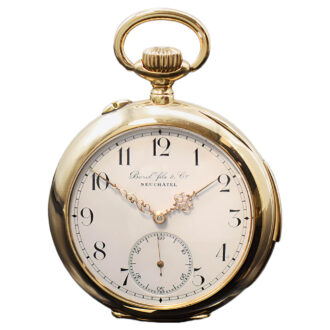
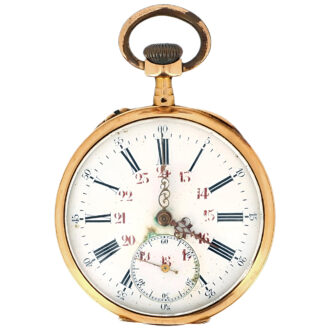
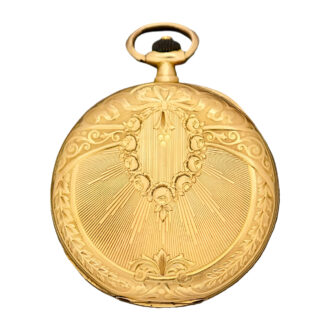
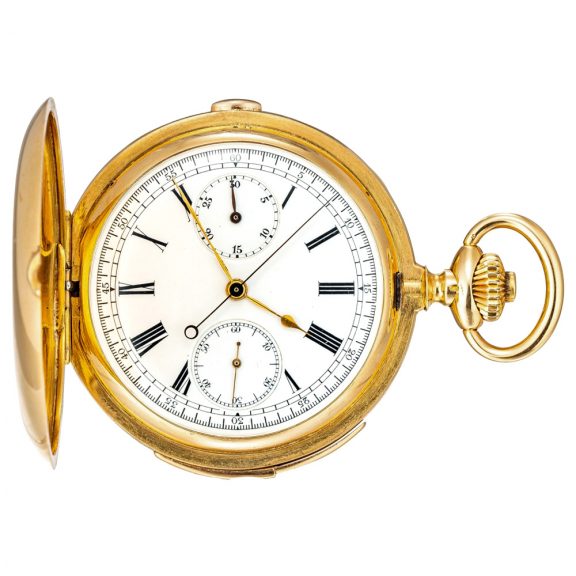
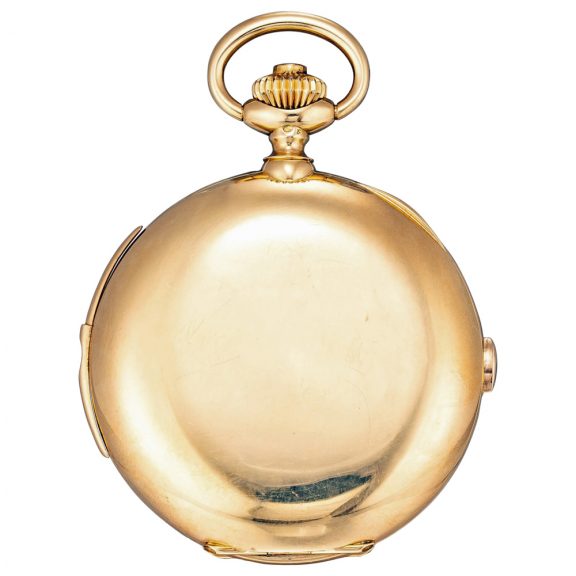
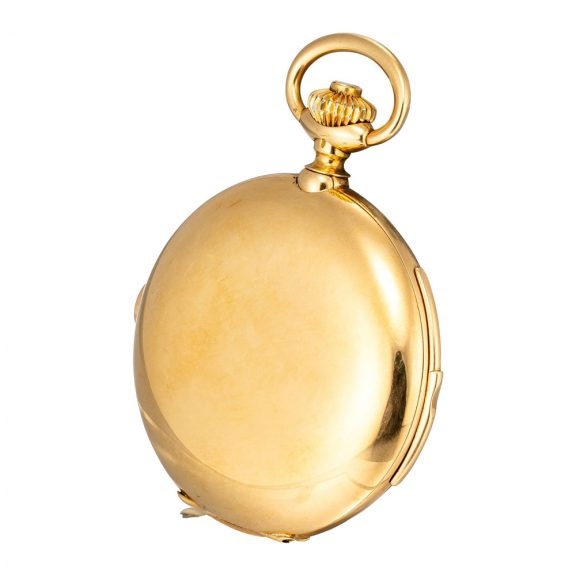
A French/Swiss yellow gold hunting cased keyless minute repeating chronograph watch, circa 1910. This watch features a mechanical, jewelled movement with a lever escapement. It has a white enamel dial with Roman numeral hour markers, an outer minute track, and an extreme outer seconds track divided into fifths of a second. The watch is equipped with gold spade hands, a subsidiary seconds dial, and a subsidiary register dial. It comes in an 18 carat gold case with a cuvette and a hinged case back. The cuvette is signed, and the case is numbered.
–
Diameter: 53 mm
–
Signed: UTI
–
The movement is not functioning and requires a complete service. The dial remains intact. The case is well preserved with tight hinges, exhibiting only light surface wear typical for the watch’s age. There is a minor dent on the edge of the cuvette.
–
UTI-Utinam, a French/Swiss watch manufacturer and retailer
The name Utinam is derived from Latin, meaning God willing. The company UTI, along with the Utinam factory, was established around 1908 by Georges Meyer. Prior to founding UTI, Georges Meyer worked as a director for Hector Lévy in Paris, who had founded his own company in 1880. Hector Lévy had taken over the business from Antoine Redier. In 1904, the Redier company was incorporated into C. Grivolas & Cie, which was subsequently acquired by Léon Maxant a year later.
–
1900- 1945
Following the establishment of UTI and the Utinam factory in Besançon, Hector Lévy’s shop at 139 Boulevard de Sébastopol in Paris served as an office and sales showroom for Etablissements Georges Meyer UTI and Utinam. The Utinam factory was located at 10 Rue des Villas, with a secondary office in La Chaux-de-Fonds at 59 Rue Leopold-Robert, which likely housed a small production facility. UTI was among the first French watch manufacturers to use radium on their dials, producing a significant number of wristwatches for both men and women.
Around 1918, Henri Blum was appointed director in Besançon. A few years later, his brother Eugène Fernand Blum joined UTI-Utinam in Besançon. After Henri Blum passed away in 1937, Eugène Fernand Blum became the director. During World War II, the company faced severe challenges; the Paris branch was renamed Etablissements UTI SA and became a member of the Convention Franco-Swiss. The situation was dire in Besançon, where director Eugène Fernand Blum was arrested and died in the Pithiviers concentration camp in 1942.
–
1945-1985
Postwar, Etablissements UTI SA in Paris transitioned increasingly into a wholesale business. The company imported wristwatches from Switzerland, small watches from Swiza, and table clocks from Warmink WUBA in the Netherlands. Watches from brands like Breitling, Pronto Watch Co., and Glycine were marketed with the additional UTI label, and under the UTI name, watches from Besançon were available under various brand names such as BEAUTEX and Chronométre UTI. At that time, the Utinam factory functioned primarily as an assembly plant. The company became the sole importer of Seiko watches and assembled Pulsar watches. Jacques Meyer served as the CEO of UTI SA.
Signed: UTI
Share this page: