Extremely early German gold, enamel and rock crystal verge Circa 1560
- Kenmerk
- AD3164
- Diameter
- -
- Estimate
- € 100.000 - 200.000
- Price sold
- -
Gold, enamel and rock crystal oval watch probably from Nuremberg
–
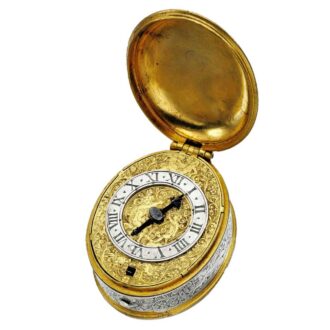
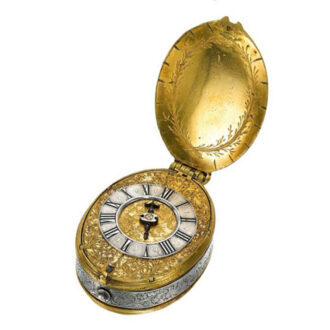
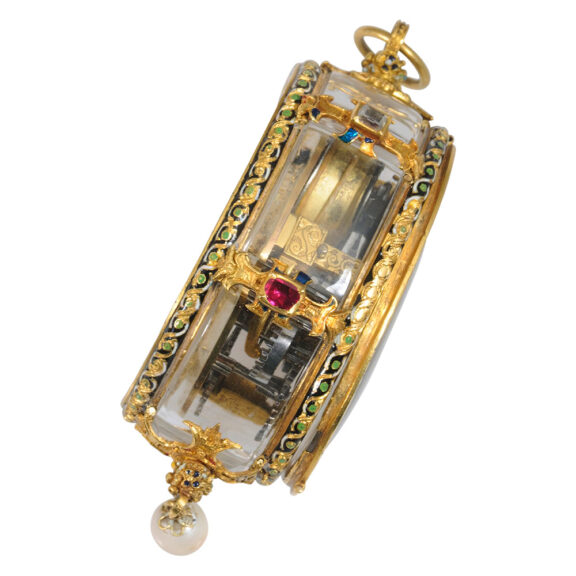
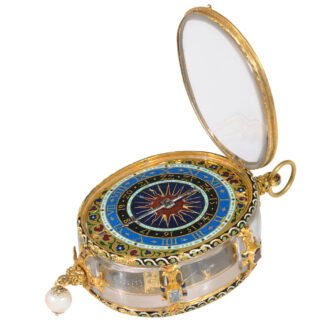
An important and extremely early German oval gold, enamel and rock crystal verge pocket watch, circa 1560.
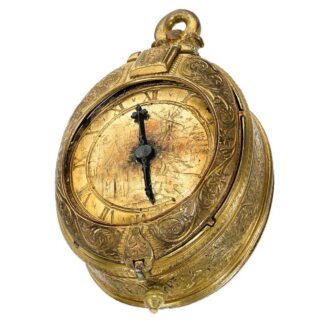
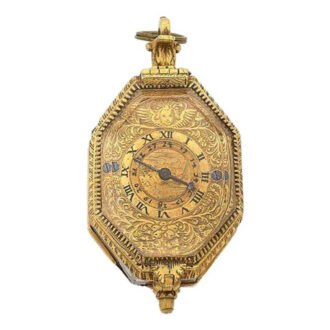
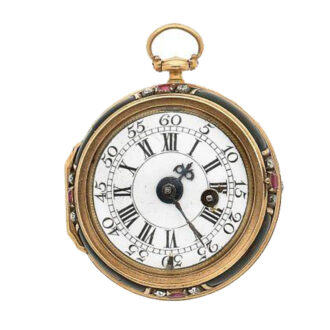
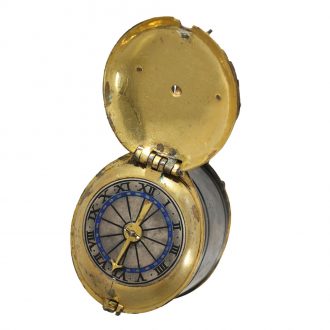
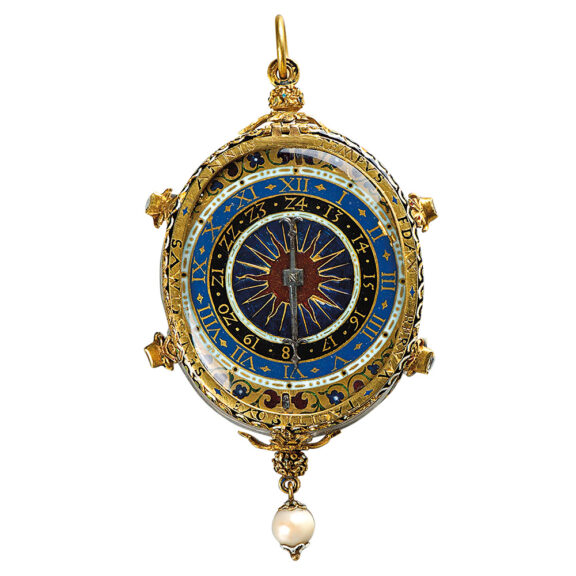
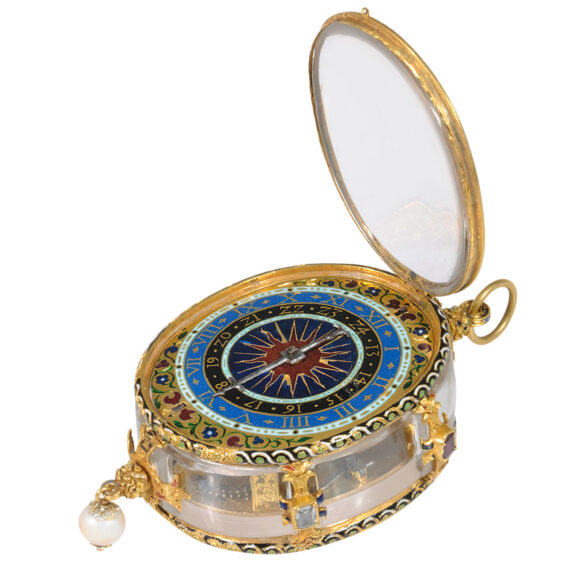
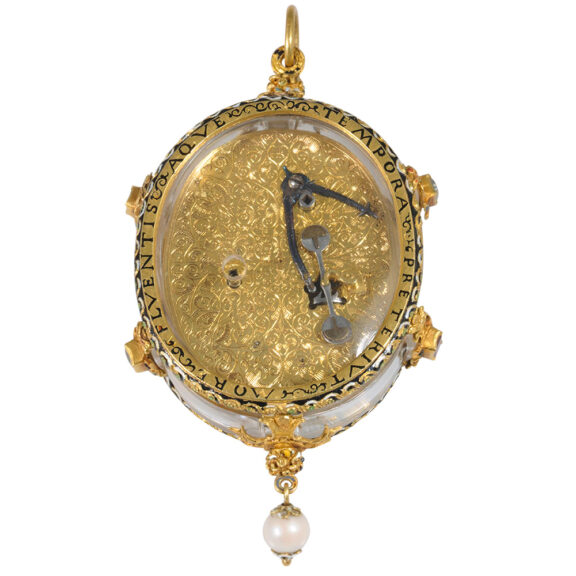
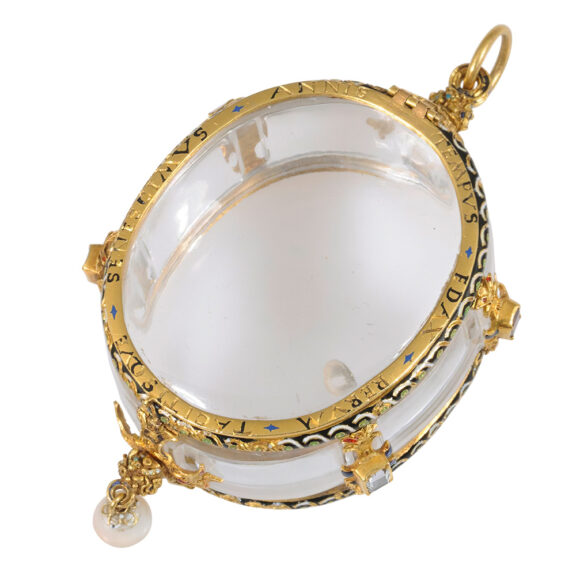
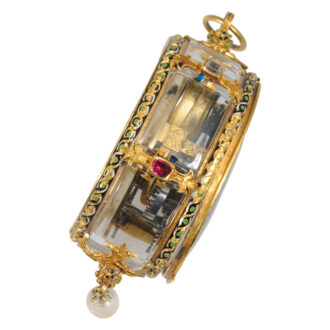
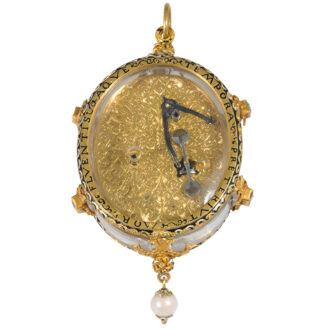
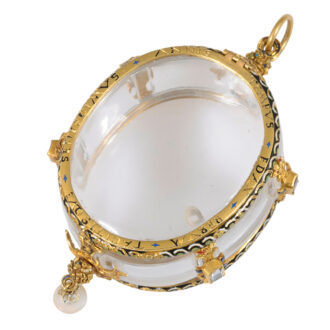
The oval case is framed in high-carat gold, decorated with a rope twist pattern in black, white and green champlevé enamel, the back frame is joined to the front by four shaped hinged straps, showing remaining traces of translucent red and blue enamel and set with a large square cut ruby or diamond, the encrusted ball pendant with a ring and similar finial with a pearl, both similarly, enamelled in white, green and translucent colours, the rock crystal side with raised bands beneath the mountings, the hinged rock crystal set front cover inscribed with the black enamelled Latin phrase Tempus Edax Rerum Tacitisque Senescimus Annis (time devours all things we grow old with the silently passing years), the back bezel with the phrase Tempora Pretereunt More Fluentis Aquae (time passes like flowing water).
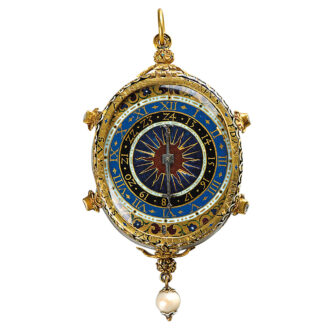
An oval gold dial, the vertices decorated with floral scrolls in green, red and blue translucent enamel, the centre with a 24-point starburst in red translucent enamel against a blue ground within a band of white enamel, then black enamel with 13-24 Arabic hour chapters, blue translucent enamel for the 12-hour ring with half-hour marks and an outer band of white, a single blued steel hand with a splayed tail.
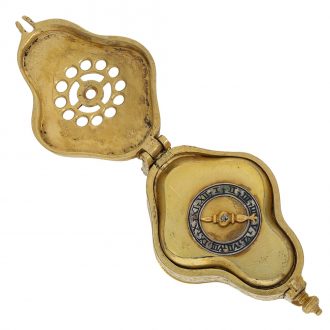
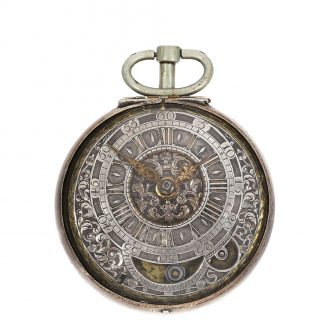
Gilt-brass and iron movement, the backplate entirely gilt and engraved with a partially cross-hatched arabesque design, makers mark a conjoined HK within a heart-shaped escutcheon and a virtually hidden cross pattée, the gilt pillars and potence block are similarly engraved, gut fusee, riveted iron barrel covers, iron wheels, the foliot with brass adjusting slips, a bristle regulator with punched scale, the winding arbour tip cut in the shape of an N.
–
Dimensions: 75 x 48 x 25 mm
–
Weight: 126 g
–
Signed: No name
–
This piece was formerly in the Debruge-Duménil Collection, the Prince Soltykoff Collection and the Rothschild Collection in Paris, it was unseen since 1861.
This watch cannot be considered in its historical context without reference to another example that survived in the Walters Art Museum in Baltimore. William Walters and his son Henry collected throughout the second half of the 19th century and the collection was left to the City in 1931 following Henry’s death. Records indicated only that the watch had been acquired pre-1915, and recent research confirmed that it had formed part of the Spitzer auction in Paris in 1893, a sale from which the Walters acquired several objects directly. In the intervening years, neither this watch nor the one now offered for sale had been published or examined. However, in 2007, in anticipation of the renewal of the Renaissance Gallery at the Museum, a scientific examination of the watch was undertaken. Although the existence of the present piece was known as a consequence of the engravings published by Pierre Dubois in 1853 and subsequently partly reproduced by Britten, only the limited descriptions provided were available to the Museum for comparison.
In brief, the Walters Art Gallery watch is also in gold, enamel and rock crystal, but without gem-set straps, perhaps on account of its being of slightly smaller size (36 mm x 31 mm without pendant and finial). It bears all the same marks on the movement. In addition, the Walters watch has initials and the date 1560 engraved on the front plate of the movement. Surprisingly, the monogram HK and the other signatory details were not described for either watch when they appeared at auction or in early publications. The Spitzer catalogue notes: Le revers du mouvement est gravé d’arabesques et de rinceaux parmi lesquelles on distingue un monogramme (the reverse of the movement is engraved with arabesques and scrollwork in which one can see a monogram). On the engraving of the current watch, published by Dubois, the monogram is clearly visible, but not mentioned at all in his accompanying text. However, now that both watches have been comprehensively examined, some interesting details have emerged:
a. Both watches have the conjoined monogram HK engraved within the backplate decoration.
b. The Walters watch has the initial ‘N’ engraved within the backplate decoration. This watch has an ‘N’ incised into the end of the winding arbour.
c. This watch has a tiny ‘cross motif’ hidden within the backplate engraving. The Walters watch has the ‘cross motif ‘ hidden under the dial between the 15 and 60 of the engraved date.
A comparison of the movements reveals further distinctive features common to both:
1. Both movements are held within their cases with sprung clips releasing tongues that locate into the gold frame. These are located at the 12 and 6 o’clock positions rather than the more usual 3 and 9 o’clock. Unusual, but not unknown since the pendant and finial are the strongest points of the frames.
2. Both movements have the barrel spring set-up clicks mounted between the plates and in order to avoid an accidental attempt to wind the watch using their extensions through the backplate, the arbours have female ends.
3. Both movements have a single piece potence, holding both pivots of the scape wheel, and secured by a pin onto one of the pillars. This is the method used on the earliest types of portable clock and watch.
Despite there being differences in detail between the movements, notably in the style of engraving of the backplates and shape of some pillars, there can be little doubt that they emanate from the same workshops even if one discounts the monograms and the curious ‘cross motifs’. The current piece has at some time been cleaned and appears to have suffered less wear than the Walters, notably not being converted to chain for the fusee and without the signs of past poor repairs carried out using soft solder. Analysis of the brass used in the construction of the Walters movement shows it to be of a composition commensurate with the period (zinc below 30% with other impurities). In addition, the Walters case is stated as having suffered losses to the enamel, notably the pendant and base straps, and the same is true of this watch. The additional straps on the present watch have only traces of enamel remaining, unsurprising in view of their delicacy, and the loss was already apparent on the engraving published by Dubois in 1858. Analysis of the enamels on the Walters watch by Mark Wypyski, Conservation Scientist at the Metropolitan Museum of Art confirmed that they are consistent with other well-dated 16th and 17th Century European enamels.
The punch or monogram ‘HK’ has usually been attributed to two makers. The most famous, Hans Koch was working from 1554 to 1599, but was based in Munich and appears to have been more specialized in clocks. The other is Hans Kiening from Fussen, with similar dates, but mostly known for his instruments. In any case, their punch marks are not of the same form as the engraved monograms on these watches. In addition, of course, there is the additional letter ‘N’, which would strongly indicate the town of Nuremberg. To date there is no obvious candidate, but the fact that they are effectively jewels, it could be that the maker was a member of the goldsmiths guild.
Louis-Fidel Debruge-Duménil from France was born in 1788 and died in 1838. After success in the property market, he began collecting in earnest during the last ten years of his life, apparently amassing some fifteen thousand objects dating from antiquity through to the 18th century and including ivories, sculpture, enamels, jewels, arms, paintings and horology. An extensive study of the subject and catalogue of the important pieces in the collection (858 pages) was compiled by Jules Labarte (1797-1880), who trained as a lawyer before marrying Debruge-Dumenils daughter in 1823 and subsequently dedicating himself to the study of the History of Art. The book of the collection was published in 1847 and formed the basis for the immense auction that took place in Paris between 23 January and 12 March 1850 and included some 2061 lots. Buyers numbered all the major Museums and collectors of the age, including Prince Soltykoff. This watch was sold as lot 1457, to a Msr. Juste, an Expert in Paris, for 1900 Francs, probably acting on behalf of Prince Soltykoff since he was an Expert for the Auction of the Princes subsequent sale in 1861.
Prince Peter Soltykoff was born in 1804 and died in 1889. He was an art collector and the grandson of Count (later Prince) Nikolay Ivanovich Soltykoff (1736-1816). Son of Prince Dmitri Nikolaevich Soltykoff (1767-1826). He moved to Paris in 1840 where he assembled an important collection of medieval objects, including a superb group of early watches and clocks. The finest of these were catalogued by Pierre Dubois, horologist and author, and published in his book in 1858 (3.). This watch is illustrated and described under Plate XII, figs 1-3. Dubois considered it to be one of the finest surviving examples in Europe. Prince Soltykoffs entire Collection comprising 1100 lots was sold by auction between 8 April and 1 May 1861 at Hôtel Drouot, Paris, and included some 87 Renaissance watches and clocks. This watch was sold as lot 406 for 3010 francs, by far the most expensive watch. It was purchased by a member of the Rothschild family.
Share this page: